age of seafarers
pp. 24-25 · Read in the full issue
New Zealand
Museum recalls the golden age of seafarers
One of the world’s most important canoe collections, featuring rare Fijian, Solomon
Islands and Polynesian craft is on display in Auckland.
By David Robie
ANOE is derived from the ■ Carib word canaoa , and accordto historians was probably introduced to Europe by Columbus.
Since then, every craft in the New World and the Pacific has been label led a “canoe” whether made of birch bark or wood; whether three metres long or 30 metres long; or whether double-hulled, single-hulled or an outrigger. It has always been, simply, a canoe. friere is an unfortunate notion that canoes evolved from floating logs, with outriggers or double hulls intro duced to prevent them rolling over.
“ I his is one of those deductive absur dities that used to come so easily to early students of mankind,” remarks Edward Dodd in Polynesian Seafaring, one of the authoritative texts on Paci fic navigation. “A canoe no more evolved from a non-rolling log than the wheel from a rolling stone.
“The wheel was the landsman’s wonder; the canoe was the water man’s. They both got him up on the surface and sped him, not effortlessly, but wondrously well on his wandering way.”
One of the world’s most important Pacific canoe collections has just gone on display in New Zealand’s Auckland War Memorial Museum. The collec tion of 22 canoes includes rare exam ples of rigged sailing canoes from the Polynesian islands of Tikopia and Sikaiana in the Solomon Islands, a double-hulled, ocean-going craft from Atiu in the Cook Islands, a Fijian camakau and a range of San Cristobal bonito fishing canoes, Polynesian out riggers and Maori war canoes.
“Some ol the most important Pacific canoes in the world are nere, the only examples of their kind still in exist ence,’' says the museum’s curator of ethnology, Robert Neich. Several of the craft have been on display in the past, but the canoe hall was closed to museum patrons last November for vital restoration work.
Pacific islanders especially the Polynesian seafarers made many sorts of journeys in their watery world. For each purpose they evolved a particular design: so diverse were these designs, writes Edward Dodd,
that it is far too superficial to describe him as ‘canoes’ or to think of them as
‘dugouts’.
“Actually, they were most indige
niously designee! and constructed to serve their several different purposes; so that taken as a whole they comprise a maritime body more varied and particularised than that of any other non-industrial culture, simply because the Polynesians were seafaring to a de gree to which no other culture had adapted.” Though there was much overlapping, the main categories listed by Dodd and the 1936 bible of Pacific navigation, Canoes of Oceania, by A C Haddon and James Hornell, are quite distinct.
Small paddling outrigger canoes,
vaa, in Tahiti, were three to six metres long and used mostliy for fishing with in tne reef or not far offshore. Neat
and delicateliy shaped, they were ba
lanced with outriggers pegged and seized in many ingenious ways.
Smaller sailing outrigger canoes,
known in Tahiti as vaa ta’ie, were generally six to nine metres long, sometimes larger. Described as “works of sea-going art”, they were used pri
marily for deep-sea fishing and for
short inter-island voyaging.
Larger sailing outrigger canoes were
mostly Micronesian and between nine and 18 metres in length. They were used for long-range, deep-sea sailing between island groups. As refined sail ing machines, mere were the best of
all: though they lacked the stability,
strength and ability to contend with rugged deep-sea conditions that chal lenged the great ocean-going double canoes, they were the most efficient sailing machines ever designed for shorter distances in fair weather.
According to Dodd, “America’s Cup contenders are clumsy in comparison’.
Small double canoes, known as tahi fa, were all-round work craft, some times rigged with one mast, more often with two vaa hara. Up to 12 metres long, they sported a flat prow and upturned stem and were used for ferrying passengers and cargo inside the reef or on shorter inter-island voyages, and often carried a shade house for sleeping and a sandbox for
cooking.
Large single-hulled war canoes, or waka taua in Maori represented a high point in design for a specific purpose and a significant aspect of New
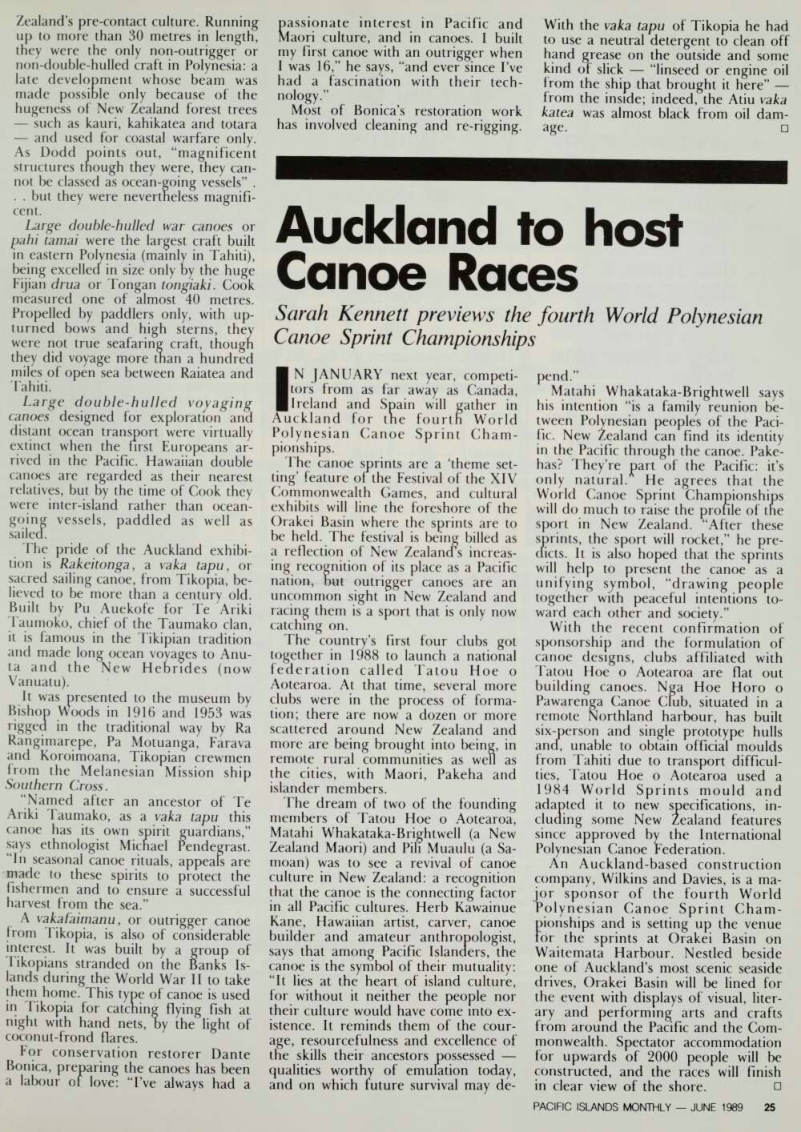
Conservation restorer Dante Bonica at work on a Tongan canoe that features in the exhibition.
Zealand’s pre-contact culture. Running up to more than 30 metres in length,
they were the only non-outrigger or
non-double-hulled craft in Polynesia: a late development whose beam was made possible only because of the hugeness of New Zealand forest trees such as kauri, kahikatea and totara and used for coastal warfare only.
As Dodd points out, “magnificent
structures though they were, they can
not be classed as ocean-going vessels” . . . but they were nevertheless magnifi cent.
Large double-hulled war canoes or pahi tamai were the largest craft built m eastern Polynesia (mainly in Tahiti), being excelled in size only by the huge
Fijian drua or Tongan tongiaki. Cook
measured one of almost 40 metres.
Propelled by paddlers only, with up
turned bows and high sterns, they were not true seafaring craft, though they did voyage more than a hundred miles of open sea between Raiatea and Tahiti.
Large double-hulled voyaging
canoes designed for exploration and distant ocean transport were virtually extinct when the first Europeans ar rived in the Pacific. Hawaiian double canoes are regarded as their nearest relatives, but by the time of Cook they were inter-island rather than ocean going vessels, paddled as well as sailed.
The pride of the Auckland exhibi tion is Rakeitonga, a vaka tapu, or sacred sailing canoe, from Tikopia, be lieved to be more than a century old.
Built by Pu Auekofe for Te Ariki Taumoko, chief of the Taumako clan, it is famous in the Tikipian tradition and made long ocean voyages to Anu ta and the New Hebrides (now Vanuatu).
It was presented to the museum by Bishop Woods in 1916 and 1953 was rigged in the traditional way by Ra
Rangimarepe, Pa Motuanga, Farava
and Koroimoana, Tikopian crewmen from the Melanesian Mission ship Southern Cross.
“Named after an ancestor of Te Ariki Taumako, as a vaka tapu this canoe has its own spirit guardians,”
says ethnologist Michael Pendegrast.
“In seasonal canoe rituals, appeals are made to these spirits to protect the fishermen and to ensure a successful harvest from the sea.”
A vakafaimanu , or outrigger canoe from Tikopia, is also of considerable interest. It was built by a group of Tikopians stranded on the Banks Is lands during the World War II to take them home. This type of canoe is used in Tikopia for catching flying fish at night with hand nets, oy the light of coconut-frond flares.
For conservation restorer Dante Bonica, preparing the canoes has been a labour of love: “I’ve always had a
passionate interest in Pacific and Maori culture, and in canoes. I built my first canoe with an outrigger when 1 was 16,” he says, “and ever since I’ve had a fascination with their tech-
nology.
Most of Bomca’s restoration work has involved cleaning and re-rigging.
With the vaka tapu of Tikopia he had to use a neutral detergent to clean off hand grease on the outside and some kind of slick “linseed or engine oil from the ship that brought it here” from the inside; indeed, the Atiu vaka katea was almost black from oil dam age. □