down the Accord?
pp. 12-15 · Read in the full issue
Did Wea gun down the Accord?
Like Chief Atai in 1878, New Caledonia’s pro-independence architect of peace Jean-Marie Tjibaou, has been slain by a fellow Kanak. David Robie, who knew the main characters in last month’s tragic events, reports on the killings and their background and profiles the three men who died.
Pierre Declercq In 1981,
Eloi Machuro in 1985, Alphonse Dianou last year . . . and now
Jean-Marie Tjibaou and Yeiwene
Yeiwene. The list of political assassina tions among Kanak independence leaders continues to grow.
Last month’s double murder of Kanak Socialist National Liberation Front (FLNKS) president Tjibaou and his deputy, and the death of their assassin, Pastor Djoubelly Wea a maverick but respected political leader on the island of Ouvea was particu larly devastating however; these kill ings were the first assassinations of leaders in modern political times that were committed by a Kanak. The tra
gic slaughter recalls the ignominious
end of High Chief Atai during the Great Insurrection of 1878, when he was betrayed by rival tribesmen from Canala, executed and his severed head sent to Paris.
But this time Tjibaou and Yeiwene were slain by men who felt a bitter sense of betrayal at the hands of the FLNKS leadership and who be lieved their struggle for the independ ence of Kanaky had been cynically compromised. It was a cruel irony that Tjibaou, the man of conciliation and negotiation, should die at the hand of Kanak: he had seemed, if anything, a prime target for the right wing ex tremist’s bullet.
The deaths of all three men were a savage blow to peace in the South Pacific, shattering attempts to heal the growing differences between the four political parties, the Kanak and Ex ploited Workers’ Union (USTKE) and the militant Kanak women’s group GFKEL that together comprise the FLNKS, threatening the future of the Matignon peace accord and leaving a power vacuum at the centre of the
Flnks.
Father Walter Lini, Prime Minister of neighbouring Vanuatu itself once burdened not only by British but also by French colonialism called
for immediate independence in Kanaky. “The slayings represent more of a fundamental process of reaction against the imposition of different forms of French colonialism,” he said.
“Vanuatu continues to believe that only independence will prevent a new chapter in the long bloody history of New Caledonia.”
Deposed Fiji Prime Minister Dr
Timoci Bavadra, currently president
of the South Pacific Progressive Par ties Association (which includes the FLNKS as a member), described Tjibaou as a “political giant” in the South Pacific.
Recalling his “huge personal sacri
fice” two of Tjibaou’s brothers died in a massacre by mixed race settlers at Hienghene in 1984 Bavadra added: “Yet Tjibaou remained always a man of peace, one who believed in dialogue and compromise to achieve the aspira tions of his people while minimising the personal cost to them.”
RPCR leader Jacques Lafleur said he had only recently warned Tjibaou to “be careful”. Speaking on radfio, he said “a certain number of individuals live in New Caledonia who have only violence, vengeance and death in their mouths, hearts and spirit ... I regret that Tjibaou did not take precau tions.”
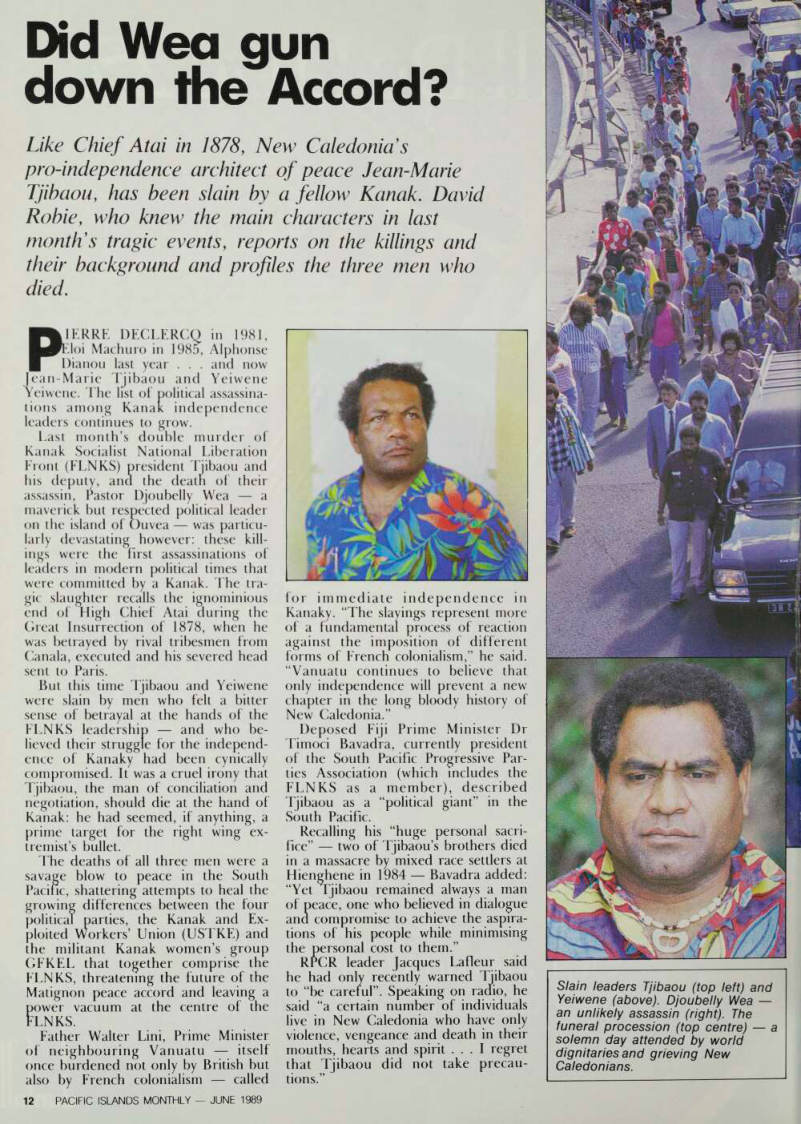
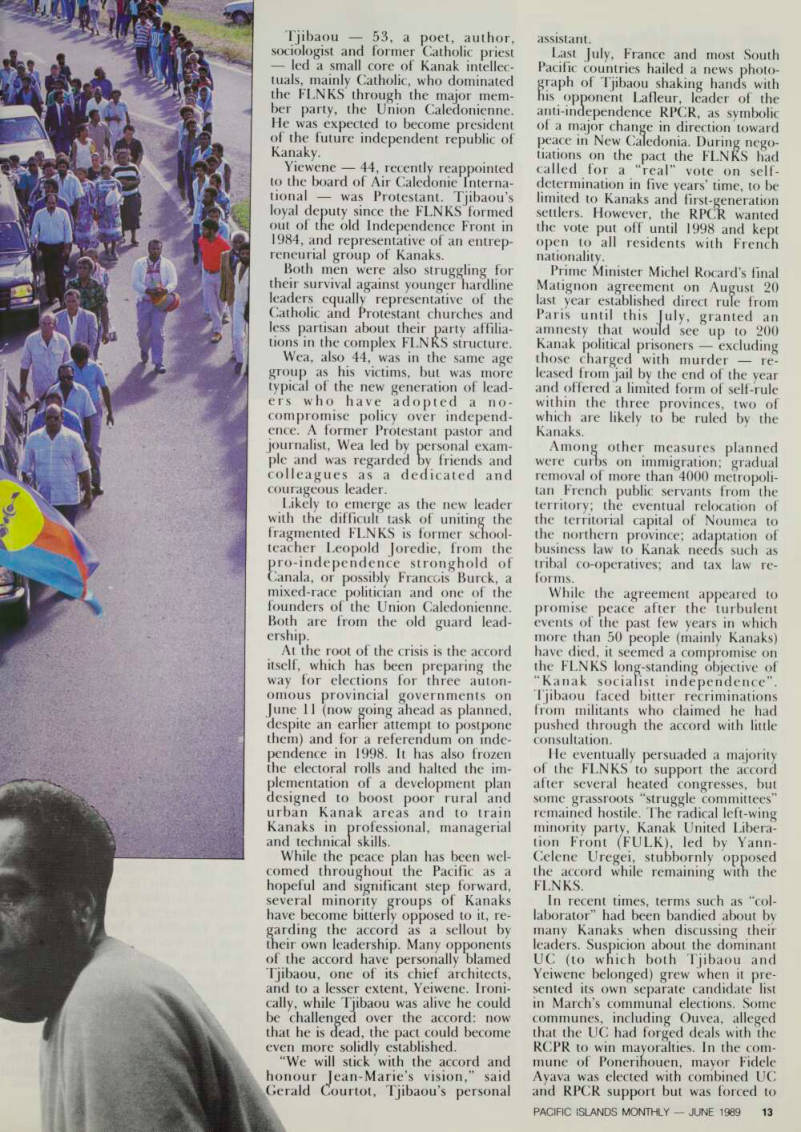
Slain leaders Tjibaou (top left) and Yeiwene (above). Djoubelly Wea an unlikely assassin (right). The funeral procession (top centre) - a solemn day attended by world dignitaries and grieving New Caledonians.
Tjibaou 53, a poet, author, sociologist and former Catholic priest led a small core of Kanak intellec tuals, mainly Catholic, who dominated the FLNKS through the major mem ber party, the Union Caledonienne.
He was expected to become president of the future independent republic of
Kanaky.
Yiewene 44, recently reappointed
to the board of Air Caledonie Interna tional was Protestant. Tjibaou’s loyal deputy since the FLNKS formed out of tne old Independence Front in 1984, and representative of an entrep reneurial group of Kanaks.
Both men were also struggling for their survival against younger hardline leaders equally representative of the Catholic and Protestant churches and less partisan about their party affilia tions in the complex FLNKS structure.
Wea, also 44, was in the same age group as his victims, but was more typical of the new generation of lead ers who have adopted a no
compromise policy over independ
ence. A former Protestant pastor and
journalist, Wea led by personal exam
ple and was regarded hy friends and colleagues as a dedicated and courageous leader.
Likely to emerge as the new leader with the difficult task of uniting the fragmented FLNKS is former school teacher Leopold Joredie, from the
pro-independence stronghold of
Canala, or possibly Francois Burck, a mixed-race politician and one of the founders of the Union Caledonienne.
Both are from the old guard lead
ership.
At the root of the crisis is the accord itself, which has been preparing the way for elections for three auton omous provincial governments on June 11 (now going ahead as planned, despite an earner attempt to postpone them) and for a referendum on inde pendence in 1998. It has also frozen the electoral rolls and halted the im
plementation of a development plan
designed to boost poor rural and urban Kanak areas and to train
Kanaks in professional, managerial
and technical skills.
While the peace plan has been wel comed throughout the Pacific as a hopeful and significant step forward, several minority groups of Kanaks have become bitterly opposed to it, re garding the accord as a sellout by their own leadership. Many opponents of the accord have personally Blamed Tjibaou, one of its chief architects, and to a lesser extent, Yeiwene. Ironi cally, while Tjibaou was alive he could be challenged over the accord: now that he is dead, the pact could become even more solidly established.
“We will stick with the accord and honour Jean-Marie’s vision,” said
.Gerald Courtot, Tjibaou’s personal
assistant.
Last July, France and most South Pacific countries hailed a news photo
graph of Tjibaou shaking hands with
his opponent Lafleur, leader of the
anti-inaependence RPCR, as symbolic
of a major change in direction toward peace in New Caledonia. During nego tiations on the pact the FLNKS had called for a “real” vote on self determination in five years’ time, to be limited to Kanaks ana first-generation settlers. However, the RPCR wanted the vote put off until 1998 and kept open to all residents with French
nationality.
Prime Minister Michel Rocard’s final Matignon agreement on August 20 last year established direct rule from Paris until this July, granted an amnesty that would see up to 200
Kanak political prisoners excluding
those charged with murder re leased from jail by the end of the year and offered a limited form of self-rule within the three provinces, two of which are likely to be ruled by the Kanaks.
Among other measures planned
were euros on immigration; gradual removal of more than 4000 metropoli tan French public servants from the territory; the eventual relocation of the territorial capital of Noumea to the northern province; adaptation of business law to Kanak needs such as tribal co-operatives; and tax law re forms.
While the agreement appeared to promise peace after the turbulent events of the past few years in which more than 50 people (mainly Kanaks) have died, it seemed a compromise on the FLNKS long-standing objective of “Kanak socialist independence”.
Tjibaou faced bitter recriminations from militants who claimed he had pushed through the accord with little consultation.
He eventually persuaded a majority
of the FLNKS to support the accord after several heated congresses, but some grassroots “struggle committees” remained hostile. The radical left-wing minority party, Kanak United Libera tion Front (FULK), led by Yann-
Celene Uregei, stubbornly opposed
the accord while remaining with the
Flnks.
In recent times, terms such as “col laborator” had been bandied about by many Kanaks when discussing their leaders. Suspicion about the dominant UC (to which both Tjibaou and Yeiwene belonged) grew when it pre sented its own separate candidate list in March’s communal elections. Some
communes, including Ouvea, alleged
that the UC had forged deals with the RCPR to win mayoralties. In the com mune of Ponerinouen, mayor Fidele Ayava was elected with combined UC and RPCR support but was forced to
resign in favour of Richard Poarairi wa, of the Melanesian Progressive Un ion (UPM). But the most fierce resist ance to the accord came from Ouvea, which has the least development of any part of New Caledonia. It has a population of fewer than 3000 and only a handful of telephones none north of the chief town of Fayaoue.
Historically, the Loyalty Islands
were never subjected to the wholesale land seizures and repression that fol lowed the Kanak insurrections in 1878 and 1917, and Ouvea is the least affected of New Caledonia’s islands by erosion of traditional culture. When the FLNKS decided to boycott and ob struct the French presidential elections last May, tactics were left up to local “struggle committees”: Ouvea militants staged a dramatic raid on the Fayaoue gendarme barracks, killing four gen darmes and seizing 27 as hostages.
The militants abducted most of their prisoners to a cave in rugged bush country near Gossanah and, as gen darmes searched for them, they de manded that regional elections be abandoned and that a mediator be flown from France to negotiate for a real referendum under United Na tions supervision. They threatened to kill their hostages if their demands were not met and the rest of that tragic action has passed into Kanak
history, forming part of the separatist
movement’s mythology of struggle and
martyrdom.
At dawn on May 5, 1988, French military and secret service forces laun ched an attack on the Ouvea cave and killed 19 Kanaks in what was officially described as a “fierce battle”. The hos tages were freed for the loss of only two French soldiers . . . but evidence indicated that they had been on the verge of being freed anyway.
Tne assault came just three days be fore the crucial presidential vote in which President Mitterrand defeated the challenge of Prime Minister Jac ques Chirac, and hours after three French hostages had been freed in Lebanon following the Chirac govern ment’s reported payment of a massive ransom. To top it off, convicted Rain bow Warrior bomber Dominique Prieur was repatriated to France. ‘Op eration Victor, as the cave assault was dubbed, was widely condemned as a
cynical political ‘adventure’ by Chirac
to gain the presidency but the move backfired.
Reports of summary executions and torture of at least three and possibly as many as nine of the militants, in cluding leader Alphonse Dianou, were published by De Monde and other leading French newspapers. One of the executed was a 19-year-old ‘tea boy’, Waina Amossa, who had been delivering food to the hostages. De fence Minister Jean-Pierre Chevene-
ment ordered an inquiry, saying that former Overseas Territories Minister Bernard Pons had not used “all possi ble means” of negotiation witn the nationalists. However, while the French Government later admitted “excesses” had occurred, no judicial action has so far been taken.
After the cave assault, Ouveans sus pected of helping the militants were harassed and assaulted. Thirty-two
prisoners, including Djoubelly Wea,
were flown to France. After a legal battle, Wea was released and returned home to a hero’s welcome; the rest were eventually freed as part of the
Matignon accord.
Wea bitterly resisted the linking of the prisoners to the accord, but was
ignored by Tjibaou when he wanted
to take part in the peace negotiations.
The FLNKS failed to act over the Ouvea islanders’ major demands, such as an international inquiry into allega tions of atrocities perpetrated by the
military.
Media reports following last month’s killings incorrectly claimed Wea was a member of FULK. He had previously belonged to the radical FLNKS mem ber party Palika, but was dumped in 1980 when he stuck to his no compromise stand. He later became undisputed political leader of the Ouvea militants and worked through the local FLNKS “struggle committee”.
Wea was deeply bitter about the treatment given to his father and un cle by the French authorities. His elderly father, Gogny Wea, died short ly after last years hostage crisis; he had been beaten and left tied up in fierce sunshine by the military, and was soon regarded as the “20th vic tim” of the Ouvea massacre.
Wea’s uncle, Maki Touet, was put in a cage and displayed as a ‘cannibal’ in
a Paris colonial exposition in the 19305.
After first meeting Wea in 1981, following the assassination of French born ‘white Kanak’ Pierre Declerq, I recently met him again in Manila, sharing a hotel room with him during the Asia-Pacific Peace and Develop ment conference. He was thoughtful, warm and dedicated to the cause . . . and though he passionately discussed New Caledonia several times and stressed his bitter opposition to the Matignon accord, he never gave any hint of the explosive anger that would lead to the assassinations.
During Wea’s last conversation with me he said that last November’s re ferendum on the Matignon accord overwhelmingly endorsed overall in the French republic showed that most settlers in Noumea rejected the agreement and Kanak independence. (On November 6, 1988, more than 80 per cent of French voters approved the agreement in an unprecedented national referendum, but 63 per cent of all voters did not cast a ballot. In New Caledonia, where the participa tion rate was twice as high, tne agree ment won 57 per cent of the ‘Yes’ vote but was strongly rejected by the large ly white population of Noumea). “For us this raises the question of whether the accord has already been broken.
These Caldochcs are already coming up strongly; racism and fascism are growing and will continue to grow.
Kanaky is already in a state of colonial war,” ne said.
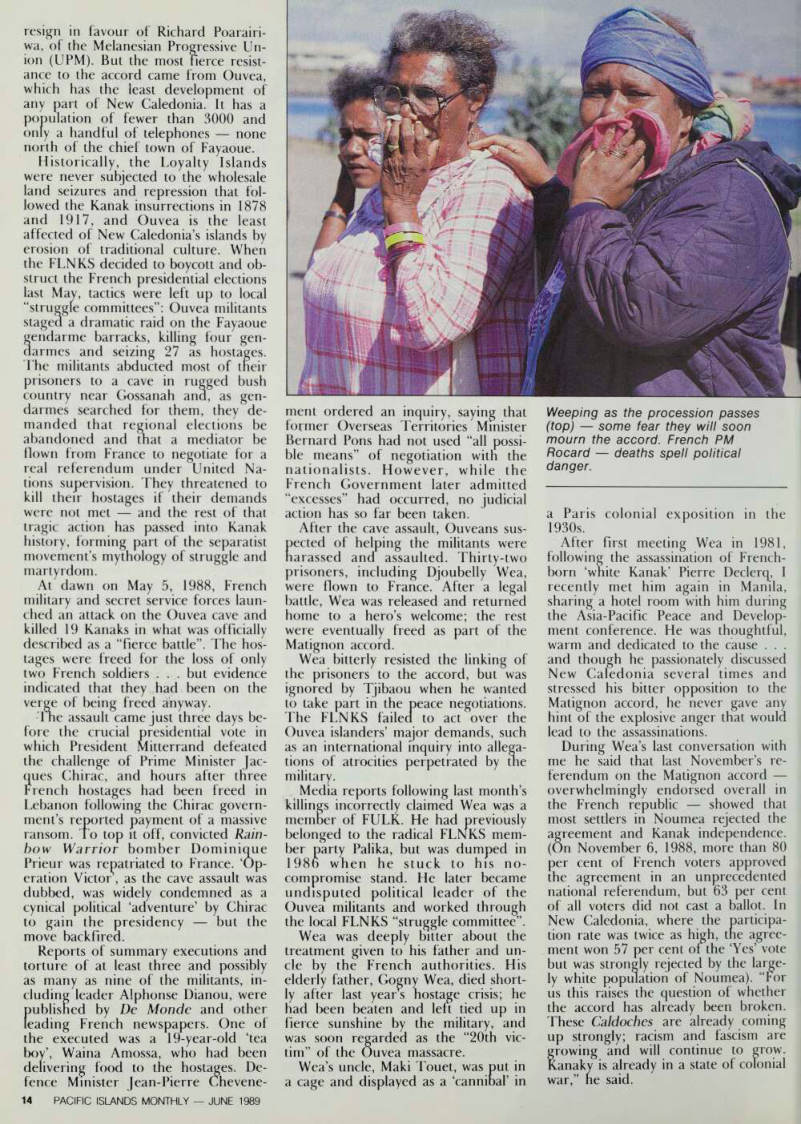
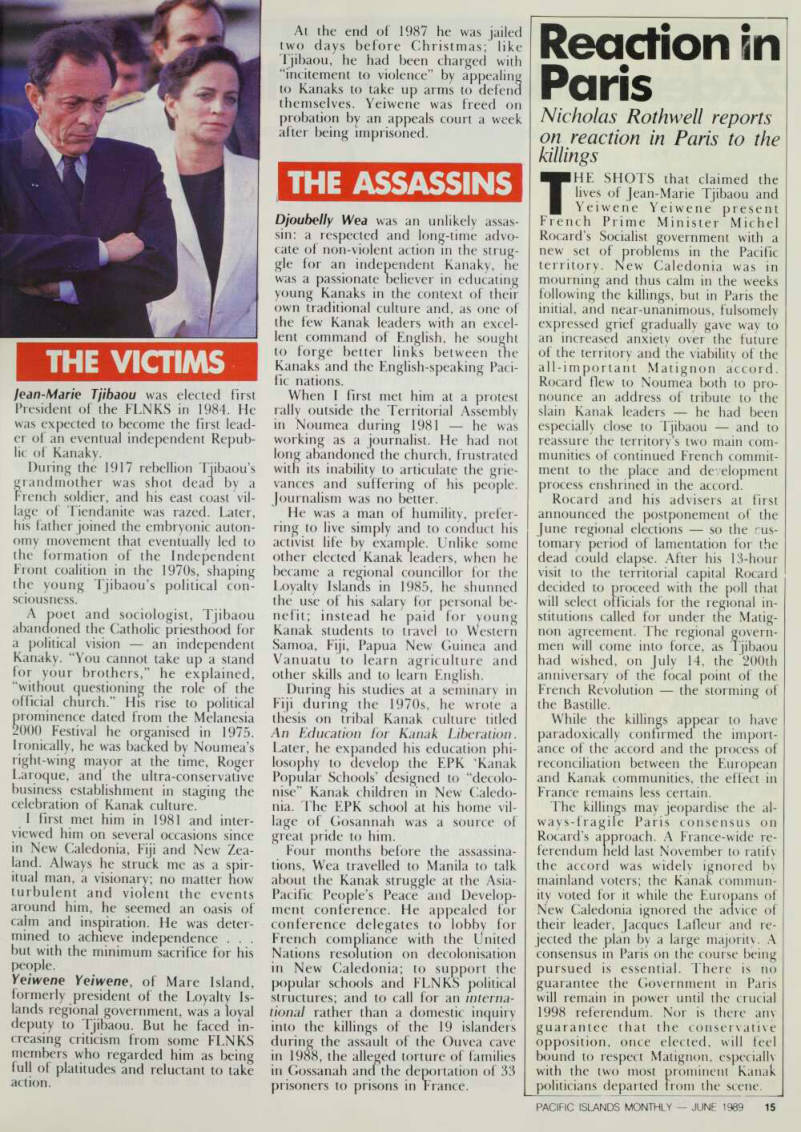
Weeping as the procession passes (top) - some fear they will soon mourn the accord. French PM Rocard - deaths spell political danger.
The Victims
Jean-Marie Tjibaou was elected first President of the FLNKS in 1984. He was expected to become the first lead er of an eventual independent Repub lic of Kanaky.
During the 1917 rebellion Tjibaou’s grandmother was shot dead by a French soldier, and his east coast vil lage of Tiendanite was razed. Later, his father joined the embryonic auton omy movement that eventually led to the formation of the Independent Front coalition in the 19705, shaping the young Tjibaou’s political con sciousness.
A poet and sociologist, Tjibaou
abandoned the Catholic priesthood for a political vision an independent Kanaky. “You cannot take up a stand for your brothers,” he explained, “without questioning the role of the official church.” His rise to political prominence dated from the Melanesia 2000 Festival he organised in 1975.
Ironically, he was bacled by Noumea’s right-wing mayor at the time, Roger Laroque, and the ultra-conservative business establishment in staging the celebration of Kanak culture.
I first met him in 1981 and inter viewed him on several occasions since in New Caledonia, Fiji and New Zea land. Always he struck me as a spir itual man, a visionary; no matter how turbulent and violent the events around him, he seemed an oasis of calm and inspiration. He was deter mined to achieve independence . . . but with the minimum sacrifice for his people.
Yeiwene Yeiwene , of Mare Island,
formerly president of the Loyalty Is
lands regional government, was a loyal deputy to Tjibaou. But he faced in creasing criticism from some FLNKS members who regarded him as being full of platitudes and reluctant to take action.
At the end of 1987 he was jailed two days before Christmas; like Tjibaou, he had been charged with “incitement to violence” by appealing to Kanaks to take up arms to defend themselves. Yeiwene was freed on probation by an appeals court a week
after being imprisoned.
The Assassins
Djoubelly Wea was an unlikely assas sin: a respected and long-time advo cate of non-violent action in the strug
gle for an independent Kanaky, he
was a passionate believer in educating
young Kanaks in the context of their own traditional culture and, as one of the few Kanak leaders with an excel lent command of English, he sought to forge better links between the Kanaks and the English-speaking Paci fic nations.
When I first met him at a protest rally outside the Territorial Assembly in Noumea during 1981 he was working as a journalist. He had not long abandoned the church, frustrated with its inability to articulate the grie vances and suffering of his people.
Journalism was no better.
He was a man of humility, prefer ring to live simply and to conduct his activist life by example. Unlike some other elected Kanak leaders, when he became a regional councillor for the Loyalty Islands in 1985, he shunned the use of his salary for personal be nefit; instead he paid for young Kanak students to travel to Western Samoa, Fiji, Papua New Guinea and Vanuatu to learn agriculture and other skills and to learn English.
During his studies at a seminary in Fiji during the 19705, he wrote a thesis on tribal Kanak culture titled An Education for Kanak Liberation.
Later, he expanded his education phi losophy to develop the EPK ‘Kanak Popular Schools’ designed to “decolo nise” Kanak children in New Caledo nia. The EPK school at his home vil lage of Gosannah was a source of great pride to him.
Four months before the assassina tions, Wea travelled to Manila to talk about the Kanak struggle at the Asia- Pacific People’s Peace and Develop ment conference. He appealed for conference delegates to lobby for French compliance with the United Nations resolution on decolonisation in New Caledonia; to support the popular schools and FLNKS political structures; and to call for an interna tional rather than a domestic inquiry into the killings of the 19 islanders during the assault of the Ouvea cave in 1988, the alleged torture of families in Gossanah and the deportation of 33 prisoners to prisons in France.