Joyita: The Mystery Lingers
p. 58 · Read in the full issue
Out Of The Past
Stuart Inder recalls a Pacific tragedy that inspired bizarre ‘solutions’.
THIRTY-THREE years ago this month, the Joyita mystery was a sensation. Speculation about the fate of the missing 25 passengers and crew, when the vessel was found drift ing north of Fiji, pushed even Princess Margaret’s love affair with Peter Townsend off the front pages of Aus tralian and New Zealand newspapers.
In Suva, the Fiji Times had gone quite mad: “All aboard Joyita mur dered!”, ran its banner of November 20, 1955, over a report it claimed was “official”, that a Japanese fishing fleet had rammed and boarded the vessel, looted her, murdered all aboard and then attempted to sink the Joyita to cover the crime.
The wooden hulled 21-metre, 71tonne Joyita a Honolulu-owned and registered twin-screw motor vessel built in Los Angeles in 1931 and used as a US Navy patrol vessel in World War II left Apia, Western Samoa, for the Tokelau islands on October 3, 1955. The passage usually took about 40 hours.
On board were her skipper, wartime
Royal Navy officer Thomas Henry
Miller, the mate, American C H “Chuck” Simpson, 14 other crew members including two supercargoes from Apia, G K Williams and J Wall work, and nine passengers: R D Pear less, the Tokelau District Officer, Dr A D Parsons, Government Medical Officer in Apia, H T Hodgkinson, the
Apia Hospital dispenser, and six
Tokelau islanders including one woman and a child. Captain Miller had for some years operated Joyita in a commercial fishing enterprise under a bare-boat charter from trie owners.
When Joyita failed to reach Tokelau by October 6 an air search began but found no trace of her. On November 10 the Gilbert and Ellice islands Col ony vessel Tuvalu found the vessel
waterlogged, partly submerged and
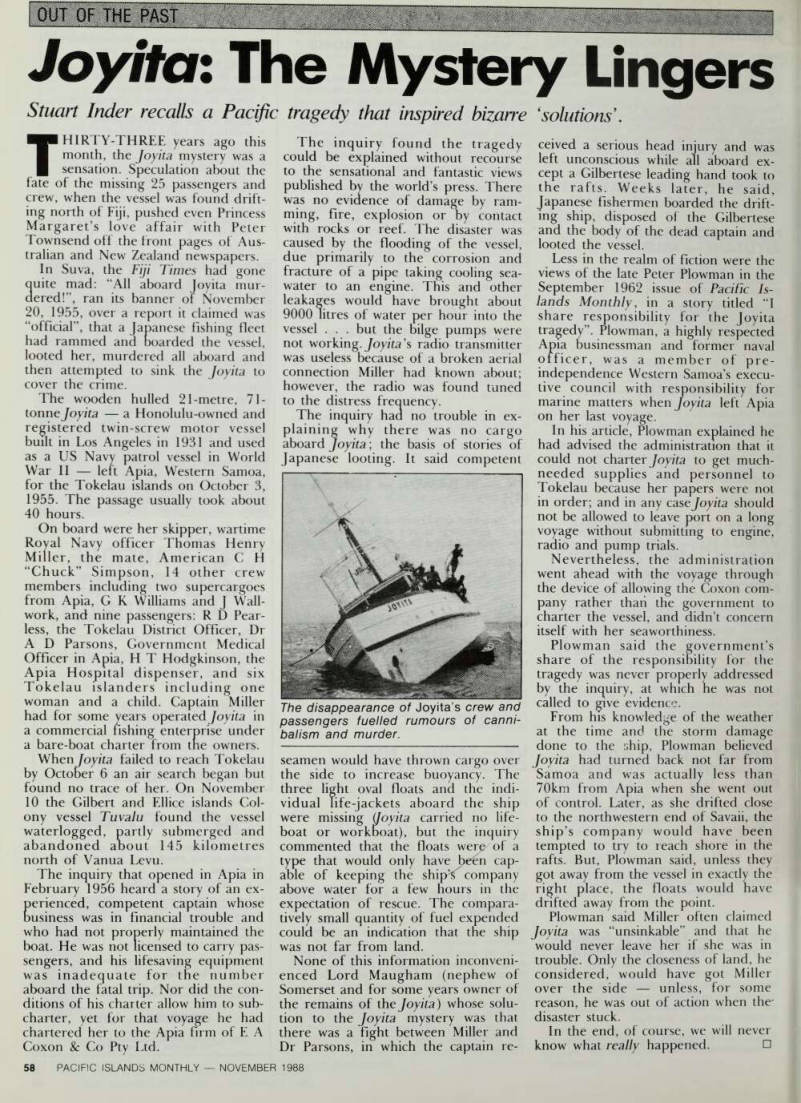
abandoned about 145 kilometres north of Vanua Levu.
The inquiry that opened in Apia in February 1956 heard a story of an ex
perienced, competent captain whose
business was in financial trouble and who had not properly maintained the boat. He was not licensed to carry pas sengers, and his lifesaving equipment was inadequate for the number aboard the fatal trip. Nor did the con ditions of his charter allow him to sub charter, yet for that voyage he had chartered her to the Apia firm of E A Coxon & Co Pty Ltd.
The inquiry found the tragedy could be explained without recourse to the sensational and fantastic views published by the world’s press. There was no evidence of damage by ram
ming, fire, explosion or by contact
with rocks or reef. The disaster was caused by the flooding of the vessel, due primarily to the corrosion and fracture of a pipe taking cooling sea water to an engine. This and other leakages would have brought about 9000 litres of water per hour into the vessel . . . but the bilge pumps were not working. Joyita ’s radio transmitter was useless because of a broken aerial connection Miller had known about; however, the radio was found tuned to the distress frequency.
The inquiry had no trouble in ex plaining why there was no cargo aboard Joyita ; the basis of stories of Japanese looting. It said competent
seamen would have thrown cargo over the side to increase buoyancy. The three light oval floats and the indi vidual life-jackets aboard the ship were missing Joyita carried no life boat or workboat), but the inquiry commented that the floats a type that would only have befm cap able of keeping the company above water for a few hours in the expectation of rescue. The compara
tively small quantity of fuel expended
could be an indication that the ship was not far from land.
None of this information inconveni enced Lord Maugham (nephew of Somerset and for some years owner of the remains of the Joyita) whose solu tion to the Joyita mystery was that there was a fight between Miller and Dr Parsons, in which the captain re
ceived a serious head injury and was left unconscious while all aboard ex cept a Gilbertese leading hand took to the rafts. Weeks later, he said, Japanese fishermen boarded the drift ing ship, disposed of the Gilbertese and the body of the dead captain and looted the vessel.
Less in the realm of fiction were the views of the late Peter Plowman in the September 1962 issue of Pacific Is lands Monthly, in a story titled “I share responsibility for the Joyita
tragedy”. Plowman, a highly respected
Apia businessman and former naval officer, was a member of pre independence Western Samoa’s execu tive council with responsibility for marine matters when Joyita left Apia on her last voyage.
In his article, Plowman explained he had advised the administration that it could not charter Joyita to get much needed supplies and personnel to Tokelau because her papers were not in order; and in any case Joyita should not be allowed to leave port on a long voyage without submitting to engine, radio and pump trials.
Nevertheless, the administration went ahead with the voyage through the device of allowing the Coxon com pany rather than the government to charter the vessel, and didn’t concern itself with her seaworthiness.
Plowman said the government’s share of the responsibility for the tragedy was never properly addressed by the inquiry, at which he was not called to give evidence.
From his knowledge of the weather at the time and the storm damage done to the ship, Plowman believed Joyita had turned back not far from Samoa and was actually less than 70km from Apia when she went out of control. Later, as she drifted close to the northwestern end of Savaii, the ship’s company would have been tempted to try to reach shore in the rafts. But, Plowman said, unless they got away from the vessel in exactly the right place, the floats would have drifted away from the point.
Plowman said Miller often claimed Joyita was “unsinkable” and that he would never leave her if she was in trouble. Only the closeness of land, he considered, would have got Miller over the side unless, for some reason, he was out of action when the' disaster stuck.
In the end, of course, we will never know what really happened. □
The disappearance of Joyita’s crew and passengers fuelled rumours of canni balism and murder.