Chile's Bitter Pacific Legacy
pp. 43-45 · Read in the full issue
Rapanui
Grant McCall looks at Easter Island’s centenary
THE remains of Captain Policarpo
Toro, a Chilean naval officer who died bitter and destitute in 1921, were retained in the centre of Hangaroa, Rapanui (Easter Island) on September 9 this year in a square bearing his name.
It was on that day a century ago that Captain Toro, representing the Government of Chile, took possession of Rapanui in the name of his coun try’s glory and his own plans for a sheep property on the world’s most remote island. In those days Chile boasted a large Pacific merchant fleet and had won a hard fought “war of the Pacific” with Peru and Bolivia from 1879 to 1883, which provided Chile with its rich nitrate and mineral lands. At the cessation of hostilities Chile began looking to consolidate its position, to boost its image on a larger stage than South America.
To do this, argued patriotic writers of the time such as Vicuna McKenna, Chile needed to have a stake in the Pacific . . . but the much of the South Pacific had already been claimed.
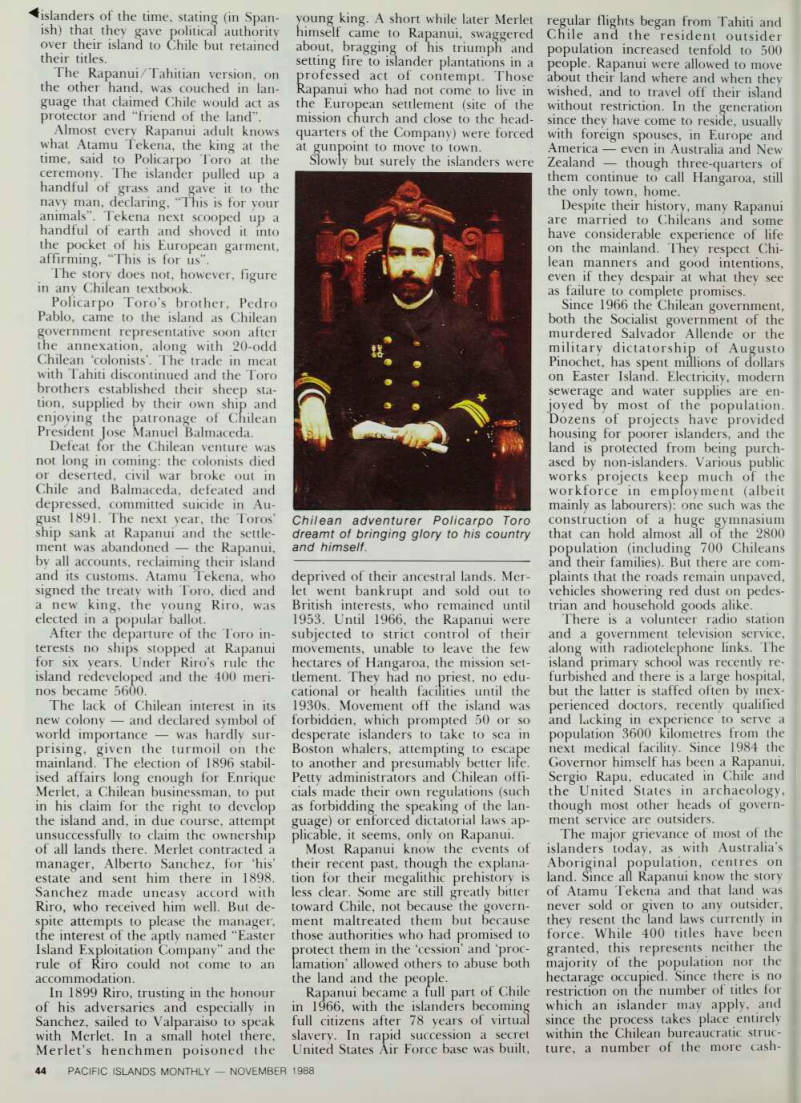
It was the ambitious Policarpo Toro who thus sought to bring glory both to his country and to himself by propos ing to investigate Rapanui as a possi ble extension of empire.
Rapanui’s first encountered with Europeans was in 1722, when the Dutchman Jacob Roggeveen rolled up in search of wealth. Due to a minor officer’s nervousness Roggeveen’s shore party of more than 120 men opened fire on its hosts, killing several.
From that time until 1862, ships
carrying explorers, businessmen,
adventurers and whalers came into Rapanui waters. There were con tinued killings of islanders, but most contacts were friendly, with trade a prime object. The islanders traded loc al products and services for those from the outside: taro and sweet pota to for nails and cloth, sex and other entertainments for haircuts. Not only was the island known as a useful over for supplies, but its huge stone fi gures, the moai, were soon famous, a factor that increased its popularity
with passing ships.
It was in 1802 that the course of
Rapanui history changed irrevocably.
From the original settlement date the development of the island’s unique culture had followed a slow but understandable course. Early Polyne
sian settlers carved small moai figures than larger ones until around the 15th century. There was a shift in worship from moai to the spring arrival of the sooty tern.
This internally derived social and cultural development came to a tragic end in 1862, when labour-hungry Peru permitted a greedy and dis astrous labour ‘recruitment’ trade from its port of Callao. It was an Irishman, Joseph Byrne who had already had a chequered career in the Australian goldfields and, later, New Caledonia who proposed the importa tion of Polynesian so-called ‘colonists’ to Peru. The trade lasted only a few months, but that was long enough for
rapacious captains to raid islands
throughout Polynesia.
Due to its relative proximity to the South American continent, Rapanui was attacked in December 1862 alone by as many as eight ships; in all, the raids (from which only a dozen ‘reemits’ even returned), disease and despair probably halved the pre-attack Rapanui population of 3000 to 4000.
Shortly after, Sacred Heart missionaries arrived, along with a French businessman partner named Jean- Baptiste Dutrou-Bornier, and convinced the islanders to cluster in European style settlements away from their coastal monuments and traditional lands. The missionaries and the
businessman eventually parted com-
pany, the Church sponsoring the de-
parture to Mangareva and Tahiti of more than 300 Rapanui.
By 1877, when the islanders killed Dutrou-Bornier (who had come to style himself “king”), the population had dropped to 110 persons.
That same businessman had initi ated the idea of turning Rapanui into a commercial sheep station when he came to Sydney in 1872 to load build ing materials and 435 head of merino sheep for his enterprise. After his death his partners carried on the en
terprise, mostly leaving the Rapanui to
rebuild their lives. Chiefs were con verted (by occasional visiting mis sionaries) into kings and a ‘Catholic Government’ was established in the
1880 s. There still was no direct Euro pean presence on the island.
Though Policarpo Toro visited the island several times during the 1880 s, his mission was to speak to the Tahi tian ranch manager there, not the islanders: negotiations with French commercial and political authorities were carried out in Papeete and by letter from Chile, and islanders were not directly informed. Nevertheless, when Toro carried out his formal annexation ceremony on September 9, 1888, he carried with him two docu ments, in both Spanish and Rapanui.
One was a ‘proclamation’ declaring the cession of Rapanui, subject to Chilean government ratification. The other was termed a ‘cession’ and carried the signatures and marks of 12 prominent
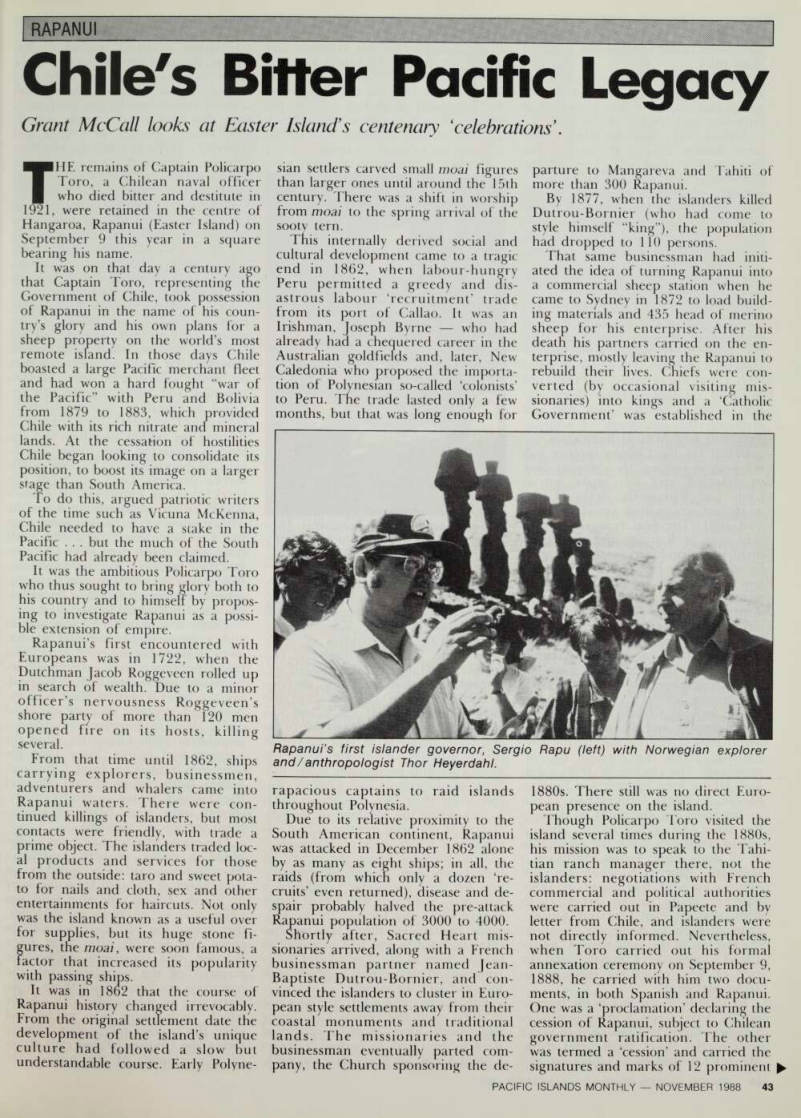
Rapanui’s first islander governor, Sergio Rapu (left) with Norwegian explorer and/anthropologist Thor Heyerdahl.
of the time, stating (in Span
ish) that they gave political authority
over their island to Chile but retained their titles.
The Rapanui/Tahitian version, on the other hand, was couched in lan guage that claimed Chile would act as protector and “friend of the land”.
Almost every Rapanui adult knows what Atamu Tekena, the king at the time, said to Policarpo Toro at the ceremony. The islander pulled up a handful of grass and gave it to the navy man, declaring, “This is for your animals”. Tekena next scooped up a handful of earth and shoved it into the pocket of his European garment, affirming, “This is for us”.
The story does not, however, figure in any Chilean textbook.
Policarpo Toro’s brother, Pedro Pablo, came to the island as Chilean government representative soon after the annexation, along with 20-odd Chilean ‘colonists’. The trade in meat with Tahiti discontinued and the Toro brothers established their sheep sta tion, supplied by their own ship and enjoying the patronage of Chilean President Jose Manuel Balmaceda.
Defeat for the Chilean venture was not long in coming: the colonists died or deserted, civil war broke out in Chile and Balmaceda, defeated and depressed, committed suicide in Au gust 1891. The next year, the Toros’ ship sank at Rapanui and the settle ment was abandoned the Rapanui, by all accounts, reclaiming their island and its customs. Atamu Tekena, who signed the treaty with Toro, died and a new king, the young Riro, was elected in a popular ballot.
After the Departure of the Toro in
terests no ships stopped at Rapanui
for six years. Under Riro’s rule the island redeveloped and the 400 meri nos became 5600.
The lack of Chilean interest in its new colony and declared symbol of world importance was hardly sur prising, given the turmoil on the mainland. The election of 1896 stabil
ised affairs long enough for Enrique
Merlet, a Chilean businessman, to put in his claim for the right to develop the island and, in due course, attempt unsuccessfully to claim the ownership of all lands there. Merlet contracted a manager, Alberto Sanchez, for ‘his’ estate and sent him there in 1898.
Sanchez made uneasy accord with Riro, who received him well. But de spite attempts to please the manager, tne interest of the aptly named “Easter Island Exploitation Company” and the rule of Riro could not come to an accommodation.
In 1899 Riro, trusting in the honour of his adversaries and especially in Sanchez, sailed to Valparaiso to speak with Merlet. In a small hotel there, Merlet’s henchmen poisoned the
young king. A short while later Merlet himself came to Rapanui, swaggered about, bragging of his triumph and setting fire to islander plantations in a professed act of contempt. Those Rapanui who had not come to live in the European settlement (site of the mission church and close to the head quarters of the Company) were forced at gunpoint to move to town.
Slowly but surely the islanders were
deprived of their ancestral lands. Mer let went bankrupt and sold out to British interests, who remained until 1953. Until 1966, the Rapanui were subjected to strict control of their movements, unable to leave the few hectares of Hangaroa, the mission set tlement. They had no priest, no edu cational or health facilities until the 19305. Movement off the island was forbidden, which prompted 50 or so desperate islanders to take to sea in Boston whalers, attempting to escape to another and presumably better life.
Petty administrators and Chilean offi cials made their own regulations (such as forbidding the speaking of the lan guage) or enforced dictatorial laws ap
plicable, it seems, only on Rapanui.
Most Rapanui know the events of their recent past, though the explana tion for their megalithic prehistory is less clear. Some are still greatly bitter toward Chile, not because the govern ment maltreated them but because those authorities who had promised to protect them in the ‘cession’ and ‘proc lamation’ allowed others to abuse both the land and the people.
Rapanui became a full part of Chile in 1966, with the islanders becoming full citizens after 78 years of virtual slavery. In rapid succession a secret United States Air Force base was built,
regular flights began from Tahiti and
Chile and the resident outsider population increased tenfold to 500 people. Rapanui were allowed to move about their land where and when they wished, and to travel off their island without restriction. In the generation since they have come to reside, usually with foreign spouses, in Europe and America even in Australia and New
Zealand though three-quarters of
them continue to call Hangaroa, still the only town, home.
Despite their history, many Rapanui
are married to Chileans and some have considerable experience of life on the mainland. They respect Chi lean manners and good intentions, even if they despair at what they see as failure to complete promises.
Since 1966 the Chilean government, both the Socialist government of the murdered Salvador Allende or the
military dictatorship of Augusto
Pinochet, has spent millions of dollars on Easter Island. Electricity, modern sewerage and water supplies are en
joyed by most of the population.
Dozens of projects have provided housing for poorer islanders, and the
land is protected from being purch
ased by non-islanders. Various public works projects keep much of the workforce in employment (albeit mainly as labourers): one such was the construction of a huge gymnasium that can hold almost all of the 2800
population (including 700 Chileans
and their families). But there are com plaints that the roads remain unpaved, vehicles showering red dust on pedes trian and household goods alike.
There is a volunteer radio station and a government television service, along with radiotelephone links. The island primary school was recently re furbished and there is a large hospital, but the latter is staffed often by inex
perienced doctors, recently qualified
and lacking in experience to serve a population 3600 kilometres from the next medical facility. Since 1984 the Governor himself has been a Rapanui, Sergio Rapu, educated in Chile and the United States in archaeology, though most other heads of govern ment service are outsiders.
The major grievance of most of the islanders today, as with Australia’s
Aboriginal population, centres on
land. Since aU Rapanui know the story of Atamu Tekena and that land was never sold or given to any outsider, they resent the land laws currently in force. While 400 titles have been granted, this represents neither the majority of the population nor the hectarage occupied. Since there is no restriction on the number of titles for which an islander may apply, and since the process takes place entirely within the Chilean bureaucratic struc ture, a number of the more cash-
Chilean adventurer Policarpo Toro dreamt of bringing glory to his country and himself.
oriented Rapanui have two or three titles one even has nine! The main concern with the land is what is to happen with the large amount managea by the descendant of the Merlet and British ranch, known today by the
acronym Sasipa.
ie o a non OdMUd IS d UUdliyU d ClUdSl IlOIl” governmental organisation - and the
Pargest employer on the island. Always
managed by an outsider, whether Scots or, today, a Chilean, the enterprise occupies 40 per cent (about 6500 (tectares) of the land and lays claims to more. Though important for the Rapanui wage economy, the enterprise can hardly be judged a success- in February 1988 Sasipa declared a loss of 24 million pesos (about |A143,000 or 1U596,000) compared with a loss of 15 8 million pesos in 1986 ' ' Apart from Chilean government wage packets, the other main source of income is from tourism. In contrast to other parts of the South Pacific (and the world), tourism on Rapanui is solidly m the hands of the islanders themselves. Vehicles of various shapes and sizes participate on a contract basis with the large local tour operators and a number of hotels and pensions provide more capacity than there are tourists at the present time.
Chilean newspapers trumpeted this
February the government largesse
planned for Rapanui in its centennial year. Plans were announced for imprqvements to the island’s limited port facilities, including installations for small-scale commercial fishermen to be placed at useful points around the coast. Development plans include enlarging the museum, constructing a
library and improved drainage about
the town. The amount involved, 280 million pesos (JAI.7 million or
SUSI.I2 million) is big money in Chilean terms, especially since it is in addition to recurrent expenditure.
Rapanui’s foreseeable future is thus bound to the destiny of Chile. Most islanders are bilingual, speaking their own language and Chilean Spanish.
Their educational qualifications and • * * <i • experience are with Chilean mstitutions and the mmority of tourists who SU PP ! V the with some cash mcor " e c ° me from Chile.
As the rate . of intermarriage with Chlleans Brow’8 row ’ ln ‘eSratlon of the Oceanic Chileans (t , he currei " Governor s dramatic P hrase > “?> n .f l0 c nal '' fe ? I,ke ' y increase. Already, Summer Institute of Linguistics researchers on the island " ole a d , edme m knowledge of the Rapanui language as Chilean Spanish comes to predominate.
But rurm ing counter to these powerful waves of influence from distant p arts there is a growing indigenous p r id e . In 1983 an islander-based ‘Council of Elders (or notable persons)’ was founded, with questions of land and local autonomy its central concerns. This Council, under the leadership of retired naval nurse Alberto Hotu, writes letters to the Chi- ean p ress about local grievances and, to those who speak Spanish, will give interviews on local afmirs to any visit-
ing journalist or casual visitor. Perhaps
emulating the government-nominated
‘Sons of Rapanui Award’, the council has also designated certain outsiders to represent the island to the world.
One of these, the redoubtable Thor Heyerdahl, was invested with the title in 1986, just after he received the government award. Heyerdahl, whose Aku-Aku adventures thrust Rapanui into modern world consciousness, returned to Rapanui for the first time
since his 1955-6 expedition in 1984.
Since then he has carried out three seasons of archaeological work to promote his theory that the original inhabitants of Rapanui came not from Polynesia, but from South America, Ethnic pride, apart from its political manifestation in the Council, man • r ip I ifests itself in an interest in things ancient, as a growing number of voung persons interest themselves in body decoration and dances. To be sure, such activities are intended for contmuesto tourist consumption; but they also highlight pr.de in the past It is unlikely that a special feeling of lslanderness TT P erha P s ev . en RaPa nu.ness - will disappear. A positive side of tourism is hat the local population is constantly reminded of its uniqueness, its special quality: im plicity because people come from such distances to see the monuments, ex plicity because the island’s culture has a commercial value. There is a wistful dream among some even quite sober Rapanui as they glance at the micros tales of Niue and Tuvalu and the proposals for autonomy for much smaller Tokelau: What if . . .? It is not a serious or even daily thought, but an abiding query. Some have estimated its cost, others its consequences, Rapanui rests, like the other two points of the Polynesian triangle, not a land with its own destiny but a captive of outsider influence, with the resent ful disadvantages and the admitted be nefits that come from such a status. □ Associate Professor Grant McCall lectures on social anthropology and is the Director of the Centre for South Pacific Studies at the University of New South Wales. He has conducted fieldwork on Rapanui since 1972 and has written many books and articles on the South Pacific.
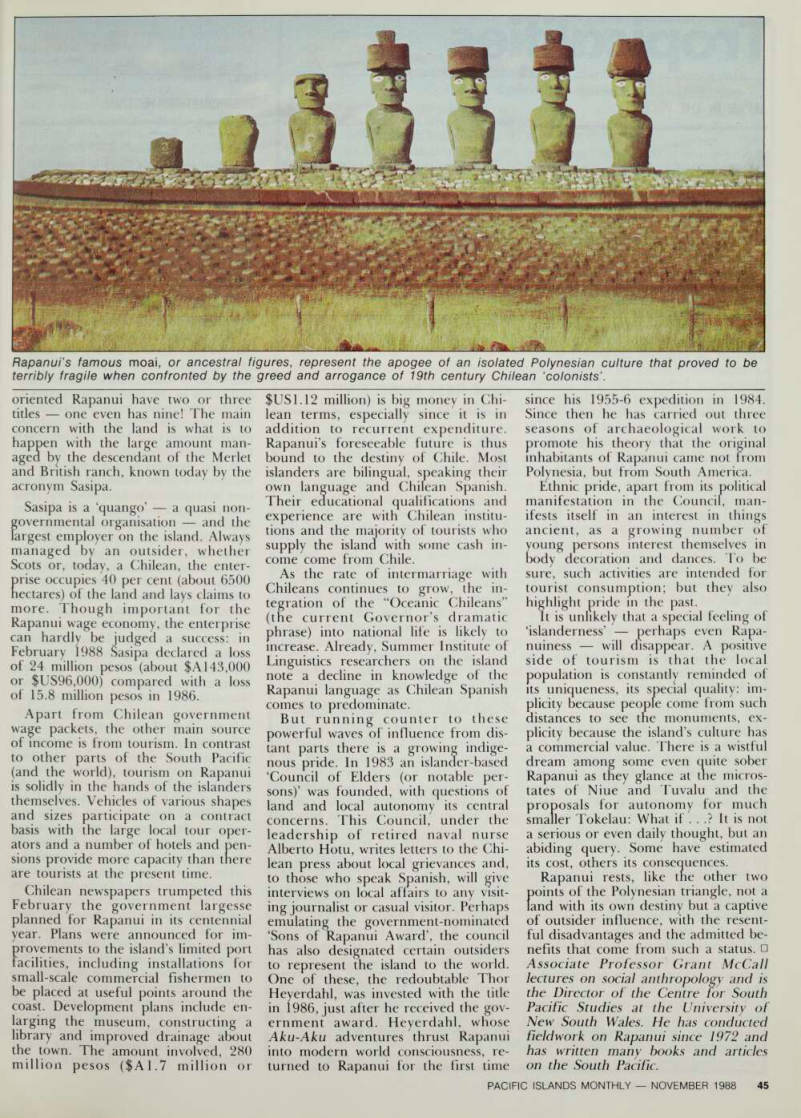
Rapanui’s famous moai, or ancestral figures, represent the apogee of an isolated Polynesian culture that proved to be terribly fragile when confronted by the greed and arrogance of 19th century Chilean ‘colonists’.