Trade Winds
pp. 40-42 · Read in the full issue
□ Nz-Fiji Business Partnership
A BOOST to trade between New Zea land and Fiji is expected following the formation of the New Zealand-Fiji Business Council in Auckland on October 17. One hundred NZ business
representatives attended the inaugural
meeting, which followed a luncheon with Fiji’s Minister of Trade and Com merce, Mr Berenado Vunibobo, and 20 Fiji businessmen representing the
Fiji-based Fiji-New Zealand Business
Council.
The two organisations will arrange for regular consultations between busi ness interests in the two countries, and will make representations to both gov ernments on behalf of their respective commercial sectors.
The first president of the NZ coun cil, Mr Harold Titter of Sedgwick’s Li mited, told the luncheon guests that business and goodwill between the two countries was of great importance to both. Mr Vunibobo for his part said NZ traders, investors and tourists were always welcome in Fiji, and he wel comed the formation of the council.
□ Fiji Bans Seafood Exports
FIJI has banned the export of giant clams for 10 years in an attempt to prevent destructive exploitation of the country’s marine products for markets in Southeast Asia and China. Exports of sandfish and brown sandfish are also totally banned and beche-de-mer must be at least 7.6 centimetres long.
□ Europe Helps Tourism
THE Commission of the European Community has approved a grant of funds equal to $F7.4 million for Phase Two of the Pacific Regional Tourism Development Program. The grant will be used by the Tourism Council of the South Pacific for the eight participat
ing states: Fiji, Kiribati, Papua New
Guinea, Solomon Islands, Tonga, Tuvalu, Vanuatu and Western Samoa.
In addition to strengthening the tourist resources of the eight countries and promoting the Pacific as a tourist destination, the program will also help
those countries assess the impact of tourism on their economies and plan their own most suitable kind of tour
ism development.
□ Samoa Goes For Gold
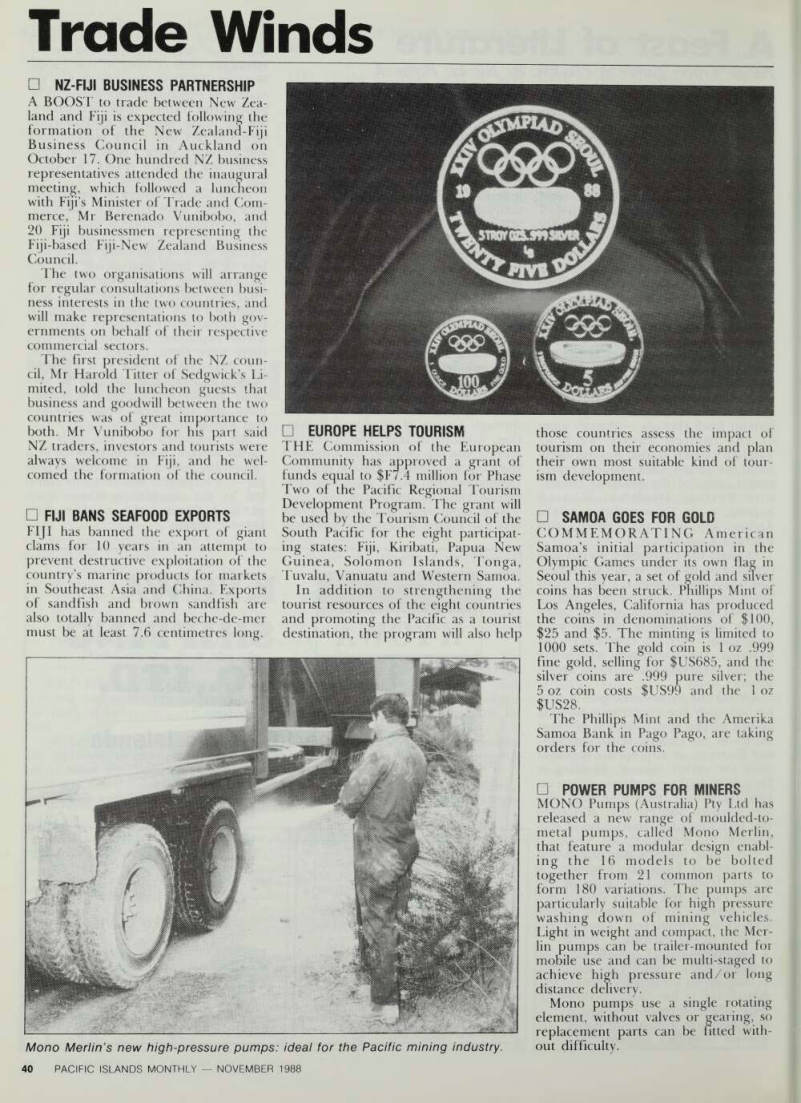
COMMEMORATING American Samoa’s initial participation in the Olympic Games under its own flag in Seoul this year, a set of gold and silver coins has been struck. Phillips Mint of Los Angeles, California has produced the coins in denominations of $lOO, $25 and $5. The minting is limited to 1000 sets. The gold coin is 1 oz .999 fine gold, selling for SUS6BS, and the silver coins are .999 pure silver; the soz coin costs SUS 99 and the 1 oz
Sus2B.
The Phillips Mint and the Amerika Samoa Bank in Pago Pago, are taking orders for the coins.
□ Power Pumps For Miners
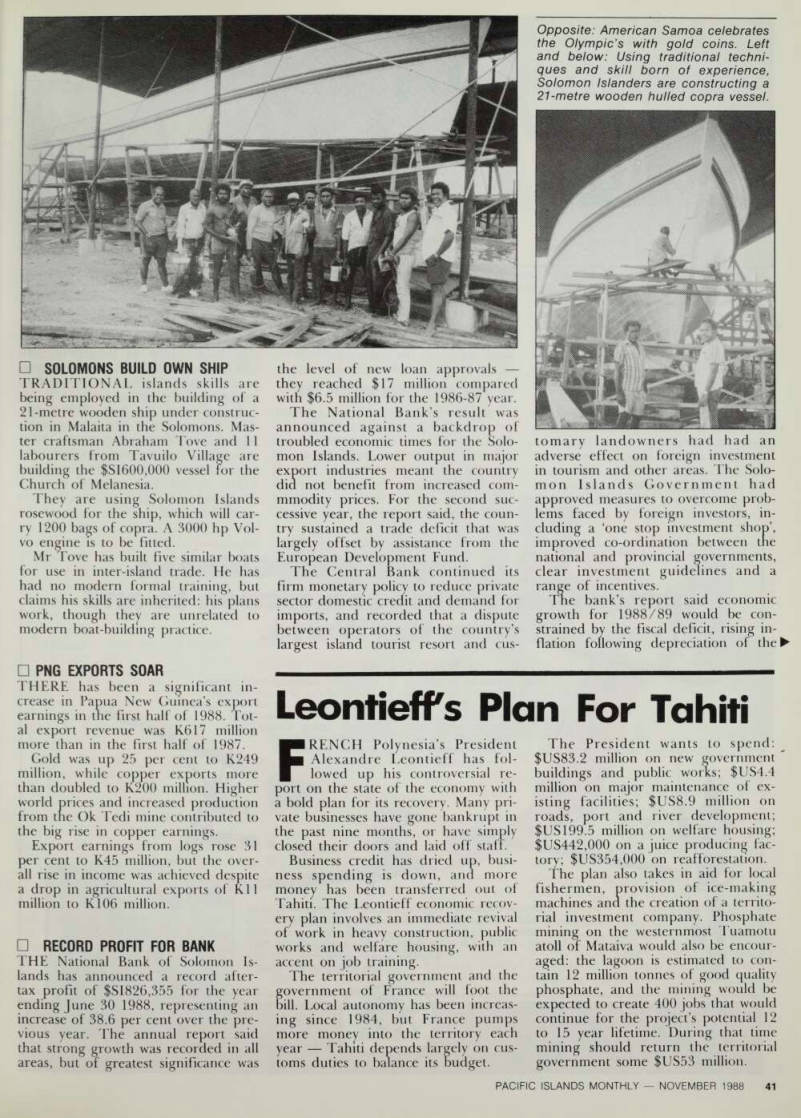
MONO Pumps (Australia) Pty Ltd has released a new range of moulded-to metal pumps, called Mono Merlin, that feature a modular design enabl ing the 16 models to be bolted together from 21 common parts to form 180 variations. The pumps are particularly suitable for high pressure washing down of mining vehicles.
Light in weight and compact, the Mer lin pumps can be trailer-mounted for mobile use and can be multi-staged to achieve high pressure and/or long
distance delivery.
Mono pumps use a single rotating element, without valves or gearing, so replacement parts can be fitted with
out difficulty.
Mono Merlin’s new high-pressure pumps: ideal for the Pacific mining industry
□ Solomons Build Own Ship
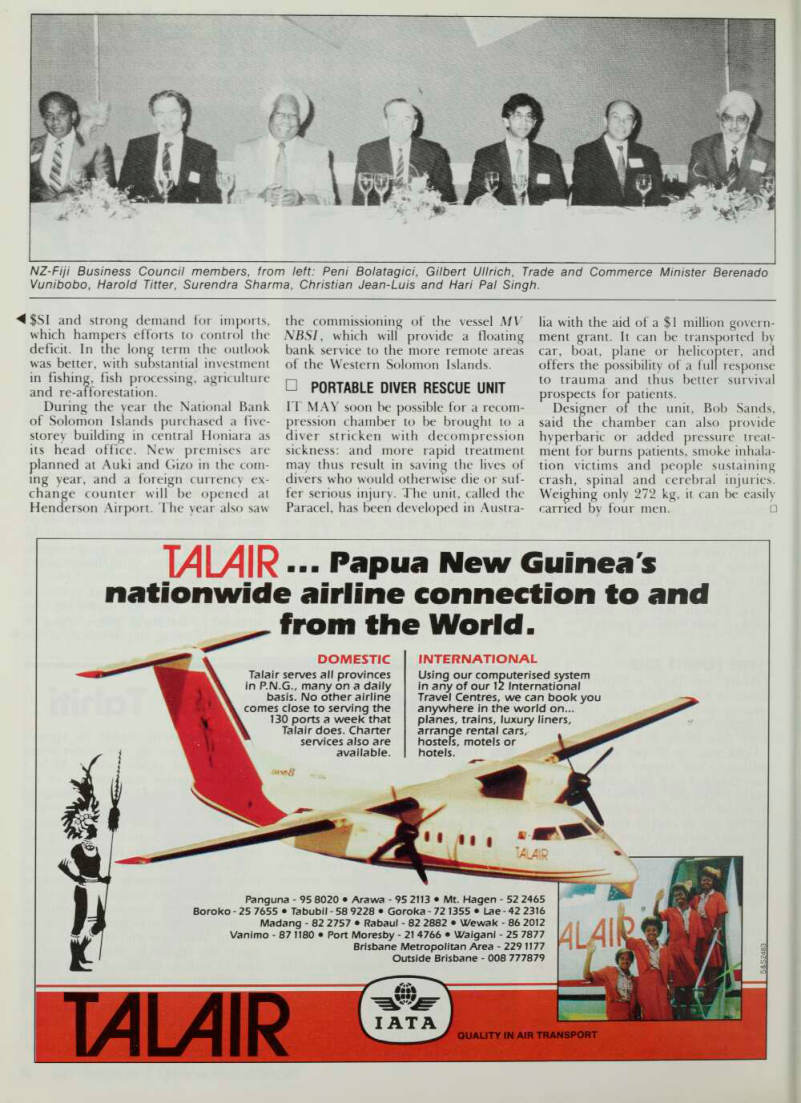
TRADITIONAL islands skills are being employed in the building of a 21-metre wooden ship under construc tion in Malaita in the Solomons. Mas ter craftsman Abraham Tove and 11 labourers from Tavuilo Village are building the $81600,000 vessel for the Church of Melanesia.
They are using Solomon Islands rosewood for the ship, which will car ry 1200 bags of copra. A 3000 hp Vol vo engine is to be fitted.
Mr Tove has built five similar boats for use in inter-island trade. He has had no modern formal training, but claims his skills are inherited: his plans work, though they are unrelated to
modern boat-building practice.
□ Png Exports Soar
THERE has been a significant in crease in Papua New Guinea’s export earnings in the first half of 1988. Tot al export revenue was K 617 million more than in the first half of 1987.
Gold was up 25 per cent to K 249 million, while copper exports more than doubled to K2OO million. Higher world prices and increased production from tne Ok Tedi mine contributed to the big rise in copper earnings.
Export earnings from logs rose 31
per cent to K 45 million, but the over all rise in income was achieved despite a drop in agricultural exports of Kll million to KlO6 million.
□ Record Profit For Bank
THE National Bank of Solomon Is lands has announced a record after tax profit of $81826,355 for the year
ending June 30 1988, representing an
increase of 38.6 per cent over the pre vious year. The annual report said that strong growth was recorded in all areas, but of greatest significance was
the level of new loan approvals they reached $l7 million compared with $6.5 million for the 1986-87 year.
The National Bank’s result was announced against a backdrop of troubled economic times for the Solo mon Islands. Lower output in major export industries meant the country did not benefit from increased com mmodity prices. For the second suc cessive year, the report said, the coun try sustained a trade deficit that was largely offset by assistance from the
European Development Fund.
The Central Bank continued its firm monetary policy to reduce private sector domestic credit and demand for imports, and recorded that a dispute between operators of the country’s largest island tourist resort and cus-
tomary landowners had had an adverse effect on foreign investment in tourism and other areas. The Solo mon Islands Government had approved measures to overcome prob lems faced by foreign investors, in cluding a ‘one stop investment shop’, improved co-ordination between the national and provincial governments, clear investment guidelines and a range of incentives.
Tne bank’s report said economic growth for 1988/89 would be con strained by the fiscal deficit, rising in flation following depreciation of the ►
Opposite: American Samoa celebrates the Olympic’s with gold coins. Left and below: Using traditional techni ques and skill born of experience, Solomon Islanders are constructing a 21-metre wooden hulled copra vessel.
◄ SSI and strong demand for imports, which hampers efforts to control the deficit. In the long term the outlook was better, with substantial investment
in fishing, fish processing, agriculture
and re-afforestation.
During the year the National Bank of Solomon Islands purchased a fivestorey building in central Honiara as its head office. New premises are planned at Auki and Gizo in the commg year, and a foreign currency exchange counter will be opened at Henderson Airport. The year also saw
the commissioning of the vessel MV NBSI, which will provide a floating bank service to the more remote areas of the Western Solomon Islands. n pnRT . R| .. mu 11 wit “ rUnIABLb UlVtn KbbbUb UNI I IT MAY soon be possible for a recompression chamber to be brought to a diver stricken with decompression sickness: and more rapid treatment may thus result in saving the lives of divers who would otherwise die or suffer serious injury. The unit, called the Paracel, has been developed in Austra-
lia with the aid of a $1 million govern ment grant. It can be transported by car, boat, plane or helicopter, and offers the possibility of a full response to trauma and thus better survival prospects for patients.
Designer of the unit, Bob Sands, said the chamber can also provide hyperbaric or added pressure treat ment for burns patients, smoke inhala tion victims and people sustaining crash, spinal and cerebral injuries.
Weighing only 272 kg, it can be easily earned by four men.
NZ-Fiji Business Council members, from left: Peni Bolatagici, Gilbert Ullrich, Trade and Commerce Minister Serenade Vunibobo, Harold Titter, Surendra Sharma, Christian Jean-Luis and Hari Pal Singh.