Conflict and Courage
p. 18 · Read in the full issue
New Caledonia
A New Zealand film about the ‘Che Guevara of the Pacific’ and Kanak culture is causing a stir. By David Robie
WHEN Wellington filmmaker
Kathy Dudding set out three years ago to make a
documentary recording the Kanak
struggle for independence, she ex pected problems with French author ities. Fortunately, she completed her filming just three weeks before the bombing of the Rainbow Warrior ; and she and her crew encountered surpri singly little trouble.
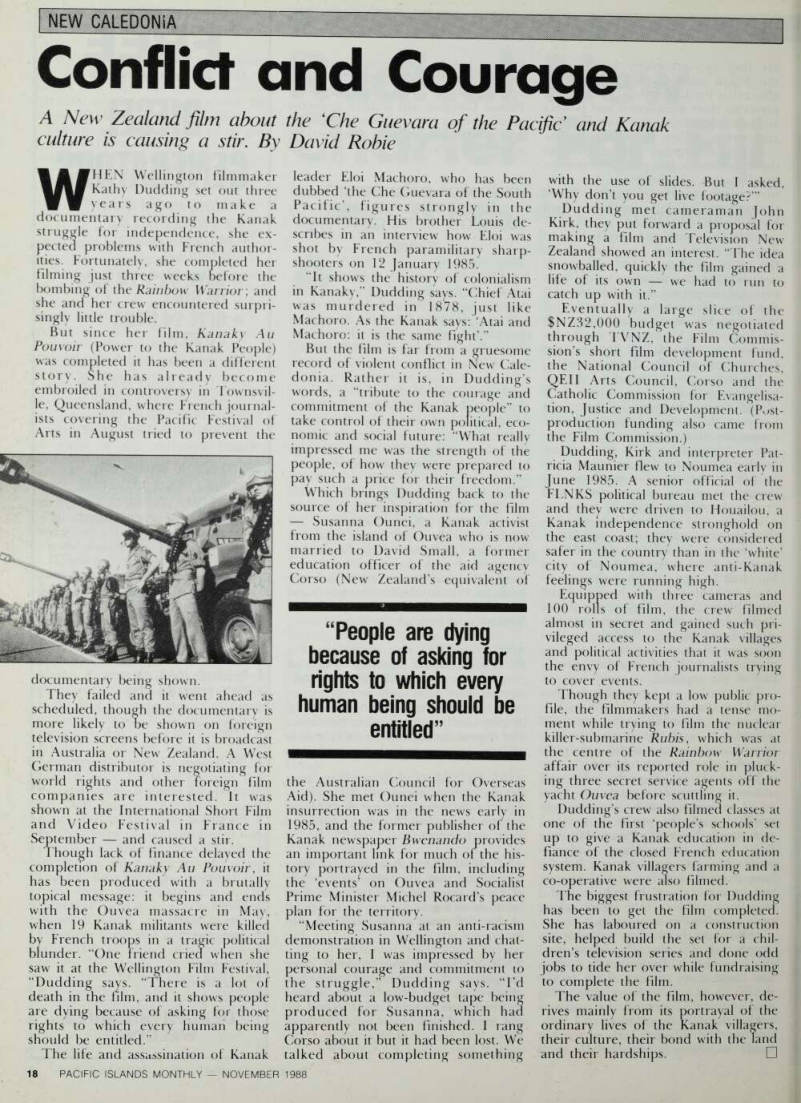
But since her film, Kanaky Au Pouvoir (Power to the Kanak People) was completed it has been a different story. She has already become embroiled in controversy in Townsvil le, Queensland, where French journal ists covering the Pacific Festival of Arts in August tried to prevent the
documentary being shown.
They failed and it went ahead as scheduled, though the documentary is more likely to oe shown on foreign television screens before it is broadcast in Australia or New Zealand. A West German distributor is negotiating for world rights and other foreign film companies are interested. It was shown at the International Short Film and Video Festival in France in September and caused a stir.
Though lack of finance delayed the completion of Kanaky Au Pouvoir, it has been produced with a brutally topical message: it begins and ends with the Ouvea massacre in May, when 19 Kanak militants were killed by French troops in a tragic political blunder. “One friend cried when she saw it at the Wellington Film Festival, “Dudding says. “There is a lot of death in the film, and it shows people are dying because of asking for those rights to which every human being should be entitled.”
The life and assassination of Kanak
leader Eloi Machoro, who has been dubbed ‘the Che Guevara of the South Pacific’, figures strongly in the documentary. His brother Louis de scribes in an interview how Eloi was
shot by French paramilitary sharp
shooters on 12 January 1985.
“It shows the history of colonialism in Kanaky,” Budding says. “Chief Atai was murdered in 1878, just like Machoro. As the Kanak says: Atai and Machoro: it is the same fight’.”
But the film is far from a gruesome record of violent conflict in New Cale donia. Rather it is, in Budding’s words, a “tribute to the courage and commitment of the Kanak people” to take control of their own political, eco nomic and social future: “What really impressed me was the strength of the people, of how they were prepared to pay such a price for their freedom.”
Which brings Budding back to the source of her inspiration for the film Susanna Ounei, a Kanak activist from the island of Ouvea who is now married to David Small, a former education officer of the aid agency Corso (New Zealand’s equivalent of
“People are dying because of asking for rights to which every human being should be entitled”
the Australian Council for Overseas Aid). She met Ounei when the Kanak insurrection was in the news early in 1985, and the former publisher of the Kanak newspaper Bwenando provides an important link for much of the his tory portrayed in the film, including the ‘events’ on Ouvea and Socialist Prime Minister Michel Rocard’s peace
plan for the territory.
“Meeting Susanna at an anti-racism demonstration in Wellington and chat ting to her, I was impressed by her personal courage and commitment to the struggle,” Budding says. “I’d heard about a low-budget tape being produced for Susanna, which had apparently not been finished. I rang Corso about it but it had been lost. We talked about completing something
with the use of slides. But I asked, ‘Why don’t you get live footage?’”
Budding met cameraman John
Kirk, they put forward a proposal for making a film and Television New Zealand showed an interest. “The idea snowballed, quickly the film gained a life of its own we had to run to catch up with it.”
Eventually a large slice of the
$NZ32,000 budget was negotiated
through TVNZ, the Film Commis sion’s short film development fund, the National Council of Churches, QEII Arts Council, Corso and the Catholic Commission for Evangelisa tion, Justice and Development. (Post production funding also came from the Film Commission.) Budding, Kirk and interpreter Pat ricia Maunier flew to Noumea early in June 1985. A senior official of the FLNKS political bureau met the crew and they were driven to Houailou, a
Kanak independence stronghold on
the east coast; they were considered safer in the country than in the ‘white’ city of Noumea, where anti-Kanak
feelings were running high.
Equipped with three cameras and 100 rolls of film, the crew filmed almost in secret and gained such pri vileged access to the Kanak villages and political activities that it was soon the envy of French journalists trying to cover events.
Though they kept a low public pro file, the filmmakers had a tense mo ment while trying to film the nuclear killer-submarine Rubis, which was at the centre of the Rainbow Warrior affair over its reported role in pluck ing three secret service agents off the yacht Ouvea before scuttling it.
Budding’s crew also filmed classes at one of the first ‘people’s schools’ set up to give a Kanak education in de fiance of the closed French education system. Kanak villagers farming and a co-operative were also filmed.
The biggest frustration for Budding has been to get the film completed.
She has laboured on a construction site, helped build the set for a chil dren’s television series and done odd jobs to tide her over while fundraising to complete the film.
The value of the film, however, de rives mainly from its portrayal of the ordinary lives of the Kanak villagers, their culture, their bond with the land and their hardships. □