Keeping The Peace
p. 15 · Read in the full issue
Papua New Guinea
Frank Senge examines proposals for the PNGDF to serve in the Middle East
PESTERED by continuing
rumours of coups and at the same time accused of doing nothing, the Papua New Guinea De fence Force is preparing to defuse both sources of discord by sending troops on United Nations peacekeep ing missions abroad. UN General Secretary Mr Perez de Cuellar is re
portedly “most pleased” by PNG’s in
terest, and the PNG Defence Council has already endorsed the concept as do Prime Minister Rabbie Namaliu and Foreign Minister Michael Somare.
Only Cabinet and Parliament have yet to approve the decision (PNG’s constitution requires that Parliament formally endorse any involvement of PNG troops overseas), but does the force have the capacity to honour the
political initiative?
Many believe it is unready, and blame that situation on past political decisions. Following rumours of a coup in 1977 and again in 1982, the government put in place a manpower ceiling of 3000 personnel and cut budget allocations to the PNGDF.
As a result, many servicemen were retrenched and the force stagnated: a review undertaken last year revealed that morale had deteriorated, the force was under-equipped and salaries and conditions haa not improved since Independence in 1975.
Soldiers’ pay had fallen behind the rest of the workforce by as much as 70 per cent: the military average was be low K5O a week and personnel had
only managed to survive through sub
sidised food and housing and other allowances. The review also stated in no uncertain terms that the force is in real need of more recruits, more
equipment and more training.
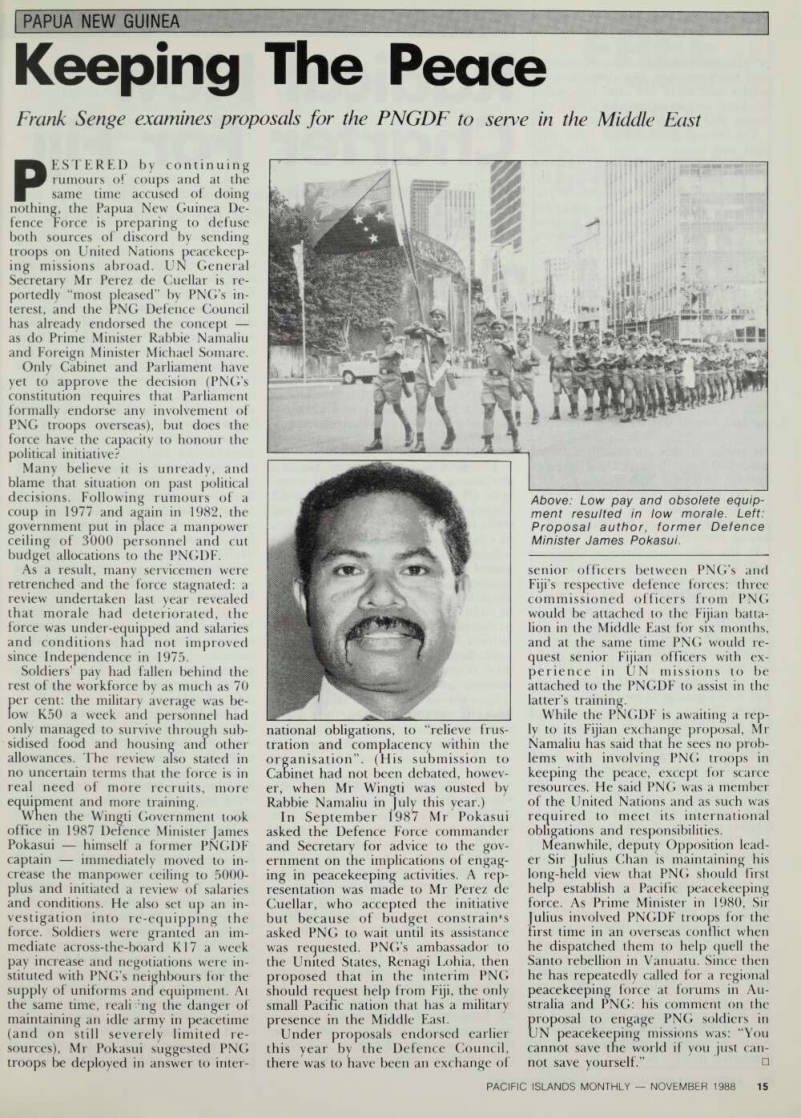
Wnen the Wingti Government took office in 1987 Defence Minister James Pokasui himself a former PNGDF captain immediately moved to in crease the manpower ceiling to 5000plus and initiated a review of salaries and conditions. He also set up an in
vestigation into re-equippmg the
force. Soldiers were granted an im mediate across-the-board Kl 7 a week pay increase and negotiations were in stituted with PNG’s neighbours for the supply of uniforms and equipment. At the same time, reali : ng the danger of maintaining an idle army in peacetime (and on still severely limited re sources), Mr Pokasui suggested PNG troops be deployed in answer to inter-
national obligations, to “relieve frustration and complacency within the organisation”. (His submission to Cabinet had not been debated, however, when Mr Wingti was ousted by Rabbie Namaliu in July this year.) In September 1987 Mr Pokasui asked the Defence Force commander and Secretary for advice to the government on the implications of engaging in peacekeeping activities. A representation was made to Mr Perez de Cuellar, who accepted the initiative but because of budget constraints asked PNG to wait until its assistance was requested. PNG’s ambassador to the United States, Renagi Lohia, then proposed that in the interim PNG should request help from Fiji, the only small Pacific nation that has a military presence in the Middle East.
Under proposals endorsed earlier this year by the Defence Council, there was to have been an exchange of
senior officers between PNG’s and Fiji’s respective defence forces: three commissioned officers from PNG would be attached to the Fijian batta lion in the Middle East for six months, and at the same time PNG would re quest senior Fijian officers with ex perience in UN missions to be attached to the PNGDF to assist in the
latter’s training.
While the PNGDF is awaiting a rep ly to its Fijian exchange proposal, Mr Namaliu has said that he sees no prob lems with involving PNG troops in keeping the peace, except for scarce resources. He said PNG was a member of the United Nations and as such was required to meet its international
obligations and responsibilities.
Meanwhile, deputy Opposition lead
er Sir Julius Chan is maintaining his long-held view that PNG should first help establish a Pacific peacekeeping force. As Prime Minister in 1980, Sir Julius involved PNGDF troops for the first time in an overseas conflict when he dispatched them to help quell the Santo rebellion in Vanuatu. Since then he has repeatedly called for a regional peacekeeping force at forums in Au stralia and PNG: his comment on the proposal to engage PNG soldiers in UN peacekeeping missions was: “You cannot save the world if you just can not save yourself.” □
Above: Low pay and obsolete equip ment resulted in low morale. Left: Proposal author, former Defence Minister James Pokasui.