A Maori Victory... Or Is It?
p. 12 · Read in the full issue
New Zealand
Controversial fisheries bill hailed as a major victory for Maori aspirations and as apartheid. David Robie reports.
ATE last year, the New Zealand V Government gave eight nego ■■ tiators a six-month deadline to solve 148 years of Maori grievances over fishing rights. Now the country is embroiled in a bitter debate over what many regard as the most radical move ever made in the history of the 1840 Treaty of Waitangi, a aocument that promised the Maori people “full, ex clusive and undisturbed possession” of their fisheries.
The Maori Fisheries Bill proposes to hand over half of the country’s fishing rights to the Maori people. It is an undeniable victory for Maori aspira tions, and for former Maori Affairs Minister Matiu Rata. But critics regard the bill as flawed; leading NZ Maori Council members have condemned the forfeit of Maori rights as apar theid, saying it would inflame racial tension. Others have attacked what has been dubbed an “Idi Amin” clause that prohibits for all time fishing legal challenges under the treaty.
Government officials met Maori negotiators early in October in an effort to avoid court action against the Crown over the bill: 38 tribes had already filed claims involving the en tire New Zealand coastline, in an attempt to protect their rights, in the
High Court.
While many pakeha who domin ate the country’s 3.3 million popula tion are becoming increasingly ner vous about land claims under the trea ty, and the rise of Maori nationalism,
tne major political parties have been
unable to respond with clearsighted politics. Even a watered-down version of a national bill of rights has emerged that has dropped the treaty (included in the first draft) and will no longer be entienched as supreme law.
The handing back of 70 hectares of prime harbourside land at Bastion Point, near the affluent Auckland sub urb of Mission Bay, to the Ngati Whatua people earlier this year was hailed as a landmark decision by the Waitangi Tribunal. It must be re garded as one of the crucial turning points in Maori land rights issues and claims that now cover nearly three quarters of the country.
Recommendations over Bastion Point were among a series of con troversial decisions that have handed back a total of 38 pieces of land, worth SNZBS million, to Maori control since
1978. In one of the largest land claims yet to be heard, the Ngai Tahu tribe is seeking control over at least a third of the South Island. The tribunal was established in 1975 by a former Labour government to review claims under the Treaty of Waitangi, under which Maori chiefs ceded the govern ment of New Zealand to Queen Vic-
toria in return for protection of their traditional land and fisheries rights.
The tribunal had earlier upheld the Muriwhenua tribe’s claim to 5000 square kilometres of fishing waters in the North Island. Praising the ruling, Rata, Minister of Maori Affairs from 1972 to 1975, said at the time: “I be lieve this generation will be rewarded for the courage to front up to the
responsibilities the Treaty of Waitangi
demands of us.” Rata is also a tribunal elder and leader of the Mana Motu hake party; the first independent Maori political party in more than half a century and one that has been
steadily gaining ground.
While he was minister, Rata initiated
the 1970 Waitangi Tribunal Act hardly realising that it would make it possible for him to take the Muriwhe nua claim before the tribunal 13 years later. The claim led to an Appeal Court ruling in June 1987 calling on the government to find a way of safe guarding future Maori land claims on Crown Land before it was transferred to state-owned enterprises.
Following an interim tribunal ruling on the Muriwhenua claim, the High Court issued an injunction against the issue of new fishing quotas and the ban was extended to all fisheries in November 1987.
Rata was also one of the four Maori
negotiators with Tipene O’Regan,
for the Ngai Tahu tribe; Denese He nare, for the Tainui; and the chair man of the Maori Council, Sir Gra ham Latimer included in the team of eight named to draft an agreement crucial not only to the fishing industry and Maori rights, but to race relations in New Zealand.
Instead, the government stepped in and initiated its own solution m the form of the fisheries bill.
The bill means the Crown will give Maori people 2.5 per cent of fishing quotas about 16,000 tonnes of fish in the coming fishing season. For the next 19 years, Maori tribes would receive 2.5 per cent a year, but only if they had ‘substantially fished’ the pre vious year’s quota. Eventually Maori tribes would have the potential to con trol half the country’s commercial fisheries by the year 2008. The gov ernment would also give Maori tribes a subsidy of $2 million a year for five years to help them become established in the industry.
However, the big catch for the Maori people is Clause 17, which im poses a 20-year blanket ban on Maori claims before the Waitangi Tribunal; including those that are currently be fore the tribunal.
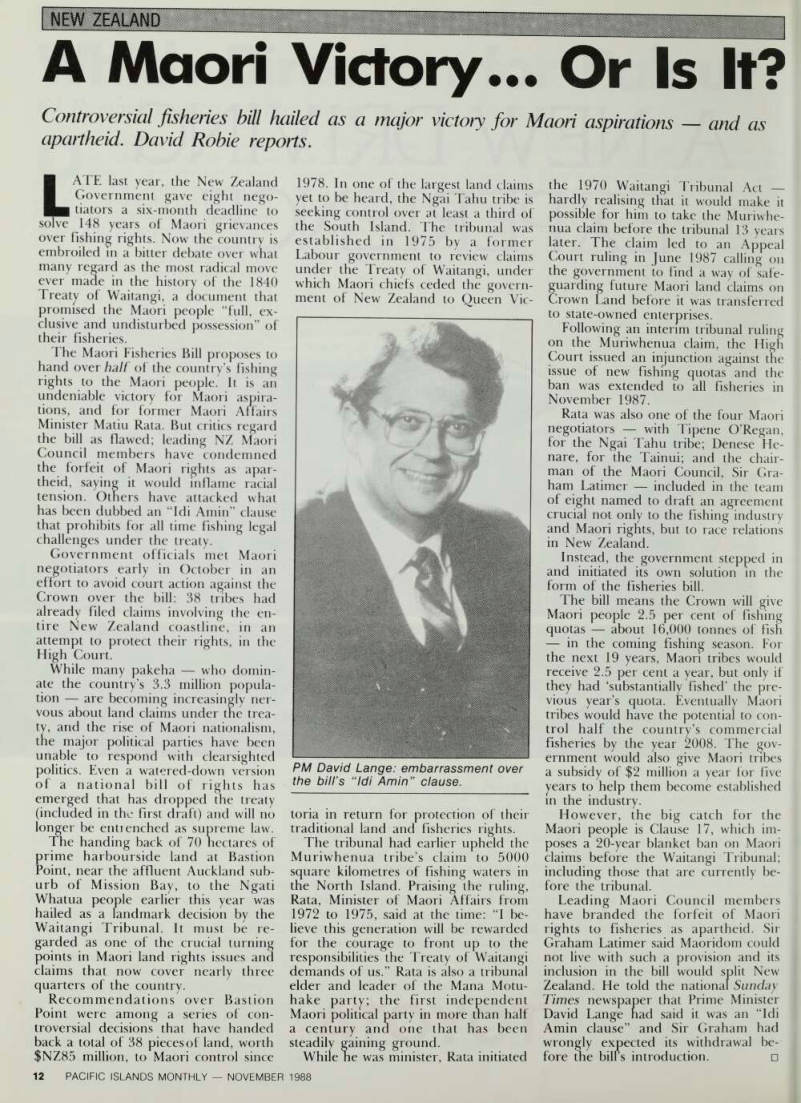
Leading Maori Council members have branded the forfeit of Maori rights to fisheries as apartheid. Sir Graham Latimer said Maoridom could not live with such a provision and its inclusion in the bill would split New Zealand. He told the national Sunday Times newspaper that Prime Minister David Lange had said it was an “Idi Amin clause” and Sir Graham had wrongly expected its withdrawal be fore the bill’s introduction. □
PM David Lange: embarrassment over the bill’s “Idi Amin” clause.