A Playground For Imperialists
p. 58 · Read in the full issue
Out Of The Past
Deborah Cass looks at Nauru’s history of exploitation
PHOSPHATE rock was first discov ered on the small Pacific island of Nauru in 1906, and when arrange ments were made to extract this valuable source of fertiliser the people of the island asked no more than that enough rocks be left for them to use as fishing weights.
Colonial business agreements were no toriously unfair to local inhabitants. Dur ing the years Britain. Australia and New Zealand controlled mining on Nauru.
SAB9 million worth of phosphate was ex tracted; the Nauruans received $A3.4 mil lion in royalties in return, or less than 2.5 per cent of its total value.
Less than half of this was paid in direct royalties to landowners. The bulk went into trust funds, controlled by the colonial ad ministrators, to be used for the benefit of the Nauruan community. And Nauruans lost any possible use of the mined land.
Nauru is a 22 square kilometre raised coral atoll, with a central plateau made up almost entirely of high quality phosphate.
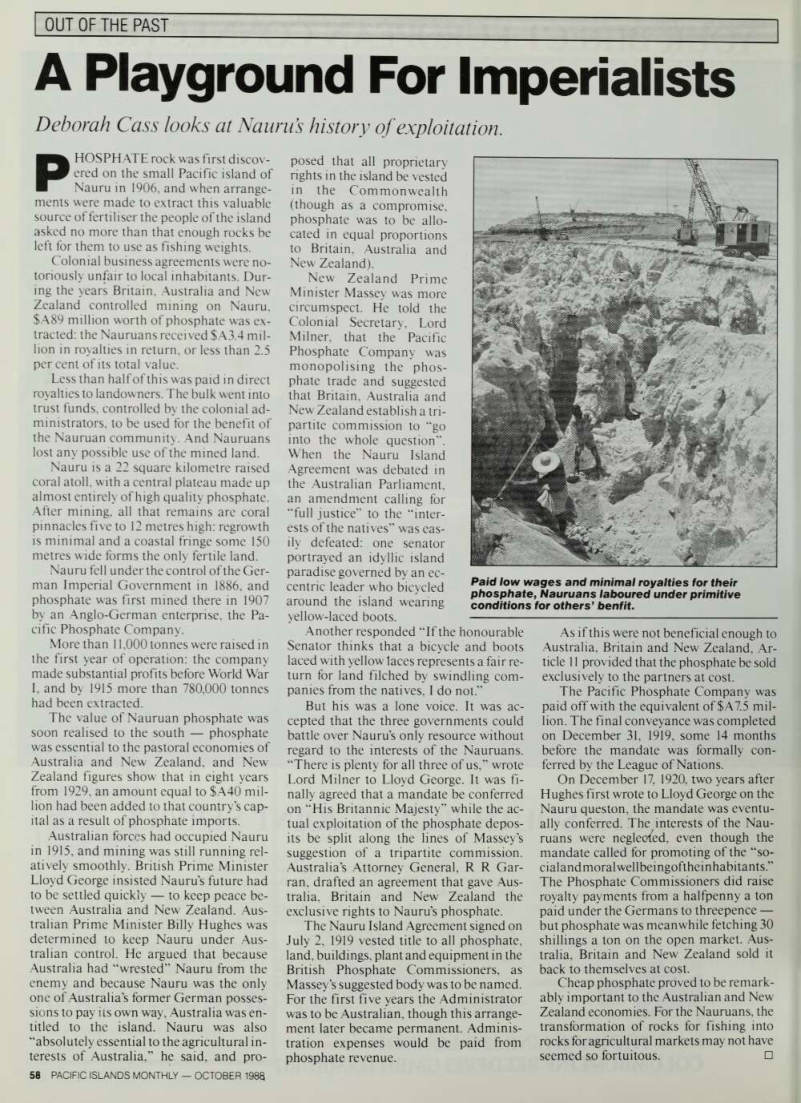
After mining, all that remains are coral pinnacles five to 12 metres high: regrowth is minimal and a coastal fringe some 150 metres wide forms the only fertile land.
Nauru fell under the control of the Ger man Imperial Government in 1886, and phosphate was first mined there in 1907 by an Anglo-German enterprise, the Pa cific Phosphate Company.
More than 11,000 tonnes were raised in the first year of operation: the company made substantial profits before World War I, and by 1915 more than 780,000 tonnes had been extracted.
The value of Nauruan phosphate was soon realised to the south phosphate was essential to the pastoral economies of Australia and New Zealand, and New Zealand figures show that in eight years from 1929, an amount equal to SA4O mil lion had been added to that country’s cap ital as a result of phosphate imports.
Australian forces had occupied Nauru in 1915, and mining was still running rel atively smoothly. British Prime Minister Lloyd George insisted Nauru’s future had to be settled quickly to keep peace be tween Australia and New Zealand. Aus tralian Prime Minister Billy Hughes was determined to keep Nauru under Aus tralian control. He argued that because Australia had “wrested” Nauru from the enemy and because Nauru was the only one of Australia’s former German posses sions to pay its own way, Australia was en titled to the island. Nauru was also “absolutely essential to the agricultural in terests of Australia,” he said, and pro
posed that all proprietary rights in the island be vested in the Commonwealth (though as a compromise, phosphate was to be allo cated in equal proportions to Britain, Australia and New Zealand).
New Zealand Prime Minister Massey was more circumspect. He told the Colonial Secretary, Lord Milner, that the Pacific Phosphate Company was monopolising the phos phate trade and suggested that Britain, Australia and New Zealand establish a tri partite commission to “go into the whole question”.
When the Nauru Island Agreement was debated in the Australian Parliament, an amendment calling for “full justice” to the “inter ests of the natives” was eas ily defeated: one senator portrayed an idyllic island paradise governed by an ec centric leader who bicycled around the island wearing yellow-laced boots.
Another responded “If the honourable Senator thinks that a bicycle and boots laced with yellow laces represents a fair re turn for land filched by swindling com panies from the natives, I do not.”
But his was a lone voice. It was ac cepted that the three governments could battle over Nauru’s only resource without regard to the interests of the Nauruans.
“There is plenty for all three of us,” wrote Lord Milner to Lloyd George. It was fi nally agreed that a mandate be conferred on “His Britannic Majesty” while the ac tual exploitation of the phosphate depos its be split along the lines of Massey’s suggestion of a tripartite commission.
Australia’s Attorney General, R R Gar ran. drafted an agreement that gave Aus tralia, Britain and New Zealand the exclusive rights to Nauru’s phosphate.
The Nauru Island Agreement signed on July 2, 1919 vested title to all phosphate, land, buildings, plant and equipment in the British Phosphate Commissioners, as Massey’s suggested body was to be named.
For the first five years the Administrator was to be Australian, though this arrange ment later became permanent. Adminis tration expenses would be paid from phosphate revenue.
As if this were not beneficial enough to Australia, Britain and New Zealand, Ar ticle 11 provided that the phosphate be sold exclusively to the partners at cost.
The Pacific Phosphate Company was paid off with the equivalent of $A7.5 mil lion. The final conveyance was completed on December 31, 1919, some 14 months before the mandate was formally con ferred by the League of Nations.
On December 17, 1920, two years after Hughes first wrote to Lloyd George on the Nauru queston, the mandate was eventu ally conferred. The interests of the Nau ruans were neglected, even though the mandate called for promoting of the “so cialandmoralwellbeingoftheinhabitants.”
The Phosphate Commissioners did raise royalty payments from a halfpenny a ton paid under the Germans to threepence but phosphate was meanwhile fetching 30 shillings a ton on the open market. Aus tralia, Britain and New Zealand sold it back to themselves at cost.
Cheap phosphate proved to be remark ably important to the Australian and New Zealand economies. For the Nauruans, the transformation of rocks for fishing into rocks for agricultural markets may not have seemed so fortuitous. □
Paid low wages and minimal royalties for their phosphate, Nauruans laboured under primitive conditions for others’ benfit.