“Unity” In Noumea
p. 12 · Read in the full issue
New Caledonia
Kanaks and Caldoches gather in a rare show of amity.
THE success of French Prime Min ister Michel Rocard’s historic visit to New Caledonia late in August can be summed up by one incredible scene in side Noumea’s Town Hall: on stage stood Kanak and Caldoche leaders Jean-Marie Tjibaou and Jacques Lafleur, arms raised to acknowledge an ovation from a Euro pean audience.
Every inhabitant of New Caledonia was aware that this was a historic moment: not only the first visit by a Socialist Prime Minister to a territory that only a few months ago was on the brink of civil war, but the first time Jean- Marie Tjibaou has been publicly hailed by those who again, only a few months ago had damned him as a terrorist.
Mr Rocard, however, was less obliging to his Noumea audience. He called on New Caledonia’s European minority to “end the unequal system where one city dominates the rest of the territory, and where one community dominates the others.” He echoed Charles de Gaulle’s warning to the pieds-noirs that France was engaged in a “decolonisation” process in Algeria, call ing on Caldoches and Melanesians alike to accept a new order albeit one where New Caledonia will maintain “close links” with France through “decolonisation in side Republican institutions”.
According to Mr Rocard, the Matignon Accord signed in Paris on August 20 es tablishes the Government of France as “a referee; not as a player in the New Cale donian game.” To this end, he has pledged to give Kanaks an opportunity to play a meaningful part in an economic and ad ministrative system that had previously seen them as marginal elements. Four thousand “development traineeships” will be offered to young Kanaks in the terri tory’s municipalities, and 400 “mostly Melanesian” public servants will be sent to France for training. The move has won support from private sector interests in New Caledonia; a representative commit tee has urged the French Government also to assist private investment in areas out side Noumea, and to encourage Melane sians to establish profit-based businesses rather than co-operatives.
In the public sector, Mr Rocard has nominated positions in the police, tele vision and judiciary for Kanaks, promis ing a division of the present judicial system and the setting up of “branches” in Lifou (Loyalty Islands), Kone (on the west coast of Grande Terre) and Poindimie (east coast) to defuse accusations of a system
that worked primarily to “condemn Kan aks”, as separatists have claimed.
One of the most notable features of the Prime Minister’s visit was the absence of disturbances, and the call by Jacques La fleur for RPCR supporters to attend Mr Rocard’s address: loyalists have previ ously boycotted Socialist officials.
By the end of the three-day visit, how ever, the RPCR was grumbling about Mr Rocard’s announcement of an inquiry into the accounts of ADRAF (Agence de De velopment Rural et d’Amenagement Fon der), the body charged with land management in New Caledonia. Effec tively controlled by the RPCR, the agency has attracted heated criticism both from the FLNKS (which accuses it of failing to take into account traditional land rights) and the anti-independence right wing (which accuses it of favouring only RPCR supporters). Mr Lafleur expressed his dis appointment with the decision, saying Mr Rocard “would do better to strengthen the peace agreement.”
On the independentist side, reaction to Mr Rocard’s visit was warmly positive: even Canala, scene of a virtual siege ear lier this year, turned out to give the PM a courteous welcome. But the celebrations masked an internal power struggle be tween Mr Tjibaou’s mainstream Union Caledonienne and more radical FLNKS members such as Yann Celene Uregei’s hardline FULK which initially refused to sign the Matignon accord that was only resolved after weeks of intense and
often extremely heated discussion.
The real test of Mr Rocard’s visit will be the November 6 referendum in France.
Traditionally regarded as a plebiscite giv ing approval (or warning) to the govern ment and its policy directions, a national referendum will determine whether all of France and her territories support the Ro card decolonisation plan (which in any case cannot afford to be watered down) or, as conservative Opposition parties claim, reject the Prime Minister’s “cynical ex ploitation” of international opinion.
Whichever path is chosen, Michel Rocard has gained valuable domestic and terri torial support through his reconciliation of communities that scant weeks ago were at each other’s throats. □
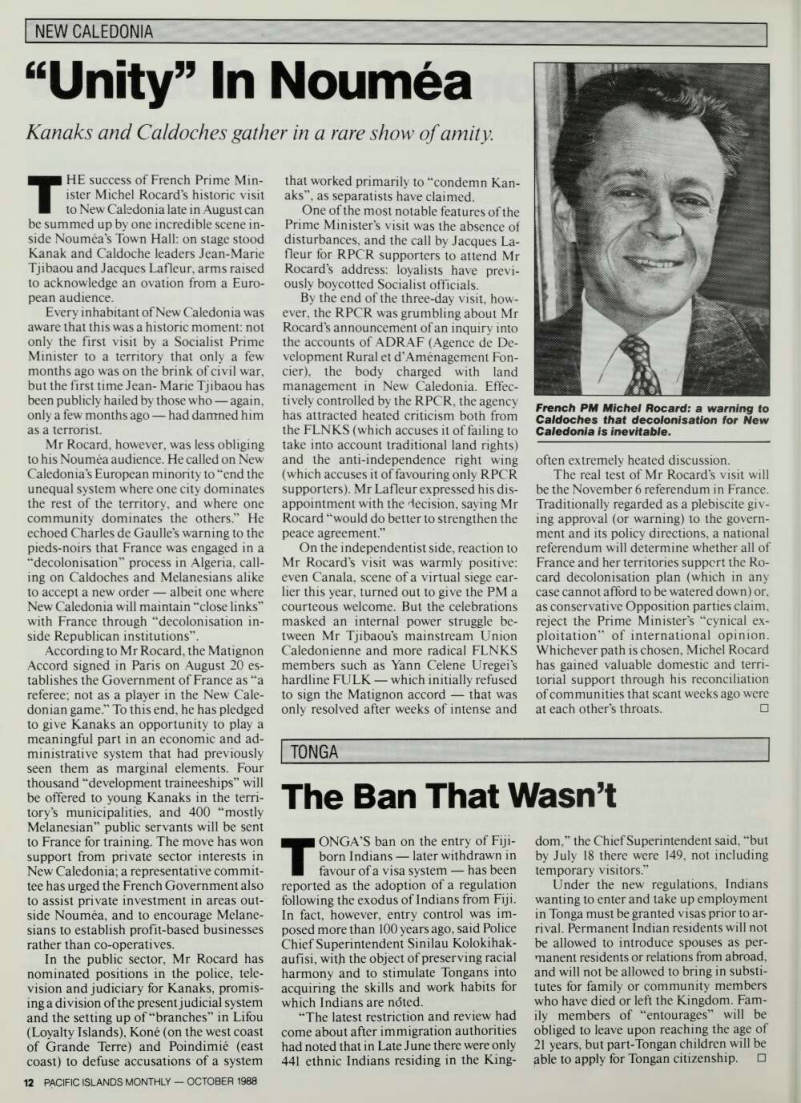
French PM Michel Rocard: a warning to Caldoches that decolonisation for New Caledonia is inevitable.