Trade Winds
pp. 42-43 · Read in the full issue
What Future For Vanuatu’s Finance Centre?
By Robin Bromby
TH E continuing constitutional prob lems in Vanuatu will almost cer tainly prove a setback for the nation’s fragile economy. While the recent political battles and one riot have been widely reported outside Vanuatu, the country remains calm. But the publicity could prove disastrous to an economy heavily dependent on tourism and the continued health of the finance centre.
What is worrying members of the fi nance centre in Port Vila is not so much the companies that now use it; they can be reassured. The troubles may deter new companies from setting up there, espe cially as Vanuatu’s reputation within fi nancial circles has taken previous batterings, most notably when relations were established with Libya.
It is not just Vanuatu that could suffer from the growing image South Pacific is a trouble spot: Trevor Clarke, managing di rector of the Cooks Island Trust Corpo ration, told Pacific Islands Monthly that businessmen who are familiar with the re gion will not be concerned, but that others may not be able to differentiate between various islands and could decide to steer clear of the Pacific altogether.
Offshore and tax-free centres are a growing business in the region. The Van uatu centre, established in 1971, now has 1200 companies and about 100 banks op erating from Port Vila. The Cook Islands, which passed its legislation in 1982, is now home to 1600 companies, including 20 banking operations.. Tonga has put off shore banking legislation in place, and The Samoa Times reported recently that the Western Samoan Government was con sidering legislation, soon to be tabled in Parliament, to establish an offshore bank ing system there (see “Pacific People” in this issue).
Flag-of-convenience shipping regis tries are also growing; Vanuatu’s lead in this direction is to be followed by Tuvalu and the Republic of the Marshall Islands.
Vanuatu needs the finance centre to be a continuing success. For the six months to June 30 1987, Vanuatu’s exports earned about SUS 7 million while imports cost SUS32.B million a deficit for six months of SUS2S.B million. The importance of in visibles such as financial transactions and tourism can be seen in such a situation, though the country is sure to continue to rely heavily on foreign aid.
One member of the Port Vila finance centre said Australian Newspapers had
made it sound as if chaos ruled in Vanu atu, when in fact the country was peaceful.
“We’ve had some clients who were nerv ous, but we’ve been able to call them and explain what is going on. But we might have frightened off some potential clients no one can really tell,” he said.
The majority of clients using Port Vila are large Asian operations or smaller fam ily companies owned by Australians or New Zealanders. The tax haven provides extensive secrecy protection (with heavy fines and prison sentences for breaches), no personal or coporate income taxes, no estate or gift duties, no capital gains taxes, no exchange controls and no participation in tax treaties. The most common vehicle for basing funds in Vanuatu (and other tax havens) is either a trust or a company, the latter earning tax free income through trusts or law firms. Alternatively, non res idents can use the finance centre by just having accounts with banks in Port Vila.
The finance centre had earlier set backs; soon after it was established a re bellion on the island of Santo against the central Government destroyed much con fidence in the nation as a reliable tax ha ven. Subsequently, the Libyan connection and a fishing deal with the Soviet Union raised doubts about just how stable the small South Pacific nation really was.
Whether or not the present political unrest will destabilise the government, the fear of such distruption is enough to frighten some investors.
Earlier this year, the Hong Kong and Shanghai Banking Corporation pulled out of Port Vila (as well as Suva and Honiara) because its operations were simply not sufficiently profitable. Westpac took over its business and now has two branches in Port Vila; previously the ANZ Bank had absorbed Barclays Bank and is currently spending $A500,000 extending its prem ises. The other bank operating in Vila is the Banque Indosuez.
The finance centre now employs 400 people and accounts for 12 per cent of the country’s gross domestic product.
Meanwhile, after a slow start there has been a recent increase in the number of ships registered under Vanuatu’s flag of convenience. Between 1981 and 1987 120 ships were registered, but in April one of the Vila-based trust companies reported that the registry contained 220 vessels and discussions were taking place with several major international fleets to move their ships on to the registry. Events in Panama may have contributed to renewed interest.
But it is the area of tax havens that there will be real competition. A top Vanuatu businessman says that the Cooks have very good legislation, and companies in Raro tonga work in a different time zone, which
gives them some advantage in dealing with the US. Eventually, he says, Western Sa moa and Tonga will win their shares of the offshore banking business: “They’re all vi able it just depends which one appeals to each different company.”
Trevor Clarke says the finance centre has taken great pains to develop a respect able image and to provide good quality service, both financial and legal. He says the Cooks centre has aimed at the higher end of the market, targeting large multi national companies.
The unknown quantity is Fiji. Earlier this year the Fiji Government was consid ering setting up a finance centre in Suva with similar tax haven provisions to those operating in Port Vila and Rarotonga. As reported at the time, the significance of the move is that the finance centre would al most certainly prosper at the expense of the others, simply because Fiji is consid ered the “hub” of the region.
Little more has been heard of the pro posal, but several months ago Finance Minister Josefata Kamikamica said that several international trading banks had discussed with the Fiji Government the impossibility of opening branches in the country. The minister declined to name the banks, but said he favoured more com petition in Fiji’s money market.
The Fijians have shown themselves to be eager to take measures that will boost economic growth; last December the Suva government introduced its tax free zones for export industries.
□ Fiji Customs Delays
AUSTRADE Fiji has advised all export ers dealing with the Republic that follow ing the arms shipment discoveries earlier in the year, all incoming sea and air cargo is being rigorously inspected by Fiji cus toms and security forces. As a result, de lays of up to two weeks have been experienced in clearing goods for consumption.
□ Anz To Open In Rarotonga
THE Australian and New Zealand Bank ing Group has received approval from the Cook Islands Monetary Board to estab lish a branch in Avarua, the financial and business district of Rarotonga.
Expected to open later this year, the branch will offer a range of banking serv ices, and according to ANZ Director for Americas and Asia Pacific Mr Roland Ish erwood, will “complement our already wide network of branches in the islands of the South Pacific.” The ANZ Banking Group has appointed Mr T Leadbeater, currently manager of the bank’s Victoria Parade, Suva, branch as manager of the Rarotonga branch.
□ Ats Takes Over Burns Philp
BURNS Philp International Forwarding has been taken over by Associated Trans portation Services for services from Syd ney and Melbourne to Pacific ports as well as handling LCL consolidation shipments to Apai/Pago Pago and Nukualofa. Ger ard Bennet, formerly of BPIF, is now di recting ATS services to the region.
□ New Air Services Via Vila
AIR Vanuatu will be adding a second weekly service from Melbourne to Port Vila in December, supplementing its ex isting direct flight with a “champagne ex perience” that offers free drinks to business and economy passengers.
Air Vanuatu chairman Clarence Marae, launching the new service in Sydney, said the Melbourne-Vila connection will pro vide an important boost to Vanuatu’s tourism industry, which has been hit by rumours of Libyan involvement in the country’s affairs and by misrepresentation by foreign journalists (see Page 10 in this issue). “In 1984 24,000 Australian tourists visited Vanuatu,” Mr Marae said, “but since then the numbers have declined. The reason is a series of factors, including doubts over political stability and confu sion with other South Pacific nations.
“However, more than SA2S million has been spent on improving and expanding hotel and resort facilities over the past 12 months, and a similar amount will be spent in the next two years. Vanuatu is a safe country, and offers a unique blend of Me lanesian, French, British and Asian cul tures. Our restaurants are well priced, and there is no tipping in Vanuatu we would rather have your smile.”
□ Nz Ends Clothing Licences
FIJI and some other island communities will be interested in New Zealand’s an nouncement that all import licensing for clothing will end by July 1992. Already the slashing of tariffs has resulted in increased importing from Fiji, and the movement to Fiji of some New Zealand manufacturers.
The companies have been taking ad vantage of lower production costs and government assistance to new industry.
Trade unions and some manufacturers have been critical of the lifting of the home
industry’s protection, but the NZ Govern ment has pointed to the cost to New Zea land consumers of the home-made article.
The most unfavourable publicity has focused on imports that have carried a “Made In New Zealand” tag: these are understood to have been from manufac turers who previously produced the gar ments in New Zealand.
Trade and Industry Minister David Caygill has said these garments comprised only 1 per cent of all imports sold in New Zealand last year. □
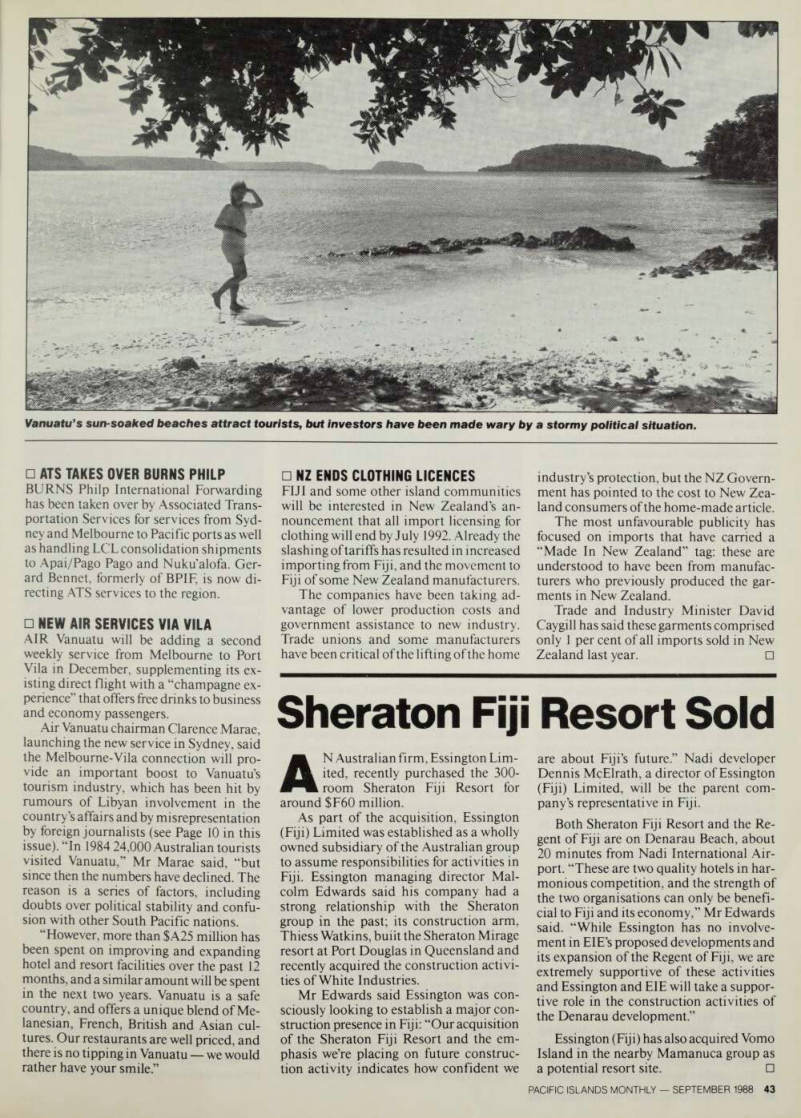
Vanuatu’s sun-soaked beaches attract tourists, but investors have been made wary by a stormy political situation.