Taking Europe By Storm
p. 40 · Read in the full issue
Pacific Arts
Pacific dancers a hit in London and Paris.
By Nicolas Rothwell
NORTHERN Europe may be half a world away from the islands of the Pacific, but both London and Paris have recently been regaled with giant fes tivals of Pacific art and music. Unfamiliar rhythms have resounded in the cities of Handel and Debussy as Tongan, Maori and Papua New Guinean dancers per formed for audiences who can rarely have heard music so alien to their own culture.
First in Paris, where the festival of mu sic was held in June, and then in London, where the Commonwealth Institute is mounting exhibitions and meetings on is lands culture (see Pacific Islands Monthly , June), the Pacific became a new focus of cultural attention.
In both cities, Melpa and Huli dancers from the Mount Hagen region of Papua New Guinea created a strong impression of the “otherness” of Pacific culture, while many French critics tended to see greater similarities between Polynesian dancers from islands such as Tahiti and the Cooks where missionary influence on the tra ditional patterns of dance has been more extensive.
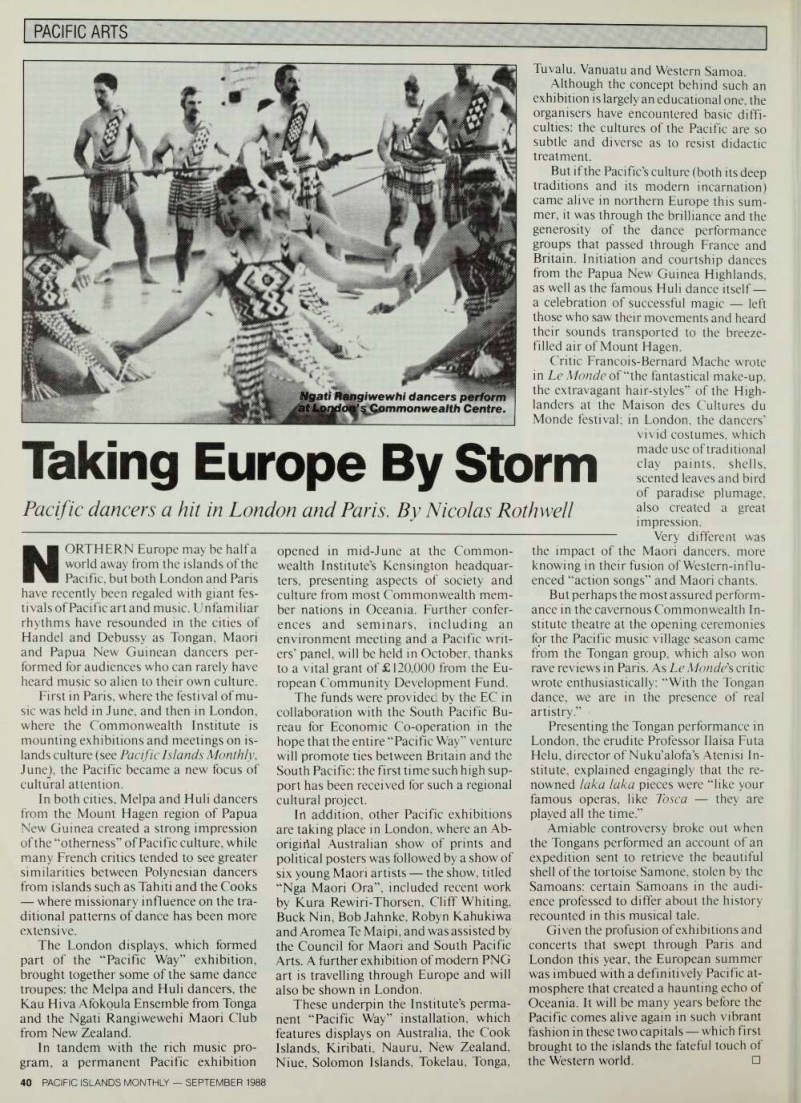
The London displays, which formed part of the “Pacific Way” exhibition, brought together some of the same dance troupes: the Melpa and Huli dancers, the Kau Hiva Afokoula Ensemble from Tonga and the Ngati Rangiwewehi Maori Club from New Zealand.
In tandem with the rich music pro gram, a permanent Pacific exhibition
opened in mid-June at the Common wealth Institute’s Kensington headquar ters, presenting aspects of society and culture from most Commonwealth mem ber nations in Oceania. Further confer ences and seminars, including an environment meeting and a Pacific writ ers’ panel, will be held in October, thanks to a vital grant of £120,000 from the Eu ropean Community Development Fund.
The funds were provided by the EC in collaboration with the South Pacific Bu reau for Economic Co-operation in the hope that the entire “Pacific Way” venture will promote ties between Britain and the South Pacific: the first time such high sup port has been received for such a regional cultural project.
In addition, other Pacific exhibitions are taking place in London, where an Ab origirial Australian show of prints and political posters was followed by a show of six young Maori artists the show, titled “Nga Maori Ora”, included recent work by Kura Rewiri-Thorsen, Cliff Whiling, Buck Nin, Bob Jahnke, Robyn Kahukiwa and Aromea Te Maipi, and was assisted by the Council for Maori and South Pacific Arts. A further exhibition of modern PNG art is travelling through Europe and will also be shown in London.
These underpin the Institute’s perma nent “Pacific Way” installation, which features displays on Australia, the Cook Islands, Kiribati, Nauru, New Zealand, Niue, Solomon Islands, Tokelau, Tonga,
Tuvalu, Vanuatu and Western Samoa.
Although the concept behind such an exhibition is largely an educational one, the organisers have encountered basic diffi culties: the cultures of the Pacific are so subtle and diverse as to resist didactic treatment.
But if the Pacific’s culture (both its deep traditions and its modern incarnation) came alive in northern Europe this sum mer, it was through the brilliance and the generosity of the dance performance groups that passed through France and Britain. Initiation and courtship dances from the Papua New Guinea Highlands, as well as the famous Huli dance itself— a celebration of successful magic left those who saw their movements and heard their sounds transported to the breeze filled air of Mount Hagen.
Critic Francois-Bernard Mache wrote in Le Monde of “the fantastical make-up, the extravagant hair-styles” of the High landers at the Maison des Cultures du Monde festival; in London, the dancers’
vivid costumes, which made use of traditional clay paints, shells, scented leaves and bird of paradise plumage, also created a great impression.
Very different was
the impact of the Maori dancers, more knowing in their fusion of Western-influ enced “action songs” and Maori chants.
But perhaps the most assured perform ance in the cavernous Commonwealth In stitute theatre at the opening ceremonies for the Pacific music village season came from the Tongan group, which also won rave reviews in Paris. As Le Monde 1 s critic wrote enthusiastically: “With the Tongan dance, we are in the presence of real artistry.”
Presenting the Tongan performance in London, the erudite Professor Ilaisa Futa Helu, director of Nukualofa’s Atenisi In stitute, explained engagingly that the re nowned laka laka pieces were “like your famous operas, like Tosca they are played all the time.”
Amiable controversy broke out when the Tongans performed an account of an expedition sent to retrieve the beautiful shell of the tortoise Samone, stolen by the Samoans: certain Samoans in the audi ence professed to differ about the history recounted in this musical tale.
Given the profusion of exhibitions and concerts that swept through Paris and London this year, the European summer was imbued with a definitively Pacific at mosphere that created a haunting echo of Oceania. It will be many years before the Pacific comes alive again in such vibrant fashion in these two capitals which first brought to the islands the fateful touch of the Western world. □
Ngati Rangiwewhi dancers perform at London's Commonwealth Centre.