Behind The Celebrations
pp. 36-38 · Read in the full issue
Tonga
Superpower rivalries and shifiting allegiances mark a
new era for the Pacific’s last monarchy.
By Ed Rampell
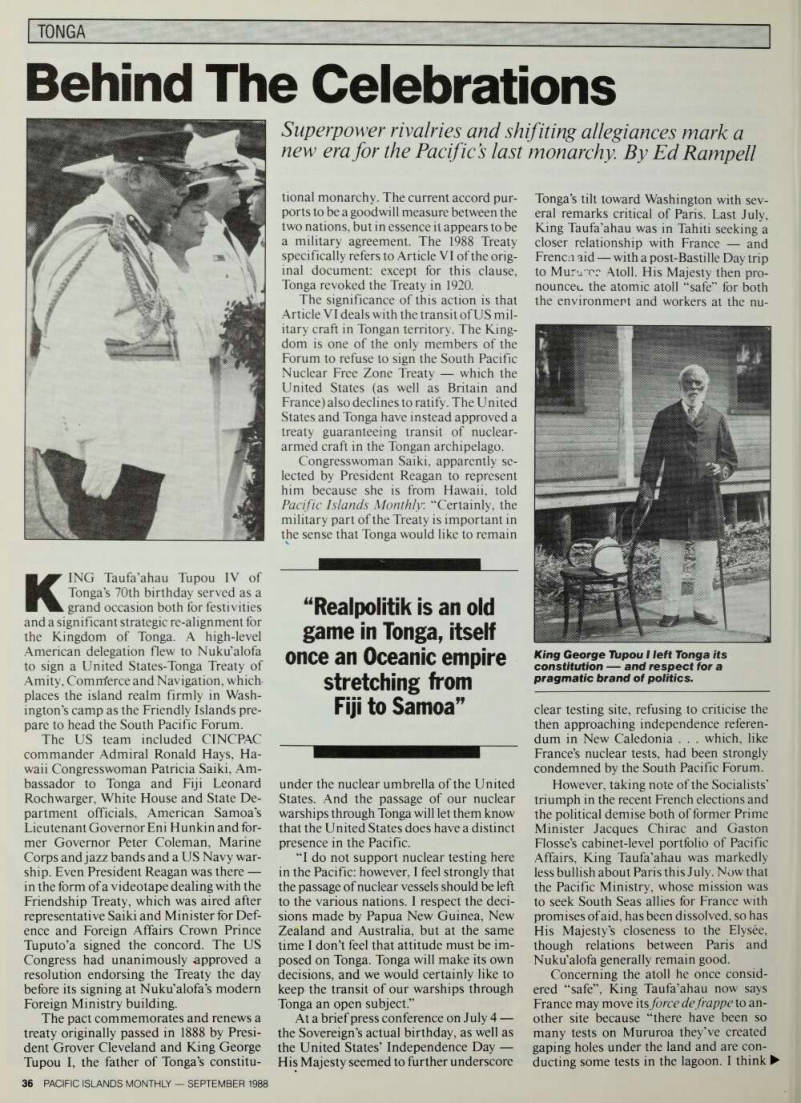
KING Taufa’ahau Tupou IV of Tonga’s 70th birthday served as a grand occasion both for festivities and a significant strategic re-alignment for the Kingdom of Tonga. A high-level American delegation flew to Nuku’alofa to sign a United States-Tonga Treaty of Amity, Commferce and Navigation, which* places the island realm firmly in Wash ington’s camp as the Friendly Islands pre pare to head the South Pacific Forum.
The US team included CINCPAC commander Admiral Ronald Hays, Ha waii Congresswoman Patricia Saiki, Am bassador to Tonga and Fiji Leonard Rochwarger, White House and State De partment officials, American Samoa’s Lieutenant Governor Eni Hunkin and for mer Governor Peter Coleman, Marine Corps and jazz bands and a US Navy war ship. Even President Reagan was there in the form of a videotape dealing with the Friendship Treaty, which was aired after representative Saiki and Minister for Def ence and Foreign Affairs Crown Prince Tuputo’a signed the concord. The US Congress had unanimously approved a resolution endorsing the Treaty the day before its signing at Nukualofa’s modern Foreign Ministry building.
The pact commemorates and renews a treaty originally passed in 1888 by Presi dent Grover Cleveland and King George Tupou I, the father of Tonga’s constitu
tional monarchy. The current accord pur ports to be a goodwill measure between the two nations, but in essence it appears to be a military agreement. The 1988 Treaty specifically refers to Article VI of the orig inal document: except for this clause, Tonga revoked the Treaty in 1920.
The significance of this action is that Article VI deals with the transit ofUS mil itary craft in Tongan territory. The King dom is one of the only members of the Forum to refuse to sign the South Pacific Nuclear Free Zone Treaty which the United States (as well as Britain and France) also declines to ratify. The United States and Tonga have instead approved a treaty guaranteeing transit of nuclear armed craft in the Tongan archipelago.
Congresswoman Saiki, apparently se lected by President Reagan to represent him because she is from Hawaii, told Pacific Islands Monthly. “Certainly, the military part of the Treaty is important in the sense that Tonga would like to remain
“Realpolitik is an old game in Tonga, itself once an Oceanic empire stretching from Fiji to Samoa”
under the nuclear umbrella of the United States. And the passage of our nuclear warships through Tonga will let them know that the United States does have a distinct presence in the Pacific.
“I do not support nuclear testing here in the Pacific: however, I feel strongly that the passage of nuclear vessels should be left to the various nations. I respect the deci sions made by Papua New Guinea, New Zealand and Australia, but at the same time I don’t feel that attitude must be im posed on Tonga. Tonga will make its own decisions, and we would certainly like to keep the transit of our warships through Tonga an open subject.”
At a brief press conference on July 4 the Sovereign’s actual birthday, as well as the United States’ Independence Day His Majesty seemed to further underscore
Tonga’s tilt toward Washington with sev eral remarks critical of Paris. Last July, King Taufa’ahau was in Tahiti seeking a closer relationship with France and Frencn aid with a post-Bastille Day trip to Muru'or Atoll. His Majesty then pro nounces the atomic atoll “safe” for both the environment and workers at the nu-
clear testing site, refusing to criticise the then approaching independence referen dum in New Caledonia . . . which, like France’s nuclear tests, had been strongly condemned by the South Pacific Forum.
However, taking note of the Socialists’ triumph in the recent French elections and the political demise both of former Prime Minister Jacques Chirac and Gaston Flosse’s cabinet-level portfolio of Pacific Affairs, King Taufa’ahau was markedly less bullish about Paris this July. Now that the Pacific Ministry, whose mission was to seek South Seas allies for France with promises of aid, has been dissolved, so has His Majesty’s closeness to the Elysee, though relations between Paris and Nukualofa generally remain good.
Concerning the atoll he once consid ered “safe”. King Taufa’ahau now says France may move its force defrappe to an other site because “there have been so many tests on Mururoa they’ve created gaping holes under the land and are con ducting some tests in the lagoon. I think ►
King George Tupou I left Tonga its constitution - and respect for a pragmatic brand of politics.
they’re probably moving away before the island collapses.”
Superpower realpolitik is an old game in Tonga (itself once an Oceanic empire stretching from Fiji to Samoa): in addition to the 1888 Treaty with the US, Tonga signed pacts with France in 1855, Germany in 1876 and Britain in 1879. The Kingdom was a British protectorate from 1900 to 1970: more recently Crown Prince Tupouto’a has made three state visits to the Soviet Union, including an audience with Foreign Minister Shevardnadze. At the same time, however, Nuku’alofa is turning to Washington for an even closer alliance and more assistance.
Although the US contingent was the most “high-power” of the delegations at King Taufa’ahau’s birthday celebrations, other Western and island leaders joined the party. Western Samoa’s Head of State, His Highness Malietoa Tanumafili 11, and Fiji’s interim Prime Minister Ratu Sir Kamisese Mara were present, as were the Maori Queen, a Cook Islands dignitary and Moses Keale, the Chairman of the Office of Hawaiian Affairs. New Zealand, Australia, Britain, France, Israel and others were also represented, along with French and Australian warships and, reportedly, a Soviet charge d’affaires.
There was much Polynesian pomp, pa-
geantry and protocol, but the conserva tive Kingdom’s place as a pro-US bulwark was the continuing subtext of the birthday proceedings.
US Ambassador Rochwarger de scribed American economic and military ties with Tonga as “part of our total re gional aid program. We are very interested in the Kingdom of Tonga: I believe you’ll find fisheries programs here, and we offer Tonga military training for its officers.”
The diplomat put the figure for Pacific aid at about SUS2O million, and Patricia Saiki added that “the report we’re going to make when we return to Washington will lend credibility to our program: as a mem ber of Congress I will seek the kinds of as sistance that are necessary here.”
The Republican stateswoman went on to say that “Admiral Hays’s presence lent a lot of credibility to the United States” and that the US “remains vitally interested in the Pacific. The relationship is a strategic, political and economic one. The United States needs to be a force here in the Pa cific, and I think there needs to be a greater focus of the world powers on the Pacific.”
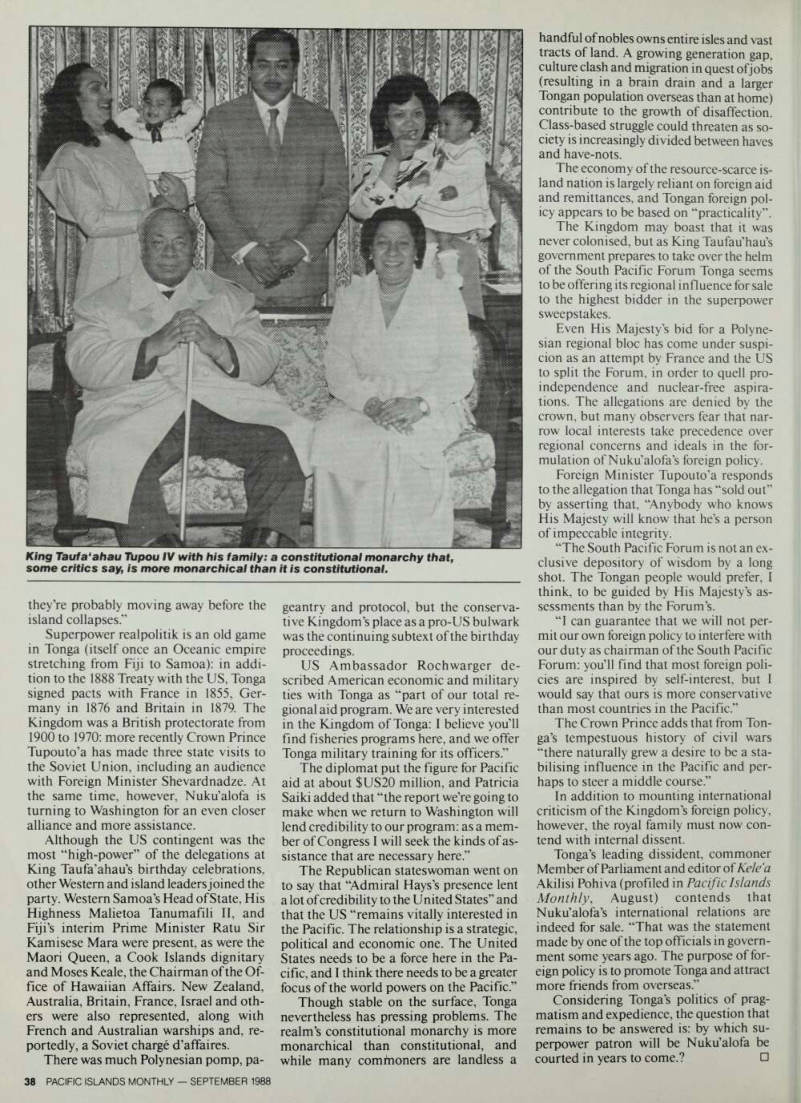
Though stable on the surface, Tonga nevertheless has pressing problems. The realm’s constitutional monarchy is more monarchical than constitutional, and while many comhioners are landless a
handful of nobles owns entire isles and vast tracts of land. A growing generation gap, culture clash and migration in quest ofjobs (resulting in a brain drain and a larger Tongan population overseas than at home) contribute to the growth of disaffection.
Class-based struggle could threaten as so ciety is increasingly divided between haves and have-nots.
The economy of the resource-scarce is land nation is largely reliant on foreign aid and remittances, and Tongan foreign pol icy appears to be based on “practicality”.
The Kingdom may boast that it was never colonised, but as King Taufau’hau’s government prepares to take over the helm of the South Pacific Forum Tonga seems to be offering its regional influence for sale to the highest bidder in the superpower sweepstakes.
Even His Majesty’s bid for a Polyne sian regional bloc has come under suspi cion as an attempt by France and the US to split the Forum, in order to quell pro independence and nuclear-free aspira tions. The allegations are denied by the crown, but many observers fear that nar row local interests take precedence over regional concerns and ideals in the for mulation of Nukualofa’s foreign policy.
Foreign Minister Tupouto’a responds to the allegation that Tonga has “sold out” by asserting that, “Anybody who knows His Majesty will know that he’s a person of impeccable integrity.
“The South Pacific Forum is not an ex clusive depository of wisdom by a long shot. The Tongan people would prefer, I think, to be guided by His Majesty’s as sessments than by the Forum’s.
“I can guarantee that we will not per mit our own foreign policy to interfere with our duty as chairman of the South Pacific Forum: you’ll find that most foreign poli cies are inspired by self-interest, but I would say that ours is more conservative than most countries in the Pacific.”
The Crown Prince adds that from Ton ga’s tempestuous history of civil wars “there naturally grew a desire to be a sta bilising influence in the Pacific and per haps to steer a middle course.”
In addition to mounting international criticism of the Kingdom’s foreign policy, however, the royal family must now con tend with internal dissent.
Tonga’s leading dissident, commoner Member of Parliament and editor of Kele’a Akilisi Pohiva (profiled in Pacific Islands Monthly , August) contends that Nukualofa’s international relations are indeed for sale. “That was the statement made by one of the top officials in govern ment some years ago. The purpose of for eign policy is to promote Tonga and attract more friends from overseas.”
Considering Tonga’s politics of prag matism and expedience, the question that remains to be answered is: by which su perpower patron will be Nukualofa be courted in years to come.? □
King Taufa‘ahau Tupou IV with his family: a constitutional monarchy that, some critics say, is more monarchical than it is constitutional.