Sope’s Desperate Gamble Falters
pp. 10-13 · Read in the full issue

Vanuatu
Rebel Vanuatu politician Barak Sope’s attempts to topple PM Walter Lini fail in Port Vila’s Supreme Court. By David Robie
TROPICAL squalls drenched the paramilitary guard of honour and the hapless crowd that ringed Port Vila’s Independence Park for muted cele brations marking the eighth anniversary of Vanuatu’s independence. It was per haps an omen.
Was there much to celebrate, in view of recent rioting over land rights, allegations of a “dictatorship” and a bitter power struggle between the Prime Minister, Father Walter Lini, and his rival Barak Sope? As far as Lini and his loyal sup porters in the ruling Vanuaaku Pati were concerned, there was still plenty to be pleased about: Lini harked back to inde pendence on July 30, 1980, when the Van uatu Government was forced to put down the Vemarana rebellion on the island of Espiritu Santo with the help of Papua New Guinean troops. “We proved then that we
could continue as a united country,” he told the drenched crowd, many sheltering under rainbow-coloured umbrellas. “We put the rebellion down and built up na tional unity.”
Now, however, some politicians “have forgotten why we fought for our independ ence and why we must continue as a peaceful, united and independent coun try. These leaders are now talking about ‘islandism’ and regionalism the very things that led to the Santo rebellion and they are causing division among the people of Vanuatu.”
Lini went on to warn the ni-Vanuatu particularly chiefs, church leaders, women and youth activists and businesspeople about “some power-hungry politicians who are spreading misinformation . . .
These politicians are working simply for their own selfish interests. They are like
wolves in sheep’s clothing.”
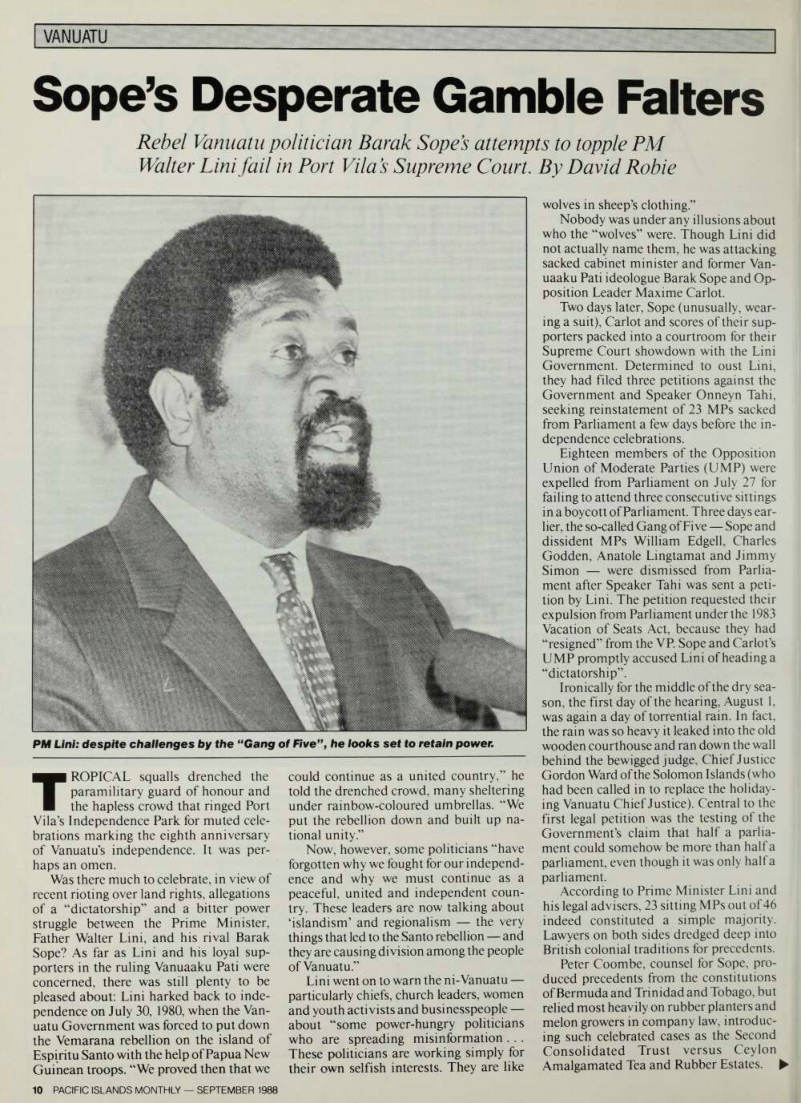
Nobody was under any illusions about who the “wolves” were. Though Lini did not actually name them, he was attacking sacked cabinet minister and former Van uaaku Pati ideologue Barak Sope and Op position Leader Maxime Carlot.
Two days later, Sope (unusually, wear ing a suit), Carlot and scores of their sup porters packed into a courtroom for their Supreme Court showdown with the Lini Government. Determined to oust Lini, they had filed three petitions against the Government and Speaker Onneyn Tahi, seeking reinstatement of 23 MPs sacked from Parliament a few days before the in dependence celebrations.
Eighteen members of the Opposition Union of Moderate Parties (UMP) were expelled from Parliament on July 27 for failing to attend three consecutive sittings in a boycott of Parliament. Three days ear lier, the so-called Gang of Five Sope and dissident MPs William Edgell, Charles Godden, Anatole Lingtamat and Jimmy Simon were dismissed from Parlia ment after Speaker Tahi was sent a peti tion by Lini. The petition requested their expulsion from Parliament under the 1983 Vacation of Seats Act, because they had “resigned” from the VP. Sope and Carlot’s UMP promptly accused Lini of heading a “dictatorship”.
Ironically for the middle of the dry sea son, the first day of the hearing, August 1, was again a day of torrential rain. In fact, the rain was so heavy it leaked into the old wooden courthouse and ran down the wall behind the bewigged judge, Chief Justice Gordon Ward of the Solomon Islands (who had been called in to replace the holiday ing Vanuatu Chief Justice). Central to the first legal petition was the testing of the Government’s claim that half a parlia ment could somehow be more than half a parliament, even though it was only half a parliament.
According to Prime Minister Lini and his legal advisers, 23 sitting MPs out of 46 indeed constituted a simple majority.
Lawyers on both sides dredged deep into British colonial traditions for precedents.
Peter Coombe, counsel for Sope, pro duced precedents from the constitutions of Bermuda and Trinidad and Tobago, but relied most heavily on rubber planters and melon growers in company law, introduc ing such celebrated cases as the Second Consolidated Trust versus Ceylon Amalgamated Tea and Rubber Estates. ►
PM Lini: despite challenges by the “Gang of Five ”, he looks set to retain power.
However, Attorney-General Silas Hakwa defended Speaker Tahi’s arith metic by arguing that he was empowered to act under Article 19:4 of Vanuatu’s con stitution and under Parliament’s Standing Order No 38. Hakwa insisted the consti tution did not specify the meaning of a simple majority.
Judge Ward: “All we have to look for is the simple meaning of the word.”
Attorney-General Hakwa : “The state of the constitution doesn’t make it quite clear what it means.”
Judge Ward: “I cannot understand why we are ducking over this. How can exactly half be a majority?”
Hakwa cited several other South Pa cific constitutions, including those of the Cook Islands, Solomon Islands and the abrogated 1970 Fiji constitution, to sup port the Government’s claim. In the end,
despite the pomp and circumstance, the issue was decided on the authority of the Concise Oxford Dictionary (“The word majority means greater than,” said Coombe, quoting from the dictionary. “It has no specific legal interpretation as far as the circumstances of this matter are concerned. It is plain, simple English”).
For most foreign journalists, misled by an apparently inept courtroom perform ance by Hakwa and expecting Sope to win this case, the judgement came as a sur prise. But Justice Ward had another shock in store for the journalists.
Before delivering his judgement he summoned Australian television reporter Margot O’Neill before the bench and cas tigated her for contempt of court after her ABC camera crew had filmed in the court room. He warned further offence could lead to her being jailed (she and another
Australian television journalist were again in strife with the judge later in the week, but were not fined).
In his judgement, Justice Ward upheld the Sope case that there had been no Par liamentary quorum when the MPs were sacked. But he also ruled that Speaker Tahi had correctly followed Parliamentary pro cedure and thus his actions were valid. Mr Ward said a quorum would need to be 31 on the first day of a sitting, and when ad journed for three days because of a lack of a quorum a simple majority of 24 would be needed. He noted that several Pacific Islands constitutions that required a quo rum also made a challenge a necessary step to obtain an adjournment of the sitting.
“Article 19:5 clearly places the respon sibility of regulating its own procedure on Parliament and, where the procedures do not breach the constitution and have been
“The Government claimed that half a Parliament could be more than half a Parliament, even though it was only half a Parliament”
followed, the court will assume the sitting was properly made,” the judge said. “To do otherwise could lead to the absurd po sition that if years after the bill has been passed and the Act brought into effect it is discovered that unknown to Parlia ment at the time, one or more of the mem bers present were disqualified and the House was thereby not quorate, the Act would be declared invalid.”
The next morning Prime Minister Lini convened a press conference in which he praised the judgement and claimed the constitutional crisis was over. He also ruled out any by-elections before Decem ber this year consistent with the one year delay rule in the constitution for any fresh general election.
“It puts to shame our opponents’ ar gument that we have broken the consti tution and that we are running a dictatorship,” he said. “Now the people know the truth: that we were right and that it is them [Sope and the Opposition UMP] who are the real dictators, trying to dictate that their personal political interests ov erride the supremacy of the Parliament protected by the constitution and attempt ing to hold the country to ransom through the constitutional crisis.”
Lini also took a swipe at Australian journalists covering the crisis, accusing them of sensationalism and irresponsible
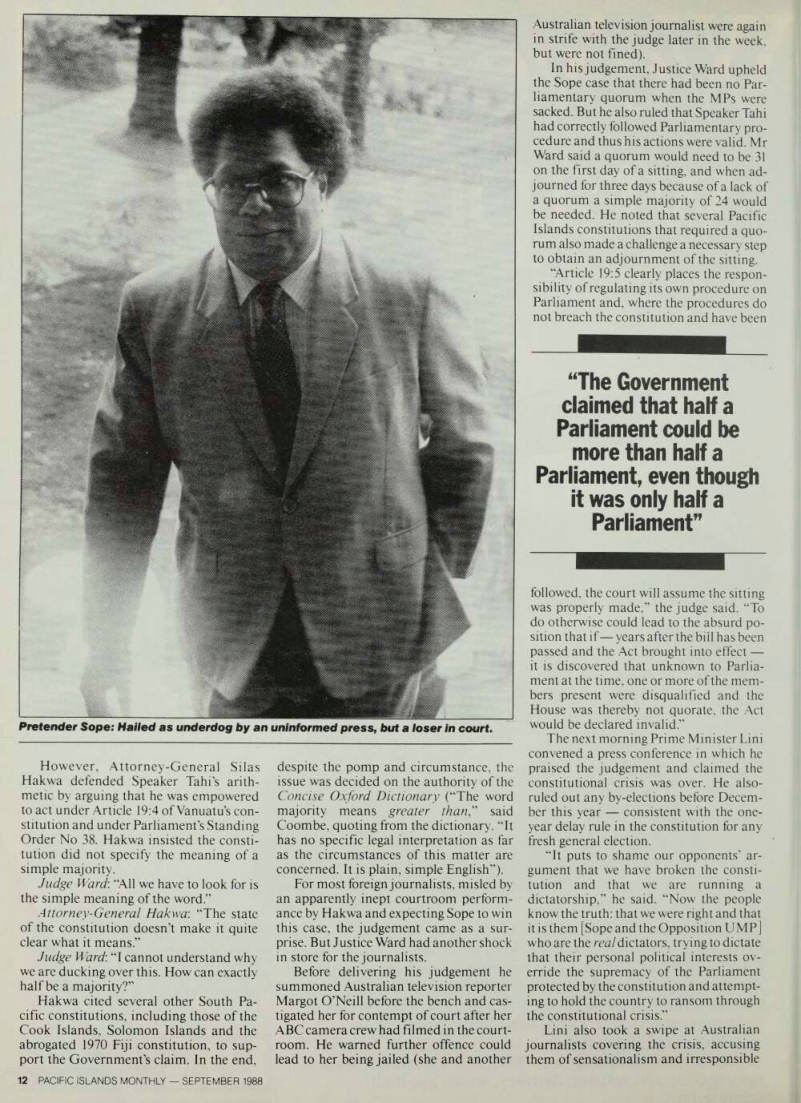
Pretender Sope: Hailed as underdog by an uninformed press, but a loser in court.
reporting. He had a point: much of the re porting reflected a simplistic and unin formed view of “underdog Sope” versus “dictator Lini”. Peter Paurakolo, one of the founders of the ruling Vanuaaku Pati and now director of the Vanuatu National Tourism Office, also attacked “war hun gry” Australian journalists for sabotaging the country’s economy by their “creeping chaos in paradise” reporting.
Though Sope won the battle of inter national press coverage, his domestic im age has continued to slide as public perception of him as a self-seeking pol itician determined to hold the country to ransom has become stronger. Few ni- Vanuatu regard him as having much chance of regaining a seat in Parliament in a by-election.
In the last general election, he won his seat by just three votes. At the time Sope challenged Lini for the Prime Minister ship, attacking the leader’s ill health after Lini had become partially paralysed fol lowing a stroke in Washington 10 months previously. But he was easily defeated.
Sope then forced Lini to include him in the cabinet by threatening to split the Van uaaku Pati if he were left out. The growing rift finally erupted with a riot on May 16,
which left one man dead and damage to talling some SA2 million.
Sope (at the time Minister for Tourism, Immigration and Transport) was blamed for instigating the riot and was dismissed from cabinet. He was later stripped of his post of secretary-general of the Vanuaaku Pati, and he and his four colleagues were sacked from the party when they signed a no-confidence motion against the Lini Government.
In an interim report on the Vila Urban Land Corporation (VULCAN), the agency set up in 1981 to administer customary land leases to businesses in the capital, al legations of irregularity and financial mis management have been upheld.
VULCAN closely associated with Sope, who was a board member repre senting Ifira Island, one of the three tra ditional landowning villages was closed by the Lands Ministry in an incident that led to protests and, eventually, the May 16 riot. It has not prepared annual accounts since 1984; the year its costs began to es calate dramatically.
A government inquiry being con ducted by Australian accountants has shown that between 1981 and 83 about 14 per cent of VULCAN’s VT27 million an
nual income was spent on administration.
However, by last year this figure had soared to almost 98 per cent of the VT22 million income. VULCAN’s surplus also dropped from a steady average of VT23 million between 1981 and 1984 to less than VT 100,000 last year.
The general manager of VULCAN, a personal friend of Sope, was being paid a salary package of $A40,000 a year al most twice as much as President Ati George Sokomanu, who earns $ A 22,000 a year, and Prime Minister Lini’s $A20,000.
Sope, reputedly the wealthiest ni-Van uatu businessman, has important busi ness interests in stevedoring and tourism.
His opponents claim his credibility has been seriously even fatally eroded during the constitutional crisis and if the two final legal petitions fail, his political gamble will founder.
The Vanuaaku Pati is therefore likely to regain a majority when by-elections are fi nally held, and even if a new general elec tion is eventually called. □ Postscript: As Pacific Islands Monthly was going to press, Barak Sope and his fellow members of the “Gang of Five” an nounced they were forming a new political party, the Freedom and Justice Party.