Roaring Days at Edie Creek
p. 56 · Read in the full issue
Out Of The Past
BERT WESTON recalls tough times in the New Guinea goldfields.
IT WAS IN 1928, with the first chill winds of the coming world depression blowing across the world, that I ar rived in the Mandated Territory of New Guinea. This was the time when the news of the rich gold finds at Edie Creek in the Morobe District had started to reach Aus tralia and there began a rush, by those who could scrape up the fare to Salamaua plus a guaranteed return fare to Sydney, to gel in on the Eldorado.
I, along with six other Australians, was easily beguiled by a plausible old villain who came down to Sydney from Sala maua with a story of a rich find he had lo cated on the Warfar River up the Markham Valley.
With our painfully accumulated funds, and on his advice, a 10 metre by three metre barge was built in Sydney, driven by an aeroplane propeller and powered by a 280 hp Beardmore water-cooled aero engine.
To cut a painful memory short this craft, with me as helmsman, was navi gated up the fast flowing Markham River to the designated area. There we found the gold strike was all an elderly miner’s fan tasy. The other members of the syndicate returned to Australia in disgust but I felt that the country owed me a return of my investment and for that reason remained there for 20 years in both peace and war.
I reached Salamaua, the administra tion centre for the large and mainly un controlled district of Morobe and in which the Edie Creek goldfield was located 65km inland and 2300 metres above sea level in a near freezing climate, in the 10 knot Burns Philp steamer Montow. The voy age lasted 21 days, costing £23, with calls at Samarai. Rabaul. Kavieng, Lorengau, Wewak. Madang, Alexishafen, Singaua Plantation and finally Salamaua.
Salamaua. 30km across the Huon Gulf from Lae. was located on a long narrow sandstrip connecting a large, hilly, wooded island to the mainland and on it was lo cated a native-built district office plus post office. Burns Philp and Carpenter’s gen eral stores, a primitive hotel with a de tached bar and billiard room, several Chinese stores, a handful of European res idences, a primitive radio station from where messages to Sydney were relayed through Rabaul and a barracks for a squad of native police.
Hopeful and would-be miners had to trudge over mountainous terrain to the goldfields, with at least 10 native carriers to carry camping gear, food for all, and mining tools. Miners with funds were able to either hire or else buy carriers from sev
eral recruiters and native labour agents on the beach.
Some of the more successful miners could return to Salamaua by boat for a few days of warmer weather, a meal on the ship, cheaper grog and a change of scenery.
Many had pegged out claims addi tional to those being worked. If these were not manned and worked inside 12 months they were forfeited. So it came about that at times a new arrival by ship would be be friended by a total stranger and after a few drinks find himself in possession of what in many cases would prove to be a rich claim to be worked on shares with his benefactor.
Salamaua, apart from being the ad ministrative supply centre and shipping port for the Morobe goldfields, was also the burial place for dozens of unfortunates who were carried in riddled with malaria, blackwater fever and scrub typhus, starv ing or boozed out of their wits. Funerals were frequent and primitive and were al ways followed by a hasty retreat to the pub by the lucky survivors.
When gold was first discovered in the Koranga and Namie Creeks in the early 1920 s the few people who worked those areas were mostly old hands who had pre viously mined on the Yodda and Mam bare goldfields in Papua. They kept their operations to themselves and the nearest administration post was at Morobe two weeks away across the mountains to Sal amaua then 100 km by canoe down the coast. The administration had heard ru mours of a gold strike near Wau. but as proclamation of a goldfield would have meant appointment of a warden, medical services, and police and other facilities
which all cost money, offi cialdom preferred to ignore the rumours.
By 1927 Edie Creek had been discovered and about 200 men were engaged in winning thousands of ounces of a low grade gold under dreadful working conditions.
Wau, at an elevation of 1200 metres, could be reached by aeroplane but cargo such as native rations, European food and mining tools then had to be carried over 1000 metres up a steep footpath to Edie Creek.
Later this was widened into a mule path and later still in the mid-’3os one Fred Deckert tried motor trans
port by cutting a car chassis down to a nar row width to negotiate the track. To travel in the vehicle was known as “dicing with death with Deckert”.
Before air freighting it was customary for a miner in need of provisions to send part of his work force down the track to Salamaua in charge of his boss boy car rying a list of requirements and perhaps a thousand ounces of gold to be credited to the store account. At best they would be away for two weeks. An honour system ex isted among the community and parcels of the precious metal was handed on from person to person for eventual arrival on the coast without loss.
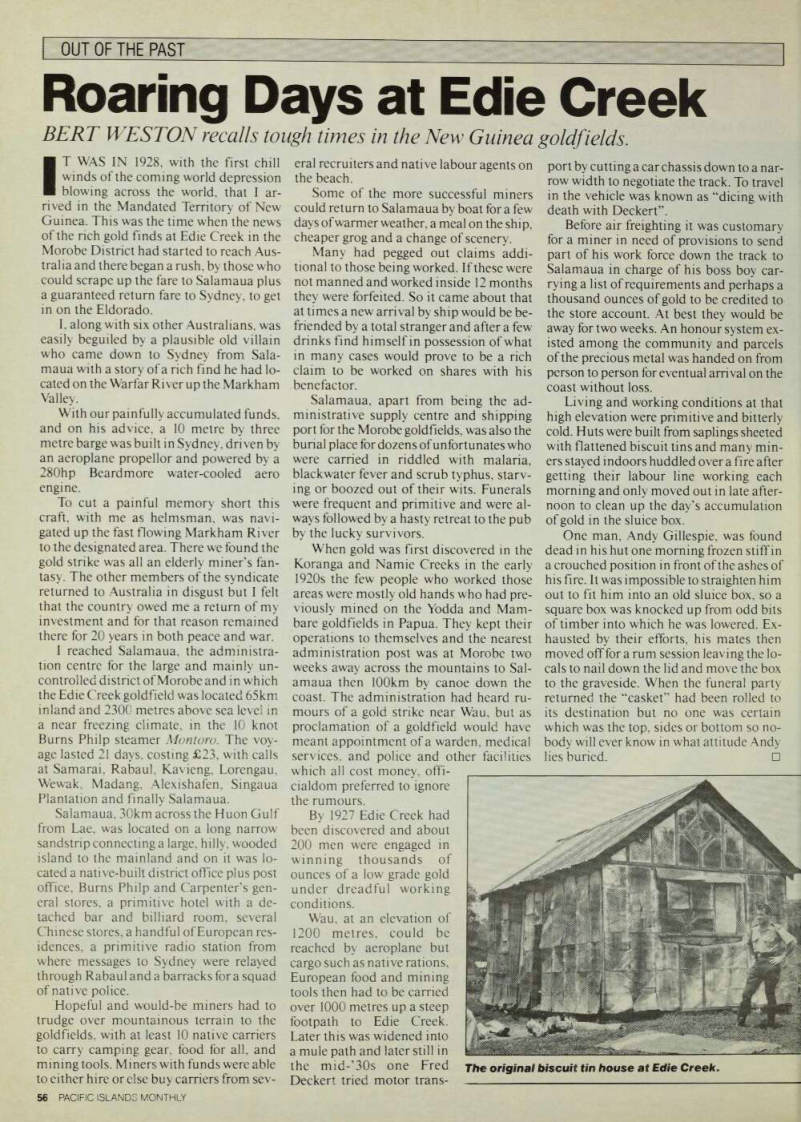
Living and working conditions at that high elevation were primitive and bitterly cold. Huts were built from saplings sheeted with flattened biscuit tins and many min ers stayed indoors huddled over a fire after getting their labour line working each morning and only moved out in late after noon to clean up the day’s accumulation of gold in the sluice box.
One man. Andy Gillespie, was found dead in his hut one morning frozen slififin a crouched position in front of the ashes of his fire. It was impossible to straighten him out to fit him into an old sluice box, so a square box was knocked up from odd bits of timber into which he was lowered. Ex hausted by their efforts, his mates then moved off for a rum session leaving the lo cals to nail down the lid and move the box to the graveside. When the funeral party returned the “casket” had been rolled to its destination but no one was certain which was the top, sides or bottom so no body will ever know in what attitude Andy lies buried. □
The original biscuit tin house at Edie Creek.