Was America to Blame?
pp. 46-48 · Read in the full issue
Forum
The Fiji Coup: Was America to Blame?
Each month we open our Forum pages to experts to air their views and theories on events of vital interest to the islands. This JOANN WYPIJEWSKI makes her case that the United States plotted the Fiji coup.
April 12: Timoci Bavadra (medical doc tor, political naif) becomes Prime Min ister, Fiji, opposing port calls by nuclear powered, nuclear-weapons-carrying ships.
April 29: Bavadra, in talk with US Am bassador Edward Dillery, expresses anxiety about USAID official’s ties to group bent on destabilising government.
April 30 May 2: General Vernon Walters (Military Intelligence, Iran 1953, Brazil 1964, Vietnam 1967; CIA 1972-76; private arms “consulting” 1976-81; US ambassador to UN 1985) visits Fiji; meets separately with Bavadra, Foreign Min ister Krishna Datt, third-ranking army officer Lieutenant Colonel Sitiveni Rabuka.
May 14: Rabuka storms Parliament; takes Bavadra wing of government hos tage; suspends Constitution.
June 16: Bavadra, in Washington, charges US involvement in coup; urges Congress to investigate.
July 13: Ratu Sir Kamisese Mara (Prime Minister, Fiji, 1970-87, now representative of outlaw regime) travels to Hawaii seeking arms; meets privately with officers from US Pacific Command,
Cincpac.
LIKE THE coral atoll, whose ringed lagoon describes a drowned vol cano far below, so the salients of the Fiji coup are best understood as the jut tings of a deeper structure. That structure came fleetingly into view on July 7, when the Fiji Sun announced that the United States was eyeing properties for a naval and an air base on the country’s second-largest island, Vanua Levu. The US Embassy in Fiji denied the report and by the next day said the paper’s source in the Ministry of Lands, the relevant surveyor’s records had
bassador to Fiji, and charted by a US based company, Business International, whose ties with the Central Intelligence Agency had been identified by The New York Times. The victorious Mara paid a visit to CINCPAC headquarters and a few months later unilaterally declared that an unenforced statute banning nuclear ves sels from Fiji’s ports no longer pertained.
Soon after, Fiji began to receive American aid the first South Pacific country to do so and its soldiers began training in the United States.
disappeared. Thus do the central emo tions animating US policy in the Pacific converge in Fiji: nervousness about American assets in the region since the fall of Ferdinand Marcos, and greediness about those assets since the emergence of the non-nuclear movement. As former Ambassador to Fiji William Bodde Jr said in 1982: “A nuclear-free zone would be un acceptable to the US given our strategic needs ... the US must do everything pos sible to counter this movement.”
That year 1982 was pivotal. Mara won re-election following a campaign influ enced by Fred Eckert, then the US Am-
It was also in 1982 that William Paupe came to Fiji as director of the Agency for International Development’s (AID) South Pacific Regional Office. He is a friend of Apisai Tora, the former trade union activ ist, Cabinet Minister under Mara and leader of the nationalist Taukei move ment. Bavadra and his adviser Jim An thony have accused Paupe, on the basis of Fijian security service reports, of chan neling SUS2OO,OOO to Tora for the purpose of fomenting anti-government demon strations and race riots after the elections; others have called Paupe a CIA operative; and the US Embassy has denied all
charges. Paupe’s resume, therefore, is of some interest. He served with AID in Vietnam from 1966 to 1975, when the agency trained Vietnamese intelligence and police forces and operated alongside or in concert with the CIA. From 1977 to 1981 he was stationed in South Korea, where AID, through its bankrolling of the Asian American Free Labour Institute (AAFLI), played a supporting role in the
repression of labour and the obstruction of democratic opposition. His arrival in Fiji coincided with stepped-up US efforts to stifle anti-nuclear sentiment in the Pa cific Trade Union Forum, a regional con sortium of left/liberal trade unions in which the Fijian labour movement is prominent.
According to an analysis of the Fiji coup by Owen Wilkes in Wellington Confiden tial, a bulletin associated with the New Zealand peace movement, those efforts flagged when the committee’s connec tions to CIA front organisations were ex posed by the New Zealand press, but were resuscitated by another agency, the übiq uitous AAFLI. In AAFLI we have a par adigm of the confluence of interests that advances US policy throughout the world.
Funded by AID and the National Endow ment for Democracy (NED) it is also linked to the American Institute for Free
Labour Development, stepchild of the CIA. In 1984, AAFLI opened an office in Suva, Fiji’s capital, where for the next two years it spent SUS 1 million to defeat a res olution for a nuclear-free Pacific that had been placed before the Pacific Trade Union Forum. That campaign was outlined in an article in The Sydney Morning Herald based on papers secured under the US Freedom of Information Act. Its job suc
cessfully completed, AAFLI closed its Suva office in 1986 and moved to Hono lulu. Its current director there, John Sloan, says he was in Fiji during the coup on “reg ular business”.
Like all the players in this story, the National Endowment for Democracy makes more than a cameo appearance. At the time of the coup its patronage took tangible form in a conference on the “meaning of democracy”, hosted by the Pacific Democrat Union in the town of Si gatoka, Fiji. The PDU, an affiliate of the International Democrat Union, is a re gional alliance of right-wing parties which last year received $119,962 from the NED.
Attending the conference were represen tatives of the National Republican Insti tute for International Affairs, a primary recipient of NED funds. Bavadra has said he believes that “retired” Major General John Singlaub, fresh from a stint in the
Philippines propping the right for a war against commu nism, was also present.
Sources in Fiji claim they saw Singlaub’s name on a hotel register in Sigatoka but that when they returned to pho tograph it, the register had been replaced by a typewrit ten list of names, among which Singlaub’s did not appear.
If that seems too ham handed a way to cover com promising tracks, consider the progress of Ratu Mara in this whole affair. Sometime be tween April 25 and May 3 he visited CINCPAC headquar ters with Paupe and, in an ob vious parallel to a similar
pilgrimage five years earlier, his return to Fiji was shortly accompanied by a boon to America’s nuclear presence in the Pacific, namely the overthrow of a government that had been democratically elected on a pledge to reinstate the very ban on nuclear missiles that Mara had revoked in 1982.
The PDU conference, which Mara co chaired, provided the former Prime Min ister with an alibi against complicity in the coup; yet the Sunday before Parliament was seized, Mara was seen playing golf with Rabuka and, reports New Zealand jour nalist David Robie, two men from the CIA.
Officially Mara had nothing to do with the coup and expressed surprise from Siga toka, but protestations of innocence on his behalf are hard to accept given that Mara himself told an Associated Press reporter that he knew and approved of the coup in advance.
All of which brings us to the coup itself.
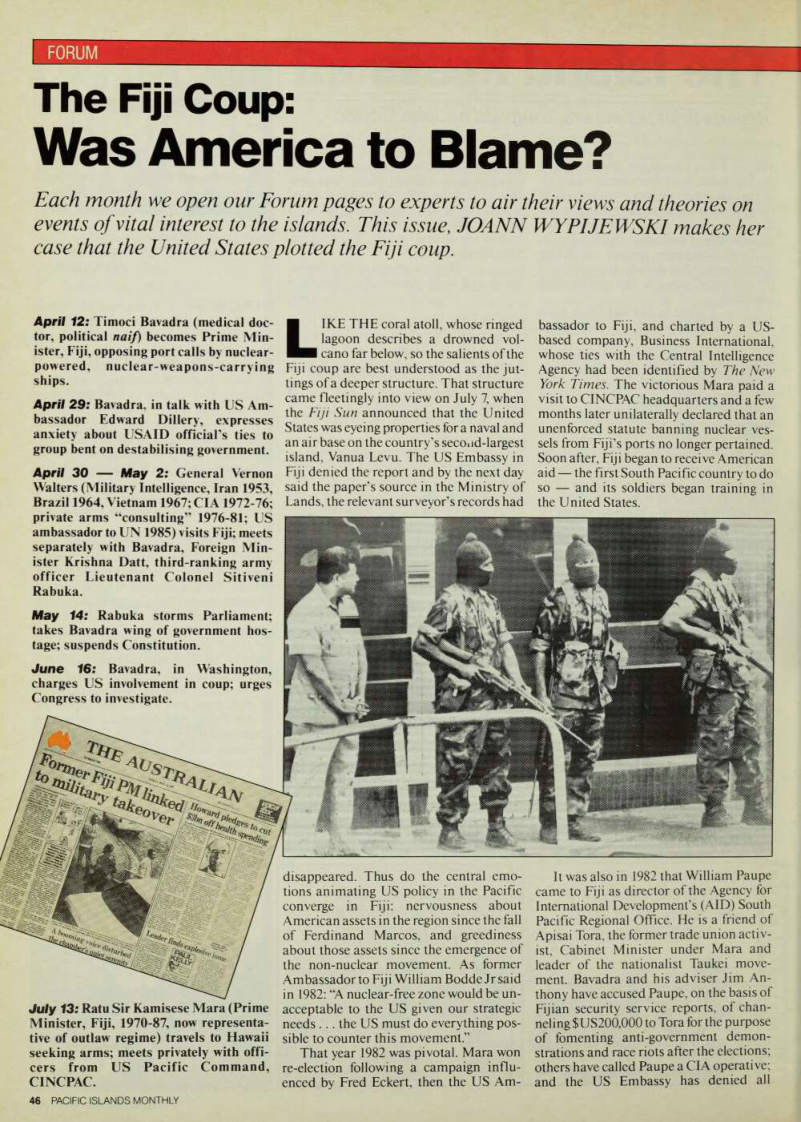
The 10 men armed with M-16s who fol lowed Rabuka into Parliament had con cealed their faces with ski masks and gas masks. At least some of them had black ened their hands with what appeared to be shoe polish. They never spoke, but ges- ►
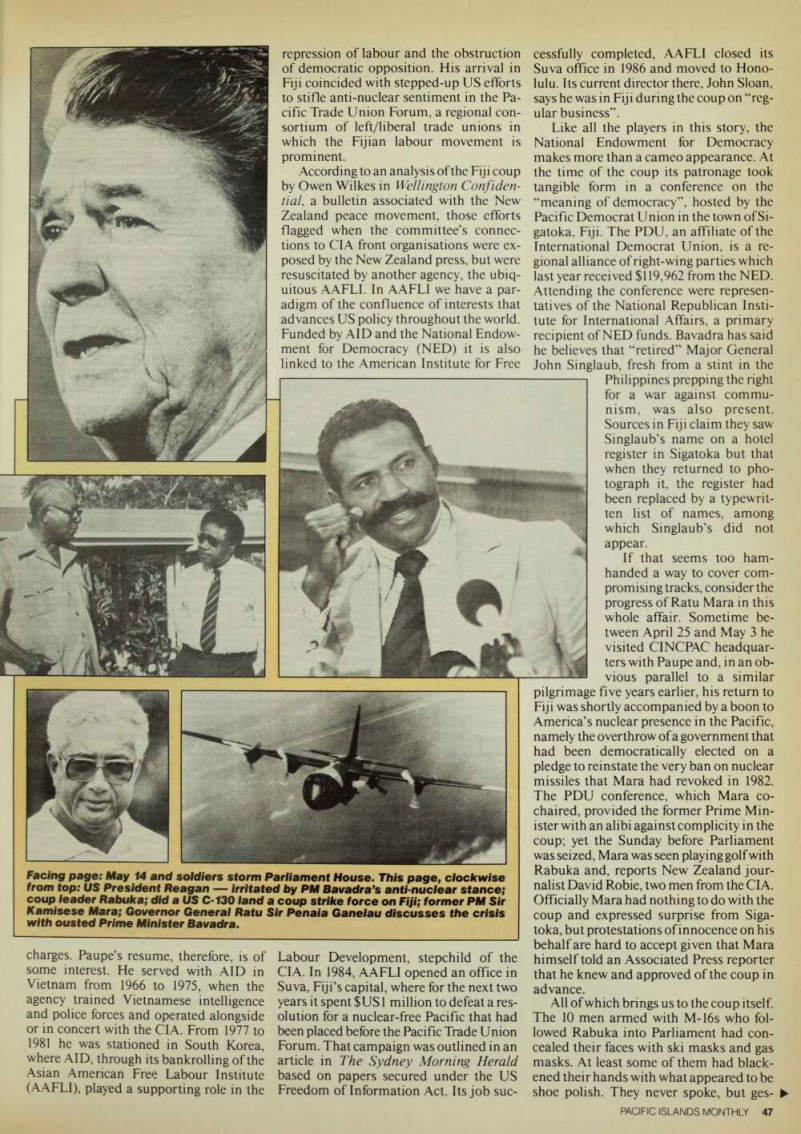
Facing page: May 14 and soldiers storm Parliament House. This page, clockwise from top: US President Reagan -irritated by PM Bavadra’s anti-nuclear stance; coup leader Rabuka; did a US C-130 land a coup strike force on Fiji; former PM Sir Kamisese Mara; Governor General Ratu Sir Penaia Ganelau discusses the crisis with ousted Prime Minister Bavadra.
“Deposed Deputy Speaker Noor Dean is convinced that the men who arrested him and his colleagues on May 14 were not Fijian”
◄ tured to one another using hand signals.
Rabuka gave orders only in English, even at moments of extreme tension. The 10 hustled their captives into trucks, drove silently with them to army headquarters and there turned them over to Fijian army regulars. Then the 10 disappeared. In an interview with Max Watts of 2SER radio in Sydney, the deposed Deputy Speaker of
Watts that a US C-130 carrying 15 black American troops landed unannounced and uncleared at Fiji’s Nadi International Airport on May 12, two days before the coup. Watts’s sources in Fiji have con firmed this with various civil service workers who requested anonymity. When asked at a June 22 press conference in Syd ney to confirm or deny that such a plane
the House of Representatives, Noor Dean, who is also a criminal lawyer, said he is convinced that the men who arrested him and his colleagues were not Fijian.
From a sharply different angle Jack Terrell, a man intimate with the merce nary “community” (most recently among the contras) and now working as a special investigator in the Philippines for the Washington-based International Centre for Development Policy, has come to the same conclusion. He told me he believes Ra buka led a squad of mercenaries at least two of them Americans and two South Af ricans acting with a nod from the US government, possibly in the person of Ver non Walters, and brought in on a C-130 SAF Air charter what he calls “the South ern Air Transport of South Africa”. Watts has it from four separate sources in Fiji that one of the 10 was Fijian, a Captain Motu; this, says Terrell, is consistent with his the ory, since such operations usually include a local military person as a guide.
Terrell says four C-130s may have been in Fiji around the time of the coup, and here again Dean is instructive. He told
had landed in Fiji on May 12, Secretary of Defense Caspar Weinberger offered a dis claimer. Asked the same question on July 30, Pentagon spokesman Commander Chris Baummann said: “I don’t know anything about it. I can’t categorically deny it, but I’d love to.”
According to Dean, the plane stayed in Fiji for four days. On June 8, he said, an other C-130, carrying about 50 US sol diers, landed at Nausori Airport, 18km from Suva, unloaded unspecified “equip ment” and left six hours later. Insurance against a possible backlash?
Rabuka’s operation had been known to only a small core within the military. The head of the army, Brigadier General Epeli Nailatikau, was in Australia on May 14 and was stripped of his post at the same time that Bavadra lost his. He has condemned the coup and on June 3 advocated an en quiry to identify “all who outside the RFMF (Royal Fiji Military Forces) were involved,” saying further that “they should be made known to the public not only in Fiji but overseas as well”.
And what of the ostensible reason for
the coup racial violence between ethnic Fijians and ethnic Indians, in a country that has a remarkable record of racial co operation and whose artful Constitution both guaranteed the prominent role of the indigenous chiefs and insured that neither Fijian nor Indo-Fijian members of Parlia ment alone could amend the Constitu tion? Apisai Tora has told Watts that he rented 60 to 70 buses at $lOO each per day to bring agitators into Suva after Bavad ra’s election. They were responsible for the militant demonstrations, the fire-bomb ings and the menacing roadblocks that provided a pretext for the coup. They also instigated the riots that broke out six days after it.
Where did Tora, who is no aristocrat and whose government salary came to no more than $25,000 a year, get the money to sponsor these activities? Bavadra looks to Paupe; Tora resents the question; Paupe derides the very suggestion of complicity, saying that the only US aid even tangen tially beneficial to Tora was a $U525,000 grant in 1984 for a community hall in the latter’s village of Natalau. A cyclone de stroyed the hall last year, says Tora, leav ing no trace of it behind.
If alarm over a non-nuclear Fiji and its negative ramifications for a new US base indeed prompted the US to deny Bavadra power, that alarm also worked to the ma terial advantage of the Fijian principals in the coup. Bavadra had campaigned as a champion of the poor as well as of a non nuclear future, and that class-based aspect of his appeal threatened Mara and his fol lowers. Coincidentally, the land surveyed for the bases lies within the home area of Colonel Rabuka and the Governor Gen eral, puppet leader of Fiji’s “interim government”. Having secured their posi tion on the coattails of US foreign policy, the Fiji elite now collaborate to institu tionalise racism by drafting a Constitu tion that would codify second-class status for Indo-Fijians with the approval of a new parliament, to be chosen in uncontested elections. The Fiji Embassy in Washing ton calls this the “path to parliamentary democracy”.
Dr Bavadra understated the case when he asked Congress to investigate possible US involvement in the Fiji coup. With half the US Navy, two-thirds of the Marine Corps and a host of radar tracking stations and testing sites in the Pacific, the US would be negligent, by the logic of Wash ington, had it not acted to subvert a coun try that so meekly challenged its supremacy in the region. □
® 1987 Joann Wypijewski, originally printed in The Nation publication.
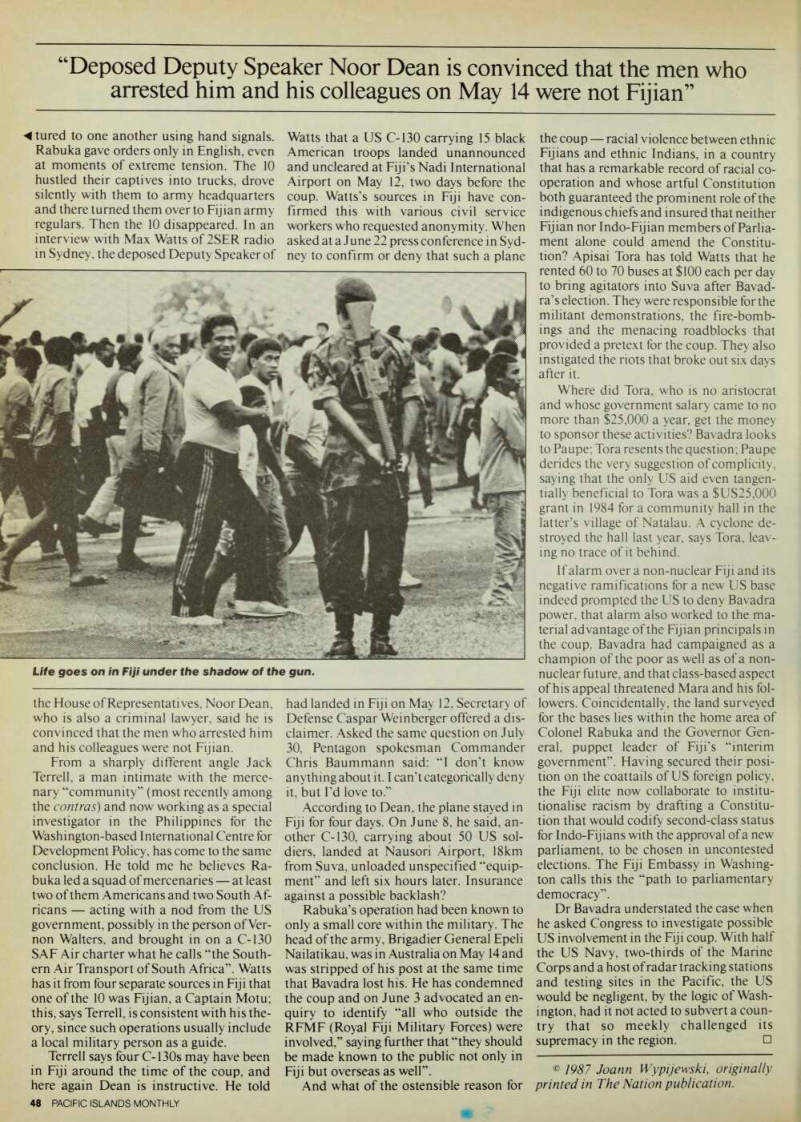
Life goes on in Fiji under the shadow of the gun.