Disease Traced to Sago Palm
pp. 42-43 · Read in the full issue
How doctors tracked down the cause of a deadly nerve and brain disorder.
By Davids. North
A 35-YEAR-OLD medical mystery has been solved. And the culprit?
The seed of the false sago palm.
The riddle facing medical researchers was why was there a remarkably high inci dence of a group of unbeatable, debilitat ing, deadly neurological disorders on Guam and Rota for decades. Further, are there implications for the rest of the world in the answers to those questions?
The medical detective story that un ravelled the riddle was detailed in a recent issue of the US publication Science.
In the early 1950 s physicians recog-
nised that Chamor ros on Guam and Roto were 50 to 100 times as likely to suffer from a group of neurological problems as roughly comparable people in other developed nations. (At the time these disorders were thought to be largely hereditary were Chamorro genes that different?)
The conditions sometimes lumped together loosely as the “Guam Disease” were progressive, and ultimately fatal. All were marked by degeneration in the brain and the nervous system. The two best known in the outside world were Parkin son’s disease and an Alzheimer-type con dition; the most frequently encountered on Guam was mononeuron disease.
A theory emerged, resulting from a 1954 study of the Guamanian diet; that a major cause of the high incidence of these neu rological disorders was the seed of the false sago palm, a major part of the Chamorro diet, and once used as a medication as well.
This theory was advanced by Leonard Kurland, a well-placed American special ist in toxic agents, affiliated with the Mayo Clinic in Minnesota, and a member of the National Academy of Sciences Toxicology Section. Kurland and his colleagues held a series of meetings to explore the theory.
The toxic agent from the seed was fed to rats for 78 days, but none developed any observable neurological changes.
Kurland, however, was not convinced.
He met another specialist in the field of neurotoxicology (the study of poisons that affect the nervous system) who had con ducted related work. That specialist was Peter S. Spencer, now with the Institute of Neurotoxicology of the Albert Einstein
College of Medicine, in New York. Kur land encouraged Spencer’s work, and the latter subsequently tried differing doses of the false sago palm seed toxin on a group of Macaque monkeys.
It took years for the testing to get un derway, but after a few weeks of the ex periment the monkeys showed much of the clinical behaviour of humans suffering from Guam Disease. The animals be came clumsy, had trouble picking up small objects, their posture became stooped and they lost interest in their environment, which is atypical of monkeys. Kurland’s theory was proved to be correct. But that was only part of the story.
Traditionally, on Guam and Rota, the starchy seed of the false sago palm was dried in the sun, then was washed and ground into a flour used in tortillas and other food. Pounding and soaking the seed to produce the flour was time-consuming, but a common practice as the flour was a major part of the Guam diet. After World War 11, when food became less scarce, and particularly after the growing popularity
of Western foods, the Guamanians’ use of the labour-intensive false sago seed flour diminished, but the incidence of the neu rological disorders kept increasing.
The Kurland-Spencer theory is that the B-N methylamino-L-alanine (BMAA) toxin of the false sago is a “slow toxin”, one that creates problems in people years, per haps even decades, after they have con sumed it. For example, the by-now richly documented medical history of the Guam Disease shows that many Guamanians who left the island for the US mainland at about the age of 20 developed the disease as long as 30 years later. Similarly, 20 Fi lipinos in their study who shared the same environment, eating the same flour, as the Chamorros for 15 to 26 years experienced the Guam Disease. Significantly, none of the million and a half US servicemen who passed through the area in World War II came down with the afflictions, presum ably because their diet did not include false sago palm flour. This evidence suggests that the problems lay not in Chamorro genes, nor in physical presence in Guam,
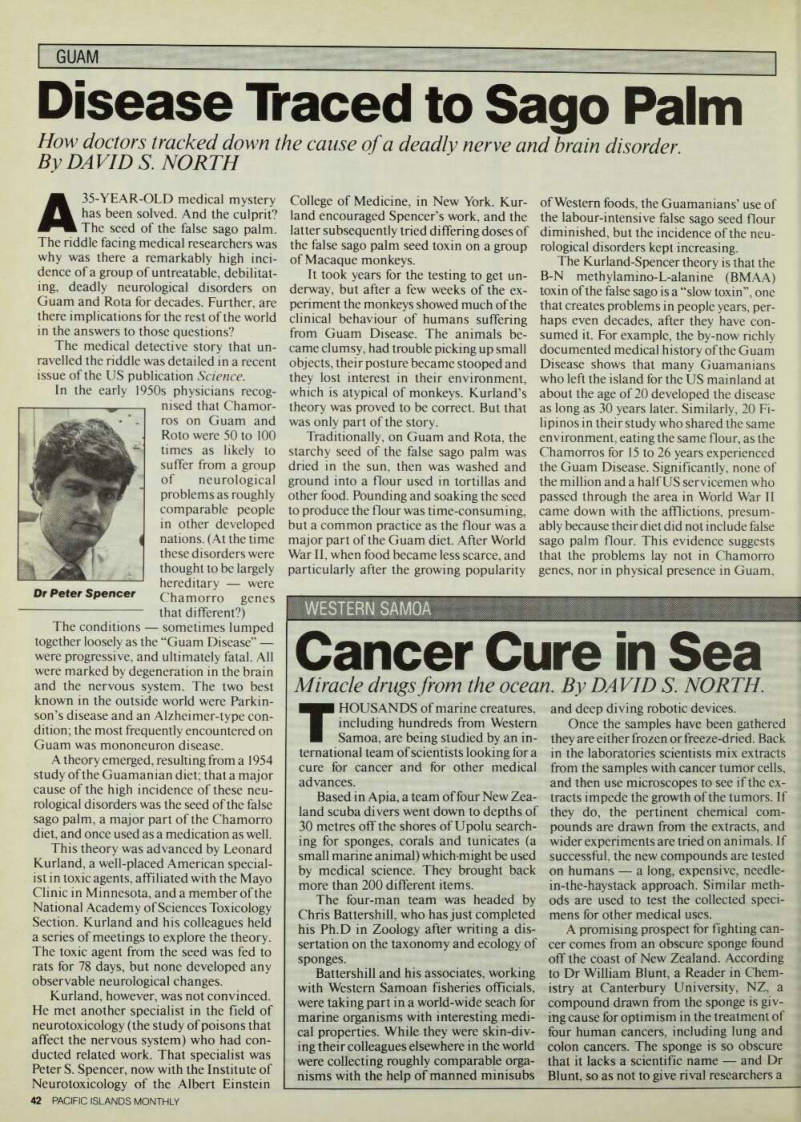
Dr Peter Spencer
but in the food that is consumed there.
In the Pacific, the false sago palm is far flung. Although Spencer and the other six authors of the article in Science report no incidence of the Guam Disease being con tracted outside Guam and Roto, they do note that “delayed-onset locomotor dys function of cattle, sheep and horses has been recorded on numerous occasions in north eastern Australia”. They do report, too, that the false sago palm grows throughout the Marshalls and the Caro lines, and that it has been used for food in the Caroline and Marshall Islands.
Spencer and his colleagues reveal that the false sago extends from the northern coast of Australia, through Indonesia and Papua New Guinea and north to the southern-most part of Japan.
On a world-wide level, physicians, sci entists and those afflicted with Alz heimer’s disease and related conditions, can take heart because of Spencer and Kurland’s discovery. (Alzheimer’s dis ease saps, and then destroys, the memory, weakens the mind’s control over the body, and, eventually, is fatal.) The work of Spencer, Kurland and others proves that at least some of the forces leading to these conditions are, fortunately, environmen tal and not genetic ones.
The discovery of the toxin within the false sago palm seed on Guam could lead to the discovery of other poisons and this may help in the control of Alzheimer’s dis ease and similar conditions. □