Problems Come to Paradise
pp. 32-33 · Read in the full issue
French Polynesia
Social tensions and political strife in a picture postcard setting.
By Alain Rollat.
THREATS OF economic recession, power struggles and several changes in the political balance since the resignation of Gaston Flosse as President of the local Assembly, has led to French Polynesia going through a period of gloomy introspection. The depression is particu larly apparent in Tahiti where the growing of unemployment has added to existing social tension.
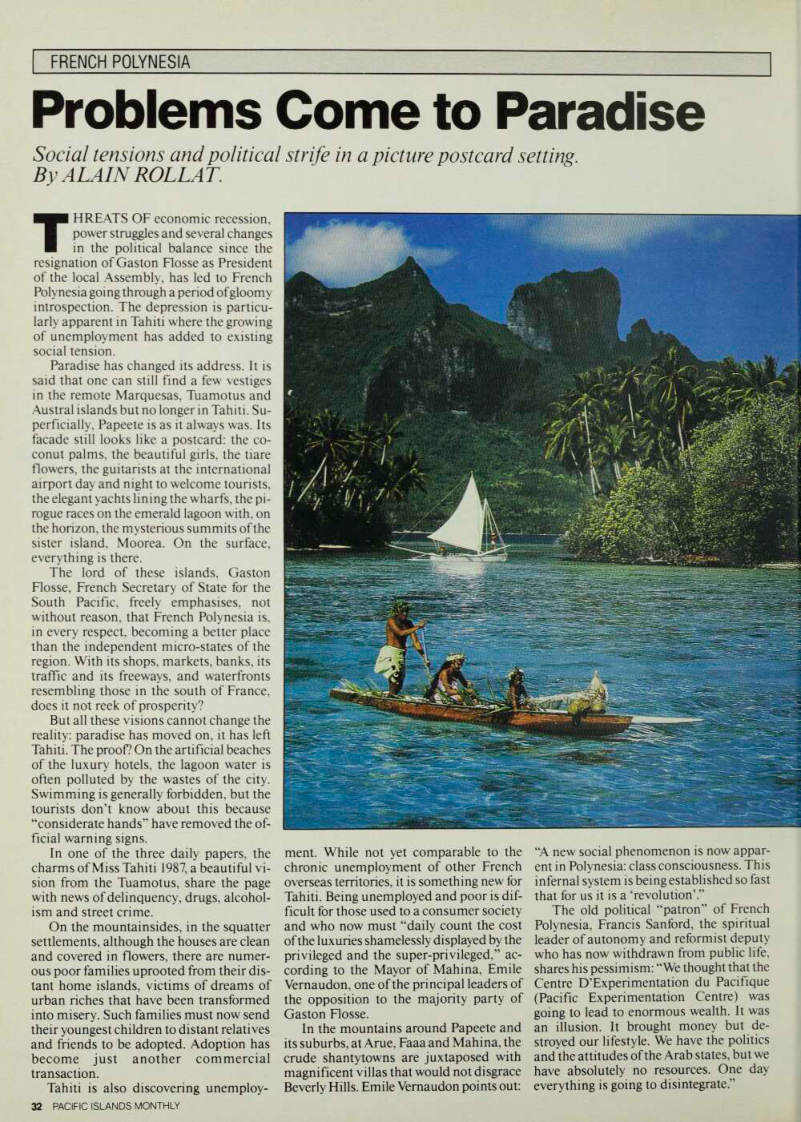
Paradise has changed its address. It is said that one can still find a few vestiges in the remote Marquesas, Tuamotus and Austral islands but no longer in Tahiti. Su perficially, Papeete is as it always was. Its facade still looks like a postcard: the co conut palms, the beautiful girls, the tiare flowers, the guitarists at the international airport day and night to welcome tourists, the elegant yachts lining the wharfs, the pi rogue races on the emerald lagoon with, on the horizon, the mysterious summits of the sister island, Moorea. On the surface, everything is there.
The lord of these islands, Gaston Flosse, French Secretary of State for the South Pacific, freely emphasises, not without reason, that French Polynesia is, in every respect, becoming a better place than the independent micro-states of the region. With its shops, markets, banks, its traffic and its freeways, and waterfronts resembling those in the south of France, does it not reek of prosperity?
But all these visions cannot change the reality: paradise has moved on, it has left Tahiti. The proof? On the artificial beaches of the luxury hotels, the lagoon water is often polluted by the wastes of the city.
Swimming is generally forbidden, but the tourists don’t know about this because “considerate hands” have removed the of ficial warning signs.
In one of the three daily papers, the charms of Miss Tahiti 1987, a beautiful vi sion from the Tuamotus, share the page with news of delinquency, drugs, alcohol ism and street crime.
On the mountainsides, in the squatter settlements, although the houses are clean and covered in flowers, there are numer ous poor families uprooted from their dis tant home islands, victims of dreams of urban riches that have been transformed into misery. Such families must now send their youngest children to distant relatives and friends to be adopted. Adoption has become just another commercial transaction.
Tahiti is also discovering unemploy-
ment. While not yet comparable to the chronic unemployment of other French overseas territories, it is something new for Tahiti. Being unemployed and poor is dif ficult for those used to a consumer society and who now must “daily count the cost of the luxuries shamelessly displayed by the privileged and the super-privileged,” ac cording to the Mayor of Mahina, Emile Vernaudon, one of the principal leaders of the opposition to the majority party of Gaston Flosse.
In the mountains around Papeete and its suburbs, at Arue, Faaa and Mahina, the crude shantytowns are juxtaposed with magnificent villas that would not disgrace Beverly Hills. Emile Vernaudon points out:
“A new social phenomenon is now appar ent in Polynesia: class consciousness. This infernal system is being established so fast that for us it is a ‘revolution’.”
The old political “patron” of French Polynesia, Francis Sanford, the spiritual leader of autonomy and reformist deputy who has now withdrawn from public life, shares his pessimism: “We thought that the Centre D’Experimentation du Pacifique (Pacific Experimentation Centre) was going to lead to enormous wealth. It was an illusion. It brought money but de stroyed our lifestyle. We have the politics and the attitudes of the Arab states, but we have absolutely no resources. One day everything is going to disintegrate.”
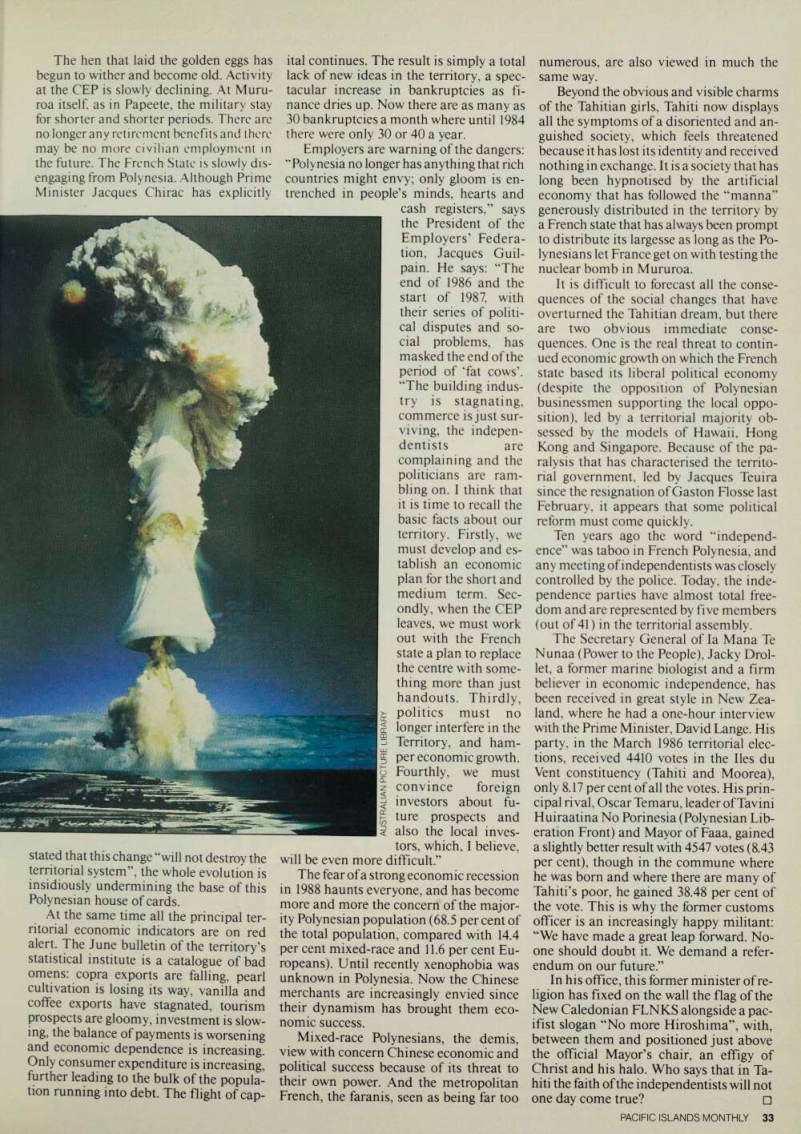
The hen that laid the golden eggs has begun to wither and become old. Activity at the CEP is slowly declining. At Muru roa itself, as in Papeete, the military stay for shorter and shorter periods. There arc no longer any retirement benefits and there may be no more civilian employment in the future. The French Stale is slowly dis engaging from Polynesia. Although Prime Minister Jacques Chirac has explicitly
stated that this change “will not destroy the territorial system”, the whole evolution is insidiously undermining the base of this Polynesian house of cards.
At the same time all the principal ter ritorial economic indicators are on red alert. The June bulletin of the territory’s statistical institute is a catalogue of bad omens: copra exports are falling, pearl cultivation is losing its way, vanilla and coffee exports have stagnated, tourism prospects are gloomy, investment is slow ing, the balance of payments is worsening and economic dependence is increasing.
Only consumer expenditure is increasing, further leading to the bulk of the popula tion running into debt. The flight of cap
ital continues. The result is simply a total lack of new ideas in the territory, a spec tacular increase in bankruptcies as fi nance dries up. Now there are as many as 30 bankruptcies a month where until 1984 there were only 30 or 40 a year.
Employers are warning of the dangers: “Polynesia no longer has anything that rich countries might envy; only gloom is en trenched in people’s minds, hearts and
cash registers,” says the President of the Employers’ Federa tion, Jacques Guil pain. He says: “The end of 1986 and the start of 1987, with their series of politi cal disputes and so cial problems, has masked the end of the period of ‘fat cows’.
“The building indus try is stagnating, commerce is just sur viving, the indepen dentists are complaining and the politicians are ram bling on. I think that it is time to recall the basic facts about our territory. Firstly, we must develop and es tablish an economic plan for the short and medium term. Sec ondly, when the CEP leaves, we must work out with the French state a plan to replace the centre with some thing more than just handouts. Thirdly, politics must no longer interfere in the Territory, and ham per economic growth.
Fourthly, we must convince foreign investors about fu ture prospects and also the local inves tors, which, I believe,
will be even more difficult.”
The fear of a strong economic recession in 1988 haunts everyone, and has become more and more the concern of the major ity Polynesian population (68.5 percent of the total population, compared with 14.4 per cent mixed-race and 11.6 per cent Eu ropeans). Until recently xenophobia was unknown in Polynesia. Now the Chinese merchants are increasingly envied since their dynamism has brought them eco nomic success.
Mixed-race Polynesians, the demis, view with concern Chinese economic and political success because of its threat to their own power. And the metropolitan French, the faranis, seen as being far too
numerous, are also viewed in much the same way.
Beyond the obvious and visible charms of the Tahitian girls, Tahiti now displays all the symptoms of a disoriented and an guished society, which feels threatened because it has lost its identity and received nothing in exchange. It is a society that has long been hypnotised by the artificial economy that has followed the “manna” generously distributed in the territory by a French state that has always been prompt to distribute its largesse as long as the Po lynesians let France get on with testing the nuclear bomb in Mururoa.
It is difficult to forecast all the conse quences of the social changes that have overturned the Tahitian dream, but there are two obvious immediate conse quences. One is the real threat to contin ued economic growth on which the French state based its liberal political economy (despite the opposition of Polynesian businessmen supporting the local oppo sition), led by a territorial majority ob sessed by the models of Hawaii, Hong Kong and Singapore. Because of the pa ralysis that has characterised the territo rial government, led by Jacques Teuira since the resignation of Gaston Flosse last February, it appears that some political reform must come quickly.
Ten years ago the word “independ ence” was taboo in French Polynesia, and any meeting of independentists was closely controlled by the police. Today, the inde pendence parties have almost total free dom and are represented by five members (out of 41) in the territorial assembly.
The Secretary General of la Mana Te Nunaa (Power to the People), Jacky Drol let, a former marine biologist and a firm believer in economic independence, has been received in great style in New Zea land, where he had a one-hour interview with the Prime Minister, David Lange. His party, in the March 1986 territorial elec tions, received 4410 votes in the lies du Vent constituency (Tahiti and Moorea), only 8.17 percent of all the votes. His prin cipal rival, Oscar Temaru, leader ofTavini Huiraatina No Porinesia (Polynesian Lib eration Front) and Mayor of Faaa, gained a slightly better result with 4547 votes (8.43 per cent), though in the commune where he was born and where there are many of Tahiti’s poor, he gained 38.48 per cent of the vote. This is why the former customs officer is an increasingly happy militant: “We have made a great leap forward. No one should doubt it. We demand a refer endum on our future.”
In his office, this former minister of re ligion has fixed on the wall the flag of the New Caledonian FLNKS alongside a pac ifist slogan “No more Hiroshima”, with, between them and positioned just above the official Mayor’s chair, an effigy of Christ and his halo. Who says that in Ta hiti the faith of the independentists will not one day come true? □