Fungus Fighters
p. 27 · Read in the full issue
Papua New Guinea
Business battles a cocoa threat.
By Chris Ashton.
ON A TINY island off the north coast of Papua New Guinea, a dis parate assortment of Australian, PNG and multi-national companies are pooling resources to find a remedy for a fungus which destroys up to 40 per cent of the world’s cocoa crop.
Banding together to fight the fungus are Sydney stockbroker Rene Rivkin through his PNG company, Dylup Plantations, and his PNG-licensed merchant bank, First Investment Finance Ltd, Burns Philp, Shell, Mobil, Coconut Products Pty Ltd, Westpac, Rabtrade, Angco, the PNG Planters Association and New Guinea Is lands Produce. The PNG Cocoa Institute, and the Ministers of Primary Industry in Queensland and Agriculture in Canberra have expressed interest without commit ting funds to the project.
Many commercial plants throughout the world, including rubber, tobacco, pineapples, tomatoes, avocadoes, pota toes and even pine trees are vulnerable to the same fungus but each requires a rem edy tailored to its particular properties.
Historically, black pod in cocoa has been treated with the bio-degradable chemical agent Metalaxyl, marketed as Ridomil by the Swiss agri-chemical firm Cybageigy. But at SA33 a kilogram it’s ex pensive, and in a high rainfall climate like PNG, wasteful as so much is washed away.
The company-sponsored trust which has been set up to fund research on Kar Kar Island is committed to finding a cheaper, more effective remedy to combat black pod. Its solution is to inject cocoa trees with phosphorous acid. Field trials to date have been encouraging.
The catalyst to the project has been the
Middleton brothers, John and Roger, whose family has been the largest copra and cocoa planters on Kar Kar for more than 60 years. Gus Gorrisen, manager of the Middletons’ avocado farm at Cabool ture, near Brisbane, was experimenting with solutions of phosphorous acid for fungus in avocado trees. Roger Middle ton, a graduate of Gatton Agricultural College, decided to do the same for cocoa.
But cocoa and avocado trees are poles apart. Middleton soon found that doses and injection techniques for the one had little relevance for the other. Over two years he and his brother invested K 27,000 in the project, and he injected 2,000 trees. But neither brother had the time, resources or scientific training to do the research which could supply the answers.
So with the help of a Brisbane manage ment consultant, Winston Hughes, for merly group accountant to the Middleton estates, they decided to seek help in cash and kind from companies with PNG interests.
From the money raised so far, a young plant pathologist, Ross Anderson, an hon ours graduate from Melbourne Univer sity, has been recruited on a 12-month contract to conduct field trials and labo ratory research at Roger Middleton’s plantation. His supervisor, Dr David Guest of the Department of Agriculture, Melbourne University, is one of a handful of scientists scattered from Paris to Cali fornia who believe the remedy is a chem ical agent derived from phosphorous acid.
Since Ross Anderson arrived on Kar Kar in June, air conditioning and a com puter have been installed in an impro vised laboratory and field tests have started to determine the optimum dose for cocoa trees, according to age, girth, sea son, time of day and a host of other variables.
Next year when the results have been collated and analysed, the trust will de cide the next steps. The scope for market ing the concept is necessarily limited.
Phosphorous acid is readily available, and there’s little prospect for selling the tech nique once it becomes public.
The one element in the project which could yield a return on the investment is the spring-activated injector which has been developed with the help of a Bris bane engineering firm, A J Parkes, specif ically tailored for the cocoa tree. The design has been patented, and the Colombian Government is currently negotiating the purchase of a trial shipment of 1,000 in jectors to combat rust in coffee. □
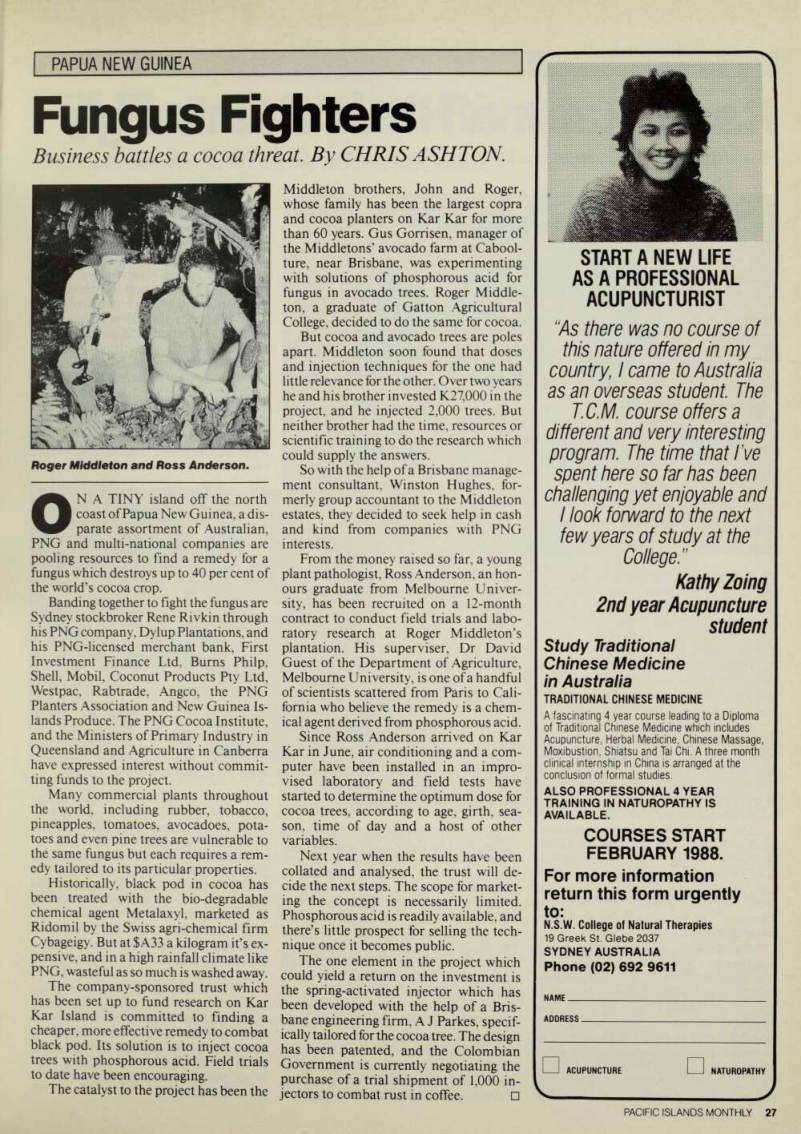
Roger Middleton and Ross Anderson.