Westpac Manages $27m Fund
p. 23 · Read in the full issue
A chance for economic independence.
By Melissa Roberts.
UNTIL NOW, Tuvalu has managed largely on the curiosity value of its stamps and handouts of foreign aid. All that is about to change with the establishment of the Tuvalu Trust Fund.
Now this nation of just 8000 people will live off the interest on its investments.
Westpac Investment Management Pty Ltd has been appointed to manage the trust fund that is made up of SA27 million in grants from Australia, New Zealand and the United Kingdom. The money will be invested in a low-risk spread of assets, in cluding fixed interest funds, equities and property. According to the document gov erning the setting up of the trust, which was overseen by the United Nations, the pur pose of the fund is to “contribute to the long-term financial viability of Tuvalu by providing an additional source of revenue for the recurring expenses of the govern ment of Tuvalu”.
Specifically it will give the Tuvalu Government greater control over its Budget, improve conditions on the islands and free other funds received in aid for de velopment projects.
Tuvalu Prime Minister Dr Tomasi Puapua says the rest of the world will be watching the performance of the fund to see if such a scheme could ease aid de pendence in other developing nations. “It is an example of an innovative approach by donor governments in assisting a small and fragile economy and therefore one which will be keenly monitored by oth ers,” Dr Puapua says.
His view is shared by Westpac Invest ment Management’s Director of Global Marketing, Mr Peter Joyner. “This is the first trust of its kind and will be of keen interest to other governments.”
However, a spokesman for the Aus tralian Development Assistance Bureau (ADAB) says the fund is simply a solution for Tuvalu and that nothing was in the off ing for the concept to be replicated by other Pacific aid recipients.
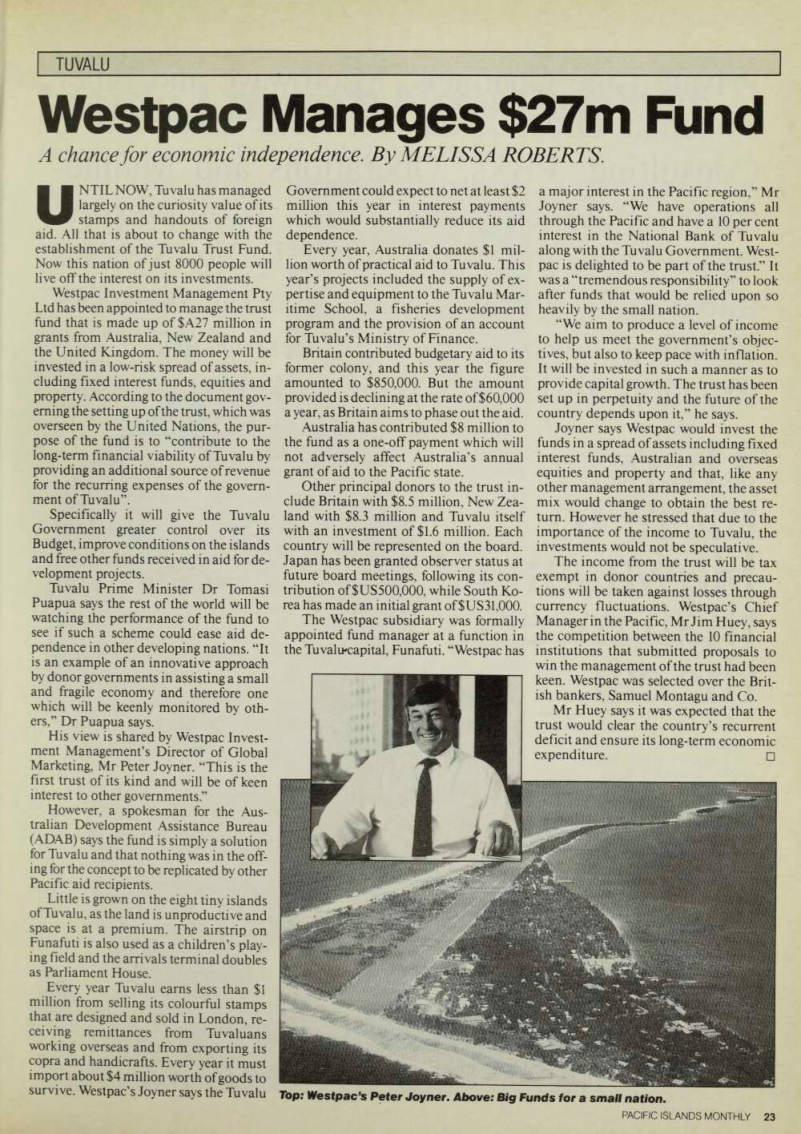
Little is grown on the eight tiny islands of Tuvalu, as the land is unproductive and space is at a premium. The airstrip on Funafuti is also used as a children’s play ing field and the arrivals terminal doubles as Parliament House.
Every year Tuvalu earns less than $1 million from selling its colourful stamps that are designed and sold in London, re ceiving remittances from Tuvaluans working overseas and from exporting its copra and handicrafts. Every year it must import about $4 million worth of goods to survive. Westpac’s Joyner says the Tuvalu
Government could expect to net at least $2 million this year in interest payments which would substantially reduce its aid dependence.
Every year, Australia donates $1 mil lion worth of practical aid to Tuvalu. This year’s projects included the supply of ex pertise and equipment to the Tuvalu Mar itime School, a fisheries development program and the provision of an account for Tuvalu’s Ministry of Finance.
Britain contributed budgetary aid to its former colony, and this year the figure amounted to $850,000. But the amount provided is declining at the rate of $60,000 a year, as Britain aims to phase out the aid.
Australia has contributed $8 million to the fund as a one-off payment which will not adversely affect Australia’s annual grant of aid to the Pacific state.
Other principal donors to the trust in clude Britain with $8.5 million. New Zea land with $8.3 million and Tuvalu itself with an investment of $1.6 million. Each country will be represented on the board.
Japan has been granted observer status at future board meetings, following its con tribution of$US5OO,OOO, while South Ko rea has made an initial grant of SUS3I,OOO.
The Westpac subsidiary was formally appointed fund manager at a function in the Tuvalihcapital, Funafuti. “Westpac has
a major interest in the Pacific region,” Mr Joyner says. “We have operations all through the Pacific and have a 10 per cent interest in the National Bank of Tuvalu along with the Tuvalu Government. West pac is delighted to be part of the trust.” It was a “tremendous responsibility” to look after funds that would be relied upon so heavily by the small nation.
“We aim to produce a level of income to help us meet the government’s objec tives, but also to keep pace with inflation.
It will be invested in such a manner as to provide capital growth. The trust has been set up in perpetuity and the future of the country depends upon it,” he says.
Joyner says Westpac would invest the funds in a spread of assets including fixed interest funds, Australian and overseas equities and property and that, like any other management arrangement, the asset mix would change to obtain the best re turn. However he stressed that due to the importance of the income to Tuvalu, the investments would not be speculative.
The income from the trust will be tax exempt in donor countries and precau tions will be taken against losses through currency fluctuations. Westpac’s Chief Manager in the Pacific, Mr Jim Huey, says the competition between the 10 financial institutions that submitted proposals to win the management of the trust had been keen. Westpac was selected over the Brit ish bankers, Samuel Montagu and Co.
Mr Huey says it was expected that the trust would clear the country’s recurrent deficit and ensure its long-term economic expenditure. □
Top: Westpac’s Peter Joyner. Above: Big Funds for a small nation.