Melanesian Union Bid Falters
pp. 21-22 · Read in the full issue
The Region
FLNKS faces a struggle to form a power bloc.
By John Dunn.
THERE SEEMS little chance of a Union of Melanesian nations be coming much more than an aca demic talking point, at least in the foreseeable future. The proposal was launched by the New Caledonian Kanak Party, FLNKS, in early September but, if initial reaction is any guide, it is having great difficulty staying afloat.
The Kanaks approached Fiji’s Great Council of Chiefs and the governments of Papua New Guinea, the Solomon Islands and Vanuatu to join them in a Melanesian Union which would have its own Consti tution, Congress and Mediation Court.
Only this very broad outline emerged initially. Details were to come after fur ther discussions.
“The whole idea,” said Mr Yeiwene Yeiwene, a FLNKS leader, “is to develop our own solidarity as Melanesians.” He made it clear that the inspiration stemmed from the moral support given by the Me lanesian nations to the Kanaks in their fight for independence from the French.
The thought was underlined a few days later when the Melanesian “Spearhead Group”, comprising Papua New Guinea, Vanuatu and the Solomon Islands met hurriedly in Honiara to discuss the inde pendence situation in New Caledonia.
These two events followed the emerg ence last year of a rather loose, but never theless interesting, Melanesian association as a sort of ginger group on the fringes of the South Pacific Forum.
In total, and on the surface, the possi bility of the emergence of a Melanesian power bloc in the South Pacific produced considerable interest and raised some eye brows among the other nations of the re gion. There was speculation that it might develop into a breakaway from the Forum or erode the Forum’s standing and effec tiveness to some degree.
However, two subsequent factors have indicated that a Melanesian Union of any substance is a long way off, if it eventuates at all, and that the reality of any Melane sian alliance is more likely to be confined to the sort of lobbying role presently being undertaken principally by Papua New Guinea, Vanuatu and the Solomons.
The first factor was the significant si lence which greeted the Kanak proposal.
Even though the sheer size of the South Pacific, and the separation of the nations, makes speedy communication difficult, there was no immediate sign of any worth while enthusiasm.
Not one nation picked it up to any ex tent. There was nothing positive from
either Papua New Guinea or Fiji, the two “big” countries of the area, whose support would be vital to the success of such a Me lanesian “state”.
Fiji, obviously, is pre-occupied with its own problems at the moment and it seems safe to assume that it will be quite some time before it becomes involved in affairs which it must view as having relatively low priority by comparison with much more pressing internal matters.
Papua New Guinea, on the other hand, sees itself as both the leader of the Me lanesians and of all the South Pacific countries apart, of course, from Australia and New Zealand.
And, as well, it has clearly signalled that it intends to take a higher profile in inter national affairs from now on, but its pref erences would appear to have a Melanesian alliance rather low on its list even though it is prepared to push hard for its Melane sian brothers in New Caledonia. Papua New Guinea is toying with a non-aligned stance, is keen to join ASEAN (the as sociation of South-East Asian nations) and to develop stronger ties with China.
Certainly it wants to continue an active Melanesian role but, so it seems, not to the extent of the Kanak proposal.
The second factor was the failure of the spearhead group in Honiara to agree on the principal matter which brought them to gether the Papua New Guinea-spon sored resolution advocating recognition of the FLNKS as the legitimate Kanak government of New Caledonia.
Quite apart from the fact that such a move would have been a destabilising and even dangerous decision, its lack of suc cess does mean that Melanesian solidarity has some cracks in it.
Even so, a Melanesian lobby both in side and outside the Forum is clearly here to stay and that could be a good thing be cause it may well serve the purpose of a ►
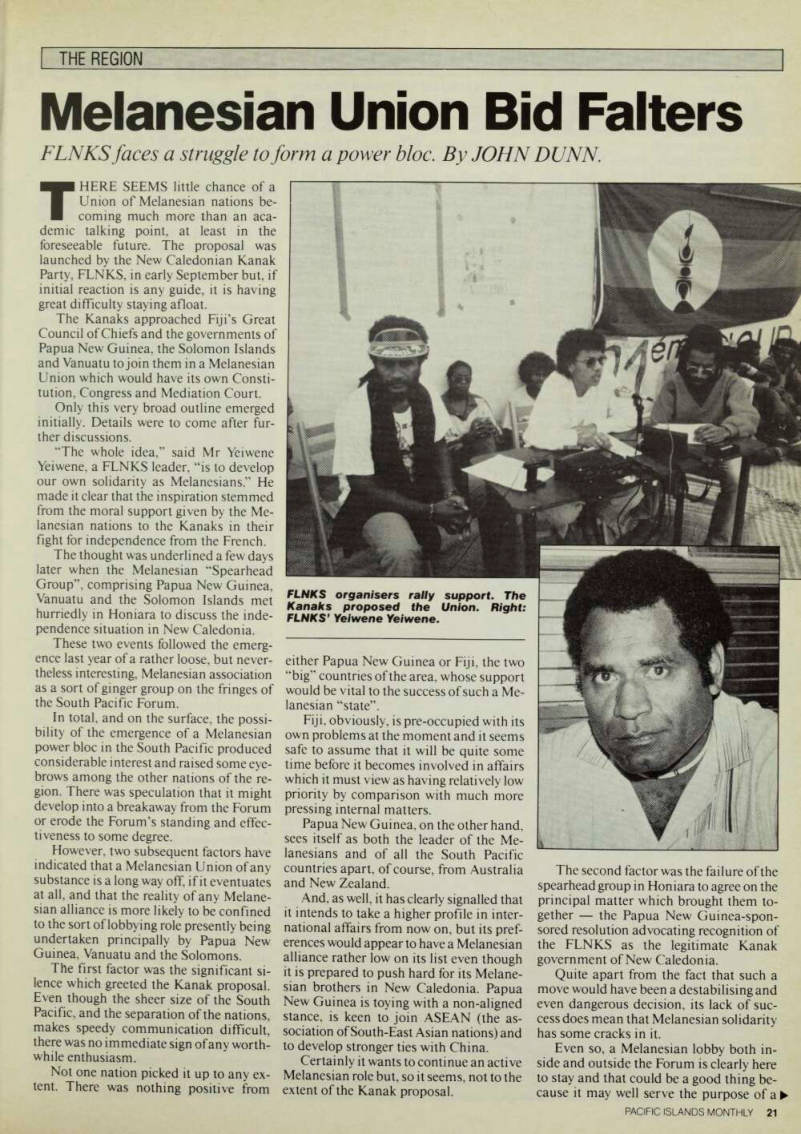
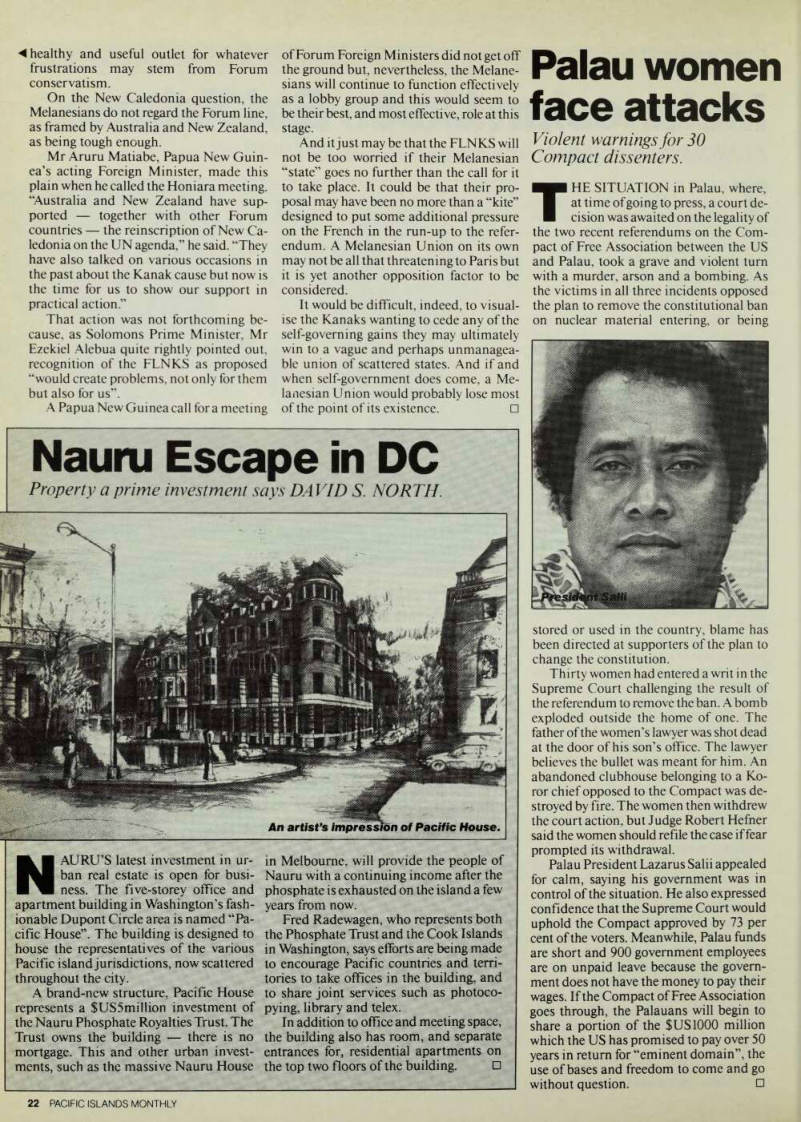
FLNKS organisers rally support. The Kanaks proposed the Union. Right: FLNKS’ Yeiwene Yeiwene.
◄ healthy and useful outlet for whatever frustrations may stem from Forum conservatism.
On the New Caledonia question, the Melanesians do not regard the Forum line, as framed by Australia and New Zealand, as being tough enough.
Mr Arum Matiabe, Papua New Guin ea’s acting Foreign Minister, made this plain when he called the Honiara meeting.
“Australia and New Zealand have sup ported together with other Forum countries the reinscription of New Ca ledonia on the UN agenda,” he said. “They have also talked on various occasions in the past about the Kanak cause but now is the time for us to show our support in practical action.”
That action was not forthcoming be cause, as Solomons Prime Minister, Mr Ezekiel Alebua quite rightly pointed out, recognition of the FLNKS as proposed “would create problems, not only for them but also for us”.
A Papua New Guinea call for a meeting
of Forum Foreign Ministers did not get off the ground but, nevertheless, the Melane sians will continue to function effectively as a lobby group and this would seem to be their best, and most effective, role at this stage.
And it just may be that the FLNKS will not be too worried if their Melanesian “state” goes no further than the call for it to take place. It could be that their pro posal may have been no more than a “kite” designed to put some additional pressure on the French in the run-up to the refer endum. A Melanesian Union on its own may not be all that threatening to Paris but it is yet another opposition factor to be considered.
It would be difficult, indeed, to visual ise the Kanaks wanting to cede any of the self-governing gains they may ultimately win to a vague and perhaps unmanagea ble union of scattered states. And if and when self-government does come, a Me lanesian Union would probably lose most of the point of its existence. □