of Strength
pp. 8-13 · Read in the full issue

New Caledonia
France’s Show of Strength
Crushing victory or French farce? NICHOLAS ROTH WELL explains the implications of the New Caledonia independence referendum result for the French, the Kanaks and the troubled territory’s Pacific neighbours.
NEW CALEDONIAN politics, troubled and stalemated for the past two years, entered a new phase with the referendum of September 13. The high vote for continued ties with France 50,250 out of 85,022 citizens on the electoral roll, or 59.10 per cent of the total, took part in the referendum, 98.3 per cent of these pro-French surprised both French and international pundits, and even astonished the Caledonians them selves. In the wake of the referendum, as the Paris Government of conservative Prime Minister Jacques Chirac readies an “autonomy statute” for its South Pacific territory, an implacable mathematical logic comes into play.
New Caledonia’s political future may yet be held hostage for a few more months, as Mr Chirac and the incumbent socialist Mr Francois Mitterand, the likely rivals for next year’s Presidential elections, make their respective bids for the Elysee Palace.
But even in the event of a victory by Mr Mitterand, architect of previous plans for New Caledonian independence, the ref erendum result will be hard to ignore.
The message of the poll was unequi vocal. The referendum was first suggested by the pro-independence Kanak umbrella group, the Kanak Socialist National Lib eration Front (FLNKS). The Government of Mr Chirac this year decided to allow all French citizens with more than three years’ residence in the territory to vote, and posed them two simple questions: “Do you wish New Caledonia to become independent?” and “Do you wish New Caledonia to re main in the bosom of the French Repub lic?” The FLNKS called a boycott of the poll. It wanted the vote limited to indige nous Kanaks and those people, “victims of colonial history”, who were born in the territory with one parent also of Caledon ian birth.
Participation in the referendum thus
became a crucial test of strength for the FLNKS, which, according to French of ficials, placed considerable “physical and moral pressure” on Kanaks not to vote.
The results, though interpreted var iously by the different sides, have effec tively redrawn the political map in New Caledonia, and so pose a serious set of new policy questions for the neighbouring countries of the South Pacific region.
The French authorities in New Cale-
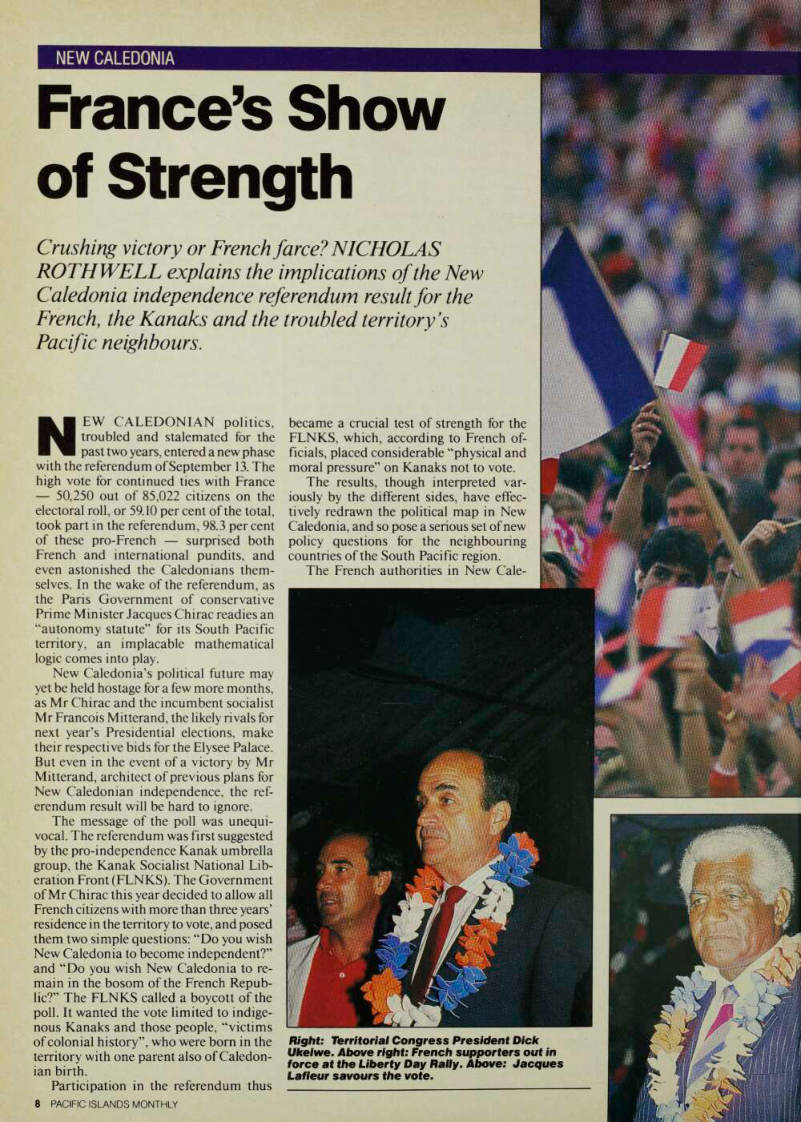
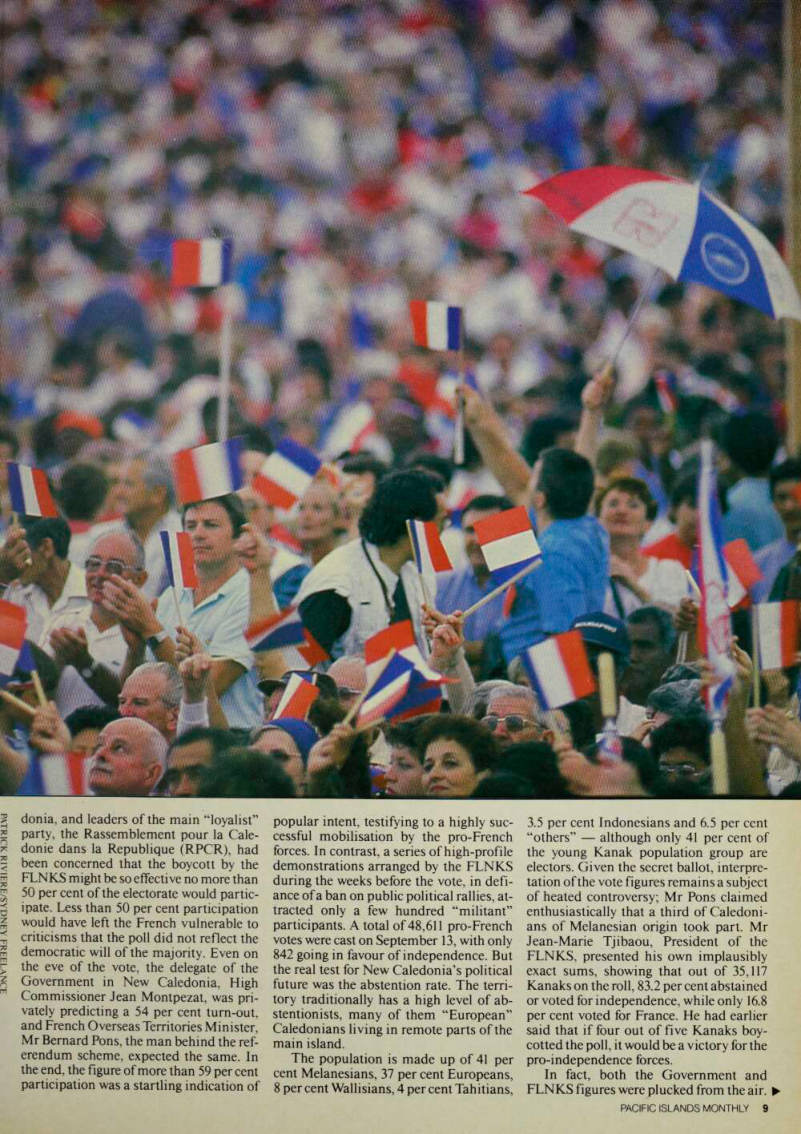
Right: Territorial Congress President Dick Ukeiwe. Above right: French supporters out in force at the Liberty Day Rally. Above: Jacques Lafleur savours the vote.
donia, and leaders of the main “loyalist” party, the Rassemblement pour la Caledonie dans la Republique (RPCR), had been concerned that the boycott by the FLNKS might be so effective no more than 50 per cent of the electorate would participate. Less than 50 per cent participation would have left the French vulnerable to criticisms that the poll did not reflect the democratic will of the majority. Even on the eve of the vote, the delegate of the Government in New Caledonia, High Commissioner Jean Montpezat, was privately predicting a 54 per cent turn-out, and French Overseas Territories Minister, Mr Bernard Pons, the man behind the referendum scheme, expected the same. In the end, the figure of more than 59 per cent participation was a startling indication of
popular intent, testifying to a highly sue cessful mobilisation by the pro-French forces. In contrast, a series of high-profile demonstrations arranged by the FLNKS during the weeks before the vote, in defi ance of a ban on public political rallies, at tracted only a few hundred “militant” participants. A total of 48,611 pro-French votes were cast on September 13, with only 842 going in favour of independence. But the real test for New Caledonia’s political future was the abstention rate. The terri tory traditionally has a high level of ab stentionists, many of them “European”
Caledonians living in remote parts of the main island.
The population is made up of 41 per cent Melanesians, 37 per cent Europeans, 8 per cent Wallisians, 4 per cent Tahitians,
3.5 per cent Indonesians and 6.5 per cent “others” although only 41 per cent of the young Kanak population group are electors. Given the secret ballot, interpre tation of the vote figures remains a subject of heated controversy; Mr Pons claimed enthusiastically that a third of Caledoni ans of Melanesian origin took part. Mr Jean-Marie Tjibaou, President of the FLNKS, presented his own implausibly exact sums, showing that out of 35,117 Kanaks on the roll, 83.2 per cent abstained or voted for independence, while only 16.8 per cent voted for France. He had earlier said that if four out of five Kanaks boy cotted the poll, it would be a victory for the pro-independence forces.
In fact, both the Government and FLNKS figures were plucked from the air. ►
Patrick Riviere/Sydney Freelance
◄ The truth lies somewhere in between; about a quarter of the Kanak population seems to have defied the boycott call well above the 20 per cent that was expected to side with the RPCR “loyalists”, This means that, gradually, the political authority of the FLNKS is waning, from the high point in 1984 when violent proindependence protests gripped the territory. Detailed study of the referendum resuits shows that in several former FLNKS strongholds, a surprising number of elec-
erendum result, the conservative forces are likely to adopt more moderate and con dilatory policies towards the Kanak mi nority, rather than hewing to the “if you’re not for us you must be against us” school of thought that has predominated since the 1984 and 1985 political riots that con vulsed the territory.
Moderate Kanak leaders may be wooed into the conservative, pro-French camp by generous political and economic patron age. An interesting figure in this context is
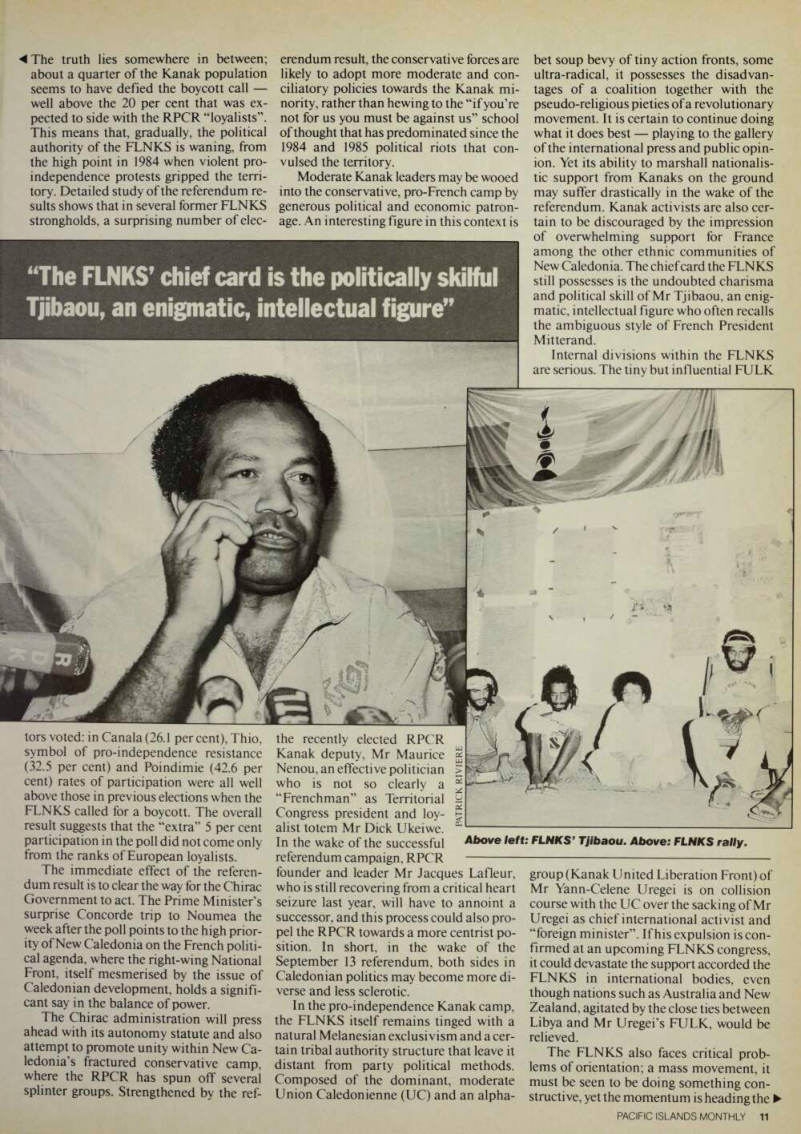
bet soup bevy of tiny action fronts, some ultra-radical, it possesses the disadvan tages of a coalition together with the pseudo-religious pieties of a revolutionary movement. It is certain to continue doing what it does best playing to the gallery of the international press and public opin ion. Yet its ability to marshall nationalis tic support from Kanaks on the ground may suffer drastically in the wake of the referendum. Kanak activists are also cer tain to be discouraged by the impression of overwhelming support for France among the other ethnic communities of New Caledonia. The chief card the FLNKS still possesses is the undoubted charisma and political skill of Mr Tjibaou, an enig matic, intellectual figure who often recalls the ambiguous style of French President Mitterand.
Internal divisions within the FLNKS are serious. The tiny but influential FULK
tors voted: in Canala (26.1 per cent), Thio, symbol of pro-independence resistance (32.5 per cent) and Poindimie (42.6 per cent) rates of participation were all well above those in previous elections when the FLNKS called for a boycott. The overall result suggests that the “extra” 5 per cent participation in the poll did not come only from the ranks of European loyalists.
The immediate effect of the referen dum result is to clear the way for the Chirac Government to act. The Prime Minister’s surprise Concorde trip to Noumea the week after the poll points to the high prior ity of New Caledonia on the French politi cal agenda, where the right-wing National Front, itself mesmerised by the issue of Caledonian development, holds a signifi cant say in the balance of power.
The Chirac administration will press ahead with its autonomy statute and also attempt to promote unity within New Ca ledonia’s fractured conservative camp, where the RPCR has spun off several splinter groups. Strengthened by the ref
the recently elected RPCR Kanak deputy, Mr Maurice Nenou, an effective politician who is not so clearly a “Frenchman” as Territorial Congress president and loy alist totem Mr Dick Ukeiwe.
In the wake of the successful referendum campaign, RPCR
founder and leader Mr Jacques Lafleur, who is still recovering from a critical heart seizure last year, will have to annoint a successor, and this process could also pro pel the RPCR towards a more centrist po sition. In short, in the wake of the September 13 referendum, both sides in Caledonian politics may become more di verse and less sclerotic.
In the pro-independence Kanak camp, the FLNKS itself remains tinged with a natural Melanesian exclusivism and a cer tain tribal authority structure that leave it distant from party political methods.
Composed of the dominant, moderate Union Caledonienne (UC) and an alpha
group (Kanak United Liberation Front) of Mr Yann-Celene Uregei is on collision course with the UC over the sacking of Mr Uregei as chief international activist and “foreign minister”. If his expulsion is con firmed at an upcoming FLNKS congress, it could devastate the support accorded the FLNKS in international bodies, even though nations such as Australia and New Zealand, agitated by the close ties between Libya and Mr Uregei’s FULK, would be relieved.
The FLNKS also faces critical prob lems of orientation; a mass movement, it must be seen to be doing something con structive, yet the momentum is heading the ►
Patrick Riviere
Above left: FLNKS’ Tjibaou. Above: FLNKS rally.
◄ other way in Caledonian politics. Its much bruited adoption of a strategy of “non violence”, which won plaudits briefly when local gendarmes charged a defence less crowd of women and children protes ters in Noumea’s central square this August, has brought little in the way of concrete achievements. A heavy (and costly) French military presence is likely to remain in New Caledonia for the bal ance of this year as an undeclared peace keeping force. Radical activists within the FLNKS are said to be deeply disheart ened by the spectacle of a weakening political front that will not countenance more “direct” action although discus sion of the activities of “Kanak extre mists” often has a decidely mirage-like quality.
Another significant Kanak pro-inde pendence party exists outside the FLNKS structure: Kanak Socialist Liberation, the party formed by a customary chief from the Loyalty Islands, the charismatic radi cal turned social democrat, Mr Nidoish Naisseline. This group has significant re gional importance, and managed to pro
duce a heavy referendum abstention rate in the island of Mare. But its importance is that it represents the elusive “third way” in Caledonian politics. Pro-independ ence, it is also open-minded and speaks the language of European politics. A number of reflective, highly intelligent Kanaks have crystallised around Mr Naisseline, and their continued success as a party and engine of ideas would form a vital com ponent in any movement towards further co-operation between the two main racial groups in New Caledonia. The great hope the referendum result holds out is that confirmation of the strength of the loyal ists may enable some in their ranks to con sider working towards a form of shared evolution with centrist parties. Only in this way could the pro-French and pro-inde pendence camps begin to forge a common political vocabulary.
The referendum has not only set the seal on a realignment of forces inside the territory; it has redefined New Caledonia as a problem for the countries of the re gion, and for the United Nations member states that will debate the territory’s status in the General Assembly this year.
Australia and New Zealand seem set to maintain their policies favouring Cale donian independence, but the strong ma jority vote for ties with France leaves these countries with one unpleasant dilemma now more clearly focused; if they call on France to disregard the majority’s will, and grant independence to the native people, what standard should they apply within their own borders, where a settler major ity has itself displaced an indigenous people?
On a more serious level, the pro-French vote, coupled with the strong support of the French Government, seems likely to ensure a continued French presence in the Pacific on the current terms. A policy of rigid hostility towards France, on the part of the South Pacific Forum nations, could be one that produces its own harvest of instability, disunity and confusion in a re gion that prides itself on consensus and discussion of political dilemmas.
The first serious policy test for the South Pacific Forum nations will come with this December’s South Pacific games, scheduled to be held in Noumea. A boy cott of the games, as called for by some Pa cific nations, would send a clear signal to Paris that continued intransigence and unreflective, absolutist opposition will be the pattern for the future.
France, of course, has the demon strated political will and economic power to remain in the Pacific indefinitely. The referendum has shown that the Caledon ian population is itself increasingly rec onciled to this scenario. A crucial time for reassessment has been reached.
The nations of the Melanesian Spear head group The Solomons, Vanuatu and Papua New Guinea yoked together largely by the single issue of Kanak inde pendence, pointedly failed to devise any new policies during a September meeting to consider the referendum. They decided against the option of creating a Kanak government in exile, but their discussions remained opposed to acceptance of New Caledonia’s French territorial status. The FLNKS itself has recently promoted a concept of “regional union” among Me lanesian nations, which could later be ex tended to other Pacific states. But the referendum appears to have dealt this pro ject a serious blow, even though the “union pact” provides for the FLNKS to partici pate even while New Caledonia stays French.
September 13, then, not only ushered in a new political era for new Caledonia; it presented a fresh challenge to the nations of the Pacific; they must now balance care fully the competing pressures of nation alism and democracy, of racial solidarity and respect for liberal principles. The ref erendum phrased the dilemma and high lighted it with exquisite accuracy; the time has come, both for New Caledonians and the nations of the Pacific, to devise a solution. n