A Formula for Harmony
Opinion
The New Caledonia vote clears the way for harmony.
NEW CALEDONIA’S politicians, whether loyalists or leaders of the independence cause, have always looked to the outside world for solutions. The great merit of this September’s referendum is not only that it records the will of the majority that the territory remain French, and marks the end of a three-year period of un certainty it also points the way forward to a political evolution an evolution loyalists and pro-independence forces should shape together. The pro-French establish ment favours greater internal autonomy for the territory, with a continued political tie to France. Moderate pro-in dependence leaders envisage a privileged role for France even after the creation of a new Kanak state.
The referendum result clears the way for coherent dis cussion to bridge these positions. No one expects the pres sures for Kanak independence to vanish; no one expects the Europeans to pack up and leave the territory. The trick is for the different communities to devise a formula by which they can live, and develop, harmoniously together.
Sadly, examples of how not to decolonise, how not to handle tensions between separate ethnic groups, now abound among the nations of the Pacific. There is Vanu atu. This neighbouring regime’s expulsion of its own French loyalists is often held up by pro-French Caledon ians as a portent of the fate they might suffer under Kanak rule; but the real lesson to be learned from Vanuatu’s early years of independence is that international activism, however satisfying it may be for the political class, brings little in the way of tangible gain. Then there is Fiji, rather disturbingly presented by pro-independence Kanaks as an example of the inevitable consequences of a decolon isation that failed to enshrine in law the special claims of the indigenous population. Kanak leaders would do well
to drop this troubling endorsement of Fijian racial supre macism. Fiji’s lesson is this: the retreat from democracy, even when justified by a principle as fair-sounding as the rights of a native people, inevitably entails a growing con tempt for freedom and the rule of law.
New Caledonia’s community has advantages denied other Pacific islands; the region’s most potent economy, a rich mix of cultures, the attention and concern of France.
It also has more than its fair share of politicians; these have spent much of the past two years engaged in sterile debate, putting forward absolutist demands, secure in the knowledge that the territory’s future was uncertain. The referendum has now cleared the way for a more construc tive dialogue between communities that must learn not only to cohabit but to develop together, and devise their own common solution to a range of political problems.
Fiji: The Terror Continues
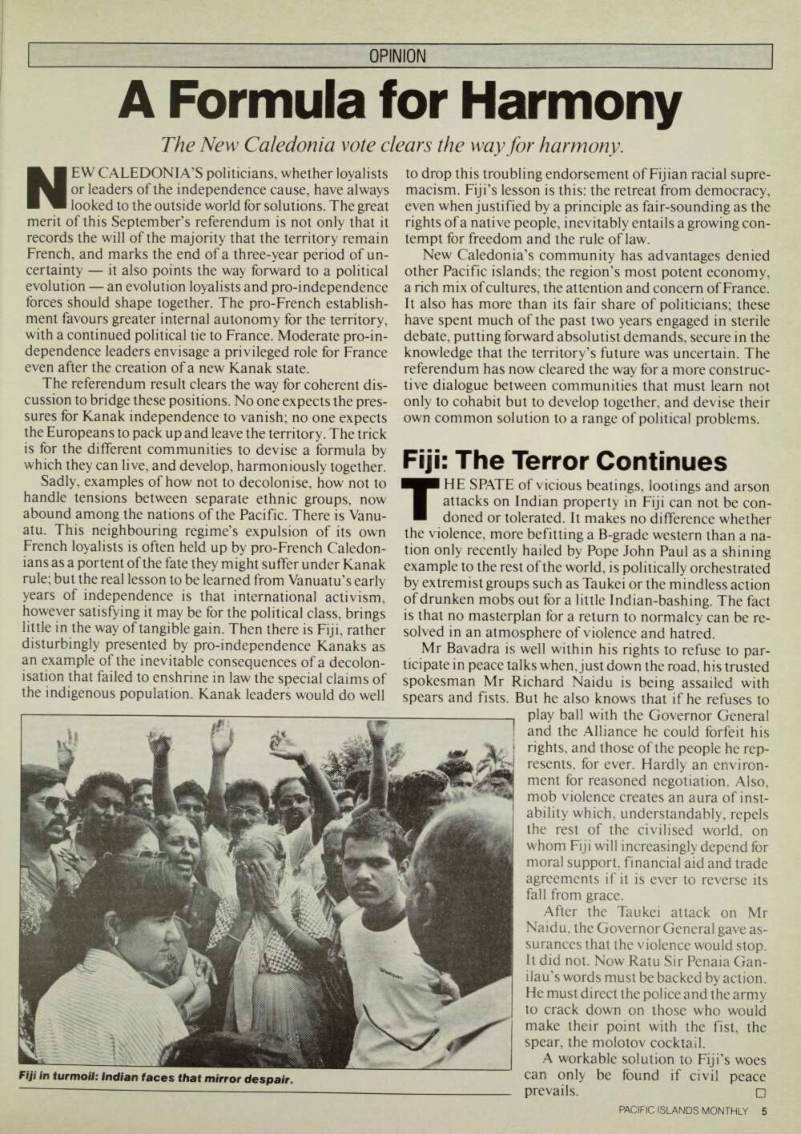
THE SPATE of vicious beatings, lootings and arson attacks on Indian property in Fiji can not be con doned or tolerated. It makes no difference whether the violence, more befitting a B-grade western than a na tion only recently hailed by Pope John Paul as a shining example to the rest of the world, is politically orchestrated by extremist groups such as Taukei or the mindless action of drunken mobs out for a little Indian-bashing. The fact is that no masterplan for a return to normalcy can be re solved in an atmosphere of violence and hatred.
Mr Bavadra is well within his rights to refuse to par ticipate in peace talks when, just down the road, his trusted spokesman Mr Richard Naidu is being assailed with spears and fists. But he also knows that if he refuses to
play ball with the Governor General and the Alliance he could forfeit his rights, and those of the people he rep resents, for ever. Hardly an environ ment for reasoned negotiation. Also, mob violence creates an aura of inst ability which, understandably, repels the rest of the civilised world, on whom Fiji will increasingly depend for moral support, financial aid and trade agreements if it is ever to reverse its fall from grace.
After the Taukei attack on Mr Naidu, the Governor General gave as surances that the violence would stop.
It did not. Now Ratu Sir Penaia Gan ilau’s words must be backed by action.
He must direct the police and the army to crack down on those who would make their point with the fist, the spear, the molotov cocktail.
A workable solution to Fiji’s woes can only be found if civil peace prevails. □
Fiji in turmoil: Indian faces that mirror despair ,