Fiji's Cabinet reshuffles:
p. 54 · Read in the full issue
political currents
Fiji's Cabinet reshuffles: more changes to come?
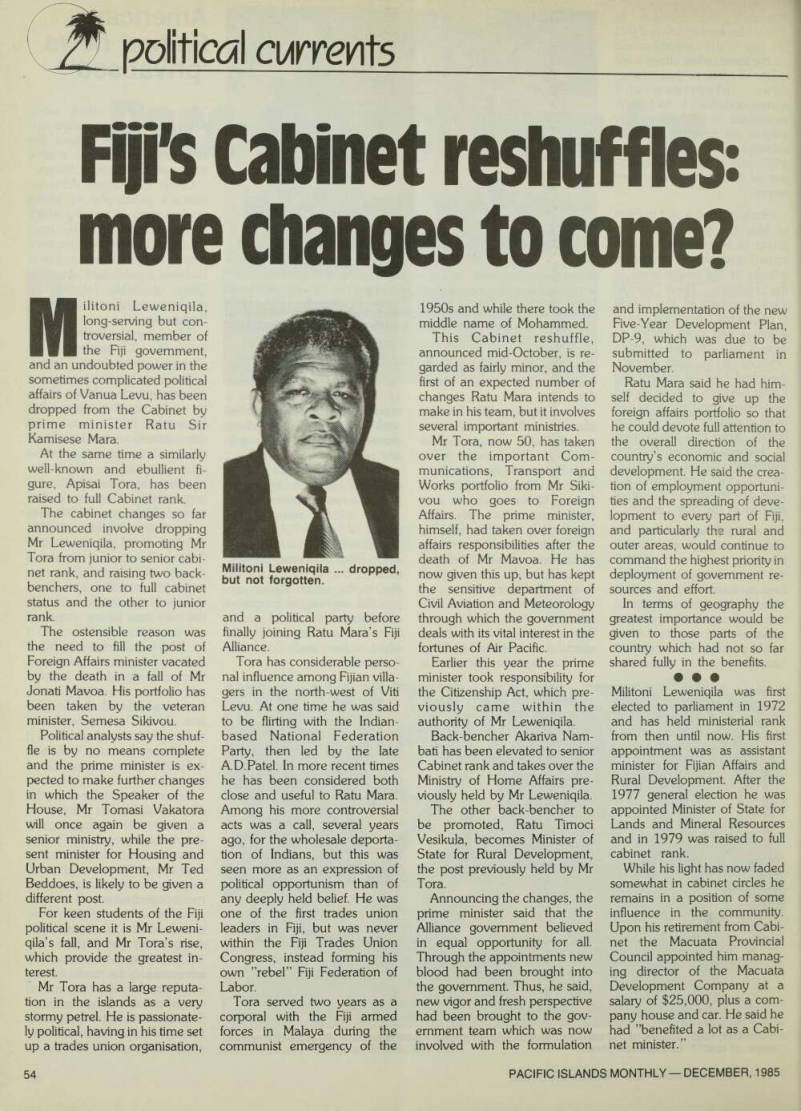
Militoni Leweniqila,
long-serving but con troversial, member of the Fiji government, and an undoubted power in the sometimes complicated political affairs of Vanua Levu, has been dropped from the Cabinet by prime minister Ratu Sir Kamisese Mara.
At the same time a similarly well-known and ebullient fi gure, Apisai Tora, has been raised to full Cabinet rank.
The cabinet changes so far announced involve dropping Mr Leweniqila, promoting Mr Tora from junior to senior cabi net rank, and raising two back benchers, one to full cabinet status and the other to junior rank.
The ostensible reason was the need to fill the post of Foreign Affairs minister vacated by the death in a fall of Mr Jonati Mavoa. His portfolio has been taken by the veteran minister, Semesa Sikivou.
Political analysts say the shuf fle is by no means complete and the prime minister is ex pected to make further changes in which the Speaker of the House, Mr Tomasi Vakatora will once again be given a senior ministry, while the pre sent minister for Housing and Urban Development, Mr Ted Beddoes, is likely to be given a different post.
For keen students of the Fiji political scene it is Mr Leweni qila’s fall, and Mr Tora’s rise, which provide the greatest in terest.
Mr Tora has a large reputa tion in the islands as a very stormy petrel. He is passionate ly political, having in his time set up a trades union organisation,
and a political party before finally joining Ratu Mara’s Fiji Alliance.
Tora has considerable perso nal influence among Fijian villa gers in the north-west of Viti Levu. At one time he was said to be flirting with the Indian based National Federation Party, then led by the late A. D. Patel. In more recent times he has been considered both close and useful to Ratu Mara.
Among his more controversial acts was a call, several years ago, for the wholesale deporta tion of Indians, but this was seen more as an expression of political opportunism than of any deeply held belief. He was one of the first trades union leaders in Fiji, but was never within the Fiji Trades Union Congress, instead forming his own ’’rebel” Fiji Federation of Labor.
Tora served two years as a corporal with the Fiji armed forces in Malaya during the communist emergency of the
1950 s and while there took the middle name of Mohammed.
This Cabinet reshuffle, announced mid-October, is re garded as fairly minor, and the first of an expected number of changes Ratu Mara intends to make in his team, but it involves several important ministries.
Mr Tora, now 50, has taken over the important Com munications, Transport and Works portfolio from Mr Siki vou who goes to Foreign Affairs. The prime minister, himself, had taken over foreign affairs responsibilities after the death of Mr Mavoa. He has now given this up, but has kept the sensitive department of Civil Aviation and Meteorology through which the government deals with its vital interest in the fortunes of Air Pacific.
Earlier this year the prime minister took responsibility for the Citizenship Act, which pre viously came within the authority of Mr Leweniqila.
Back-bencher Akariva Nam bati has been elevated to senior Cabinet rank and takes over the Ministry of Home Affairs pre viously held by Mr Leweniqila.
The other back-bencher to be promoted, Ratu Timoci Vesikula, becomes Minister of State for Rural Development, the post previously held by Mr Tora.
Announcing the changes, the prime minister said that the Alliance government believed in equal opportunity for all.
Through the appointments new blood had been brought into the government. Thus, he said, new vigor and fresh perspective had been brought to the gov ernment team which was now involved with the formulation
and implementation of the new Five-Year Development Plan, DP-9, which was due to be submitted to parliament in November.
Ratu Mara said he had him self decided to give up the foreign affairs portfolio so that he could devote full attention to the overall direction of the country’s economic and social development. He said the crea tion of employment opportuni ties and the spreading of deve lopment to every part of Fiji, and particularly the rural and outer areas, would continue to command the highest priority in deployment of government re sources and effort.
In terms of geography the greatest importance would be given to those parts of the country which had not so far shared fully in the benefits. • • • Militoni Leweniqila was first elected to parliament in 1972 and has held ministerial rank from then until now. His first appointment was as assistant minister for Fijian Affairs and Rural Development. After the 1977 general election he was appointed Minister of State for Lands and Mineral Resources and in 1979 was raised to full cabinet rank.
While his light has now faded somewhat in cabinet circles he remains in a position of some influence in the community.
Upon his retirement from Cabi net the Macuata Provincial Council appointed him manag ing director of the Macuata Development Company at a salary of $25,000, plus a com pany house and car. He said he had ’’benefited a lot as a Cabi net minister.”
Militoni Leweniqila ... dropped, but not forgotten.