No-Confidence Vote
p. 10 · Read in the full issue
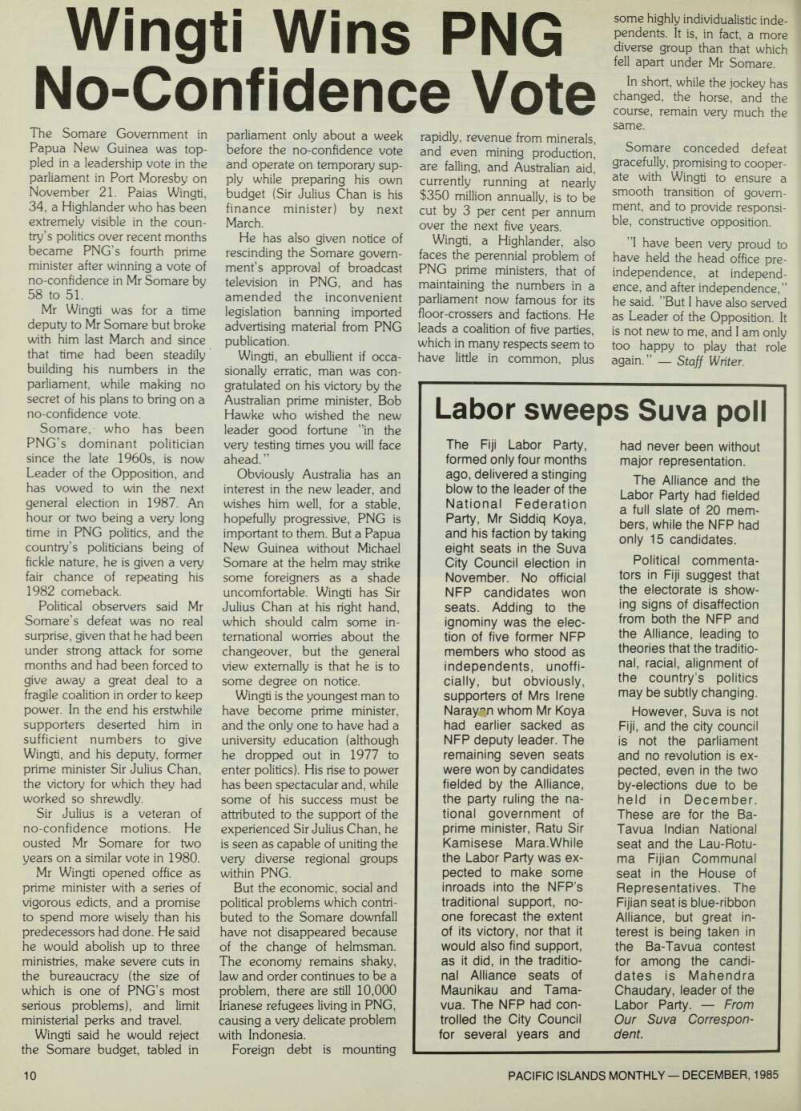
Wingti Wins PNG No-Confidence Vote
The Somare Government in Papua New Guinea was top pled in a leadership vote in the parliament in Port Moresby on November 21. Paias Wingti, 34, a Highlander who has been extremely visible in the coun try’s politics over recent months became PNG’s fourth prime minister after winning a vote of no-confidence in Mr Somare by 58 to 51.
Mr Wingti was for a time deputy to Mr Somare but broke with him last March and since that time had been steadily building his numbers in the parliament, while making no secret of his plans to bring on a no-confidence vote.
Somare, who has been PNG’s dominant politician since the late 19605, is now Leader of the Opposition, and has vowed to win the next general election in 1987. An hour or two being a very long time in PNG politics, and the country’s politicians being of fickle nature, he is given a very fair chance of repeating his 1982 comeback.
Political observers said Mr Somare’s defeat was no real surprise, given that he had been under strong attack for some months and had been forced to give away a great deal to a fragile coalition in order to keep power. In the end his erstwhile supporters deserted him in sufficient numbers to give Wingti, and his deputy, former prime minister Sir Julius Chan, the victory for which they had worked so shrewdly.
Sir Julius is a veteran of no-confidence motions. He ousted Mr Somare for two years on a similar vote in 1980.
Mr Wingti opened office as prime minister with a series of vigorous edicts, and a promise to spend more wisely than his predecessors had done. He said he would abolish up to three ministries, make severe cuts in the bureaucracy (the size of which is one of PNG’s most serious problems), and limit ministerial perks and travel.
Wingti said he would reject the Somare budget, tabled in
parliament only about a week before the no-confidence vote and operate on temporary sup ply while preparing his own budget (Sir Julius Chan is his finance minister) by next March.
He has also given notice of rescinding the Somare govern ment’s approval of broadcast television in PNG, and has amended the inconvenient legislation banning imported advertising material from PNG publication.
Wingti, an ebullient if occa sionally erratic, man was con gratulated on his victory by the Australian prime minister, Bob Hawke who wished the new leader good fortune ”in the very testing times you will face ahead.”
Obviously Australia has an interest in the new leader, and wishes him well, for a stable, hopefully progressive, PNG is important to them. But a Papua New Guinea without Michael Somare at the helm may strike some foreigners as a shade uncomfortable. Wingti has Sir Julius Chan at his right hand, which should calm some in ternational worries about the changeover, but the general view externally is that he is to some degree on notice.
Wingti is the youngest man to have become prime minister, and the only one to have had a university education (although he dropped out in 1977 to enter politics). His rise to power has been spectacular and, while some of his success must be attributed to the support of the experienced Sir Julius Chan, he is seen as capable of uniting the very diverse regional groups within PNG.
But the economic, social and political problems which contri buted to the Somare downfall have not disappeared because of the change of helmsman.
The economy remains shaky, law and order continues to be a problem, there are still 10,000 Irianese refugees living in PNG, causing a very delicate problem with Indonesia.
Foreign debt is mounting
rapidly, revenue from minerals, and even mining production are falling, and Australian aid currently running at nearly $350 million annually, is to be ed by 3 per cent per annum over the next five years.
Wingti, a Highlander, also faces the perennial problem of PNG prime ministers, that of maintaining the numbers in a parliament now famous for its floor-crossers and factions. He leads a coalition of five parties, which in many respects seem to have little in common, plus
some highly individualistic inde pendents. It is, in fact, a more diverse group than that which fell apart under Mr Somare.
In short, while the jockey has changed, the horse, and the course, remain very much the same.
Somare conceded defeat gracefully, promising to cooper ate with Wingti to ensure a smooth transition of govern ment, and to provide responsi ble, constructive opposition. ”1 have been very proud to have held the head office pre independence, at independ ence, and after independence,” he said. ”But I have also served as Leader of the Opposition. It is not new to me, and I am only too happy to play that role
again.”
Staff Writer.