Economic recipe for PNG future
pp. 67-70 · Read in the full issue
PNG future
The first truly embracing study of Papua New Guinea’s post-independ ence economy has just been produced in Canberra, the result of a key recom mendation in the Jackson Re port and part of the current effort by Australia to see if its erstwhile dependent charge can stand a little more firmly on its own feet.
The weighty document (268 close-typed foolscap pages) has been compiled by Raymond Goodman, Charles Lepani and David Morawetz - all highly respected experts in their field and will be the base upon which negotiations will be held for assessing the next five-year Australian aid package, and for much more in PNG’s future.
The report’s conclusion, very broadly, is that PNG is in better shape than might have been expected 10 years ago, but needs some very careful and probably inspired management in the future.
Key recommendations in clude: 1. Maintain law and order, without which the govern ment’s efforts will be under mined. 2. Increase financial and hu
man resources for deve lopment. 3. Reserve government re sources for activities that only government can undertake, while deregulating other areas to encourage private initiative. 4. Maintain sound foreign exchange, monetary and fiscal policies. 5. Raise food and export production, aiming to encour age the bulk of the population to remain in rural areas. 6. Promote only those indus tries which make intensive use of resources which PNG has in plenty. 7. Broaden the tax base and increase customs levies to raise more internal revenue. 8. Use foreign aid on educa tion, training and staff assist ance. 9. Simplify procedures for productive foreign investors, and joint ventures. 10. Encourage recruitment of competent expatriate mana gers, technicians and super visory personnel for positions for which properly qualified lo cals are not available. 11. Gradually reduce the ex ternal value of the kina to stimulate exports and export
substitution and discourage im ports. 12. Find ways to reduce real wages so as to increase in ternational competitiveness. 13. Do not encourage indus tries which need high tariffs or import restrictions. 14. Rationalise provincial government. 15. Reform the administra tion, improve the public service and increase the efficiency of government-owned enter prises, disposing of those not justified by their performance. 16. Use government re sources to improve roads, bridges, ports and harbors. 17. Improve productivity among smallholders in agricul ture, controlling pests and dis eases. 18. Raise standards in educa tion, re-orient secondary and tertiary courses to better suit national conditions, provide more fully for education of females. 19. Adopt an official popula tion control policy. 20. Repeal the Plantation Redistribution Scheme and re habilitate rundown estates; re form land policy.
Since the publication of this report a high-ranking PNG offi
dal delegation has been in Canberra putting a case for no cuts in Australia’s current $350 million per annum grant aid cutting costs being the order of the day in Canberra right now. (See separate report, this issue).
In suggesting that PNG is not yet ready to survive without Australian aid at its full levels the Port Moresby officials, led by the shrewd head of the department of Foreign Affairs and Trade, Paulias Matane, were running counter to the Jackson Report, and against the tide of opinion in Canberra where governmental attention is now focused very heavily on Australia’s own economic prob lems.
There is some basis for the Australian view, among them PNG’s inflation rate (one of the lowest in the world), and the considerable improvement achieved in giving grass-roots Papua New Guineans a better chunk of the gross domestic product. The report shows that their share of the cake is grow ing three times faster than that of expatriates, that average liv ing standards have risen, and that education has improved in its quality and its spread across the country.
Despite the considerable list of recommendations made by the economists, PNG’s performance is recognised.
According to the report, more than half all village households (and most of PNG’s population is still in the villages, despite a concern about urban drift), are now involved in the cash eco nomy and earn from agricultu ral crops such as coffee, cocoa, vegetables and other items.
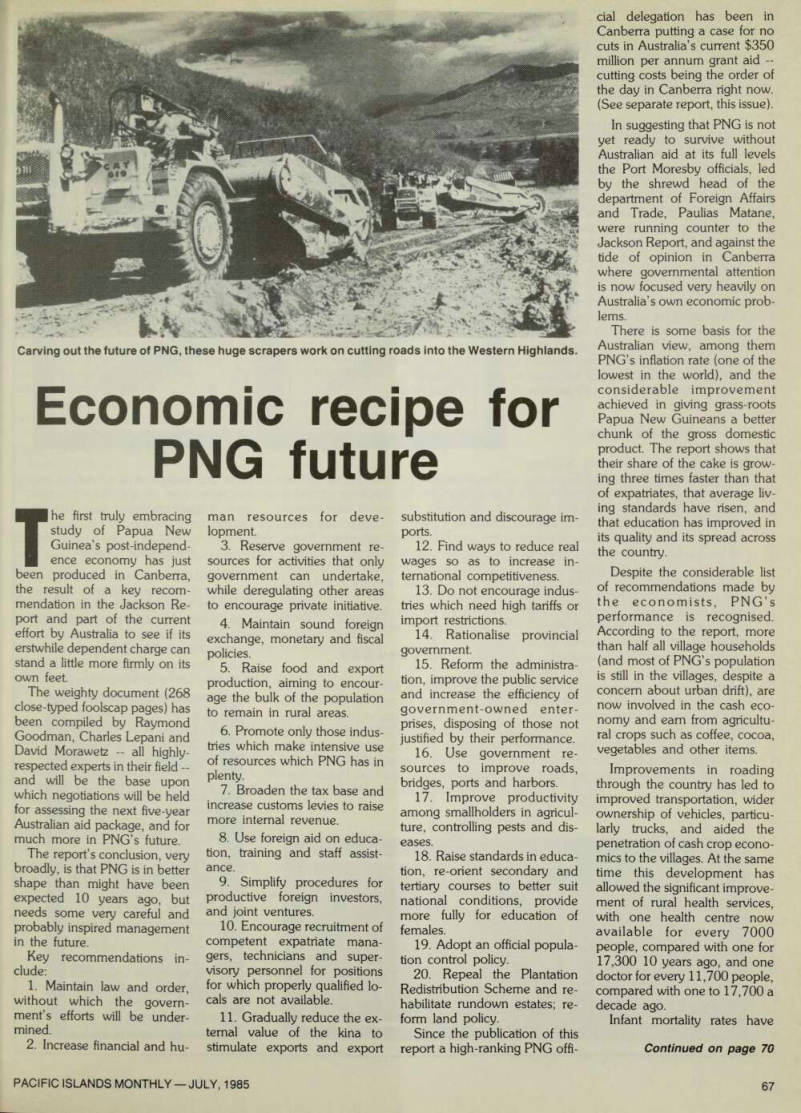
Improvements in reading through the country has led to improved transportation, wider ownership of vehicles, particu larly trucks, and aided the penetration of cash crop econo mics to the villages. At the same time this development has allowed the significant improve ment of rural health services, with one health centre now available for every 7000 people, compared with one for 17,300 10 years ago, and one doctor for every 11,700 people, compared with one to 17,700 a decade ago.
Infant mortality rates have
Continued on page 70
Carving out the future of PNG, these huge scrapers work on cutting roads into the Western Highlands.
dropped nearly 50 per cent in the last 14 years and child mortality by 56 per cent, although these remain far too high, the report says. Average life expectancy is now 50 years, up from 40 in the decade.
Simultaneously, the report says, more trade stores have opened, widening diet choice, turning attention even further towards the use of cash, and improving life styles. ”In a country which in most respects is just beginning to develop, small improvements such as these spread widely across the population mark the beginnings of sustained, re latively equitable, economic growth,” the report said.
In short, says the report, PNG’s progress has been re markable in its years of inde pendence, an opinion which justifies prime minister Michael Somare’s outrage over criticism in the Jackson Report that aid was being wasted and should be subject to supervision, and more closely tied to specific
projects rather than being, as now, simply handed over to support the national budget.
PNG came to independence with considerable problems ahead of it. The economy was largely foreign-owned, the new government lacked essential in struments for national policy making, capital had fled in a massive way because of fore igners’ worry about the new leadership, and the world, gen erally, was reeling from the oil crisis.
Against such odds the leader ship had performed remarkably in maintaining political and eco nomic stability and democratic government. ’Yet serious problems re main which, if not resolved, threaten to abort these achieve ments,” the report says. ’’Skil led and trained people and financial resources for deve lopment are in short supply; wages are higher than in com peting countries; not enougj jobs are being created; pro tectionist pressures are increas ing; lawlessness appears to be on the rise.”
Protectionism remains evi dent. For example, last month
the government announced that from September no fore ign-sourced advertising material would be acceptable; all had to come from PNG-based agen cies.
And the report’s reference to lawlessness is seen by many in PNG as far too delicate. During June prime minister Somare put before parliament a bill aimed at curbing the battalions of ’’rascals” now plaguing the major towns and included in the proposed penalties, public hangings, floggings and other measures designed, hopefully, to make outlaws more careful.
The report examines the PNG economy in detail, study ing the rural sector, industry and mining, minerals and ener gy, government authorities and foreign investments. Social services, transport, communica tions, foreign aid, the public service (a somewhat vexed matter), the role of women (much debased, in the report’s view), and the environment, all come under the experts’ scru tiny.
The report concludes that ’’the changing emphasis of the government of Papua New
Guinea towards economic growth and the creation of productive employment oppor tunities will not be easier to achieve in the future than in the past because, at least in the near term, the conditions that have constrained their attain ment seem unlikely to become more favorable.”
“The population of Papua New Guinea is growing rapidly, creating demands for food, employment and public services that have to be met before a general improvement in living standards can be achieved.
“The skills needed to imple ment development plans quick ly and effectively are still limited.
“The price prospects for most of PNG’s exports are not bright.
“Budgetary resources con tinue to be limited by the difficulty of raising additional revenue and the desire to con tinue moving along the path towards fiscal self-reliance, that is, making do with less external budgetary support without re sorting to excessive borrow ing.” Staff Writer.