on provinces
p. 65 · Read in the full issue
political currents
Somare bites bullet on provinces
Drastic revision of Papua New Guinea’s provin cial government system seems now inevitable in the wake of recent attacks from the mother parliament at Waigani.
Prime minister, Michael So mare, had gone quiet in pre vious months about his 1984 call for a national referendum on provincial governments, but pressure is now building up from his own party followers to do something quickly.
In the May-June sitting of parliament, his fellow members from East Sepik petitioned parliament to suspend the East Sepik provincial government for alleged abuses by provincial politicians and officers.
Somare, the parliaments’s member for East Sepik, did not co-sign the petition, but lent his public support.
Already, three provincial governments are under suspen sion: Enga and Simbu in the Highlands, and Manus in the New Guinea Islands region.
The May meeting of all pre miers was told in closed-door session by the prime minister that if things did not pick up dramatically, some other pro vincial governments would be on the government’s “hit list.”
Prime among these were Cen tral, Gulf, Western and Oro, all in the Papuan region. And now comes the news that the PNG Electoral Commission has pre pared a series of options for the government on the referendum idea.
A full-scale referendum along western lines could prove ex pensive. The last national elec tion cost K 3 million to stage and a referendum would not be much cheaper.
So electoral commissioner,
PNG’s prime minister, Michael Somare, faced with a straitened economy, and a rising public demand for a clean-up of local government, is grasping the nettle presented by the country’s 19 provincial governments. Corruption, waste, nepotism and inefficiency are all alleged to infest the provinces, and cost the country KinalOO million a year money which, right now, PNG needs to save. NOEL PASCOE, in Port Moresby, reports on the situation.
Henry Veratau, has drawn up suggestions, including the radi cal proposal that a modified referendum could be managed with a major debate in parlia ment. This suggestion proposes a “selective referendum” which would see the elected repre sentatives of the people, that is, the 109 members of National Parliament, casting their vote after a series of public meetings around the country and a major debate in parliament.
Even in the best of traditional democracies this could be de scribed as a somewhat flawed method of determining the real mind of the people. One senior public servant at Waigani de scribed it as “reminiscent of the infamous act of free choice foisted upon the people of Irian Jaya by the Indonesian govern ment.”
Back in September last year Mr Somare argued for a re ferendum on solid financial grounds. “Some people will argue against it on the grounds of cost,” he said, “but when one looks at it carefully, it will cost about K 3 million, com pared to the amount of more than KlOO million the national government has to allocate each year to provincial govern ments. ”
He said that results from each
province would be given to parliament to consider, indicat ing an attitude at that time of possibly retaining full provincial government status for some “deserving” provinces while re ducing or abolishing it in other areas where the experiment has apparently failed.
PNG has 19 provincial gov ernments, with an estimated 500 elected members on allow ances, with access to vehicles and, in the case of ministers in many provinces, high-cost housing in provincial capitals.
Wewak (East Sepik) MP and former minister for justice Tony Bais, said that last year KlO million in the provincial budget went on the public servants and only K 2 million was left for development projects.
Mr Bais, a former district commissioner noted for his anti-colonial views, added with ire: “People say that in the colonial days there was a lot of development. Now the govern ment money goes to Wewak and doesn’t reach the rural people. ”
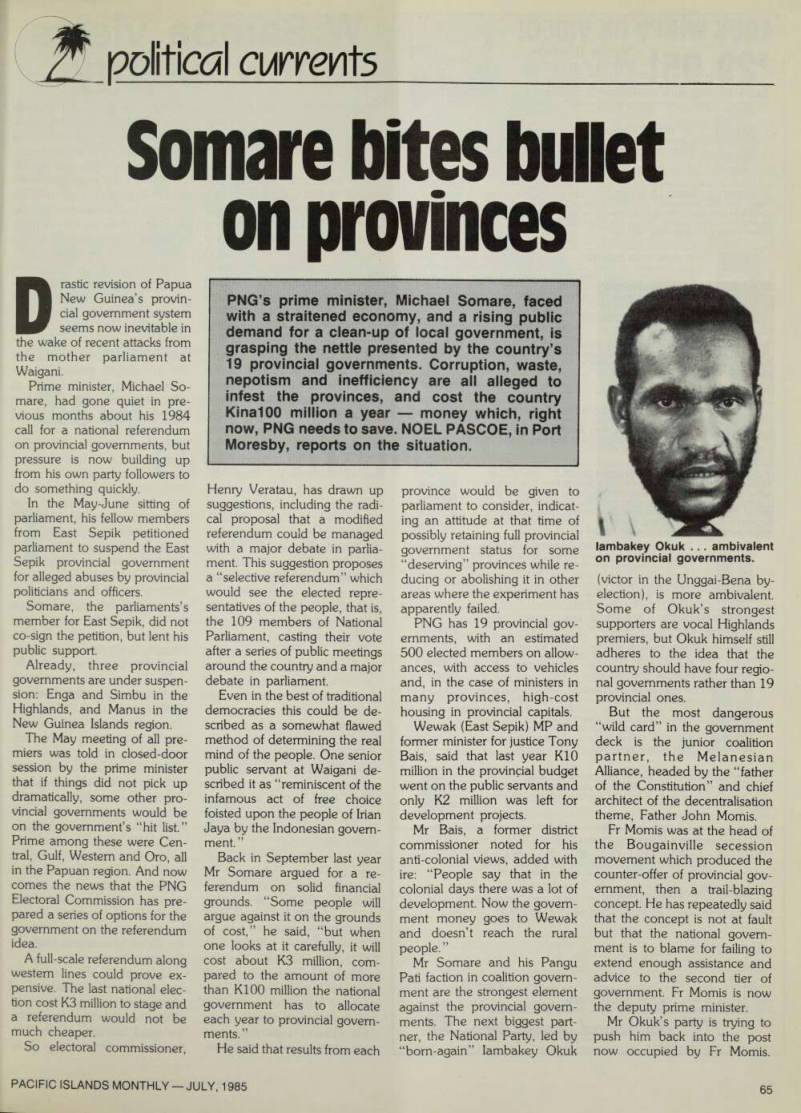
Mr Somare and his Pangu Pati faction in coalition govern ment are the strongest element against the provincial govern ments. The next biggest part ner, the National Party, led by “born-again” lambakey Okuk
(victor in the Unggai-Bena by election), is more ambivalent.
Some of Okuk’s strongest supporters are vocal Highlands premiers, but Okuk himself still adheres to the idea that the country should have four regio nal governments rather than 19 provincial ones.
But the most dangerous “wild card” in the government deck is the junior coalition partner, the Melanesian Alliance, headed by the “father of the Constitution” and chief architect of the decentralisation theme, Father John Momis.
Fr Momis was at the head of the Bougainville secession movement which produced the counter-offer of provincial gov ernment, then a trail-blazing concept. He has repeatedly said that the concept is not at fault but that the national govern ment is to blame for failing to extend enough assistance and advice to the second tier of government. Fr Momis is now the deputy prime minister.
Mr Okuk’s party is trying to push him back into the post now occupied by Fr Momis.
lambakey Okuk ... ambivalent on provincial governments.