Artefacts to go home
pp. 60-61 · Read in the full issue
A major advance in the protection of the cultural heritage of Micronesia and Polynesia has been taken by Unesco and the Australian Museum in Sydney. At the end of April the museum completed a Unesco-funded inventory of virtually all the artefacts from these islands held in Australia.
The inventory, which is being distributed primarily in the Pacific (May, June and July), is believed to be the first of its kind in the world. Andrew Symon looks at its significance.
One legacy of the age of im perialism for Pacific Islanders is that they are often more likely to find examples of weapons, clothing and carvings made by their ancestors in Western museums than on their own islands.
Anthropologists at the Aus tralian Museum in Sydney say that Western contact led to the disintegration of traditional ways of life as new technologies and values were introduced.
This means the end of the manufacture of many items.
Steel replaced stone and wood.
Masks and images used in ceremonies disappeared as rituals to native gods were replaced by Christian worship, Meanwhile, existing objects were shipped to museums from St Petersburg to Hobart as curiosities from remote exotic islands.
Today there are many Pacific islands which lack examples of objects which once were made locally. The anthropologists say that as a result Pacific peoples do not have information about
their past which such artefacts can provide. Without a sense of the past there can be no strong sense of cultural identity, which is much needed to cope with a rapidly changing world.
To help revitalise the cultural identity of the peoples of Polynesia, and Micronesia, the United Nations Education, Sci entific and Cultural Organisa tion and the Australian Museum have taken the major step of compiling a detailed inventory of artefacts from these islands in Australian public collections.
A co-ordinator of the Un esco-funded inventory, Dr Jim Specht, head of the museum’s Anthropology Department, s. ys that it will lead to the return of information about traditional cultures in these areas. Further, it will facilitate exchanges and loans of objects, and the return of material that has been identi fied as being of religious or educative significance.
Dr Specht says the three volume inventory was being distributed to museums and governments in Polynesia, Melanesia and Micronesia (May, June and July). He says this was the first time any country has prepared a detailed listing of artefacts in its public collections from a particular part of the world for internatio nal distribution. Only a few broad preliminary surveys had ever been made.
“There will be a great deal of information returned and a breakdown of distrust. Many have felt museums to have been too secretive. We are saying, ‘we have nothing to hide, there is no shame or guilt,”’ he says.
The inventory details more than 12,000 objects, ranging
from Triton shell trumpets and wicker helmets to war canoes and parts of houses. The Aus tralian Museum estimates that about 90 per cent of Polynesian and Micronesian artefacts in Australia are covered by the inventory.
Work began on the inventory in 1982 as a result of Unesco’s Project for the Study of Pacific Cultures. This project arose out of Unesco’s concern for cul tures in danger of disappearing.
Compiling inventories for use by museum professionals is seen by Unesco as a first step in revitalising a culture. The return of objects, or even the return of information about objects, is argued to have a very stimulat ing effect on a people.
The Australian inventory’s other co-ordinator, Ms Lissant Bolton, also of the Anthropolo gy Department, says that there was a resurgence of the tradi tions of the Gogodala people in Papua New Guinea when a few years ago they were exposed to a photographic inventory of some of their old cultural material by author Tony Craw ford.
Mr Crawford wrote that the older Gogodala men “soon realised that such a record was
not only going to give them a positive identity, but also that the younger men could be taught through this, thus re generating the arts styles, songs, legends and ceremony amongst their children.”
The Gogodala subsequently built a traditional longhouse which has become a cultural centre where many traditions have been recalled.
Dr Specht says the growing efforts to return cultural in formation to various peoples around the world represents a major change of attitude.
Twenty years ago it would have been difficult to compile sur veys for international distribu tion because of a psychological
attitude among museum offi cials that “if you made known what you held, everybody would want it back.”
Ms Bolton says inventories will not cause indiscriminate demands for return of artefacts but “discriminate demands based on a better understan ding of where material is and what it is. ” She says that Pacific collections in Western museums, for example, could be better balanced as a result, for the return of an object of which a museum might have several examples will bring enormous goodwill, allowing the museum to collect other items and information on the island concerned.
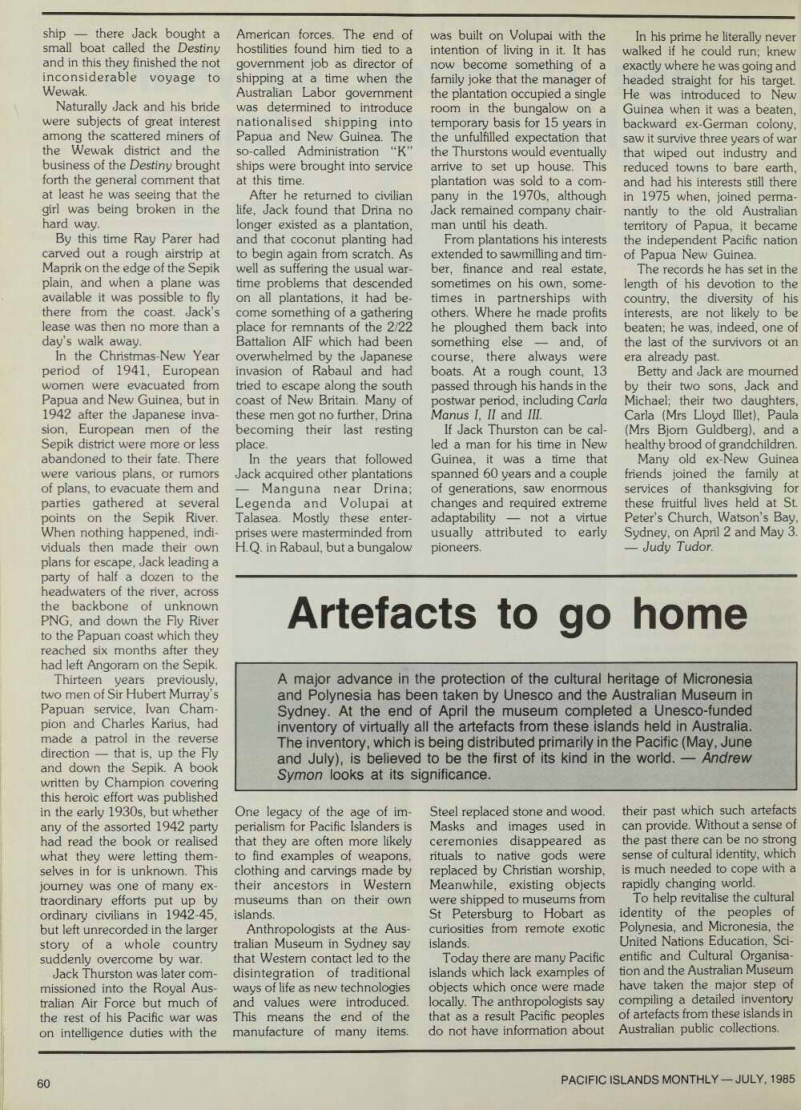
The garment, with a modern look, came from Abaiang, Kiribati and is now in the Australian Museum. Courtesy of the Museum.
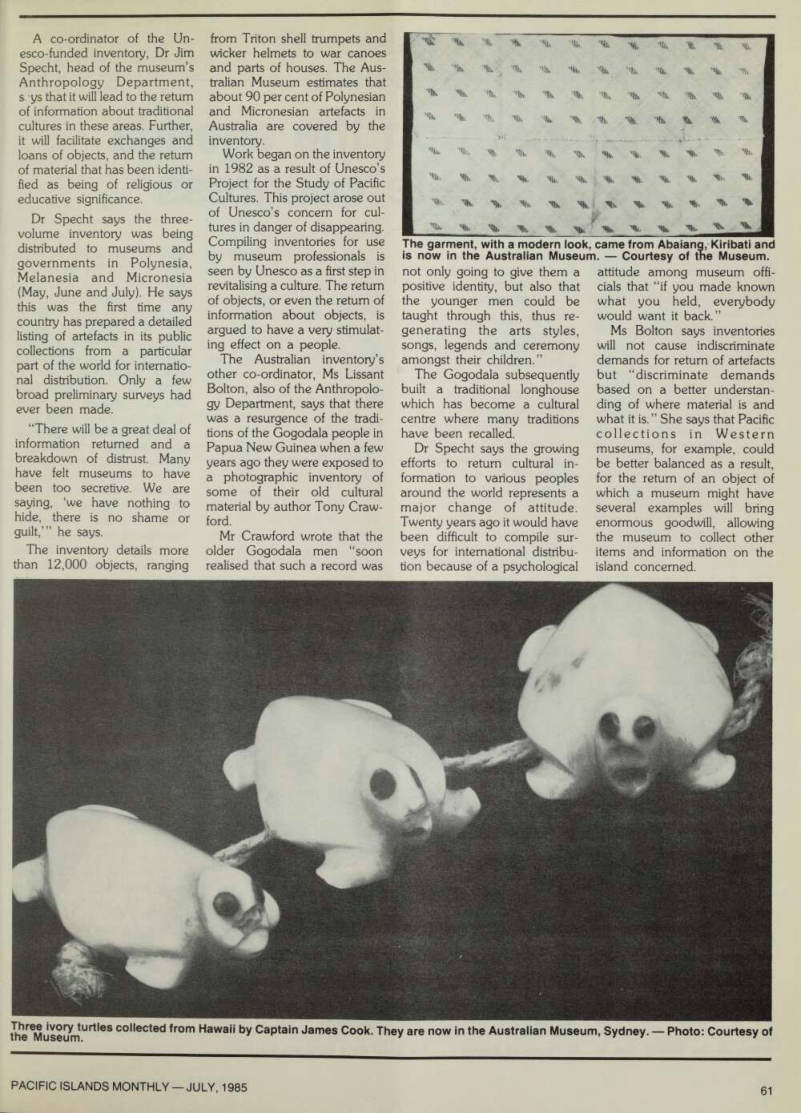
Three ivory turties collected from Hawaii by Captain James Cook. They are now in the Australian Museum. Sydney.-Phpto: Courtesy of the Museum