Fiji traders “biting
pp. 27-28 · Read in the full issue

trade winds
Fiji traders “biting a feeding hand”
A campaign of criticism and complaint has been mounted by Fiji against Australia over trade arrangements under SPARTE CA, the regional aid-through trade-opportunity scheme set up for Forum Island countries by Australia and New Zealand.
Government and industry representatives have accused Australia of tangling the trade in red tape, of applying “hidden” duties of up to 105 per cent “contrary to the spirit of SPAR TECA” and of limiting quotas.
Under the present agreement island countries have a quota of 66,000 units of which Fiji gets 36,000. Fiji says it wants a quota of 500,000 units for 1985-86.
A meeting, held in Sydney last December, failed to satisfy the Fiji Garment Manufacturers’
Association which has been highly critical of what they say are deliberate restrictions im posed on clothing exports to Australia under SPARTE CA. They claim that quotas are limited, that there are “un certainties” in the trade and that “delaying tactics” are used by the Australian government in hearing their grievances.
For their part the Australians say they cannot follow the Fiji reasoning. They say the islands have a better deal than anyone else. Said one Australian trader: “Instead of complaining all the time and asking to be spoon fed, the Fiji crowd should real ise the benefits of the scheme and set about competing with the genuine advantages they have been offered.”
Meantime the industry cam paign continues with diplomatic and political voices also being heard. There have been suggestions from Suva that Fiji should introduce a paper at the Forum’s Regional Committee on Trade, due to be held in
Nauru during June, proposing that SPARTECA was “a fail ure. ”
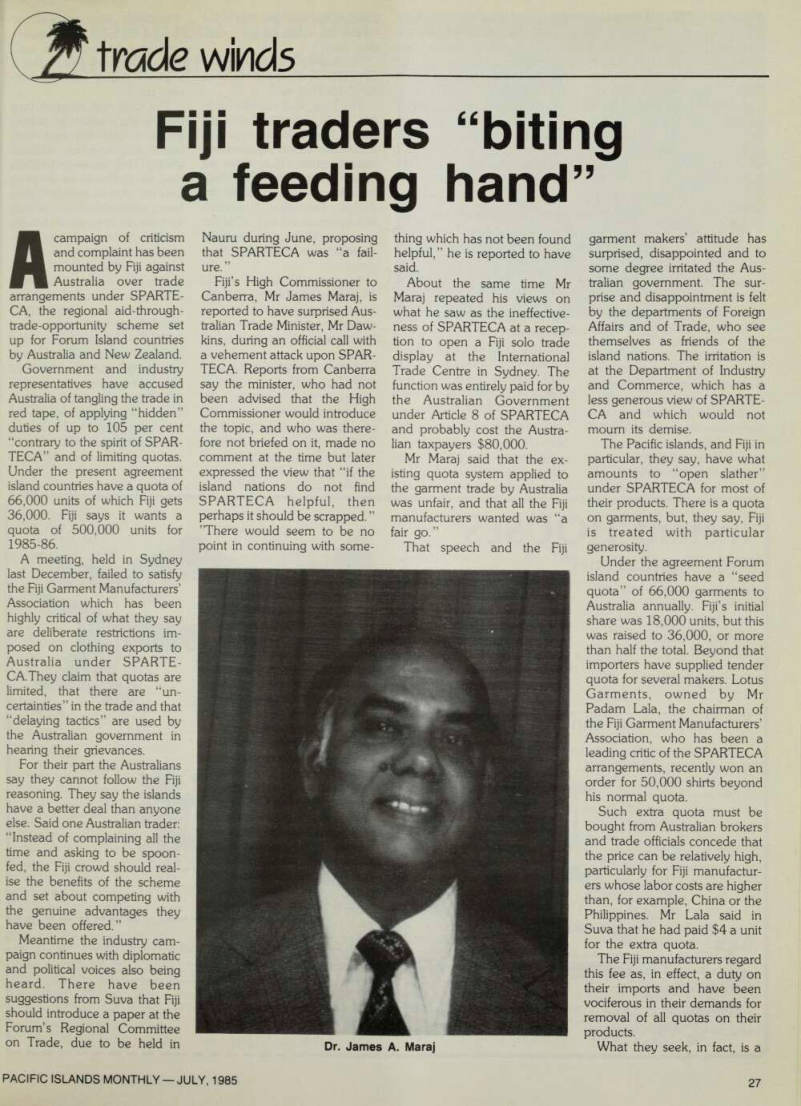
Fiji’s High Commissioner to Canberra, Mr James Maraj, is reported to have surprised Aus tralian Trade Minister, Mr Daw kins, during an official call with a vehement attack upon SPAR TECA. Reports from Canberra say the minister, who had not been advised that the High Commissioner would introduce the topic, and who was there fore not briefed on it, made no comment at the time but later expressed the view that “if the island nations do not find SPARTECA helpful, then perhaps it should be scrapped. ” ’’There would seem to be no point in continuing with some
thing which has not been found helpful,” he is reported to have said.
About the same time Mr Maraj repeated his views on what he saw as the ineffective ness of SPARTECA at a recep tion to open a Fiji solo trade display at the International Trade Centre in Sydney. The function was entirely paid for by the Australian Government under Article 8 of SPARTECA and probably cost the Austra lian taxpayers $BO,OOO.
Mr Maraj said that the ex isting quota system applied to the garment trade by Australia was unfair, and that all the Fiji manufacturers wanted was “a fair go.”
That speech and the Fiji
garment makers’ attitude has surprised, disappointed and to some degree irritated the Aus tralian government. The sur prise and disappointment is felt by the departments of Foreign Affairs and of Trade, who see themselves as friends of the island nations. The irritation is at the Department of Industry and Commerce, which has a less generous view of SPARTE CA and which would not mourn its demise.
The Pacific islands, and Fiji in particular, they say, have what amounts to “open slather” under SPARTECA for most of their products. There is a quota on garments, but, they say, Fiji is treated with particular generosity.
Under the agreement Forum island countries have a “seed quota” of 66,000 garments to Australia annually. Fiji’s initial share was 18,000 units, but this was raised to 36,000, or more than half the total. Beyond that importers have supplied tender quota for several makers. Lotus Garments, owned by Mr Padam Lala, the chairman of the Fiji Garment Manufacturers’
Association, who has been a leading critic of the SPARTECA arrangements, recently won an order for 50,000 shirts beyond his normal quota.
Such extra quota must be bought from Australian brokers and trade officials concede that the price can be relatively high, particularly for Fiji manufactur ers whose labor costs are higher than, for example, China or the Philippines. Mr Lala said in Suva that he had paid $4 a unit for the extra quota.
The Fiji manufacturers regard this fee as, in effect, a duty on their imports and have been vociferous in their demands for removal of all quotas on their products.
What they seek, in fact, is a
Dr. James A. Maraj
guaranteed market in Australia, without quota or duty, and there is no practical way of giving them that. The Austra lians say that the garment mar ket is highly complex, that the quota system is a fact of life in international trade, that Fiji is, in fact, given better access and more generous terms than any other supplier country, and that SPARTECA is a gift to the Pacific island countries, neither Australia nor New Zealand get ting any concession in return.
Fiji’s real problem, say in dustry experts in Australia, and Hong Kong, is high costs caused partly by inefficiencies of management and produc tion, and partly, by comparison with their major competitors, high labor charges. Their other difficulty is that they have yet to fully understand, and operate within the complex Australian tendering system for import quotas with its tendering. And their reaction to it all, while to some degree understood all round, does now appear to be endangering the whole SPAR
TECA structure.
Four Fiji manufacturers are involved in the Australian trade at present. These are Lotus, Tiki Togs, Narotam Garments and G.B.Hari.
Lotus produces garments for Givoni of Australia and also Henry Bucks, an up-market menswear store in Melbourne, which supplies high grade cloth for Fiji to cut and make.
Narotam makes Farah brand men’s slacks under licence for the Australian brand owner and also shirts. Ramesh Solanki, managing director of Narotam, told the Fiji Times recently that Farah was prepared to order up to 30,000 units a month, but that all it was able to get under the SPARTECA scheme was a little over 1000 a month. Addi tionally it had orders for 15,000 high fashion shirts, but was unable to meet this demand under the present system.
G.B.Hari, a later arrival in the SPARTECA trade, has won an initial order for 19,000 gar ments, but, according to
director Raman Hari, has been unable to obtain quota to ex port them.
“I don’t know whether SPARTECA is just a gimmick or not,” Mr Hari said.
Tiki Togs, well-established in the bula shirt, and tropical casual dress fields, has plans to enter the North Queensland resort market. They have an order for uniforms from Hay man Island Resort, one of the Ansett Transport Industries hotels, which will take all of the quota of 3000 units they have reserved for their pilot ship ment.
Desmond Whiteside, of Tiki Togs, said he thought the gar ment industry had enormous potential for Fiji and forecast it would become a major export earner.
Before SPARTECA began in 1981 the industry in Fiji em ployed 300 people, Mr Whiteside said. But, due to the opportunities offered under the scheme the industry had ex panded rapidly and today em ployed at least 2000.
Australian garment marketers say the Fiji manufacturers are confusing import duty with quota premiums. The market is available if they learn to com pete for it.
The only real question they raise is Fiji’s ability to supply goods in the numbers they could sell, and to maintain quality. They say some factories may be too small to keep up with the level of orders already being taken. Other makers may be brought in to meet delivery dates which may produce prob lems of quality.
It may ultimately be neces sary for Fiji to license exporters to ensure that quality and spe cifications are maintained.
“They have got a golden run now, and a great opportunity,” said one trader. “But if some one starts cutting his cloth a bit too close to make more money, and the garments start coming back from dissatisfied buyers, then a very good trade could be destroyed overnight. Quality, and performance are what it’s all about.”