"The solution
pp. 10-12 · Read in the full issue
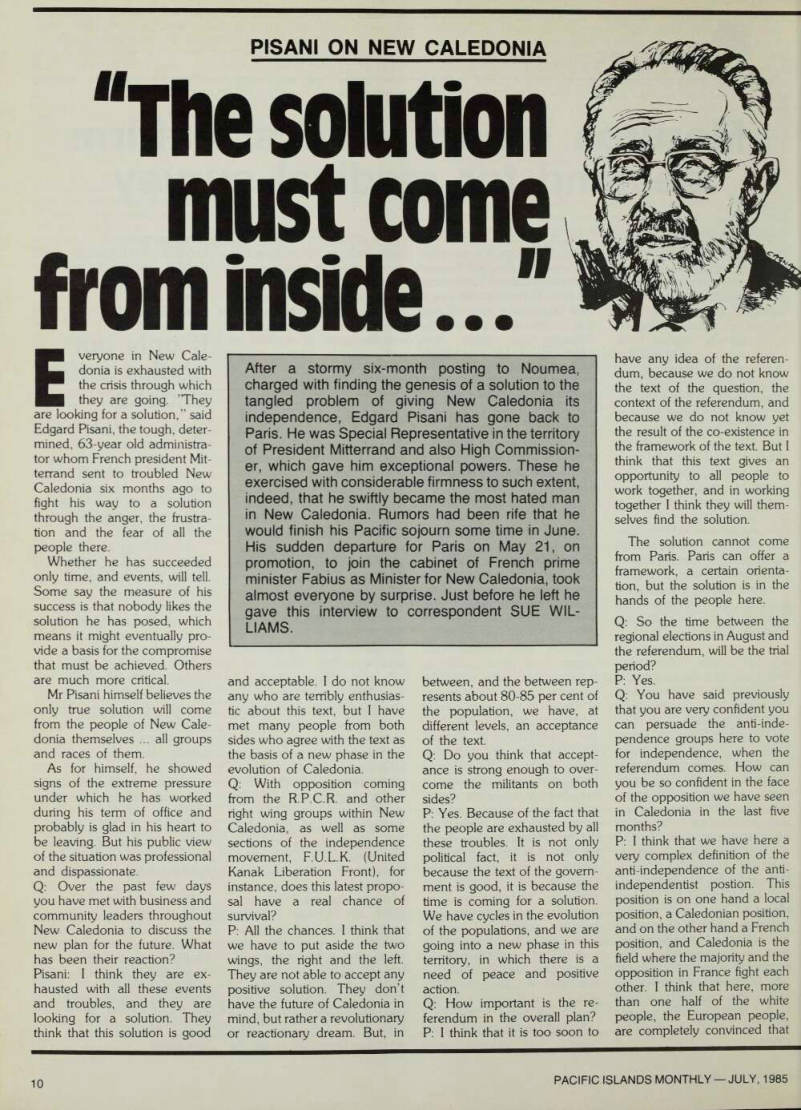
Pisani On New Caledonia
"The solution must come from inside
Everyone in New Cale donia is exhausted with the crisis through which they are going. ’They are looking for a solution,” said Edgard Pisani, the tough, deter mined, 63-year old administra tor whom French president Mit terrand sent to troubled New Caledonia six months ago to fight his way to a solution through the anger, the frustra tion and the fear of all the people there.
Whether he has succeeded only time, and events, will tell.
Some say the measure of his success is that nobody likes the solution he has posed, which means it might eventually pro vide a basis for the compromise that must be achieved. Others arc much more critical.
Mr Pisani himself believes the only true solution will come from the people of New Cale donia themselves ... all groups and races of them.
As for himself, he showed signs of the extreme pressure under which he has worked during his term of office and probably is glad in his heart to be leaving. But his public view of the situation was professional and dispassionate.
Q: Over the past few days you have met with business and community leaders throughout New Caledonia to discuss the new plan for the future. What has been their reaction?
Pisani: I think they are ex hausted with all these events and troubles, and they are looking for a solution. They think that this solution is good
After a stormy six-month posting to Noumea, charged with finding the genesis of a solution to the tangled problem of giving New Caledonia its independence, Edgard Pisani has gone back to Paris. He was Special Representative in the territory of President Mitterrand and also High Commission er, which gave him exceptional powers. These he exercised with considerable firmness to such extent, indeed, that he swiftly became the most hated man in New Caledonia. Rumors had been rife that he would finish his Pacific sojourn some time in June.
His sudden departure for Paris on May 21, on promotion, to join the cabinet of French prime minister Fabius as Minister for New Caledonia, took almost everyone by surprise. Just before he left he gave this interview to correspondent SUE WIL
Liams.
and acceptable. I do not know any who are terribly enthusias tic about this text, but I have met many people from both sides who agree with the text as the basis of a new phase in the evolution of Caledonia.
Q: With opposition coming from the R.P.C.R. and other right wing groups within New Caledonia, as well as some sections of the independence movement, F.U.L.K. (United Kanak Liberation Front), for instance, does this latest propo sal have a real chance of survival?
P; All the chances. I think that we have to put aside the two wings, the right and the left.
They are not able to accept any positive solution. They don’t have the future of Caledonia in mind, but rather a revolutionary or reactionary dream. But, in
between, and the between rep resents about 80-85 per cent of the population, we have, at different levels, an acceptance of the text.
Q; Do you think that accept ance is strong enough to over come the militants on both sides?
P: Yes. Because of the fact that the people are exhausted by all these troubles. It is not only political fact, it is not only because the text of the govern ment is good, it is because the time is coming for a solution.
We have cycles in the evolution of the populations, and we are going into a new phase in this territory, in which there is a need of peace and positive action.
Q: How important is the re ferendum in the overall plan?
P: I think that it is too soon to
have any idea of the referen dum, because we do not know the text of the question, the context of the referendum, and because we do not know yet the result of the co-existence in the framework of the text. But I think that this text gives an opportunity to all people to work together, and in working together I think they will them selves find the solution.
The solution cannot come from Paris. Paris can offer a framework, a certain orienta tion, but the solution is in the hands of the people here.
Q: So the time between the regional elections in August and the referendum, will be the trial period?
P: Yes.
Q: You have said previously that you are very confident you can persuade the anti-inde pendence groups here to vote for independence, when the referendum comes. How can you be so confident in the face of the opposition we have seen in Caledonia in the last five months?
P: I think that we have here a very complex definition of the anti-independence of the anti independentist postion. This position is on one hand a local position, a Caledonian position, and on the other hand a French position, and Caledonia is the field where the majority and the opposition in France fight each other. I think that here, more than one half of the white people, the European people, are completely convinced that
independence is on the way in any case, and we have to demonstrate to them that the sooner it comes, the better.
Because, I think, that if we hide the problem over five years, it will spring up again very much worse than it is now. I think the timing of this proposal is the best we could have hoped for.
Q: Are you disappointed that your calendar for independ ence next year was not adopted by your government?
P: I am never disappointed.
When a man has to face such a problem, he has to be adamant, without any disappointment, without any personal feeling.
Q: And you can be like that?
P: It’s not so easy .. it’s very difficult to be such, but I have to be such, and I am not at all disappointed by the choice made by the French Govern ment. Because, I suggested two ways the other which was the referendum in September, and this way, and the government chose this way with a two and a half year trial period to renew the relationship between the communities.
It is a very good solution. For me it is the best one, because it has been chosen by the govern ment. You see, when two solu tions are in balance, different but equally good, the best one is that which is chosen by those responsible in power. Now I have completely forgotten the other solution.
Q: So in your job now, to
devise a plan for the economic and social restructure of New Caledonia, what are your main goals?
P; Education and training the experience of responsibility for the Melanesian people in the towns and regions, agricultural development, solution of the land tenure problem, and perhaps, mainly, the opportun ity for the two communities to work together.
Q: Do you think the people of Noumea will accept such changes as will come about after the regionalisation of New Caledonia, with Noumea then being by-passed as the main hub of economic and social activity?
P: Caledonia without Noumea is nothing; Noumea without Caledonia is nothing. They have to work together. The wealth of Noumea is reaching its ceiling, because of the rela tive poverty of the territory, and without Noumea, the machine, Caledonia has no chance of development. Regionalisation is an attempt to spread out the wealth of Noumea in the terri tory, and to give Noumea a new impetus in the economic field. But this is not the main problem. The main problem is for the European people to accept to share the power, to accept to share the wealth.
Q: Do you understand though, their feeling of fear that they may lose everything -everything they have fought
for, built and invested in this country?
P: To take the problem by another way, imagine this status remaining. There would be no peace, no chance of deve lopment. In this political ba lance, this position, Caledonia will not, could not, know any peace, any development, be cause the Melanesian people do not accept this present situa tion.
We are trying to set up a more balanced system, where European people, Melanesian people, and other communities, will have a fair place in power and in the economy.
Q: But what about the very vocal viewpoint that you parti cularly, and your government, have allowed the F.L.N.K.S. to operate freely as criminals in this country, murdering, bur ning, robbing...?
P: How many murders? And you have no murders on the other side? We have to take into account the fact that when a political need, a political de mand, is made and remains strong and loud, no-one can stop the violence.
I think, we think, that the Melanesian demand is largely legitimate, normal.
We have to redefine the system of managing this coun try to take this demand into account, and nowhere in the world can anyone stop this kind of evolution. The United King dom knows perfectly well this problem, France knows perfect ly well this problem. Can we
repeat our mistakes? A French philosopher wrote in the 19th century “When you cannot stop a revolution, please do it by yourself.”
Q: How many countries have you helped prepare for inde pendence?
F: This is the first. But I used to work with newly-independent countries, many of them 90.
I have visited perhaps 60 new ly-independent countries and negotiated with them their own development so I know the difficulties of independence.
In my dream we are trying to succeed, building up an inde pendence. It is a very ambitious job and to succeed here we have to face three problems.
The Kanak demand, the rights of the other communities, and the necessity for France to remain present in this region of the world. I think we can succeed.
Q: You sound very positive.
P: I think we are on the way, and I think we are in a country where cyclones are frequent, so we have to avoid, if it is possible, cyclones, and we have to proceed quietly, without any trouble.
Q: Surely, that is one of the difficulties with New Caledonia.
Is it not like a pressure cooker, and you cannot predict when it will explode? A few weeks ago things appeared to be calming down, and yet look at the events we have just experi enced?
P: Yes. Let us look back to the events of May 8. All the ingredients were there for an
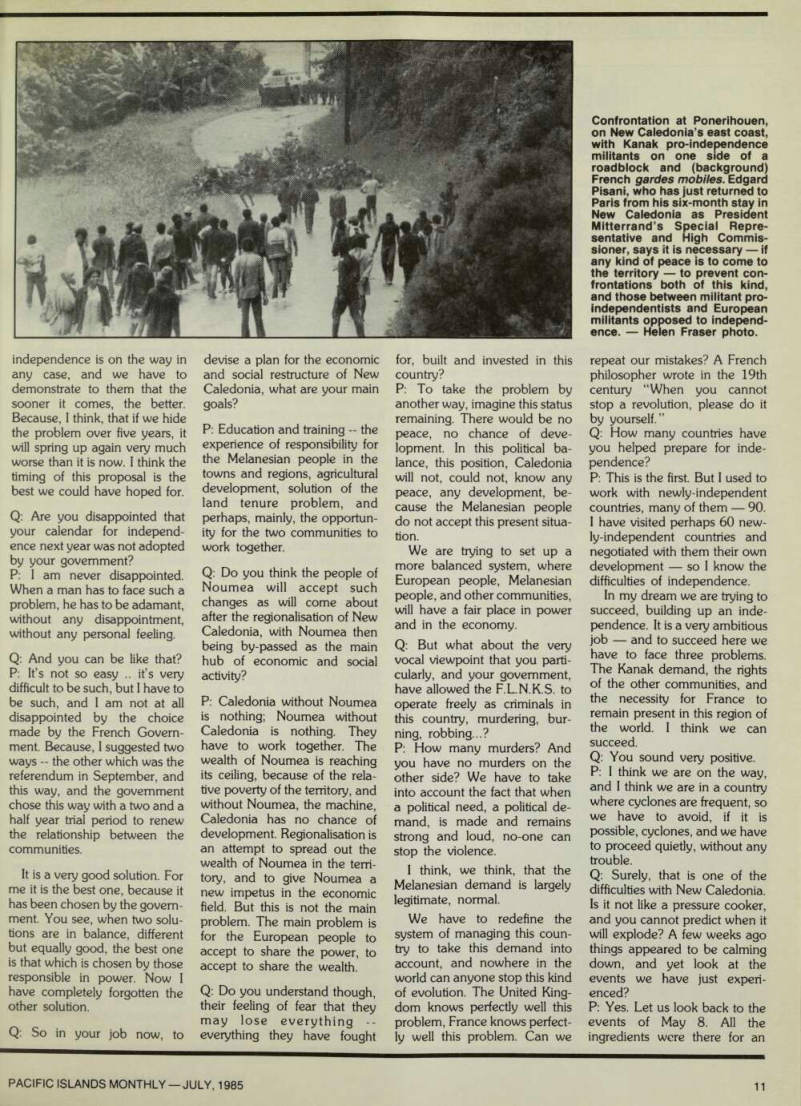
Confrontation at Ponerihouen, on New Caledonia’s east coast, with Kanak pro-independence militants on one side of a roadblock and (background) French gardes mobiles. Edgard Pisani, who has just returned to Paris from his six-month stay in New Caledonia as President Mitterrand’s Special Repre sentative and High Commis sioner, says it is necessary - if any kind of peace is to come to the territory - to prevent con frontations both of this kind, and those between militant pro independentists and European militants opposed to independ ence. - Helen Fraser photo.
explosion - but no explosion occurred. We were on the brink for several hours. But, how many people were on the streets? Fifteen hundred? Cer tainly no more. Six months ago there were 20,000 people. The situation is not the same as it was. I am not saying that we are
succeeding. I am not saying that I am sure to succeed. But I am saying that we are on the way and that people here are aware of the dangers confronting them.
Q; What is your biggest frustra tion in this job? You said earlier you had to maintain a fairly
inhuman front, but the job has obviously taken its toll.
P: I have no frustration. You see, democracy for me is a system where one who cannot convince others does not ac cuse others, but accuses him self, and I have the feeling that we are on the way to convin cing a large majority that the only way is to work together again in the framework of a totally new definition of the relationship between France and Caledonia.
Q: What has been your greatest satisfaction?
P: 0h...1 have a lot of them, the main satisfaction is clearly, alas, the meeting of young scholars, the young people, on May 9, when they called to us to be responsible, telling us the future is in our hands. This fact has been paid for by the death of a young Melanesian (in the riot of May 8), but the reaction has been a white guy and a black girl asking us to face our re sponsibilities and to build Cale donia. Yes ... and it is because of that, in spite of all, I am confident. And not even confi dent, I am adamant.
Q; And if you return to Paris, will you continue your work on New Caledonia?
P: Ask President Mitterrand. I don’t know. But I will never forget Caledonia. Caledonia will be present in my mind in any case, because I reached
here the extreme point of my capability.
Q; Do you think true democra cy is possible here? I mean, is a Kanak socialist government a democracy?
P: I think the majority of F.L.N.K.S. and L.K.S. are strongly democratic, but I know that some people among the independentists are more re volutionary, so we will have problems. And I know that independence is very difficult with a democratic system such as ours. But I think that the men I know are truly democrats respectful of men, respectful of differences between the com munities, and able to imagine forms of democracy at the village level, and town level, that we do not know. Less formal, more based on solidar ity, biological solidarity. I think that it’s not impossible to have here a true democracy with some original aspects.
Q: That leaves the question wide open, doesn’t it? Such a democracy could mean many things. P: The problem is not only in the hands of the inde pendentists, it is at the same time in the hands of the anti independentists. If these ones accept to go in this way, the future is open. If independence has to be conquered achieved the hard way then democracy could become more difficult.
Map of the proposed four autonomous regions into which New Caledonia is to be divided under the new plan of the French Government. Each region will be administered by an elected council, and will also form a constituency for elections to a
territory wide Congress.
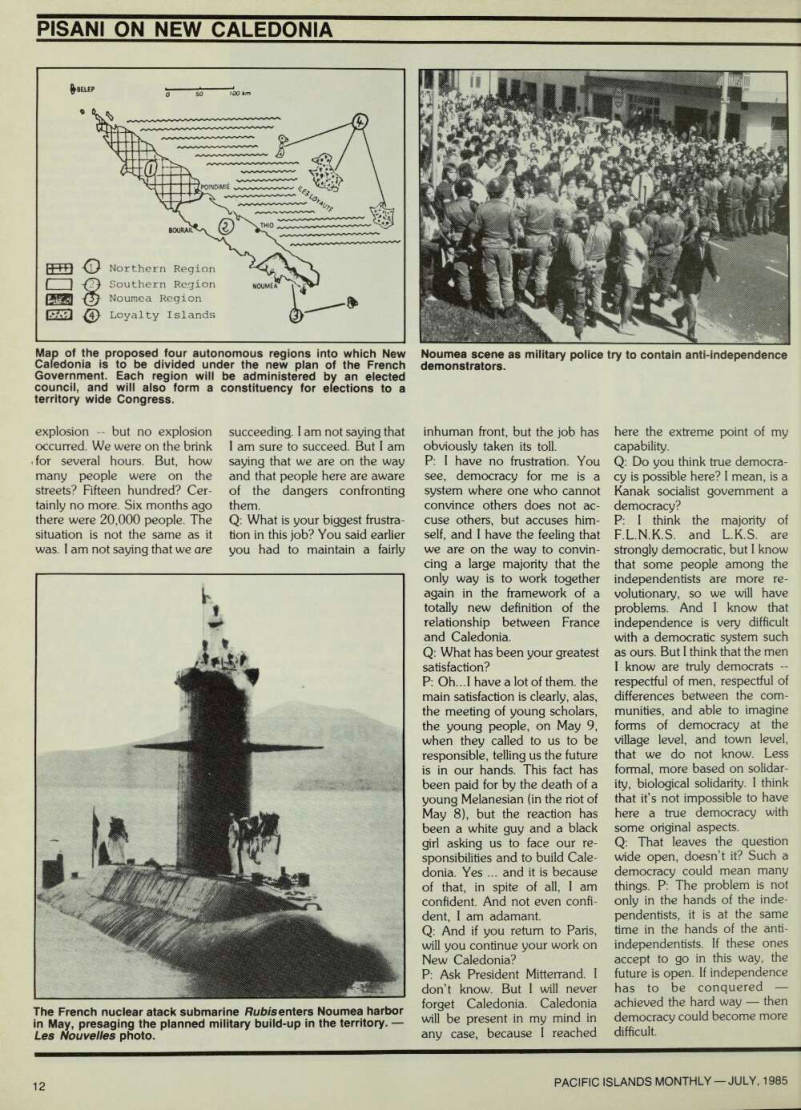
The French nuclear atack submarine Rubise nters Noumea harbor in May, presaging the planned military build-up in the territory.- Les Nouvelles photo.
Noumea scene as military police try to contain anti-independence demonstrators.