and Reality
p. 56 · Read in the full issue
Tahiti . . . the Dream, and Reality
When Western holidaymakers dream of tropic isles, grass-skirted maidens and balmy tradewinds softly caressing palm trees (which is the sort of thing holidaymakers tend to conjure up in their more hedonistic moments), they often think of Tahiti.
For all sorts of reasons, historic, fictional, literary, artistic and com mercial, Tahiti is the name they think of.
They might not always end up in
Tahiti. Indeed, the tourist head-count shows more go to Fiji by a factor of 2'/ 2 to one. But they think of Tahiti.
Fiji’s success is another story . . . forward thinking, investment, histor ical associations with Australia and New Zealand, and many other factors have made it the leader in Pacific tourism ... so that today they have better than 200,000 tourist visitors a year.
Tahiti by comparison has about
90,000 or slightly less, but is now very seriously seeking more, partly because it must now find jobs for 1800 Polynesian school-leavers each year, and tourism, which employs only about 4000 at the moment, looks like the best way of making a lot of jobs in a hurry at relatively little cost. It is labor intensive, and
relatively undemanding of high
technology skills at the customer service end.
Like many things in Tahiti tourism is, of course, quite political. Gaston Flosse, leader of the present local government, claims that the fairly slow progress being made by Tahiti’s tourist industry is the result of over centralised rule imposed by the ministries in Paris. Since he took over as Vice-President in 1982 he has tried to win wider powers over foreign investment and commerce and international air traffic.
Outsiders wonder about this and, while recognising the mysteries and
complications of French Polynesian
affairs, think that advances would be greater if there were less, rather than more, political intervention. Analysts observe that anyone with the capacity to sign a cheque to the value of a 200room resort hotel is unlikely to view kindly the prospect of political power plays in the vicinity of his money.
But, many aspects of the tourism picture in Tahiti are very encourag ing. The local government last year spent more than 100 million Pacific francs (about $A704,000) on promo tional campaigns in the U.S. Aust ralia, New Zealand and Europe.
Foreign investors are also wooed by not only substantial tax reductions (which are, of course, useful only if the enterprise makes a profit within the stipulated time) but soft loans from local banks and a three-year holiday from half the social security charges for their staff.
Academics absorbed by Tahiti’s complex human and natural environ ment tend to agonise over any expan sion of tourism and sometimes see
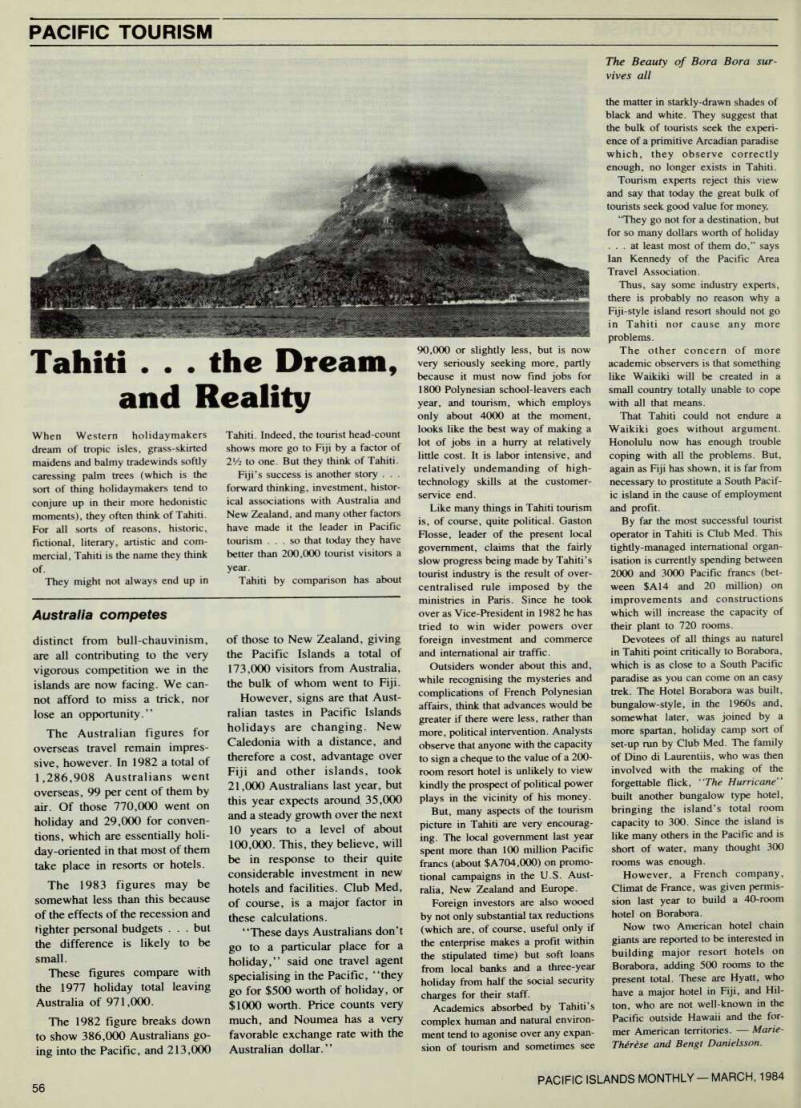
The Beauty of Bora Bora sur vives all the matter in starkly-drawn shades of black and white. They suggest that the bulk of tourists seek the experi ence of a primitive Arcadian paradise which, they observe correctly enough, no longer exists in Tahiti.
Tourism experts reject this view and say that today the great bulk of tourists seek good value for money.
“They go not for a destination, but for so many dollars worth of holiday ... at least most of them do,” says lan Kennedy of the Pacific Area Travel Association.
Thus, say some industry experts, there is probably no reason why a Fiji-style island resort should not go in Tahiti nor cause any more problems.
The other concern of more academic observers is that something like Waikiki will be created in a small country totally unable to cope with all that means.
That Tahiti could not endure a Waikiki goes without argument.
Honolulu now has enough trouble coping with all the problems. But, again as Fiji has shown, it is far from necessary to prostitute a South Pacif ic island in the cause of employment
and profit.
By far the most successful tourist operator in Tahiti is Club Med. This tightly-managed international organ isation is currently spending between 2000 and 3000 Pacific francs (bet ween SAI4 and 20 million) on improvements and constructions which will increase the capacity of their plant to 720 rooms.
Devotees of all things au naturel in Tahiti point critically to Borabora, which is as close to a South Pacific paradise as you can come on an easy trek. The Hotel Borabora was built, bungalow-style, in the 1960 sand, somewhat later, was joined by a more spartan, holiday camp sort of set-up run by Club Med. The family of Dino di Laurentiis, who was then involved with the making of the forgettable flick, “The Hurricane ” built another bungalow type hotel, bringing the island’s total room capacity to 300. Since the island is like many others in the Pacific and is short of water, many thought 300 rooms was enough.
However, a French company, Climat de France, was given permis sion last year to build a 40-room hotel on Borabora.
Now two American hotel chain giants are reported to be interested in building major resort hotels on Borabora, adding 500 rooms to the present total. These are Hyatt, who have a major hotel in Fiji, and Hil ton, who are not well-known in the Pacific outside Hawaii and the for
mer American territories.
Marie-
Therese and Bengt Danielsson.