someone’s fault - but whose?’
pp. 45-47 · Read in the full issue
Death at Walanga: ‘lt must be someone’s fault - but whose?’
Continuing the account of his sojourn, with his brother MARCO, on Papua’s Rossel Island (see PIM Feb.), ROBERTO PETTINI tells of Rossel’s unique custom money ndap, and of the “death feast” and public disputation which followed the death of a woman at Rossel’s Walanga Village.
January 13, 1981: If Tam is the biggest village we have seen on Rossel so far, Sa man is certainly the most beautiful.
Many free-standing huts scat
tered along a stretch of coast, which is covered with enormous shade trees, and with a white sandy beach where we collected shells of a thousand shapes and colors.
We are guests of the village chief, who has the largest hut and the biggest family, 10 children, all from the same wife, plus many brothers, also married with mapy children. Chief and rela tives constitute practically half the population of Saman.
January 14: This morning we went to collect pippies with John, one of the chiefs youngest children.
After our canoe had gone some distance up the river, we stopped and entered a mangrove forest. We were in water up to our chins, and in less than an hour we had collected enough pippies to fill two baskets and had been bombarded by squad rons of mosquitoes.
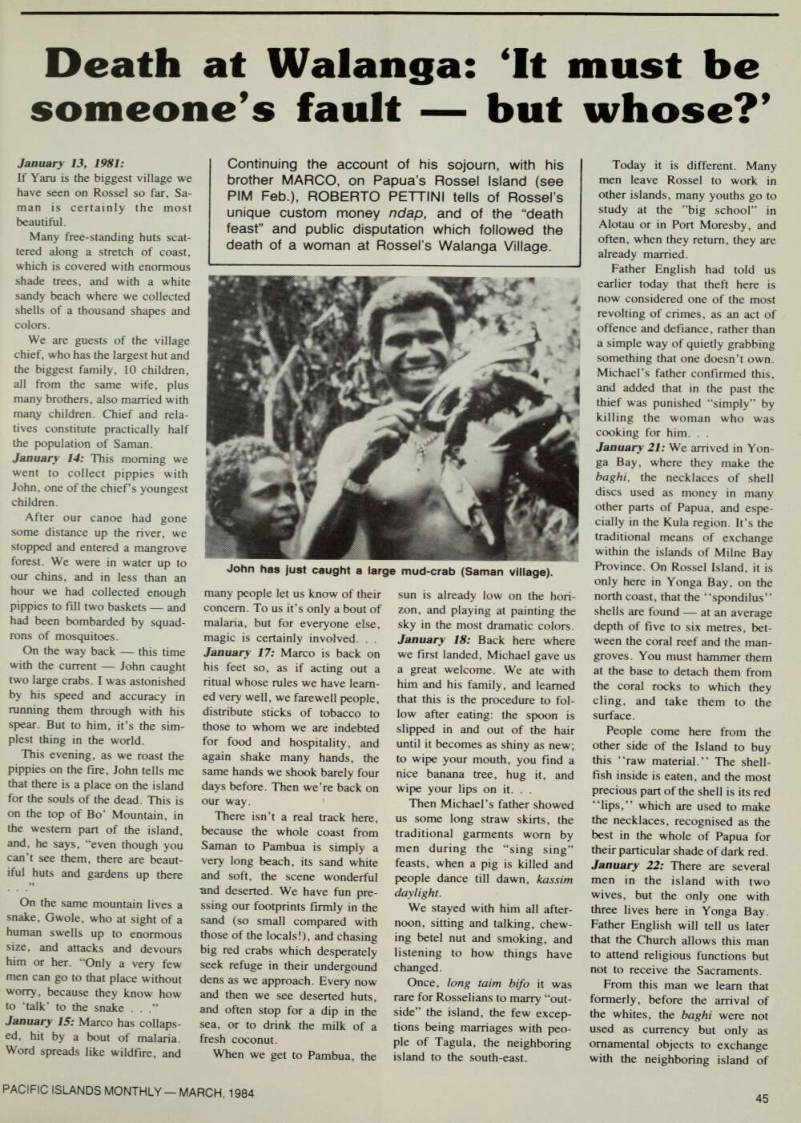
On the way back this time with the current John caught two large crabs. I was astonished by his speed and accuracy in running them through with his spear. But to him, it’s the sim plest thing in the world.
This evening, as we roast the pippies on the fire, John tells me that there is a place on the island for the souls of the dead. This is on the top of Bo’ Mountain, in the western part of the island, and, he says, “even though you can’t see them, there are beaut iful huts and gardens up there On the same mountain lives a snake, Gwole, who at sight of a human swells up to enormous size, and attacks and devours him or her. “Only a very few men can go to that place without worry, because they know how to ‘talk’ to the snake ...”
January 15: Marco has collaps ed, hit by a bout of malaria.
Word spreads like wildfire, and
many people let us know of their concern. To us it’s only a bout of malaria, but for everyone else, magic is certainly involved. . .
January 17: Marco is back on his feet so, as if acting out a ritual whose rules we have learn ed very well, we farewell people, distribute sticks of tobacco to those to whom we are indebted for food and hospitality, and again shake many hands, the same hands we shook barely four days before. Then we’re back on our way.
There isn’t a real track here, because the whole coast from Saman to Pambua is simply a very long beach, its sand white and soft, the scene wonderful mid deserted. We have fun pre ssing our footprints firmly in the sand (so small compared with those of the locals!), and chasing big red crabs which desperately seek refuge in their undergound dens as we approach. Every now and then we see deserted huts, and often stop for a dip in the sea, or to drink the milk of a fresh coconut.
When we get to Pambua, the
sun is already low on the hori zon, and playing at painting the sky in the most dramatic colors.
January 18: Back here where we first landed, Michael gave us a great welcome. We ate with him and his family, and learned that this is the procedure to fol low after eating; the spoon is slipped in and out of the hair until it becomes as shiny as new; to wipe your mouth, you find a nice banana tree, hug it, and wipe your lips on it. . .
Then Michael’s father showed us some long straw skirts, the traditional garments worn by men during the “sing sing’’ feasts, when a pig is killed and people dance till dawn, kassim daylight.
We stayed with him all after noon, sitting and talking, chew ing betel nut and smoking, and listening to how things have changed.
Once, long taint bifo it was rare for Rosselians to marry “out side” the island, the few excep tions being marriages with peo ple of Tagula, the neighboring island to the south-east.
Today it is different. Many men leave Rossel to work in other islands, many youths go to study at the ’’big school” in Alotau or in Port Moresby, and often, when they return, they are
already married.
Father English had told us earlier today that theft here is now considered one of the most revolting of crimes, as an act of offence and defiance, rather than
a simple way of quietly grabbing
something that one doesn’t own.
Michael’s father confirmed this, and added that in the past the
thief was punished “simply” by
killing the woman who was
cooking for him. . .
January 21: We arrived in Ton ga Bay, where they make the baghi, the necklaces of shell discs used as money in many other parts of Papua, and espe cially in the Kula region. It’s the traditional means of exchange within the islands of Milne Bay Province. On Rossel Island, it is only here in Tonga Bay, on the north coast, that the “spondilus” shells are found at an average depth of five to six metres, bet ween the coral reef and the man groves. Tou must hammer them at the base to detach them from the coral rocks to which they cling, and take them to the surface.
People come here from the other side of the Island to buy this “raw material.’’ The shell fish inside is eaten, and the most precious part of the shell is its red “lips,’’ which are used to make the necklaces, recognised as the best in the whole of Papua for their particular shade of dark red.
January 22: There are several men in the island with two wives, but the only one with three lives here in Tonga Bay.
Father English will tell us later that the Church allows this man to attend religious functions but not to receive the Sacraments.
From this man we learn that formerly, before the arrival of the whites, the baghi were not used as currency but only as
ornamental objects to exchange
with the neighboring island of
John has just caught a large mud-crab (Saman village).
Tagula, the only island that has always had contact with Rossel a contact, moreover, that has
always been peaceful.
“People of Tagula never came here to fight the inhabitants of Rossel, and the Brooka Islanders and other pirates who often at tacked the coasts of Tagula, were too far away to reach Rossel . . .
In exchange for the baghi and carved “lime sticks,” the Rosse lians would receive clay pots and beautiful parrots of many colors, the latter being favorite presents for their women.
“Do you still go to Tagula?” we ask.
“In the last few years, con tacts have been less frequent, and
were completely interrupted two
years ago when one of our sailing canoes was almost wrecked dur
ing the crossing.”
The clay pots, as well as sev eral other things, have been re placed. Metal pots can be pur chased at the Mission store: “They are much less fragile, lighter, and much easier to wash 9 9 January 23: We picked the best baghi, those that were the brigh test red and best crafted. We paid one Kina per inch, the “official
price” the price Father
English pays when he goes on patrol around the island. Now we too have “custom money” around our necks . . . very use ful in case we should want to take a wife ... It will be the memento of a “story,” the first in this journey of ours through Melanesia.
January 24: We were sitting
quietly, chatting and chewing be
tel, when news came of a woman found dead yesterday in Walanga
Village. The body has already
been buried and many people have gone there to mourn. In two or three days there will be the “payment,” and the traditional quarrels among relatives.
Everywhere in Melanesia it seems that death is never accept ed as a“natural” event, as part of life itself. There is always someone or something respons ible, a precise reason. Here in Rossel, it is explained to us, tradition requires a public meet ing where the dead woman’s
family, especially the relatives
who were living with her, are publicly accused of being re sponsible for her death, of not having been able to look after her
“properly.”
January 26: Walanga Village.
We have been in Rossel for almost a month, and those who haven’t met us in person have certainly heard of “those two white brothers who chew betel.”
Maybe our presence in the island has been, in some way, accepted. For the fact is that we too are here, at the “death feast,” and nobody seems
surprised.
Inevitably, magic is discussed.
Three people have died in the same family over the last two months, including the father of Miami, the deceased, a man of great power, a “big man” known throughout the island.
Many people have come from far away journeying for many hours by canoe, to talk and establish a price to be paid to compare sus picions . . .
Who is the puri-puri man (the witch) who killed Miami?
Behind the accusations thrown from one side and the other, there are moments of attrition, alternating with sentiments of in tense rivalry going back for gen erations; there are loyalties to one’s clan; there are jealousies and competition among different villages, villages which in some cases have been foes from time immemorial.
Everybody is convinced that there is a culprit, a murderer, and
today everyone’s trying to find
out who it is.
Direct and indirect accusations have gone on all morning, but the “culprit” is still without a name, even though the suspi cions will remain alive for a long time to come.
Now the time has come to pay for the work of those who buried Miami. The “coins” used for this occasion, and used only here in Rossel, are called ndap. They are flat orange shells, very smooth because they have been passed and rubbed from hand to hand for centuries. Everyone was
very busy establishing the
“price,” the number and quality of the ndap, and we also saw polished stone axes being drawn out. By the time everybody had taken his or her way home, on foot or by canoe, the sun was
already low.
January 28: We are in Ginger again!
After 26 days of sweet potatoes, boiled bananas, pump kins, taro, yams, coconut and some fish, we had a super breakfast of porridge, slices of bread, butter and jam, cheese,
meat, fruit, milk and coffee!
Father English could not have welcomed us in a better way.
January 29: The Christmas holi days are over.
The day after tomorrow, the Mission boat should come on a
“special” trip to take the high
school students back to Alotau,
the provincial capital. It’s a gol
den opportunity, since the next boat won’t sail until March, for us to reach Nimowa, the first island of the Calvados Chain.
February 3: Since first light, the small wharf at Ginger has gradu
ally been filling up with people,
parents and relatives coming to farewell their boys: It will be a year till they see them again.
The luggage and food baskets for the trip pass from hand to hand and are loaded on board in the general confusion. People laugh, gesticulate, talk: many
continually get on and off the boat as if they are in two minds as to whether to go or stay.
Being the only white man.
Father Kevin English is easily spotted in the crowd. With his hat in his hand, and wiping away his sweat, he comes towards us and says: “This is for you,’’ as he hands us a basket containing lunch, dinner and breakfast, al
ready prepared.
“God only knows whether you will return to Rossel one day, isn’t that so . . .?”
“Maco Bamba, Father . .
“Maco Bamba, boys ...”
The boat starts rocking gently, the whole wharf is a waving of hands. We pass the small island of Heron and then enter the open sea towards . . . Another story is about to begin. • Next month: Through the Calvados Chain.