Story of the Dean-Carell
pp. 33-36 · Read in the full issue


Books
Story of the Dean-Carell duo, artists and doers
Twin Journey. By Beth Dean and Victor Carell. Published by Pacific Publications. ISBN: 0 85807 054 3. 352 pp. $A10.95.
The message of Twin Journey is quite simple. It is the story of a love affair or, to be more accu rate, a series of love affairs, in the lives of two people whose capacity for work, enjoyment, and the care, in many directions, of their fellow man, surpasses the ordinary. It tells of love of the arts, of dance, music, song, words, theatre, and above all of people, among them many of the most interesting people in the Pacific.
No one, meeting the Carells, could fail to warm to them, or to admire their industry, and their dedication to the arts, and to people.
For Pacific folk their story centres on their participation in the South Pacific Festival of Arts in Fiji in 1972, and, later, on their effort to breathe new life into the charming, but very much faded, old former capital, Levuka.
Victor and Beth, by then both retired and well deserving of easier days, threw themselves into the task of galvanising the Levuka citizenry into recreating a bit of their history and, in the process, raising enough money to complete restoration of the old Morris Hedstrom warehouse and store. This broken-down heap of timber and corrugated iron, slumped beside the Customs house and wharf was threatened with demolition and conversion into a parking lot. Not that Levu ka has enough cars to warrant such an act of vandalism . . . but it was better, the owners, Carpenters, felt, than continuing to pay rates and let the rats run riot.
It is possible that nobody in Fiji, let alone anyone in Levuka, really believed the task could be achieved. By local standards it was a monumental task, involv
ing skills which would be envied by a P. T. Bamum, a General Mac Arthur and J. S. Hill, the builder.
Not only had they to keep everyone fired up about convert ing the MH building into a com
munity centre, library, sports
hall and kindergarten, but they had also to be mainsprings of an effort to stage an historical car nival in which the entire town, and a goodly part of Fiji, was to take part, including the gover
nor-general, half the indigenous
nobility, much of the cabinet, several government departments, and such fringe groups as the game-fishing association, the rugby union, The Fiji Times, and whoever else could be coerced cajoled or otherwise turned to the effort.
In the end it was a wow of an affair, the like of which Levuka had not seen since the last big punch-up among the sandalwood pirates. The MH building was opened with due ceremony, a genuinely magnificent re enactment of the Cession was held on the historic site, and history was not only remembered but, in a way, was written.
The fact that it happened at all can be credited to Victor Carell, Beth Dean, and the very small band of Levuka people they gathered to their bosoms and with whom they worked long and
exhausting hours.
You could put it down to the Carells’ capacity of enthusiasm.
Beth Dean, still with the energy, grace and slimness of the dancer,
scampering around the dusty
streets and through the shaky buildings, getting things done.
Victor, tall, slightly stooped, ut terly polite, simply refusing to take no for an answer in the mildest and nicest of ways . . . and in the end getting exactly what he sought.
Twin Journey has a little de voted to that chapter in the long and very eventful lives of the Carells, and much more besides to fascinate those who enjoy good biography.
The Levuka episode is remem bered because it was small and very personal, a triumph in its way, a discovery of things and of talents few believed were there.
The story of their involvement in production of the South Pacific Festival is not only bigger, it is also slightly awesome. It was the first-ever festival of its kind, it brought together 4000 more than slightly diverse people, and it overcame, in true Carell style, a large number of doubts harbored by an even larger number of people that the thing was ever going to happen. Nobody in the Pacific believed in the festival.
The Carells made them believe.
As the book observes: “Victor found that no plans had been made for this first South Pacific Festival, nor did anyone have much idea of what was needed . . When Victor had finished work in a stiflingly hot office in a comer of the Fiji Museum, the outline plan ran to 10 typed pages covering dance, music, tradition, art handicrafts, various ways of making a canoe, and island architecture. It mentioned plays and poetry, literature and children’s art, films, stamps and how to cook a pig, island style.
In short, with his usual thoroughness, Victor, the pro ducer, sought to give opportunity through the festival for anything of style or value to surface and show itself off.
Victor was bom in Australia, after his parents had emigrated to that country from the Italian
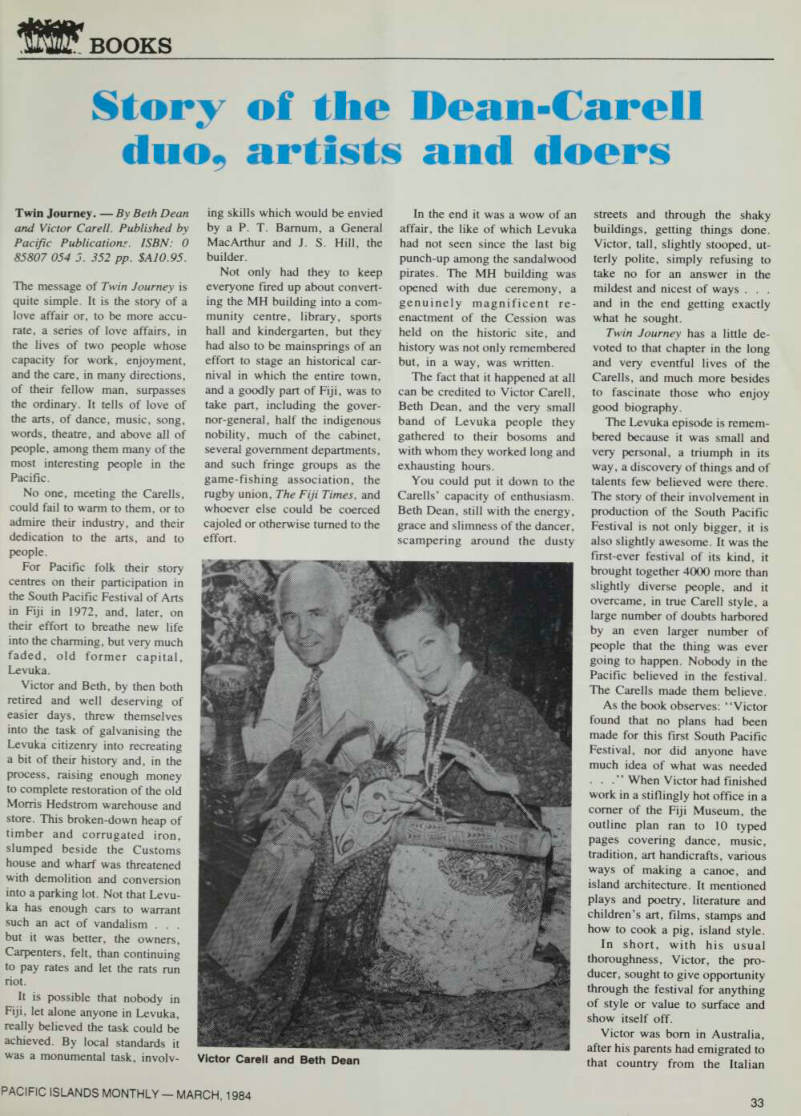
Victor Carell and Beth Dean
Swiss Alps just before World War I.
Life in Sydney was difficult, and Victor’s parents, brothers and sisters worked extremely hard to make ends meet. The depression years brought the
worst or the best out in people. In Victor’s case, out of the mono tony of his everyday existence he developed a strong interest in song and music, and an urge to strive for excellence. This inter est eventually led him to Italy,
and thence to England and America.
Beth was bom in Denver, Col orado, and from the age of four was performing, already set on the path to her greatest dream to become a dancer. She was able to travel with her family to Europe to hear good music and watch ballet.
Twin Journey truly begins in Hollywood, where Beth was playing the leading ballerina in a musical on the life of Johann Strauss, The Waltz King. In the baritone role was Victor Carell.
Twin Journey is a story of people, just as the authors’ pre vious 12 books have been.
The reader is introduced to hundreds of celebrities, artists,
friends, and just ordinary people
who have had an impact on the lives of Beth and Victor. The anecdotes, scenes and experi ences leave the reader with the
sort of gratification experienced
from watching and listening to a good opera.
Published by Pacific Publica tions, and printed and bound by the Fiji Times and Herald Ltd. in Suva, the book is another miles tone in Fiji’s local publishing history, an encouragement to all those who want to see more local authorship and publishing in this country.
Meanwhile, the journey con tinues: Beth and Victor have just completed their 10th annual Christmas Show for the Sydney Opera House Trust and it was, as usual, a total sell-out. They say it’s their swansong, and perhaps it is, although hardly anyone
believes they will just drop out.
“But we would like a little time to ourselves now,’’ Victor said . . . just before he and Beth set off on a cruise ship-bome lecture tour of the Pacific!
This is a book in which we can
all find inspiration.
Kantilal
Jinna with Garry Barker.
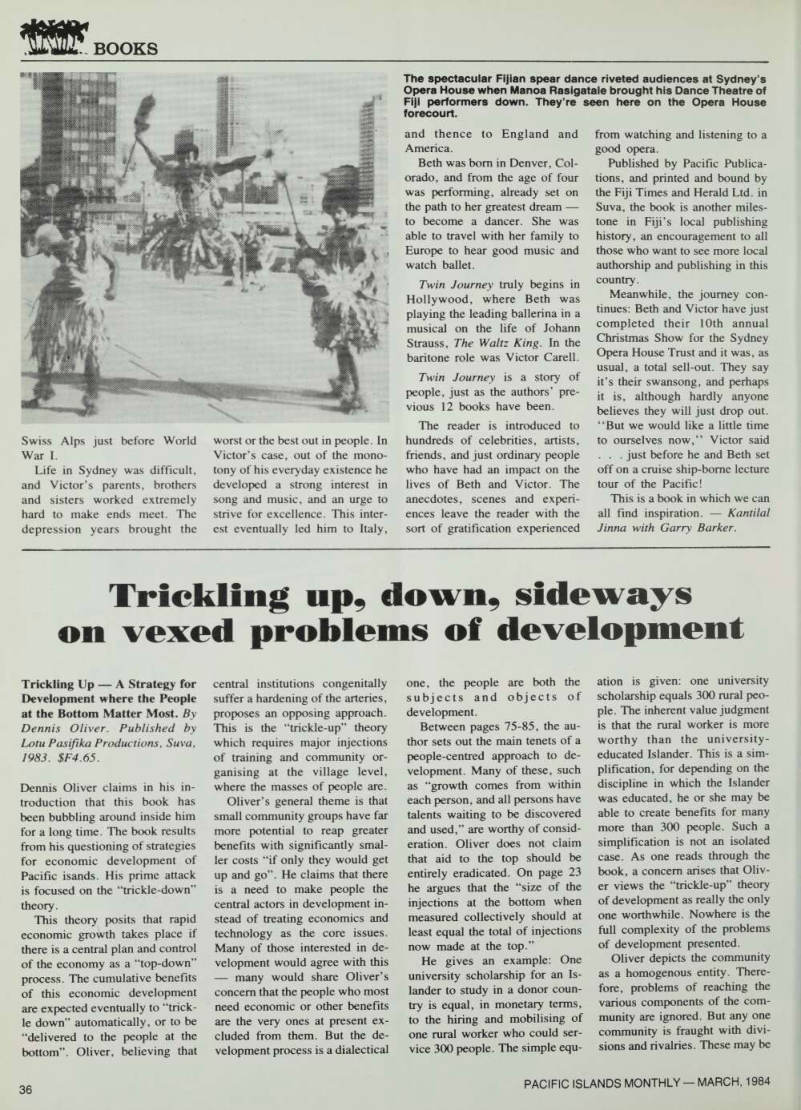
The spectacular Fijian spear dance riveted audiences at Sydney’s Opera House when Manoa Rasigatale brought his Dance Theatre of Fiji performers down. They’re seen here on the Opera House forecourt.