of megabucks Ok Tedi
pp. 29-31 · Read in the full issue
Trade Winds
Megatonnes of mud mire future of megabucks Ok Tedi
Everything about Papua New
Guinea’s Ok Tedi gold and cop per mining project is on the ‘‘mega” scale costs of the first stage of the mine develop ment alone are estimated at $l.l billion, the gold and copper de posits to be mined are believed to be worth $5 billion, projected profits from the mine when it comes on stream are in the same
high-flying league.
So it should come as no sur prise that the January landslide on the east bank of the Ok Ma River which has thrown the im mediate and possibly even the long-term future of the project into doubt involved the slippage of a volume of mud on the same grandiose scale at least 50 million tonnes of it.
The massive landslide cut
right across a continuing debate on environmental issues between the Ok Tedi Mining Ltd (OTML) consortium on the one hand, and the PNG Government and en vironmentalists on the other.
The problem had been posed as early as 1975 when the late Ken Lamb, then professor of biology at the University of Papua New Guinea, said: ‘‘ln Bougainville we have seen the disastrous effects of discharge of tailings into a river. ‘‘We would want to be reas sured that this did not happen to the Ok Tedi and in turn to the Fly River which is the main source of fish protein for the
local people . . .
‘‘lt should be possible to im pound and precipitate the wastes
as much as possible before release.”
Only a few weeks before the landslide, the government had advised OTML that it could not accept its proposals for the build ing of a temporary tailings dam on the Ok Ningi River in order to
get first-stage gold production
started on schedule May, 1984.
PNG Prime Minister Michael Somare said in Port Moresby that the interim plan ‘‘did not have the same measure of protection as the permanent dam planned
for containing tailings”.
He said that the permanent dam offered ‘‘excellent environ mental protection”, whereas the interim scheme did not.
He went on: ‘‘lt is important that developers understand the
strong view the government has on environmental protection.
They must also understand that the government expects develop ers to adhere to agreements.”
It was said at the time that the government’s decision would de
lay the start of gold production
for at least six months, and, according to company sources, would add at least $2OO million to overall project costs.
As a 20 per cent shareholder in the venture the PNG Government stood to lose money too.
But, in reaching its decision, it had to balance this loss against the potential danger to PNG’s barramundi and prawn fishing
industry if tailings escaped into
the Gulf of Papua.
Then the earth started to move on the east bank of the Ok Ma
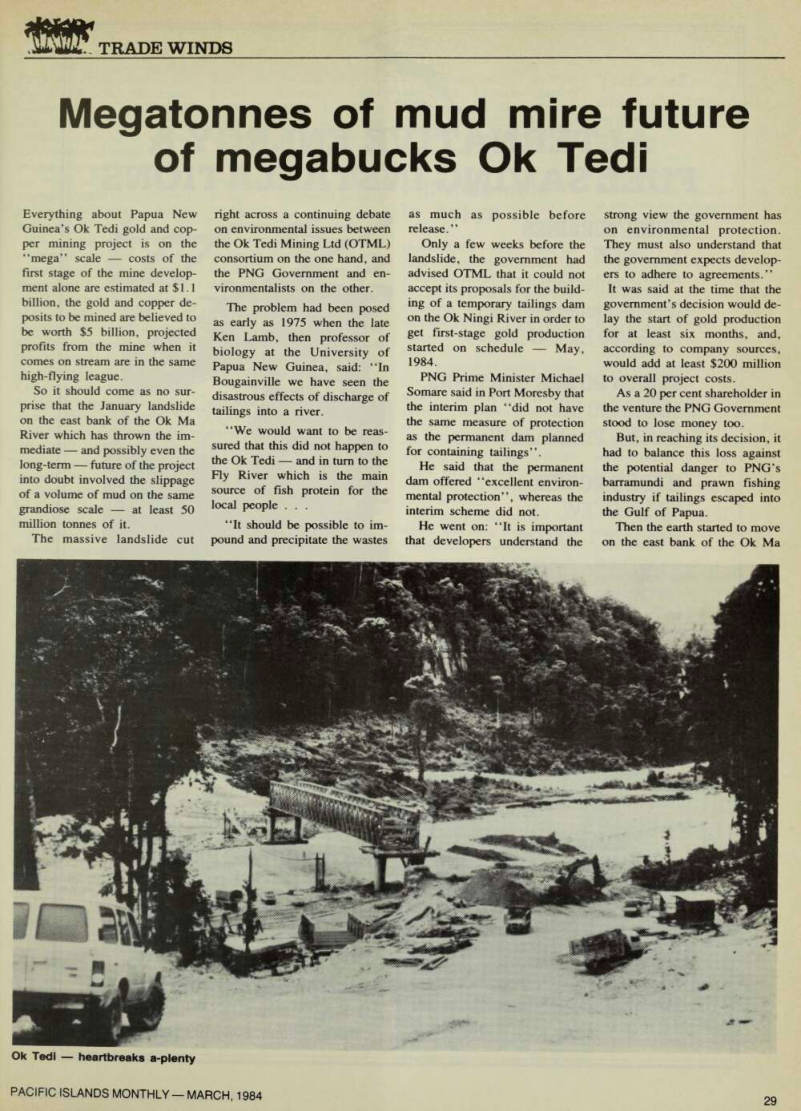
Ok Tedi heartbreaks a-plenty
River, site of the proposed per manent dam which Mr Somare and others had believed would provide “excellent en vironmental protection.” Sliding on a front a kilometre wide, it proved once and for all that (in the words of OTML General Manager Irwin Newman) “it will be impossible to build a safe dam in the area.”
No one was injured, and no equipment was lost. But the magnitude of the setback to the project was at once obvious to all. In the immediate aftermath of the landslide, it was expected that 600 workers would lose then jobs. Insurance experts flew in from Melbourne to inspect dam age expected to give rise to what Radio Australia called “one of the biggest insurance claims ever made in Papua New Guinea.”
Mr Newman said the landslide left OTML with the options either of spending $l6O million on short-term disposal of waste products, or planning and build ing a waste dam costing several hundred millions.
According to one report, the short-term waste disposal would involve “the uncontrolled dump ing of huge amounts of waste in the Fly River system” exactly the course against which the gov ernment has firmly set its face.
Professor Richard Jackson, di rector of the Institute of Public Affairs in Port Moresby, had canvassed the environmental is sues associated with Ok Tedi in a major article in The Sydney Morning Herald of January 7 ironically, the very day on which the great Ok Ma landslide began.
On the attitudes of local Papua New Guineans, he wrote: “In addition to the politicians’ stand and the unfortunate experi ences in Bougainville, local level politicians in the Western Province, in which Ok Tedi is located, frequently voiced their concern about possible environ mental effects.
“While they and their con stituents might not know much about international financing and sophisticated mining technology, they can directly experience negative environmental impacts.
“Further, while the experts might deride their doubts as be ing those of ignorant men who do not understand the first thing
about ion exchange under al kaline conditions or about metabolism and food chains in aquatic organisms, in this case such derision is not only pat ronising but foolish since there are no experts on this subject who can actually say what is going on or what might go on in the Fly.”
Professor Jackson could not have known what was to come on the Ok Ma River dam site.
But the events of January 7 and subsequent days would seem to have magnified by many times the relevance of his comments.
He made a couple of other remarks whose importance has only been increased by the Ok Ma landslide when he wrote: “Whereas reaction to the gov ernment’s decision to (reject the Ok Ningi interim dam) has been sharp, the frustration expressed in those reactions seems to me to stem more from deeper-seated and longer-suffered conflicts embedded in this project. Ironic ally, govemment-OTML rela tions are not poor at all. But antagonisms mentioned last year C Herald , August 6) between the prime contractors Bechtel/MKI and OTML are still bubbling away.
“Similarly, animosity between
Australian and North American project staff remains evident. It is to be hoped that professional ism will override these conflicts and will not allow the PNG Gov ernment’s eminently reasonable decision to become the scapegoat for weaknesses elsewhere in the project.”
Whatever the outcome and it certainly can’t be foreseen at this stage 1984 was only a week old when the Ok Tedi project found itself wracked with problems more complex and more awesome than anyone could have envisaged even on New Year’s Eve, 1983. • Despite everything, life goes on. Only a week after the Ok Ma landslide, Don Kirk wood, a finance writer for The Weekend Australian, reported that the Bank of America had emerged as the successful tender er to organise a consortium of international banks which will raise at least SUS2OO million to cover “cost over-runs” on the Ok Tedi project.
Kirkwood added, in what seemed like a masterly piece of understatement, that following the Ok Ma landslide “BHP and its partners might need more than $2OO million ...”
Fiji flies solo
in Tokyo
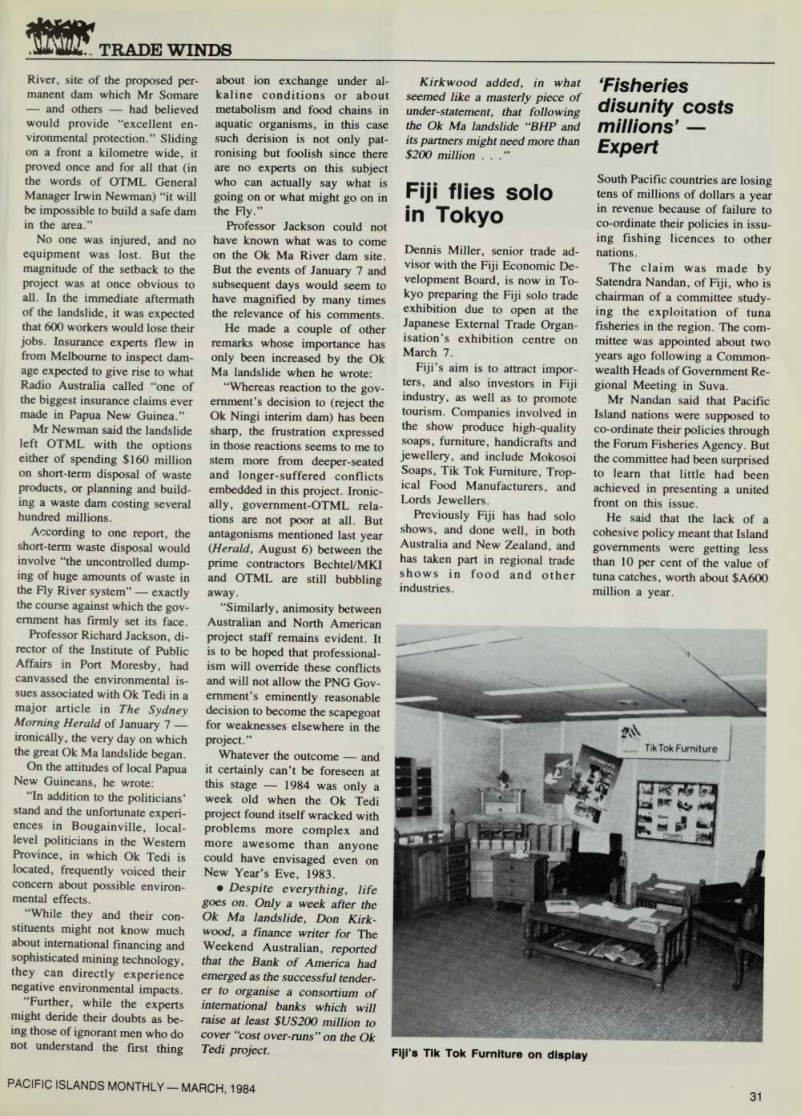
Dennis Miller, senior trade ad visor with the Fiji Economic De velopment Board, is now in To kyo preparing the Fiji solo trade exhibition due to open at the Japanese External Trade Organ isation’s exhibition centre on March 7.
Fiji’s aim is to attract impor ters, and also investors in Fiji industry, as well as to promote tourism. Companies involved in the show produce high-quality soaps, furniture, handicrafts and jewellery, and include Mokosoi Soaps, Tik Tok Furniture, Trop ical Food Manufacturers, and Lords Jewellers.
Previously Fiji has had solo shows, and done well, in both Australia and New Zealand, and has taken part in regional trade shows in food and other industries.
‘Fisheries
disunity costs
millions’
Expert
South Pacific countries are losing tens of millions of dollars a year in revenue because of failure to co-ordinate their policies in issu ing fishing licences to other nations.
The claim was made by Satendra Nandan, of Fiji, who is chairman of a committee study ing the exploitation of tuna fisheries in the region. The com mittee was appointed about two years ago following a Common wealth Heads of Government Re gional Meeting in Suva.
Mr Nandan said that Pacific Island nations were supposed to co-ordinate their policies through the Forum Fisheries Agency. But the committee had been surprised to leam that little had been achieved in presenting a united front on this issue.
He said that the lack of a cohesive policy meant that Island governments were getting less than 10 per cent of the value of tuna catches, worth about SA6OO million a year.
Fiji’s Tik Tok Furniture on display