a Pacific role
pp. 55-61 · Read in the full issue
New Zealand a Pacific role in transition
One of the most recent special performances in the Australian capital of Canberra which sees any number of them, it must be added was provided at the South Pacific Forum conference by New Zealand Prime Minister Robert Muldoon. In his role as advocate and defender of the New Zealand Pacific partnership theory, he accused Australia
roundly of being “Pacific
ignorant”. It was a masterly per formance, delivered at a press briefing with scowls and gloomy prophecies thrown in for special effect.
The thrust of Mr Muldoon’s comments was that New Zealand by its nature and policies had a far greater rapport with the Pacif ic Island communities than any
which Australia might attempt to establish. While he spoke, the content of his argument was re layed to Australian Foreign Minister Bill Hayden waiting outside the room for an oppor tunity to reply.
Mr Muldoon referred to the “dead hand of Australian bureaucracy”, and when he was asked if he regarded the bureauc rats as being Pacific-ignorant he replied “That would not be too strong a statement. Pacific ignorant would be a very, very fair comment”.
The subject was the financial prospects of the Pacific Forum shipping line. New Zealand be lieves the line has potential and should receive financial support while it becomes viable. Aust-
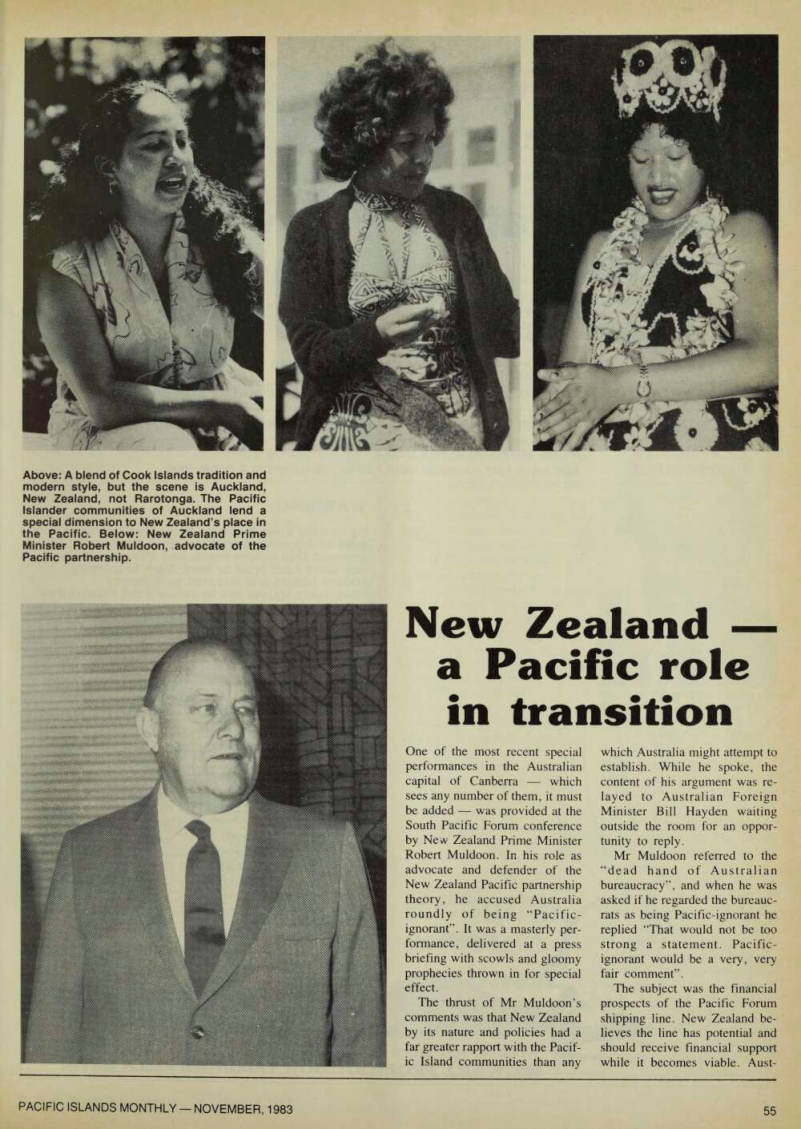
Above: A blend of Cook Islands tradition and modern style, but the scene is Auckland, New Zealand, not Rarotonga. The Pacific Islander communities of Auckland lend a special dimension to New Zealand’s place in the Pacific. Below; New Zealand Prime Minister Robert Muldoon, advocate of the Pacific partnership.
New Zealand
ralia regards the line as unwork able, and refuses to support it further. Putting aside the specif ics of the Forum Line, the gener al point of wide interest is the extent to which New Zealand has projected itself as a partner of the Island countries. Is New Zealand filling a special role among the new nations of the Pacific, or is it
largely image-building?
There is no doubt that very real links exist, and the Pacific Islander communities of Auck land add weight to the New Zealand claim. Since about 1973 New Zealand has shown a subtle shift from a detached Pacific relationship to a partnership style of relationship. For well over a century New Zeland saw itself as an extension of Britain as
Australia did, too. But where Australia concentrated in time on an isolated individuality, New Zealand immersed itself in the Island communities. To some ex tent this situation was thrust on the New Zealanders by circumst ance, to some extent it was a result of New Zealand attitudes.
Traditionally the New Zealand interest has been with the Cook Islands, Western Samoa and Niue. This was a natural exten sion of earlier administrative and hitorical links. But today the interest has significantly wide ned, with aid and exchanges ex tending to all parts of the Pacific.
Australian officials complained in semi-serious vein earlier this year that although Australia sup ports about one-third of the entire Papua New Guinea budget, New Zealand was getting all the news paper publicity when it made any
contributions to PNG develop ment. Special rural projects and timber and marine equipment have featured in New Zealand aid to PNG.
Significant overall New Zea land aid now flows to the Cook Islands, Niue, Vanuatu, Sol omon Islands, Papua New Guinea, Western Samoa, Fiji, Tokelau and Tonga. The 1982-83 bilateral aid allocation to the South Pacific is $38.2 million, about 72 per cent of the total New Zealand bilateral aid. (The ASEAN countries are next on the list of New Zealand aid recipients.).
New Zealand’s special iden tification with the Island coun tries of the Pacific is reflected in the current process of determin ing aid projects. There is now an extensive consultation process in which New Zealand and the reci pient countries negotiate on the type of aid projects best suited to circumstances.
New Zealand politicians and officials, sensitive to their role, are anxious to avoid any sugges tion that they thrust aid onto Island countries without consul tation. They see the overall aid program as promoting social and economic development outside the immediate material gain of the individual projects. New Zealand believes that its own rural background puts it in a particularly understanding and sympathetic role when determin ing the nature of aid.
The official aid program is administered by the Ministry of Foreign Affairs through its Divi sion of External Aid. The prog ram operates on annual appropri ations from parliament. Some of New Zealand’s Pacific aid is “hidden” aid because it is in the form of milti-lateral assistance to United Nations, and Com mowealth and South Pacific in stitutions and organisations.
Bridging
mission
outlined
A major thrust of New Zealand diplomacy today is not only to
recognise the special require
ments of its Islands neighbors in the Pacific, but also to make
these requirements known to the rest of the world. The New Zea land Deputy Director of foreign Affairs, Mr Malcolm Templeton, made this point when he address ed a conference of Rotary clubs on Norfolk Island earlier this year.
Mr Templeton said that over the years the South Pacific region had not made a great impact on world consciousness, mainly be cause its problems were not the type which were relevant to the major capitals of the world. “The problems of the region are long standing and very real but they are not the sort which make the headlines,” he said. New Zealand saw itself in a special position as a bridge which could make the world aware of the realities of the region.
As a result a prime objective of New Zealand diplomacy in recent years in northern hemis phere capitals and in internation al organisations such as United Nations, had been to get through to other countries the special characteristics of the South Pacific and its special needs for
development.
In the past 20 years, Mr Tem pleton said, New Zealand had seen 11 countries in the region become independent. Each had a strong sense of its national iden tity and each had an individuali ty. There were, however, some characteristics which were obvi ously shared and these were the characteristics which New Zea land was bringing to world atten tion. They included such things as small land areas, few or no
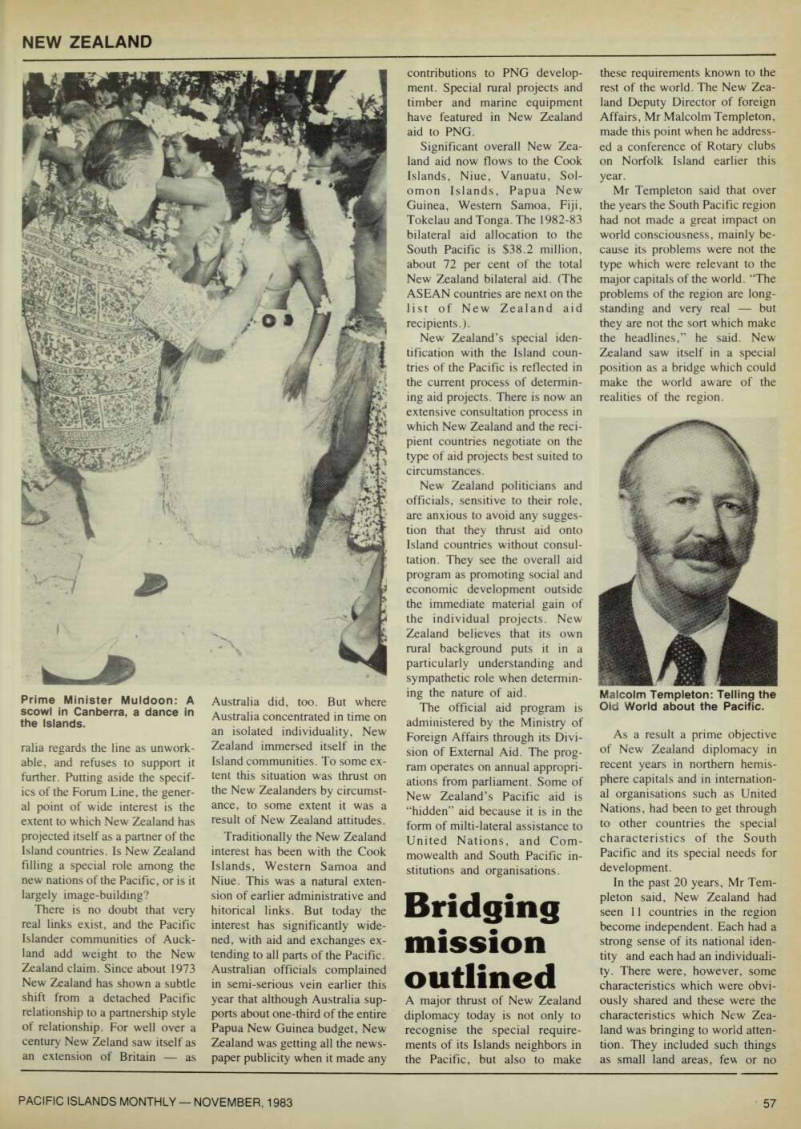
Prime Minister Muldoon: A scowl in Canberra, a dance in the Islands.
Malcolm Templeton: Telling the Old World about the Pacific.
natural resources, rapidly grow ing populations, limited pros pects for economic development, reliance for export income on a very few number of products, susceptibility to natural disasters and remoteness from world mar kets and world concepts.
Mr Templeton said that in some regions of the world where small developing countries were in close association with bigger countries there had been a ten dency to meddle in the internal affairs of the smaller countries.
This had not happened on a large scale in the South Pacific “al though not altogether for want of trying” he said. It was a tribute to the governments of the small Pacific countries that their tradi tions, freedoms and cultures had
been largely preserved.
Mr Templeton continued: “But they are well aware that they cannot go it alone, they know that they need continuing help in their efforts to overcome the problems of smallness, isolation and scarcity of natural resources.
“New Zealand accepts the re
sponsibility imposed by geog
raphy and kinship in relation to these countries, the development of New Zealand aid and dip lomatic links with the island countries bilaterally and through such regional institutions as the South Pacific Forum is therefore one of the principal concerns of New Zealand foreign policy. Our interests coincide with those of our Island neigh bors. they do not want to be obliged to seek outside aid at the price of political interference.
And we do not want that to
happen.”
Mr Templeton said that one of the best illustrations of New Zea land’s increasing involvement in the Pacific community was in trade. The European market re mained critical for New Zealand
traditional primary products, but
the import-export flow of Pacific trade was assuming greater
weight.
Discussing New Zealand aid policies Mr Templeton said that the Island countries received top priority in the allocation of funds and programs. Since 1973 the region had become the main priority for bilateral aid, and suc cessive New Zealand govern ments had reinforced this con-
cept. In the 1982/83 financial year the allocation for the Pacific in bilateral and regional prog rams had been about $4l million, this amounted to 61 per cent of New Zealand’s total aid for the year.
Water
supply
schemes
One of the biggest single con tributions which New Zealand has made in funds and expertise over a prolonged period has been the development of Pacific Island water resources. The coral-based soil of many of the smaller coun tries together with the absence of catchment areas of any signifi cance have created long-standing water supply problems.
New Zealand water resources assistance has been given to 11 countries in the region during the past 20 years. Several major pro jects were carried out in the
19705, including water supply
schemes for Apia in Western Samoa and for water reticulation systems in Fiji.
However the aid for which New Zealand is probably best known is the provision of a wide variety of small-scale village level water supply systems, with
emphasis placed on self-help.
These projects consist of tanks, pipelines, pumps and wells re presenting low-cost and low maintenance systems suitable for small rural communities. The
money, expertise and some materials are contributed by New Zealand aid, and the labor and maintenance is provided by the communities involved in the schemes.
Countries which have par ticipated in the small-scale water supply schemes include Vanuatu, Papua New Guinea, Niue, Kiribati, Tonga and Fiji.
Sales aid
from
Sparteca
Sparteca is probably the most important economic agreement ever concluded by New Zealand with its Pacific neighbors. It pro vides duty-free unrestricted ac cess for most products exported by South Pacific Forum island countries, and it is encouraging New Zealand firms to set up joint ventures with Islands interests.
Sparteca is the South Pacific Regional Trade and Economic Co-operation Agreement. It was signed three years ago with Aust ralia as well as New Zealand offering duty free access to their markets from Pacific Island countries. There was some early criticism of the scheme on the grounds that some important pro ducts were exempted, but in gen eral the agreement is now seen to be working well.
New Zealand ministers and
officials believe that the access given under Sparteca to the New Zealand market is very generous.
Most products have unrestricted access. The only exception to free access of products to New Zealand is where it is necessary to protect Cook Islands, Niue and Western Samoan interests and, in one or two cases, New Zealand industries.
The genesis of Sparteca was in 1978 through a report compiled by the Commonwealth Sec retariat and the South Pacific Bureau for Economic Develop ment. The report summarised the scope for the development of
manufacturing and processing
activities in the South Pacific. It also investigated the New Zea land and Australian markets, and the trade policies of the two in assisting such development. The report suggested the greatest con tribution to development would be to create a more certain framework for the future and that a renewed approach to trade ex pansion would be an important step forward. After lengthy dis cussions amongst the countries concerned Australia, New Zealand, the Cook Islands, Kiribati, Niue, Solomon Islands, Tonga, Tuvalu, Western Samoa, Fiji, Nauru and Papua New Guinea draft texts were drawn up.
It took two more meetings before texts were approved. This was no mean feat. Not only were there problems concerning vari ous domestic industries, but New Zealand also had to take into account its special trading rela tionships with the Cook Islands, Niue and Western Samoa. These relations had to exist in line with
Sparteca. Luckily, the three
countries were prepared to make concessions in the interests of the Forum as a whole.
After talks with the Govern ments of the Cook Islands, Niue and Western Samoa it was de cided some protection would be offered to these countries on fro zen passionfruit, copra, coconut oil, canned pineapple, pineapple juice, lime juice, grapefruit
juice, orange juice, passionfruit
juice and coconut cream. But other Forum countries, under Sparteca, still receive improved concessions on access for most of these products.
An industry for Niue sponsored by New Zealand government aid: Pulping passionfruit.
Ministry
defines
attitudes
Some of the more controversial matters involving New Zealand relationships in the Pacific have included Western Samoan citi
zenship, independence for New
Caledonia and the practical im plications of administration in Tokelau. Official attitudes as outlined by the Ministry of Foreign Affairs are: The South Pacific region in general: In every respect New Zealand is a part of the region, and its interests are bound up with the welfare of the Island states. Its links with the countries of the region are ethnic, historic al and cultural in their origins.
These links are an important as pect of New Zealand’s domestic life and they are a dynamic ele ment in its external relations.
Because New Zealand does not see itself as separate from the region, its progress and future are linked to regional stability.
New Zealand believes that its continued bilateral relations in the region and its active partici pation in regional undertakings have fostered regional economic development and have enhanced
regional stability.
Tokelau: A special arrange ment exists between Tokelau and New Zealand regarding To kelau’s administration. The Sub committee on Small Territories of the United Nations Special Committee on Decolonisation notes that New Zealand is com mitted to assisting Tokelau to wards a greater degree of self government at a pace determined by the wishes of the people of Tokelau.
There has been an important consolidation of the political pro cess in Tokelau with the general
legislature there becoming the
principal decision-maker re sponsible for Tokelau’s future.
The relation between the Tokelau leaders and the New Zealand authorities is now, more than ever, one of partnership.
Western Samoan citizen ship; Last year the Privy Council in Britain ruled that all Western
Samoans bom in Western Samoa between 1924 and 1948, and certain of their descendants, were New Zealand citizens by virtue of the political administra tive link which had existed bet ween New Zealand and Western Samoa during that period.
The implications of this, which would have included unre stricted entry to New Zealand by a significant proportion of the Western Samoan population, led to a series of discussions between the two governments. Satisfac tory arrangements were finally reached between the two coun tries which led to a less-sweeping situation, but in return New Zea land undertook to look to its
immigration policies, particular
ly where Western Samoans were making temporary entry to New Zealand. Since April this year, new arrangements have applied as a result of the review.
French Pacific territories: New Zealand supports a South Pacific Forum resolution which welcomes the French Govern ment’ c , stated program of reforms in New Caledonia, and New Zea land expresses the hope that con tinued endeavors will be made for an ultimate peaceful transi tion to independence.
New Zealand aid: Funds help building projects at the Univer sity of the South Pacific, Fiji.