development institute
pp. 25-28 · Read in the full issue

Political Currents
‘ASOPA was never like this..
Post-colonial mood at Australia’s development institute
The bus with its sprinkling of passengers grinds downhill past the faded brown brick facade of Balmoral Naval Hospital. On both sides Sydney Harbour twinkles blue and silver through a scrubby cover of blue and lemon-scented gums. Then, just past the turn-off to Chowder Bay, there it is.
At first glance the old place looks the same. It is still unim posing and unpretentious, but the quaint, almost tropical charm lin gers on. The low, cream weath erboard huts are clustered to gether near the road while, bey ond, trim green lawns sweep down to merge with an exquisite view across the harbor to Rose
Bay.
Between the mid-’4os and the mid-’7os, about 2000 Aust ralians spent time in this place, most of them absorbed, even obsessed, by the prospect of the adventure which lay ahead Papua New Guinea or, as they called it, the Territory.
Twenty years ago I had been
an “Asopian” myself. Hitting
Sydney from the country as a gangling and unconfident 17year old, my first clumsy attempt at dating a Mosman girl was
despatched callously with a
grimace and a disapproving: “Oh, you’re an ASOPA boy!”
Those were the days when patrol officers on the long course were banned from the Buena Vista, Clifton Gardens and Mosman hotels and were compelled to make the considerable journey to the Oaks at Neutral Bay for a cold beer.
We all made the most of our time at ASOPA because, for many of us, graduation meant loneliness and hardship on a Ter ritory out-station. And the youn ger we were, the tougher was life after ASOPA. So we boozed and womanised and worked damn hard into the bargain.
My old student record card
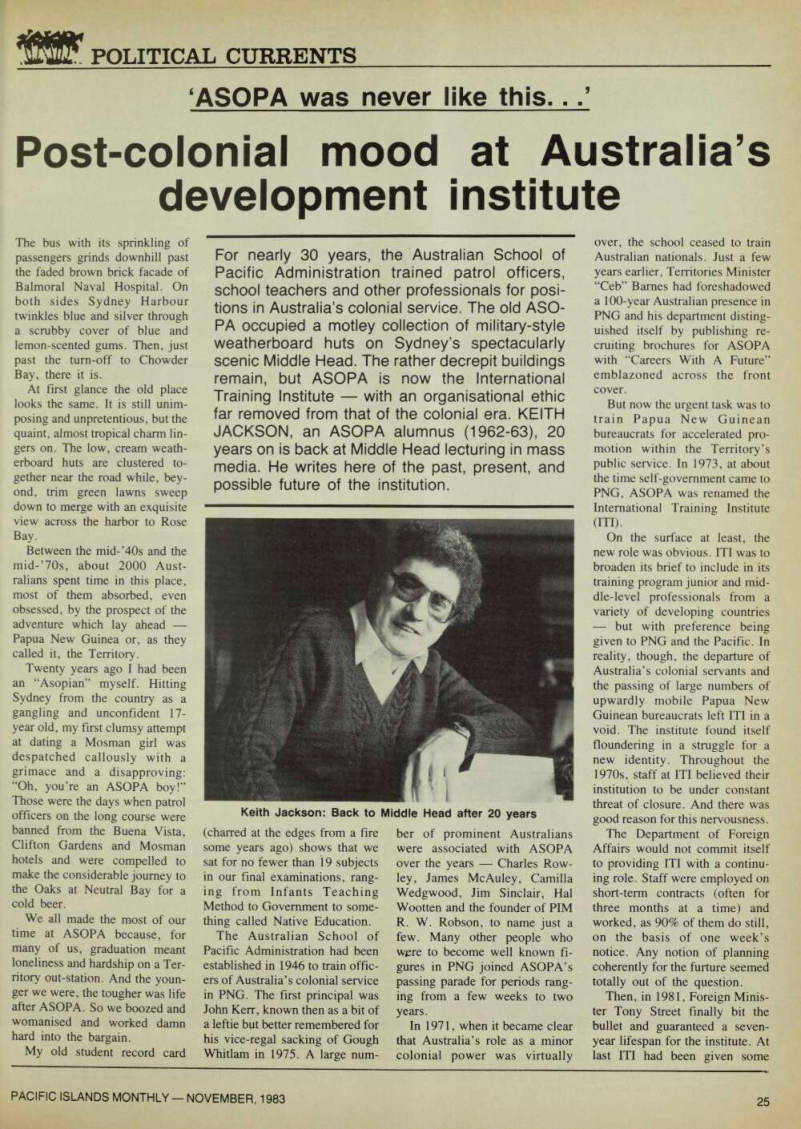
For nearly 30 years, the Australian School of Pacific Administration trained patrol officers, school teachers and other professionals for posi tions in Australia’s colonial service. The old ASO PA occupied a motley collection of military-style weatherboard huts on Sydney’s spectacularly scenic Middle Head. The rather decrepit buildings remain, but ASOPA is now the International Training Institute with an organisational ethic far removed from that of the colonial era. KEITH JACKSON, an ASOPA alumnus (1962-63), 20 years on is back at Middle Head lecturing in mass media. He writes here of the past, present, and possible future of the institution.
(charred at the edges from a fire some years ago) shows that we sat for no fewer than 19 subjects in our final examinations, rang
ing from Infants Teaching
Method to Government to some thing called Native Education.
The Australian School of Pacific Administration had been established in 1946 to train offic ers of Australia’s colonial service in PNG. The first principal was John Kerr, known then as a bit of a leftie but better remembered for his vice-regal sacking of Gough Whitlam in 1975. A large num
ber of prominent Australians were associated with ASOPA over the years Charles Row
ley, James McAuley, Camilla
Wedgwood, Jim Sinclair, Hal Wootten and the founder of PIM R. W. Robson, to name just a few. Many other people who were to become well known fi gures in PNG joined ASOPA’s passing parade for periods rang ing from a few weeks to two years.
In 1971, when it became clear that Australia’s role as a minor colonial power was virtually
over, the school ceased to train Australian nationals. Just a few years earlier, Territories Minister “Ceb” Barnes had foreshadowed a 100-year Australian presence in PNG and his department disting uished itself by publishing re cruiting brochures for ASOPA with “Careers With A Future” emblazoned across the front cover.
But now the urgent task was to train Papua New Guinean bureaucrats for accelerated pro motion within the Territory’s public service. In 1973, at about the time self-government came to PNG, ASOPA was renamed the International Training Institute
(Iti).
On the surface at least, the new role was obvious. ITI was to broaden its brief to include in its training program junior and mid dle-level professionals from a variety of developing countries but with preference being given to PNG and the Pacific. In reality, though, the departure of Australia’s colonial servants and the passing of large numbers of upwardly mobile Papua New Guinean bureaucrats left ITI in a void. The institute found itself floundering in a struggle for a
new identity. Throughout the
19705, staff at ITI believed their institution to be under constant threat of closure. And there was good reason for this nervousness.
The Department of Foreign
Affairs would not commit itself to providing ITI with a continu ing role. Staff were employed on short-term contracts (often for three months at a time) and worked, as 90% of them do still, on the basis of one week’s notice. Any notion of planning coherently for the furture seemed totally out of the question.
Then, in 1981, Foreign Minis ter Tony Street finally bit the bullet and guaranteed a seven year lifespan for the institute. At last ITI had been given some
Keith Jackson: Back to Middle Head after 20 years
breathing space. Only now, in 1983, is it beginning to emerge with some confidence from the trauma of its decade of despair.
Walking into the institute to day with seven separate prog rams running for more than 100 people from 30 countries it is difficult to believe that an Austa lian Government could have ever seriously contemplated shutting down the place. It is almost as difficult to understand why, to a large extent, ITI still exists in a policy vacuum, suffering in many respects from a tolerant and benign neglect on the part of its masters in Canberra.
Right now, fellows the term covers both sexes from nations in the South Pacific, Asia, the Indian Ocean, East Africa and the Caribbean are undertaking courses at ITI. They are studying rural develop ment, school evaluation, indust rial relations, local and provin cial government, financial and personnel management, public administration and media man agement. The course members are all middle and senior level people in the main public servants and, with each suc cessive course, it seems the calibre and status of participants improves.
Increasingly, fellows possess a first degree and often have post graduate qualifications. Every year, ITI offers what it terms a “core program” of some 20 courses, each lasting for three months. In addition another four or five special courses of shorter duration are organised. Training awards are allocated only on a govemment-to-govemment basis and, while in Australia, fellows are looked after in every respect.
The courses themselves pro vide a neat blend of seminar sessions, intensive theoretical work, comparative studies, visits to various parts of Australia and working attachments at organisa tions relevant to the fellows’ own vocation. While on work attach ment, course members find that they are valued highly because of their professional skills and, not infrequently, because of their ability as after-dinner speakers.
Earlier this year the manager of Radio St Vincent in the Carib bean, on work attachment from FITs media management course,
found herself training announ cers at a new community radio station at Bellingeh on the north coast of New South Wales.
Another broadcaster on the same course Romano Taro from Solomon Islands Broadcasting Corporation ended up as guest lecturer in mass media at a techn ical college in Castlemaine, Victoria.
Experiences like these (plus mayoral receptions and that apogee of Aussie culture,the poker machine) make the three month stay at ITI a stimulating one for most course participants.
On campus at the institute, academic and administrative staff do their best to create a
collegiate atmosphere. Use of the word “student” is assiduously avoided.
As the Principal of ITI, Bob Heron, says: “We don’t view our overseas guests as students but as professional colleagues. In many cases they have as much to offer us, and their fellow participants, as we have to offer them. By bringing together 16 or so people from five continents to work to gether in particular areas of pro fessional concern, ITI creates the necessary conditions for a pro ductive exchange of knowledge and experience.“We see ourse lves as facilitators rather than as instructors. And, in addition, be cause of our close contacts with
the Australian academic and business communities, we’re able to tap into a vast range and
depth of local expertise.”
ITI course members are thus able to sit down and talk at length with leading Australians in a variety of fields and those same Australians are themselves able to keep abreast of trends and thinking in the Pacific and the rest of the Third World.
In its day ASOPA was con sidered to be a pioneer in the
professional training it provided
to colonial officers. Now, the born-again ITI having ex ecuted a 180 degree shift from its
history and traditions provides
what, for want of a better term, we could call “intellectual aid” to the developing world. The mood is post-colonial, the methodology innovative, the trend progressive.
But, as most ITI staffers would agree, there’s some way to go yet. “It seems almost as if
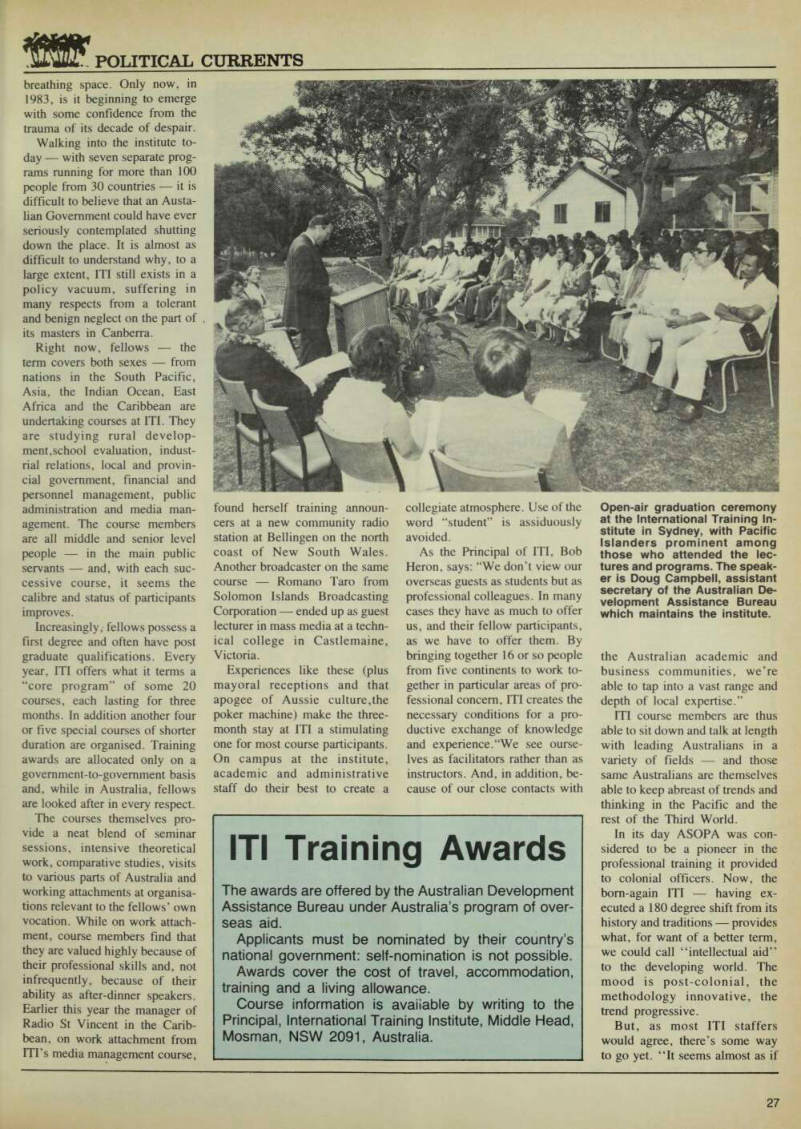
Open-air graduation ceremony at the International Training In stitute in Sydney, with Pacific Islanders prominent among those who attended the lec tures and programs. The speak er is Doug Campbell, assistant secretary of the Australian De velopment Assistance Bureau which maintains the institute.
ADAB doesn’t really like the place,” said one academic who didn’t want to be named. ADAB is the Australian Development Assistance Bureau, the aid agency of Australia’s Department of Foreign Affairs. It is ITl’s Canberra-based parent and is rather unfortunately named (Third World countries these days talk in terms of co-operation rather than assistance). “There’s so much that could be done here,”
complained the academic, “but ADAB just doesn’t seem to see the potential, “For a start, there needs to be much more interchange between ITI and the rest of the world with ITI running courses in de veloping countries where this would be more economic or more effective. As for ADAB’s
staffing policies here they
stink. Few Australian public ser vants or academics would toler-
ate for long the cavalier way in which ADAB treats its ITI staff. ’ ’
There’s some slight hope, al though not much more than a flicker, that the Aid Review Committee appointed by Foreign Minister Bill Hayden may come up with some positive recom mendations which may encour age ITI to pursue a more creative and less restricted role in offering its intellectual aid. The commit tee, under the chairmanship of Sir Gordon Jackson, is due to report to the Minister in Decem ber. It was established to ex amine both the composition and direction of Australian aid ex penditure (which in 1983/84 is up 13 per cent to $822 million).
ITI staff, infused with a num ber of recent appointments which
have emphasised developing
country experience as well as academic credentials, are begin ning to devote more of their time to considering the broader con text of the institute’s operations and to making ITI itself a better place. “This institute isn’t just a collection of buildings with a slightly interesting history,” says economics lecturer Bruce Knapman. “It’s a resource centre pooling a number of assets which are crucial to de
velopment: new knowledge, new
experience, new skills. Unlike material aid which is con sumed, wears out or is diffused beyond recognition these as sets can be shared without being diminished.”
The International Training In stitute, in full flight mid-term, radiates an air of pleasant pur pose. Occasional peals of laugh ter emanate from seminar rooms and roll down the covered walk ways, indicating that the learning process is not altogether po-faced and serious. ITI is a bright, re laxed, cosmopolitan outpost on the fringe of solid, Establish ment, middle-class Mosman.
About 3100 people from 60 na tions have passed through here during the last 10 years. And, to its credit, the institute remains in touch with most of them through regular newsletters. There are alumni associations in a number of countries, one in the Philip pines having more than 100 members. ITI has become the focal point of a whole network of international contacts, many at the highest level in government.
When senior lecturer June Whittaker visited southern Africa recently, she was welcomed roy ally by ITI graduates in each of the seven countries she visited. It seems the pendulum has swung its full arc. The ITI is blossoming with petals of a very different hue from its predecessor. ASO PA was never like this.
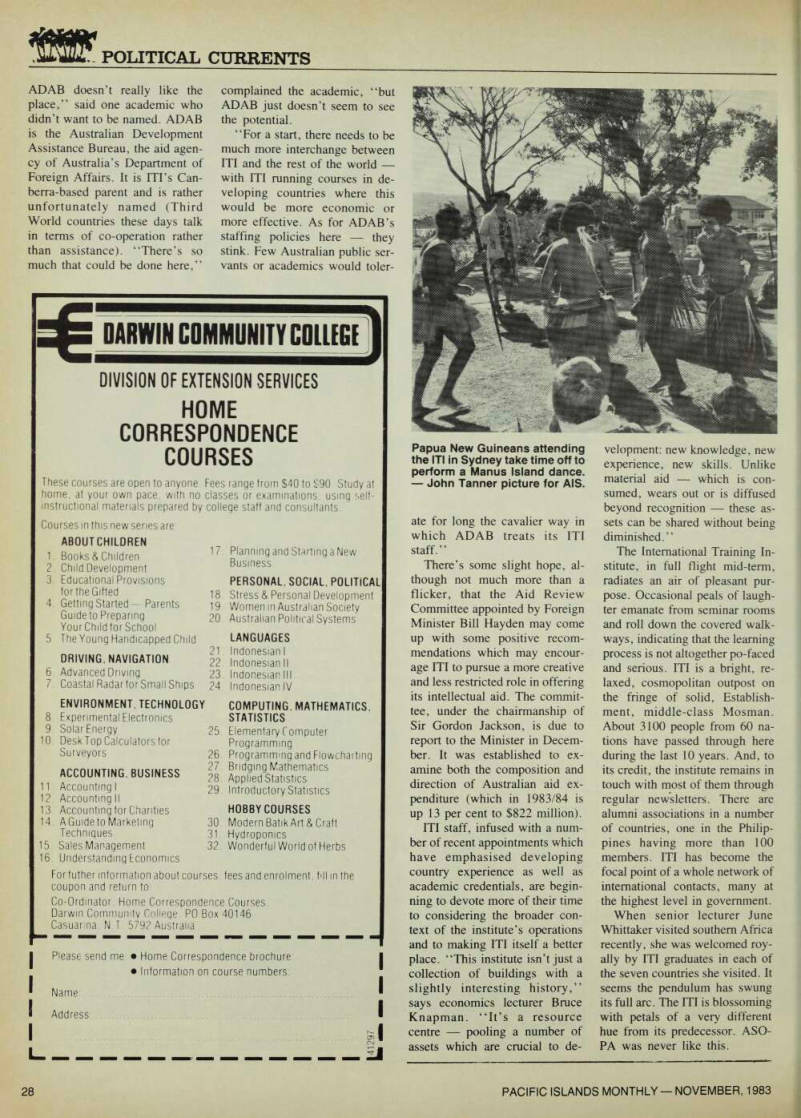
Papua New Guineans attending the ITI in Sydney take time off to perform a Manus Island dance. - John Tanner picture for AIS.