spells it out
pp. 19-22 · Read in the full issue
Fred M. Zeder spells it out
Let the cynics be damned!
America may have left an unholy
legacy of economic dependency
in Micronesia, but after 36 years of trusteeship administration, Islanders in the Trust Territory know how to hold an election. In fact, as the September 7 free association plebiscite in the Marshall Islands proved, the seriousness with which Microne-
sians take the democratic process puts most Americans to shame, How else can one explain the sight of thousands of Marshallese lining up before seven in the morning and (in the case of quite a few) waiting until past mid night to cast their ballot? And vote they did. The unofficial count showed that 10,724 went to the polls to approve free as
sociation by a margin of 16%.
There were 6215 votes for the status and 4509 against, out of the approximately 13,000 who were eligible to take part in the plebiscite.
Opposition to free association came from “traditional” areas: the islanders of Bikini and Enewetak who have a strong distrust of President Amata Kabua and the central govern ment. These groups had earlier indicated they would support the compact, but in the final weeks of campaigning it became clear that the leadership’s initial “yes” stance was out of synch
with the people’s desires. Also opposed to the compact was the Kwajalein group, which is in volved in a simmering power play with Kabua.
By all accounts, however, the vote in favor of free association is a smashing success for Presi dent Kabua. He put his personal prestige and that of his office on the line by coming out strongly in favor of the status, and urging Marshallese to do the same. Had
Notes from the North Floyd K. Takeuchi on Micronesia
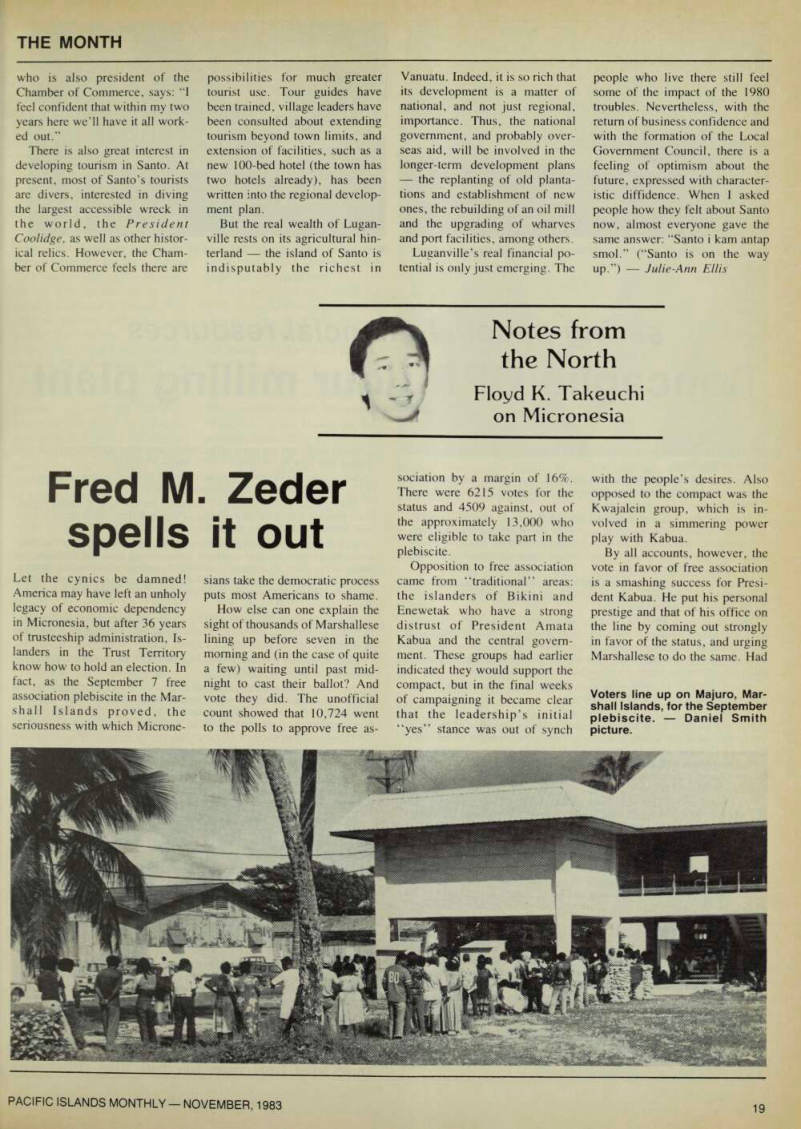
Voters line up on Majuro, Mar shall Islands, for the September plebiscite. - Daniel Smith picture.
the vote gone the other way, it would have signalled a remark able loss of power and influence for the leader.
But with his victory under his belt, Kabua goes into this month’s Nitijela (parliament) elections with considerable momentum. Indeed, it is difficult to see how the opposition has any real chance of boosting its al ready limited influence. And un less something happens to Kabua a serious illness, for example he now appears to be in a good position to dominate Mar shallese politics perhaps to the end of the century.
With the “firm” political situ ation in the Marshalls, with the solid yes vote for free association in the Federated States of Mic ronesia, and with the Northern Marianas becoming increasingly impatient to become an Ameri can commonwealth, the Reagan administration is going ahead and seeking separate termination of the trusteeship.
That will leave only Palau, which continues to muddle along with its internecine political problems. Palau’s situation is so uncertain one hesitates even to hazard a guess as to what might happen. Yet given the Palauan penchant for not wanting to be last, it would not be surprising to see the squabbling in those is lands end as the other four Mic ronesian entities near their termi nation deadlines.
That’s so not only from the standpoint of national pride something which the Palauans have in abundance but also from the fact that free association will mean that the fiscal flood gates are going to be opened up as never before. The sight of the rest of their Micronesian brethren enjoying the benefits of relative ly unrestricted American funds may be just the tonic to cure the current Palauan political malady.
What is Washington’s view at this critical juncture? U.S. Am bassador Fred M. Zeder 11, Presi dent Reagan’s special representa tive to the Micronesian political status negotiations, recently spent an hour with Pacific Is lands Monthly discussing current issues. Zeder’s style is straight fward; “Everything is on re cord.” That comes from his background as a very successful
businessman; he made his mill ions in Texas oil and his latest venture (which someone else is running while Zeder’s in office) is a pleasure boat service catering to Hawaii’s tourists. Zeder’s self-confidence is such that when he’s with his diplomatic corps aides, they’re usually on edge wondering what “the old man” will say next.
Zeder was alone when he spoke with PIM. Some quotes from the conversation: On a timetable for getting the free association agreements through the U.S. Congress: “What we’re trying to do is get the Senate to take action prior to the Christmas recess . . . We have good support in the Senate and we’re not anticipating any real problem there. The same thing, too, in the House (of Re presentatives). It is going to be very difficult for representatives ... to vote against the will of the people of Micronesia. They have in properly conducted plebiscites expressed their desire to enter into this relationship of free association and I can’t anti cipate any congressman or senator saying, ‘No, we prefer to deny them that right’.”
On the American desire to seek separate termination of the trusteeship: “It’s just really not fair (to wait until the Palauan situation is settled) to the vast majority of people in Micronesia . . . We’re just going to have to move ahead.”
On the Palauan stalemate: “There’s just really a handful of people holding this up in Palau . . . What I’ve told them this time is that I wanted them to convene their House of Dele gates and their Senate and seek a solution that they agree . . .
Wrap this thing up. Get a pack age. Get everyone on board and say, yes, this is what we want to do, and then bring it to us.”
On the fate of the July com promise which was thought to be a way around Palau’s constitu tional prohibitions against nuc lear material, but which was defeated by the Palauan Senate: “We haven’t heard from the House of Delegates on that. We heard from their Senate . . .But it was a solution . . . They have discussed going back and having
another vote, a referendum. We don’t believe, and we continue to hold fast to our position, that another plebiscite is not neces sary . . . But if a referendum was required, it’s an internal prob lem, if that’s the solution they are going to have to find it. But again, the United States is not going to tell them what to do. We didn’t write their constitution for them, and we’re not going to be put in a position where we’re falsely accused of trying to dic tate to them, and we don’t.”
On Palau’s leadership: ‘‘l wouldn’t characterise the Palauan’s relationship with the United States as duplistic. I think they are acting very Palauan.
This is the way they do business, and they always have. I don’t think there is anything immoral
or indecent.lt’s annoying . . .
it’s certainly a little frustrating.
But that’s the way they operate. I don’t believe you can apply the way we do business in the United States with the way things are done all through Micronesia. It’s the style.”
On the ability of Palau’s lead ership to deliver on promises made to the United States: “They haven’t demonstrated their ability so far.”
On the prospects for develop ing a strong economic base in Micronesia during the free as sociation period: “I happen to be very optimistic about the possi
bility of a viable economy being established in Micronesia ... I think it can be done, I think it can be done out here. If you’re given 40 per cent of $2.5 to $3 billion to start a business (what free association will provide during the life of the agreements), say this is seed money, here’s some equity to start a business, you know I think you can start a business any place in the world for 125,000 people with that kind of seed money. And I don’t think you have to be very smart to do it. I know seven or eight deals right now that could cut it for them. Sea mining is a big deal for them, and there’s a hell of a lot of cobalt out there. There are people who are interested in go ing after it. There are a number of business opportunities that ex ist today in Micronesia if they get their act together that they can take advantage of. One of the things that disturbs me about what’s happening in Palau right now is that you don’t want to put major investment in an unstable area. If they get a reputation for having an unstable government where they’re burning up each other’s houses and throwing bombs at each other industry
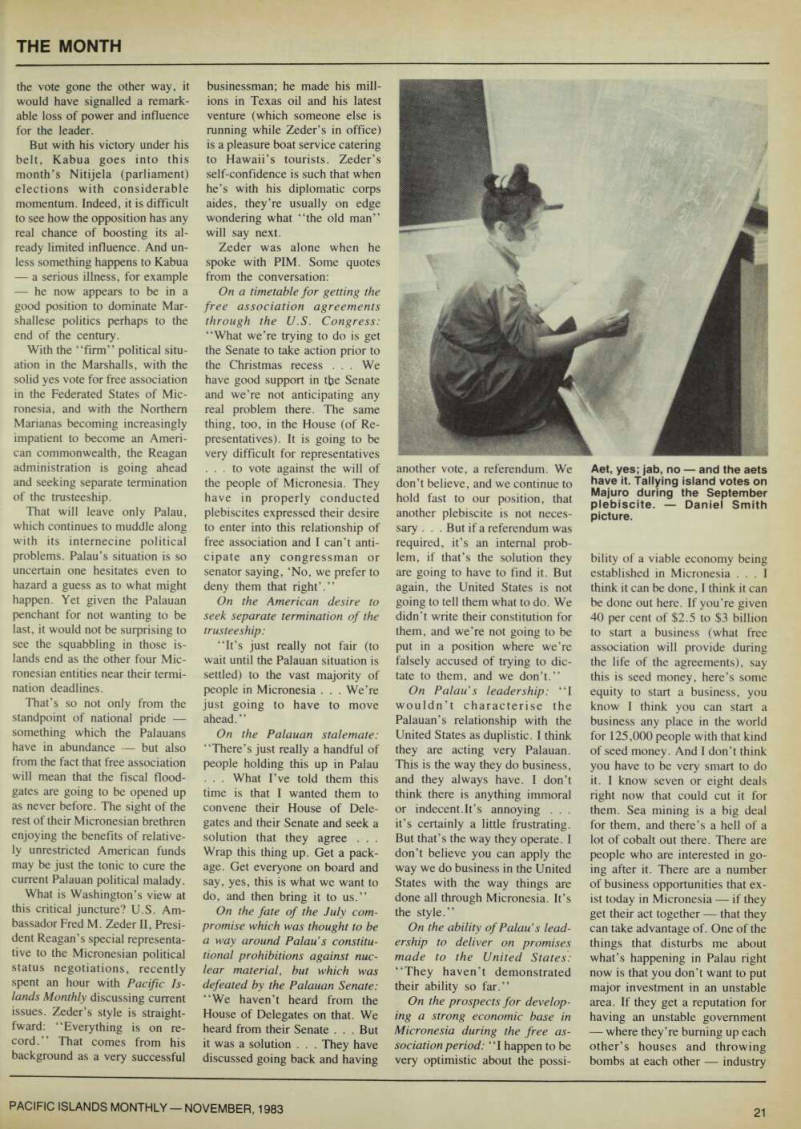
Aet, yes; jab, no - and the acts have it. Tallying island votes on Majuro during the September plebiscite. - Daniel Smith picture.
isn’t interested in going in there.”
On the annual rent the U.S. pays to the Kwajalein landow ners: ‘‘When I negotiated that lease for Kwajalein in 1976 (when Zeder was with the Ford administration) ... I thought I did a lousy job because we al ready had it for $650,000 (a year) for 99 years. We came back and agreed to give them $72,000 a year to lease Kwaja lein. During the Carter administ ration, somehow or other, that got up to $9 million a year and there’s no accounting for a nickel of that money. I have asked time and time again for the Kwajalein landowners to give an accounting on what they spent it for, what they do. They’ve never spent any real money on cleaning up Ebeye, and the money is there.
All they do is complain that it is a cesspool ... I hope that (Mar shalls President Amata) Kabua will not demand that the Kwaja lein landowners account for this Defense Department funding . . . They promised me they
would give it to me. they said, ‘Oh, you want an accounting of what we do with the money.’
Three times they’ve told me that ‘Well, we’ll send it next week, you know.’ They never have; Kabua has never had an account ing. I notice they (the Kwajalein leadership) fly first-class all over and they buy condominiums here in Honolulu, but they are not doing very much for their peo ple, and that’s wrong.”
On U.S. reaction to the possi bility of the Bikinians buying beachfront land on the Hawaiian island of Maui to resettle: ‘‘l think we’d have to think a long time before we’d continue any additional support. The (free as sociation) agreement right now, as far as the Bikinians are con cerned, is a good agreement for them. You’ve got only 1000 of them, and they’ve got $lOO mill ion plus, so they get $lOO,OOO a piece. They’ve got 10 members of each family, so they’ve got $1 million for each family. They ought to be able to get by on
that.”
Floyd K. Takeuchi.