in coming satellite tangle
pp. 60-62 · Read in the full issue


Trade Winds
Pacific leaders face hard choices in coming satellite tangle
Pacific Island countries have been using a declining satellite, low-cost equipment and basic skills to operate a cheap non-commercial radio-communications network across the region. When the present arrangement ends will they be kept out by the need for high technology and big money?
For the past 12 years, the US National Aeronautics and Space Administration (NASA) has al lowed its aging communications satellite ATS-1 to be used by non-commercial networks in the South Pacific. There is a single voice channel which permits people in 15 island nations to exchange information or provide education on a time-shared basis.
This main international network is usually referred to as
Peacesat.
Until recently, NASA anti cipated that ATS-1 would cease operation in October, 1983.
However, the satellite has now been moved into a different posi tion, which means that it may last another 10 years. The new position allows the beam to cover a different area which includes most of Southeast Asia, all parts of Australia, and half the Pacific Ocean.
Many of the Pacific users have come to rely on the free ATS-1 service, and are fearful of the new satellite proposals being studied by the South Pacific Bureau for Economic Co
operation. They believe the new schemes involve technology which will be “out of reach” to the small non-commercial user; costly earth stations, even more costly terrestrial links, and the principle of “user-pays” will all combine to price the service bey ond their limited means.
At present, PEACESAT users can gain direct access to satellite services through simple and in expensive ground stations which cost between SUSIOOO and $2OOO. Stuart Kingan, president of the PEACESAT network, re calls how the stations have gone through three different technologies.
“At first there were vacuum tubes, then crystal-controlled re ceivers and transmitters, and
now synthesised transceivers with better performance than in the past.”
“Recently NASA has de veloped a ground terminal which fits inside two normal-sized suit cases. The whole plugs into a cigarette lighter socket in a car and is capable of voice or digital telegraph communication with similar stations covered by the satellite beam.”
Kingan is an ATS-1 enthusiast who has been involved in estab lishing an inter-island HE radio network in the Cook Islands.
This network links up with the main PEACESAT station in Rarotonga and is free to all islan ders who need it.
A more sophisticated regional
network operates out of the
PEACESAT station at the Un iversity of the South Pacific (USP) in Suva. Recently, each of the 10 different USP stations which span nine Pacific countries has acquired an Apple computer.
This provides a type of “electron ic mail” service which supple ments the normal voice communication.
The USP now regards satellite technology as essential for its distance education programs.
When ATS-1 ceases operation and is replaced by more sophis ticated and costly satellite and earth technology, they fear that
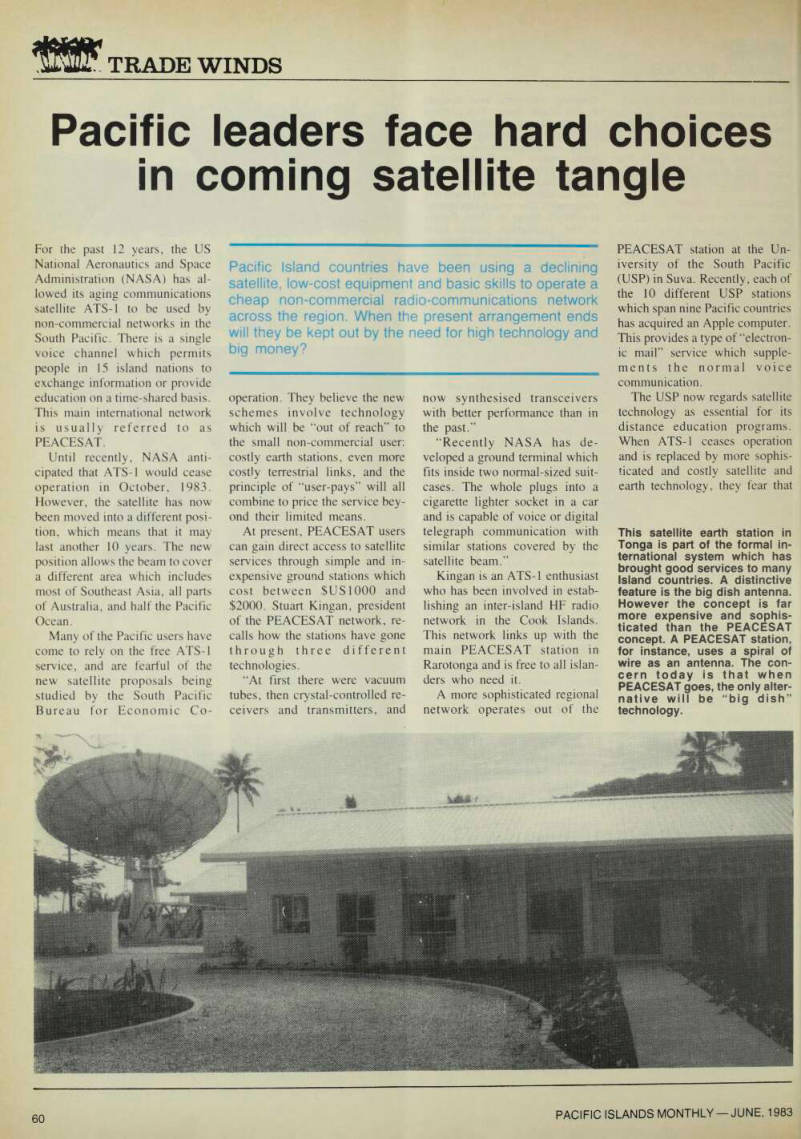
This satellite earth station in Tonga is part of the formal in ternational system which has brought good services to many Island countries. A distinctive feature is the big dish antenna.
However the concept is far more expensive and sophis ticated than the PEACESAT concept. A PEACESAT station, for instance, uses a spiral of wire as an antenna. The con cern today is that when PEACESAT goes, the only alter native will be “big dish” technology.
the service, especially the terrest rial links, will be priced beyond their annual budget.
Australia is a relative new comer to the PEACES AT net work, but under the guidance of Dr Steve Seumahu in Melbourne there are stations in all the major capital cities forming what is called the Kangaroo network.
Future plans include sub networks which will be used by groups as diverse as the police,
geological researchers, public
broadcasters and educators in the remote centre of Australia.
The demise of ATS-1 may not be a major problem for many of these users, since Australia will be launching its own national satellite system in 1985.
The newest network planning to share time on PEACESAT is centred in the University of Guam and calls itself the Pacific Post-Secondary Education Coun cil (PPEC). Dr James Lange, Professor of Communications in Guam, believes that the PPEC must learn how to use satellites to deliver their courses because they can no longer afford to “fly bodies around”.
Lange is critical of the new satellite proposals for the South Pacific, arguing that they are designed for international business users rather than the small educational groups who have had access to PEACESAT and ATS-1. He believes that the new system will be designed in a way that enables the outer islands and remote areas to communicate with a central point such as a major national or international city. The design will not enable remote areas to communicate with one another directly.
“We need a voice network which will allow people to talk easily, and, right now, ATS-1 is the only way you can put three islands together and let them talk with one another. Everything we know about Pacific Island cul tures shows that decisions are made by discussion in groups until consensus is reached, so the network must allow for this”.
Lange is convinced that a co ordinated approach from all the potential satellite users in the region must be developed. This would include banks, hotels, air lines, health agencies, news out lets, and smaller non-commercial
users. Without this co ordination, all the users will find their interests represented by the telephone companies or satellite providers who are mainly inter ested in carving out a profitable market for themselves.
The South Pacific heads of government have a difficult task ahead of them in making a choice and resolving the various con flicting interests. As one NASA official commented recently: “With the Japanese, INTELSAT and NASA all planning to beam over the Pacific, there will be difficulties in solving the cook
ing problems”.
Liz Fell.
Standards for
seafarers
Implementation of a regional training and examination system to rationalise maritime training facilities in the region and ensure that minimum agreed standards are maintained was the principal issue discussed at a meeting of the South Pacific Advisory Com mittee on Uniform Maritime Standards held in Madang, Papua New Guinea, in March under the auspices of the South Pacific Bureau for Economic Co operation (SPEC).
Under the proposed system, maritime training facilities in Su va, Honiara and Madang will be designated regional centres.
An agreement to formalise such a system is under considera tion by Pacific Island Governments.
The committee recognised that there was an urgent need to es tablish a full-time position to oversee the implementation and operation of the system and has requested SPEC to seek funding for such a position.
The meeting was attended by representatives of seven South Pacific countries (Fiji, Kiribati, New Zealand, Papua New Guinea, Solomon Islands, Tuvalu and Western Samoa).
The role of the committee, which reports to the Regional Shipping Council, the body of transport ministers of South Pacific Forum countries, is to develop common standards throughout the region for the safety of ships and the training and certification of sea
farers.
SPEC release.