People
pp. 44-47 · Read in the full issue

In the mid-1960s PlM’s editorial adviser JOHN CARTER was news editor of The Fiji Times, Suva. In this capacity he covered the visits to Fiji of U.S. film actor RAYMOND BURR, who at the time was in the process of purchasing the Fiji island of Naitauba. Below Carter offers his light-hearted recollection of the events surrounding the purch ase of the island, which is now up for sale. • • • So Raymond Burr, Hollywood actor inside “mouthpiece” Perry
Mason, paraplegic policeman
Ironside, one or two inscrutable Chinese villains and a few scrut able Caucasian ones, has put his island of Naitauba in Fiji on the market. Reason for sale, accord ing to Suva real estate agent David Ragg, is “to avoid estate complications after his death”.
There couldn’t be any other reason, except, maybe, hard upness, for Naitauba is a very attractive piece of real estate; one of those “away from it all” places especially in these nuclear fission days a valuable piece of freehold in a country where more than 80 per cent of the land is owned by the Fijians, who can’t sell any.
It’s one of those upraised cor al-on-limestone islands; is in northern Lau, about 135 kilometres from Taveuni and ab out 500 kilometres from Suva; has an area of 7.8 square kilometres, roughly circular in shape, flat in the southeast rising steeply to 186 metres with its north coast rising straight out of the Pacific Ocean (17 deg S) in 30-metre high cliffs. It has limes tone caves and 12 sandy beaches, though you’ve to climb down the cliffs to reach nine of them.
Its previous owners, the Hen
nings, once the largest trading
firm in Fiji, worked it as a copra plantation and it still has a large
coconut plantation.
But Mr Burr introduced sever al exotic sidelines as befits a film star. Obviously partial to nuts, macadamia-type he installed a nut farm, plantation or what, and imported some birds par
tridges, ptarmigan, pheasant,
etc. It has been his vacation isle but he has also run it as a business.
Sydney newspapers reported
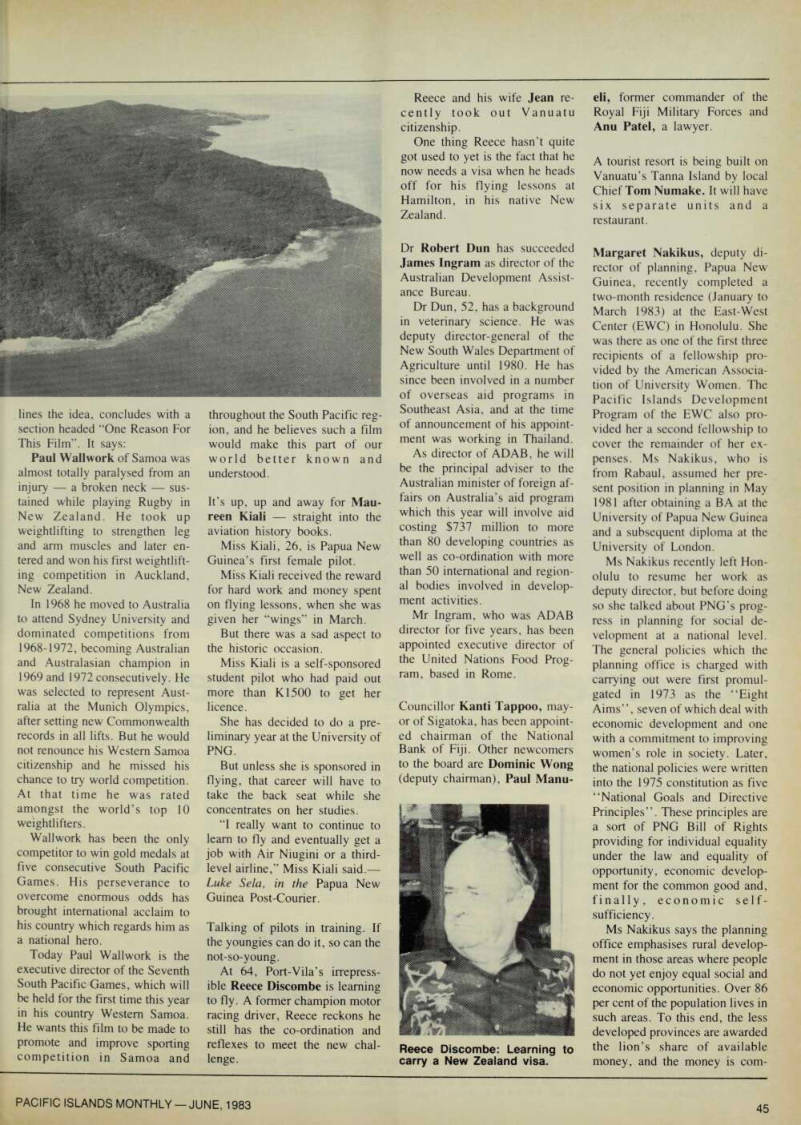
recently that he bought Naitauba for $12,716. Ye gods. I’d have borrowed $12,700 as I had $l6 and bought it myself at that price. Burr paid around 80,000 pounds, not dollars, for the is land. Now, he’s asking $3.9 million, which, with inflation and all the improvements he’s made, seems a fair enough price which could attract an American millionaire, like Smiley Ratliff, for instance, who’s set his sights on leasing Henderson in the Pit cairn Islands. When American business magazine owner millionaire Malcolm Forbes bought Laucala Island (11.7 square kilometres and 30 kilometres from Taveuni) in 1972 he flew over Naitauba and wished he’d bought it!
Burr’s negotiations with a Su va estate agent over Naitauba in 1965 were a cloak-and-dagger operation. Had it been divulged that he was wanting to buy the
island, there was sure to be a queue of competing buyers. He told reporters at a press confer ence in Suva in June, 1965, tha the had come to Suva to renew memories, as he did some con valescing there after being wounded in the Pacific War, and to buy seashells for his collection.
I had had a tip that the real reason for his visit was Naitauba.
When I asked Raymond Burr, he agreed that was the real reason but asked me to keep it under covers until he returned at Christ mas time and completed the deal.
Then, he promised, he’d give me the full, exclusive story and, later, any other personal news he had. He kept his promise to the letter and we broke the story in the following January — and several stories later, his casting off of the role of Perry Mason and donning the mantle of Iron side, plus news of new com panies. The news all went to the U.S. and Hollywood via Suva.
Having become a Fiji landow ner, Burr was determined to do what he could for Fiji. One way in which he publicised Fiji’s charms was to have his scriptwri ters do a quickie episode for his Ironside series in which he was kidnapped by criminals (import-
ed) while staying in Suva and incarcerated in a bure in Tamavua village. No doubt some Suva people got very worried about his health when they saw him being pushed in his invalid chair along Victoria Parade. He was Ironside, of course, the para plegic policeman. If asked, he’d probably admit it was the weak est episode in a very good series, carrying all the signs of being a makeshift piece. But, it was publicity for Fiji he was after. He also became a major shareholder in the Fiji Sun newspaper.
He’s a sentimental sort. His film company is named Harbour Productions, not Harbor as in the American language. He told me that he inserted the “u” into harbor because his father was a Canadian and spelt it that way.
Where he’ll go for his holidays when he has disposed of Naitau ba will be an important decision to make, but he’ll be seen in Suva, no doubt, when it’s snow
ing in America.
John Carter.
Film Australia is seeking com mercial sponsors for a projected film on the Seventh South Pacific Games in Apia, Western Samoa, in August.
Its handsomely produced booklet “Proposal”, which out
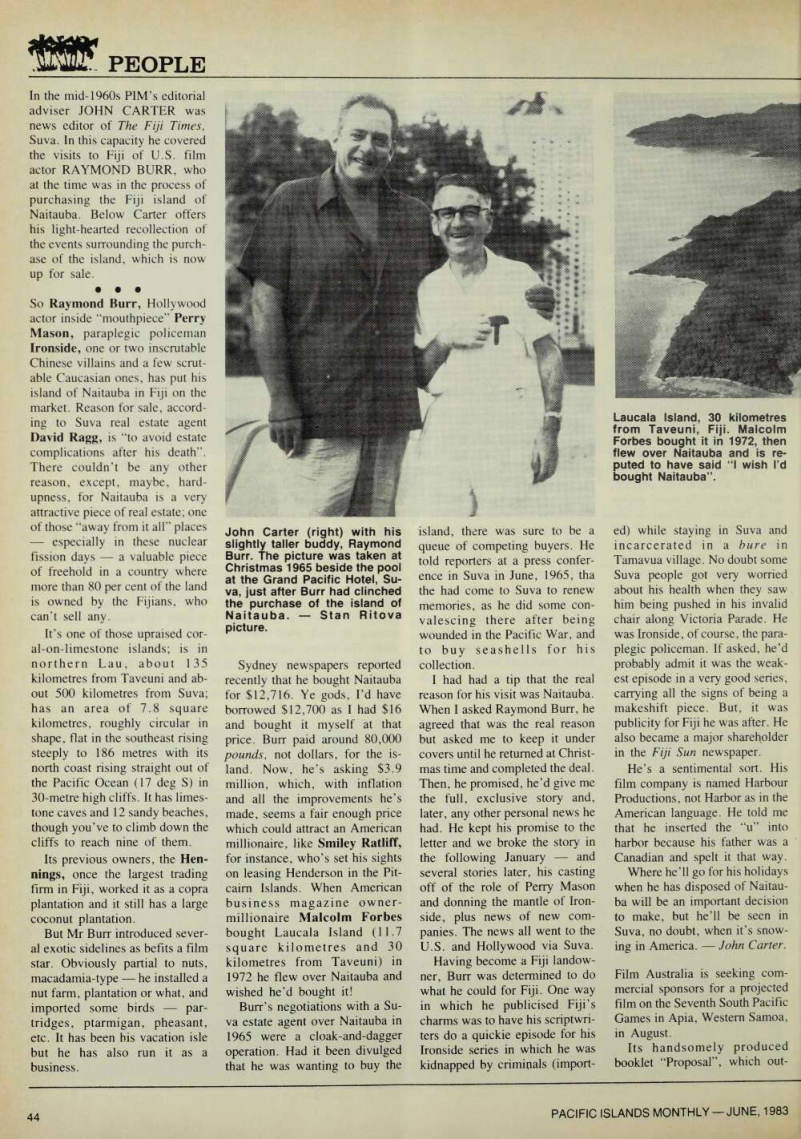
John Carter (right) with his
slightly taller buddy, Raymond
Burr. The picture was taken at Christmas 1965 beside the pool at the Grand Pacific Hotel, Su va, just after Burr had clinched the purchase of the island of Naitauba. - Stan Ritova picture.
Laucala Island, 30 kilometres from Taveuni, Fiji. Malcolm Forbes bought it in 1972, then flew over Naitauba and is re puted to have said “I wish I’d bought Naitauba”.
lines the idea, concludes with a section headed “One Reason For This Film”. It says; Paul Wallwork of Samoa was almost totally paralysed from an injury a broken neck sus tained while playing Rugby in New Zealand. He took up
weightlifting to strengthen leg
and arm muscles and later en tered and won his first weightlift
ing competition in Auckland,
New Zealand.
In 1968 he moved to Australia to attend Sydney University and dominated competitions from 1968-1972, becoming Australian and Australasian champion in 1969 and 1972 consecutively. He was selected to represent Aust ralia at the Munich Olympics, after setting new Commonwealth records in all lifts. But he would not renounce his Western Samoa citizenship and he missed his chance to try world competition.
At that time he was rated amongst the world’s top 10
weightlifters.
Wallwork has been the only competitor to win gold medals at five consecutive South Pacific Games. His perseverance to overcome enormous odds has brought international acclaim to his country which regards him as a national hero.
Today Paul Wallwork is the executive director of the Seventh South Pacific Games, which will be held for the first time this year in his country Western Samoa.
He wants this film to be made to
promote and improve sporting
competition in Samoa and
throughout the South Pacific reg ion, and he believes such a film would make this part of our world better known and understood.
It’s up, up and away for Mau reen Kiali straight into the aviation history books.
Miss Kiali, 26, is Papua New Guinea’s first female pilot.
Miss Kiali received the reward for hard work and money spent on flying lessons, when she was given her “wings” in March.
But there was a sad aspect to the historic occasion.
Miss Kiali is a self-sponsored student pilot who had paid out more than Kl5OO to get her licence.
She has decided to do a pre liminary year at the University of
Png.
But unless she is sponsored in flying, that career will have to take the back seat while she concentrates on her studies.
“I really want to continue to learn to fly and eventually get a job with Air Niugini or a third level airline,” Miss Kiali said.— Luke Sela, in the Papua New Guinea Post-Courier.
Talking of pilots in training. If
the youngies can do it, so can the not-so-young.
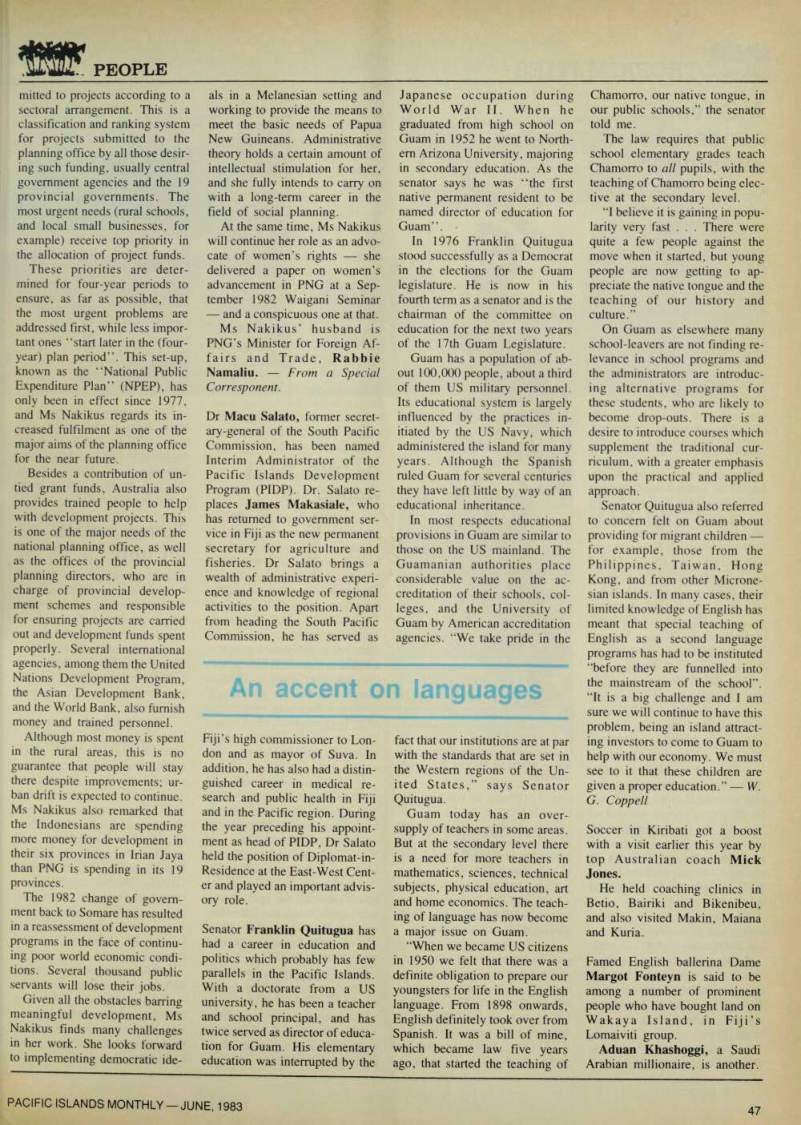
At 64, Port-Vila’s irrepress ible Reece Discombe is learning to fly. A former champion motor racing driver, Reece reckons he still has the co-ordination and reflexes to meet the new chal lenge.
Reece and his wife Jean re cently took out Vanuatu
citizenship.
One thing Reece hasn’t quite got used to yet is the fact that he now needs a visa when he heads off for his flying lessons at Hamilton, in his native New Zealand.
Dr Robert Dun has succeeded James Ingram as director of the Australian Development Assist ance Bureau.
Dr Dun, 52, has a background in veterinary science. He was
deputy director-general of the
New South Wales Department of Agriculture until 1980. He has since been involved in a number of overseas aid programs in Southeast Asia, and at the time of announcement of his appoint ment was working in Thailand.
As director of ADAB, he will be the principal adviser to the Australian minister of foreign af fairs on Australia’s aid program which this year will involve aid costing $737 million to more than 80 developing countries as well as co-ordination with more than 50 international and region al bodies involved in develop ment activities.
Mr Ingram, who was ADAB director for five years, has been appointed executive director of the United Nations Food Prog ram, based in Rome.
Councillor Kanti Tappoo, may or of Sigatoka, has been appoint ed chairman of the National Bank of Fiji. Other newcomers to the board are Dominic Wong (deputy chairman), Paul Manu-
eli, former commander of the Royal Fiji Military Forces and Anu Patel, a lawyer.
A tourist resort is being built on Vanuatu’s Tanna Island by local Chief Tom Numake. It will have six separate units and a restaurant.
Margaret Nakikus, deputy di rector of planning, Papua New
Guinea, recently completed a
two-month residence (January to March 1983) at the East-West Center (EWC) in Honolulu. She was there as one of the first three recipients of a fellowship pro vided by the American Associa tion of University Women. The Pacific Islands Development Program of the EWC also pro vided her a second fellowship to cover the remainder of her ex penses. Ms Nakikus, who is from Rabaul, assumed her pre
sent position in planning in May
1981 after obtaining a BA at the University of Papua New Guinea and a subsequent diploma at the University of London.
Ms Nakikus recently left Hon olulu to resume her work as deputy director, but before doing so she talked about PNG’s prog ress in planning for social de velopment at a national level.
The general policies which the planning office is charged with carrying out were first promul gated in 1973 as the “Eight Aims”, seven of which deal with economic development and one with a commitment to improving women’s role in society. Later, the national policies were written into the 1975 constitution as five “National Goals and Directive
Principles”. These principles are
a sort of PNG Bill of Rights
providing for individual equality
under the law and equality of
opportunity, economic develop
ment for the common good and, finally, economic self
sufficiency.
Ms Nakikus says the planning
office emphasises rural develop
ment in those areas where people do not yet enjoy equal social and economic opportunities. Over 86 per cent of the population lives in such areas. To this end, the less
developed provinces are awarded
the lion’s share of available money, and the money is com-
Reece Discombe: Learning to carry a New Zealand visa.
mitted to projects according to a sectoral arrangement. This is a classification and ranking system for projects submitted to the planning office by all those desir ing such funding, usually central government agencies and the 19 provincial governments. The most urgent needs (rural schools, and local small businesses, for example) receive top priority in the allocation of project funds.
These priorities are deter mined for four-year periods to ensure, as far as possible, that the most urgent problems are addressed first, while less impor tant ones “start later in the (four year) plan period’’. This set-up, known as the “National Public Expenditure Plan” (NPEP), has only been in effect since 1977, and Ms Nakikus regards its in creased fulfilment as one of the major aims of the planning office for the near future.
Besides a contribution of un tied grant funds, Australia also provides trained people to help with development projects. This is one of the major needs of the national planning office, as well as the offices of the provincial planning directors, who are in charge of provincial develop ment schemes and responsible for ensuring projects are carried out and development funds spent properly. Several international agencies, among them the United Nations Development Program, the Asian Development Bank, and the World Bank, also furnish money and trained personnel.
Although most money is spent in the rural areas, this is no guarantee that people will stay there despite improvements; ur ban drift is expected to continue.
Ms Nakikus also remarked that the Indonesians are spending more money for development in their six provinces in Irian Jaya than PNG is spending in its 19 provinces.
The 1982 change of govern ment back to Somare has resulted in a reassessment of development programs in the face of continu ing poor world economic condi tions. Several thousand public servants will lose their jobs.
Given all the obstacles barring meaningful development, Ms Nakikus finds many challenges in her work. She looks forward to implementing democratic ide
als in a Melanesian setting and working to provide the means to meet the basic needs of Papua New Guineans. Administrative theory holds a certain amount of intellectual stimulation for her, and she fully intends to carry on with a long-term career in the field of social planning.
At the same time, Ms Nakikus will continue her role as an advo cate of women’s rights she delivered a paper on women’s advancement in PNG at a Sep tember 1982 Waigani Seminar and a conspicuous one at that.
Ms Nakikus’ husband is PNG’s Minister for Foreign Af fairs and Trade, Rabble Namaliu. From a Special
Corresponent.
Dr Macu Salato, former secret ary-general of the South Pacific Commission, has been named Interim Administrator of the Pacific Islands Development Program (PIDP). Dr. Salato re places James Makasiale, who has returned to government ser vice in Fiji as the new permanent secretary for agriculture and fisheries. Dr Salato brings a wealth of administrative experi ence and knowledge of regional activities to the position. Apart from heading the South Pacific Commission, he has served as
An accent on languages
Fiji’s high commissioner to Lon don and as mayor of Suva. In addition, he has also had a distin guished career in medical re search and public health in Fiji and in the Pacific region. During the year preceding his appoint ment as head of PIDP, Dr Salato held the position of Diplomat-in- Residence at the East-West Cent er and played an important advis ory role.
Senator Franklin Quitugua has had a career in education and politics which probably has few parallels in the Pacific Islands.
With a doctorate from a US university, he has been a teacher and school principal, and has twice served as director of educa tion for Guam. His elementary education was interrupted by the
Japanese occupation during World War 11. When he graduated from high school on Guam in 1952 he went to North ern Arizona University, majoring in secondary education. As the senator says he was “the first native permanent resident to be named director of education for Guam”.
In 1976 Franklin Quitugua stood successfully as a Democrat in the elections for the Guam legislature. He is now in his fourth term as a senator and is the chairman of the committee on education for the next two years of the 17th Guam Legislature.
Guam has a population of ab out 100,000 people, about a third of them US military personnel.
Its educational system is largely influenced by the practices in itiated by the US Navy, which administered the island for many years. Although the Spanish ruled Guam for several centuries they have left little by way of an educational inheritance.
In most respects educational provisions in Guam are similar to those on the US mainland. The Guamanian authorities place considerable value on the ac creditation of their schools, col leges, and the University of Guam by American accreditation agencies. “We take pride in the
fact that our institutions are at par with the standards that are set in the Western regions of the Un ited States,” says Senator
Quitugua.
Guam today has an over supply of teachers in some areas.
But at the secondary level there is a need for more teachers in mathematics, sciences, technical
subjects, physical education, art
and home economics. The teach ing of language has now become a major issue on Guam.
“When we became US citizens in 1950 we felt that there was a definite obligation to prepare our youngsters for life in the English language. From 1898 onwards, English definitely took over from Spanish. It was a bill of mine, which became law five years ago, that started the teaching of
Chamorro, our native tongue, in our public schools,” the senator told me.
The law requires that public
school elementary grades teach
Chamorro to all pupils, with the teaching of Chamorro being elec tive at the secondary level.
“I believe it is gaining in popu larity very fast . . . There were
quite a few people against the
move when it started, but young people are now getting to ap preciate the native tongue and the teaching of our history and culture.”
On Guam as elsewhere many school-leavers are not finding re levance in school programs and the administrators are introduc ing alternative programs for these students, who are likely to become drop-outs. There is a desire to introduce courses which supplement the traditional cur riculum, with a greater emphasis upon the practical and applied approach.
Senator Quitugua also referred to concern felt on Guam about
providing for migrant children
for example, those from the
Philippines, Taiwan, Hong
Kong, and from other Microne sian islands. In many cases, their limited knowledge of English has meant that special teaching of English as a second language programs has had to be instituted “before they are funnelled into the mainstream of the school”.
“It is a big challenge and I am sure we will continue to have this problem, being an island attract ing investors to come to Guam to help with our economy. We must see to it that these children are
given a proper education.”
w.
G. Coppell
Soccer in Kiribati got a boost with a visit earlier this year by top Australian coach Mick Jones.
He held coaching clinics in Betio, Bairiki and Bikenibeu, and also visited Makin, Maiana and Kuria.
Famed English ballerina Dame Margot Fonteyn is said to be among a number of prominent people who have bought land on Wakaya Island, in Fiji’s Lomaiviti group.
Aduan Khashoggi, a Saudi Arabian millionaire, is another.