Protest by Australia prompts
pp. 31-32 · Read in the full issue

French Polynesia
Protest by Australia prompts French statement on N-Tests
French Polynesia is a territory which is exclusively under French sovereignty. This point of international law is indisputable.
The French Government under takes measures which it sees as appropriate on its own territory, and, in so doing, France can be
the only judge.
Nuclear tests are an essential part of our defence policy. They aim at maintaining the credibility of our deterrent force, thereby
safeguarding our independence.
As the Minister for External Relations, M Claude Cheysson, said in July 1982 in the National Assembly: “French nuclear de terrent capabilities have been kept down to the strict minimum needed to ensure deterrence.
France cannot fall below the threshold of credibility without
endangering her security and
independence”.
Nuclear tests have a bearing on vital French interests and con tribute to the world strategic balance.
We are well aware of the position of Australia: this posi tion is opposed to all nuclear tests carried out by all States.
The French Government there fore feels that the Australian Government cannot fail likewise to make known its opposition to tests carried out by China, the USA, and the USSR.
The monitoring of radio activity: Radio-activity in French Polynesia is monitored by two organisations under the joint re sponsibility of the army and the Atomic Energy Commission; A) The joint radiological sur veillance service (Service Mixte de Surveillance Radiologique) is in charge of monitoring irradia tion of personnel working on the test sites, as well as the physical environment (water soil air). 1. As for personnel, very strin gent regulations and strict monitoring procedures are in
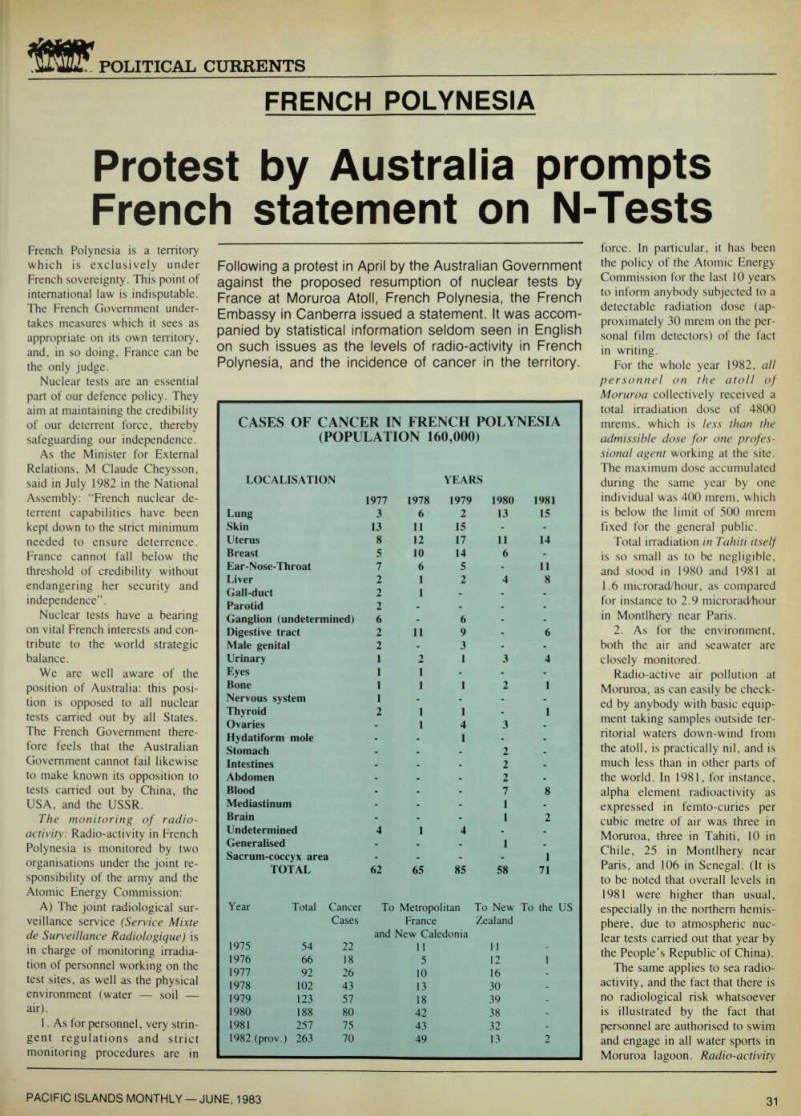
Following a protest in April by the Australian Government against the proposed resumption of nuclear tests by France at Moruroa Atoll, French Polynesia, the French Embassy in Canberra issued a statement. It was accom panied by statistical information seldom seen in English on such issues as the levels of radio-activity in French Polynesia, and the incidence of cancer in the territory.
Cases Of Cancer In French Polynesia
(Population 160,000)
force. In particular, it has been the policy of the Atomic Energy Commission for the last 10 years to inform anybody subjected to a detectable radiation dose (ap proximately 30 mrem on the per sonal film detectors) of the fact
in writing.
For the whole year 1982, all personnel on the atoll of Moruroa collectively received a total irradiation dose of 4800 mrems, which is less than the admissible dose for one profes sional agent working at the site.
The maximum dose accumulated during the same year by one individual was 400 mrem, which is below the limit of 500 mrem fixed for the general public.
Total irradiation in Tahiti itself is so small as to be negligible, and stood in 1980 and 1981 at 1.6 microrad/hour, as compared for instance to 2.9 microradtiour in Montlhery near Paris. 2. As for the environment, both the air and seawater are
closely monitored.
Radio-active air pollution at Moruroa, as can easily be check ed by anybody with basic equip ment taking samples outside ter ritorial waters down-wind from the atoll, is practically nil, and is much less than in other parts of the world. In 1981, for instance,
alpha element radioactivity as
expressed in femto-curies per cubic metre of air was three in Moruroa, three in Tahiti, 10 in Chile, 25 in Montlhery near Paris, and 106 in Senegal. (It is to be noted that overall levels in 1981 were higher than usual, especially in the northern hemis phere, due to atmospheric nuc lear tests carried out that year by the People’s Republic of China).
The same applies to sea radio activity, and the fact that there is no radiological risk whatsoever is illustrated by the fact that personnel are authorised to swim and engage in all water sports in
Moruroa lagoon. Radio-activity
Localisation
Years
1977 1978 1979 1980 1981 Lung 3 6 2 13 15 Skin 13 11 15 . - Uterus 8 12 17 11 14 Breast 5 10 14 6 - Ear-Nose-Throat 7 6 5 - 11 Liver 2 1 2 4 8 Gall-duct 2 1 . - - Parotid 2 . . - .
Ganglion (undetermined)
6 - 6 - - Digestive tract 2 11 9 - 6 Male genital 2 - 3 - - Urinary 1 2 1 3 4
Eyes
1 1 - - - Bone 1 1 1 2 1 Nervous system 1 - - - - Thyroid 2 1 1 - 1 Ovaries 1 4 3 .
Hydatiform mole - 1 - - Stomach . 2 .
Intestines . 2 .
Abdomen . 2 .
Blood . 7 8 Mediastinum . 1 .
Brain - 1 2 Undetermined 4 1 4 . .
Generalised . 1 .
Sacrum-coccyx area
- - 1
Total
62 65 85 58 71 Year Total Cancer
To Metropolitan
To New To the US Cases France Zealand and New Caledonia 1975 54 22 11 11 - 1976 66 18 5 12 1 1977 92 26 10 16 - 1978 102 43 13 30 - 1979 123 57 18 39 - 1980 188 80 42 38 - 1981 257 75 43 32 . 1982 (prov.) 263 70 49 13 2
in the waters of French Poly nesia, including Moruroa, is on a par with minimum levels re corded in the North Atlantic.
B) The joint biological control service (Service Mixte de Con trole Biologique) is in charge of
radiological monitoring of living
creatures except man, and of foodstuffs and drinking water.
More than 2000 samples are taken each year to test any radio activity in locally produced food stuffs. To put it simply, it has been observed that artificial radio-activity regularly amounts to no more than 1/10th of natural radio-activity.
C) These data, as well as those collected independently by a loc al United Nations antenna, are passed on to the UN, and provide the basis for the reports drawn up by the United Nations Scientific Committee on the Effects of Atomic Radiation (UNSCEAR).
The latest of these reports was published at the beginning of 1983 and can be purchased from the New York-based United Na tions Sales Section. 2. The Incidence of Cancer: Mortality rates in French Poly nesia are not a secret in any way.
They are in fact regularly brought to the attention of the relevant authorities, and publish ed in the local press.
The main conclusion to be drawn from the statistics is that the number of cancer cases in Polynesia, while subject as else where to variations, is in now way higher than in other areas.
It is in fact significantly lower than in some places, being on average 50 per 100,000, com pared with 106 in Australia, 175 in metropolitan France, and 264 in New Zealand. 1. Total figures for recent years are as follows: 1977 62, 1978 65, 1979 85, 1980 58, 1981 71.
The fluctuation in numbers is a direct result of the limited size of the population concerned (160,000), and is a normal stat
istical phenomenon.
2. Types of cancers: Cancers affecting organs which are the most radio-sensitive thyroid, blood cells do not occur more frequently than other types of cancers, and have shown no sig nificant variations.
On the other hand, cases of
cancer linked with tobacco and alcohol lungs, upper respirat ory tract, and digestive tract are very much on the increase, and this is a cause of great concern to the authorities. To bacco appears to be the major issue, since 75 per cent of all Polynesians are smokers, and to bacco consumption increased by 150 per cent between 1961 and 1979, while population rose by only 50 per cent.
Skin cancer occurrences ap pear to be no more numerous than would be expected in a climate- such as prevails in Polynesia. 3. Persons evacuated for med ical reasons; It should be noted that these figures obviously do not coincide with the figures for cancer cases. The same person may be evacuated for treatment overseas, twice or more in the course of a year, and this in any case may not be required in the year in which cancer has been
diagnosed.
The number of persons evacuated for medical reasons has been increasing. But all evacuees are not necessarily can cer cases. In 1982, for example, the latter were 70 out of a total of 263 persons sent overseas for medical treatment, the remainder being victims of heart disease, or
cases requiring major surgery.
Some are sent to metropolitan France, others to the United States or New Zealand. The reason for this is that the small
population in French Polynesia
has not made it possible to pro vide the islands with the com plete range of medical facilities to be found in larger communities.
At the same time increasing efforts are going into the early detection of cancer cases. This, coupled with a substantial rise in life expectancy, which brings a larger segment of the population into the potential cancer age groups, explains that there has been an increase in the numbers of persons evacuated.
The decision to evacuate pa tients is made on purely medical and/or personal grounds, and no attempt is made, contrary to cer tain allegations, to hide the fact since statistics on the matter, herewith provided, are readily available.