first government
pp. 12-14 · Read in the full issue

Cook Islands
Henry the Second’s first government
Geoffrey Henry, prime minister and a successor to Albert Henry, has chosen his cabinet to govern the Cook Islands. For the first time a woman who ear lier threatened to resign holds one of the positions.
Geoffrey Arama Henry, 42, the new Cook Islands Prime Minis ter, sees the world trend to economic recession as a signific ant factor in his programs for government. Speaking soon after he was sworn in he said that the Cook Islands could not be isolated from the world trend, and there was “sweet little” that a country of its size could do to alter the situation.
This made the task facing his new government that much more difficult, Mr Henry said.
Mr Henry has created a seven member cabinet, which for the first time in the Cook Islands includes a woman. She is Mrs Fanaura Kingstone, 42, who will
be postmistress general and
minister for internal affairs. Mrs
Kingstone is also the first mem ber of parliament to represent the controversial newly-created elec torate: known as the Overseas electorate. It was created so that Cook Islanders living outside the country they are mainly in New Zealand could vote for and obtain a member of parlia ment to represent them at home.
However Mrs Kingstone’s election to the seat is not without its own controversy. Earlier she had stated that her only reason in standing for the seat was to abol ish it because she believed that the parliamentary affairs of the Cook Islands were matters only for Cook Islanders who lived in their own country. If she were elected she could be expected to resign “the very next day” she
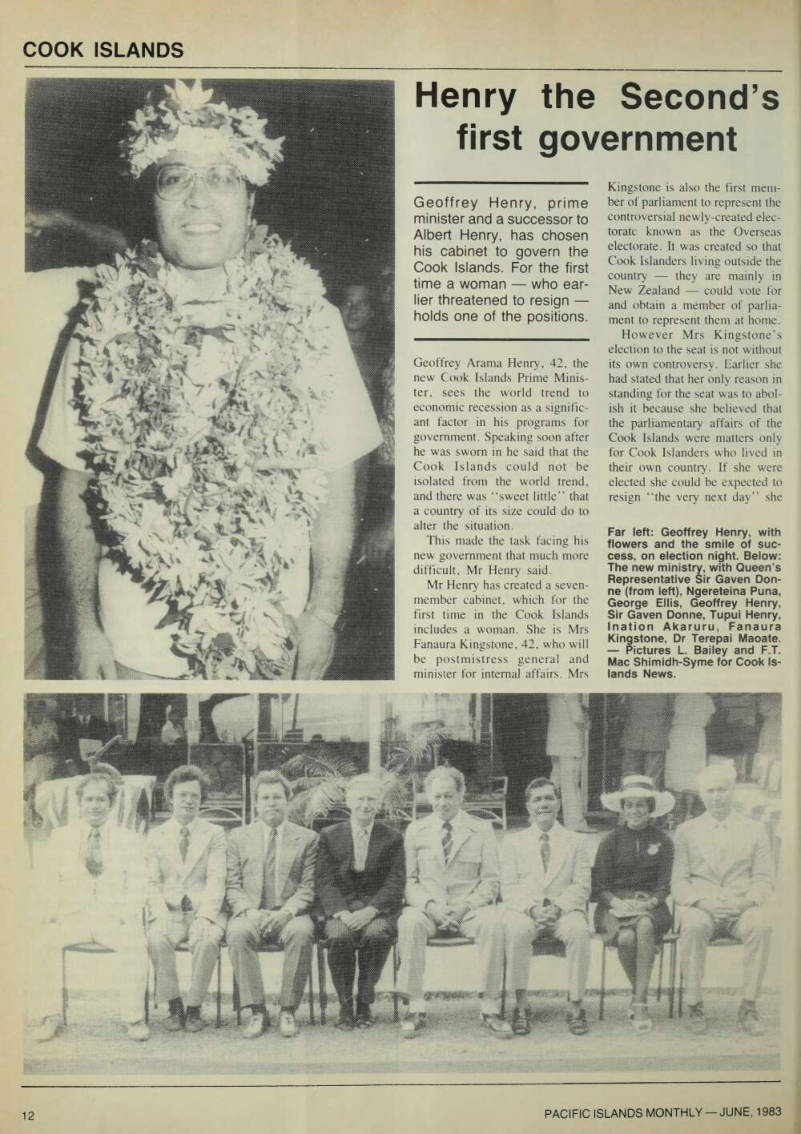
Far left: Geoffrey Henry, with flowers and the smile of suc cess, on election night. Below: The new ministry, with Queen’s Representative Sir Gaven Don ne (from left), Ngereteina Puna,
George Ellis, Geoffrey Henry,
Sir Gaven Donne, Tupui Henry, Ination Akaruru, Fanaura
Kingstone, Dr Terepai Maoate.
- Pictures L. Bailey and F.T.
Mac Shimidh-Syme for Cook Is lands News.
told television interviewers in New Zealand.
But when it came to the point she didn't resign. Her reason was that the government did not have a majority of at least two-thirds in parliament. Presumably she felt it couldn’t afford to lose any of its members. With admirable frankness she added another reason her appointment to cabinet.
The new government has created five new departments, and one of its most interesting policy statements concerns radio and newspaper services. It has indicated that offers from the private sector to buy the govem ment-owned Cook Islands Broadcasting and Newspaper Corporation will be considered.
Geoffrey Henry himself will hold the portfolios of finance, immigration, tourism, police, external affairs, ombudsman and parliamentary services.
The five other ministers and their portfolios are; Ination Akar uru, public works, electrical of-
fice, water commission, hur ricane safety; George Ellis, trade, labor, transport, energy, development planning, statistics; Tupui Henry, marine resources,
fisheries, justice and survey, broadcasting and newspaper cor poration, outer islands, local government, art and culture; Dr Terepai Maoate, health, agricul ture; Ngereteina Puna, educa tion, public service, corrective services, religious advisory council.
Sir Gaven Donne, Queen’s re presentative, conducted the cere mony to swear in the new gov ernment following the 1983 gen eral election (PIM May pi 5). Mr Henry leads the Cook Islands Party which had been in opposi tion for just over four years. He takes over from Sir Thomas Davis, 66, leader of the Democ ratic Party.
Sir Gaven Donne told Mr Hen ry as the ceremony ended “The country is over to you, and I know it will be in good hands.”
Geoffrey Henry is a cousin of the late Albert Henry, the man who led the Cook Islands into inde pendence. Albert Henry’s Cook Islands Party was in office for 13 years until 1978. Then its candi dates for election were removed by electoral petition and Albert Henry was finished politically following electoral conspiracy charges to which he pleaded guil ty. He was found to have bol stered his party’s election chances by using public money to charter aircraft which flew in voters.
Geoffrey Henry became leader
of the opposition in 1978 when Albert Henry was forced to retire from the political arena follow ing the court case. In 1981 Albert Henry died and seven months later, Geoffrey Henry was cho sen as the leader of the party after a confidence vote during a CIP conference. There was some dis content among CIP supporters who saw 54-year-old Tupui Ariki Henry, the son of the former premier, as the more appropriate
leader. Despite this, Geoffrey
Henry led his party into victory in the general election winning 13 of the 24 seats, with the
Democratic Party gaining 11.
The third party. Unity Movement failed to win any seats.
Some staunch CIP supporters believe their party was able to
scrape through only after a plea
made by Geoffrey Henry to vote in the memory of the “old man”
Albert Henry. The prime minister was quoted by a New Zealand newspaper as saying this was a crucial ploy during the
campaign.
F. T. MacShimidh-
Syme in Rarotonga.
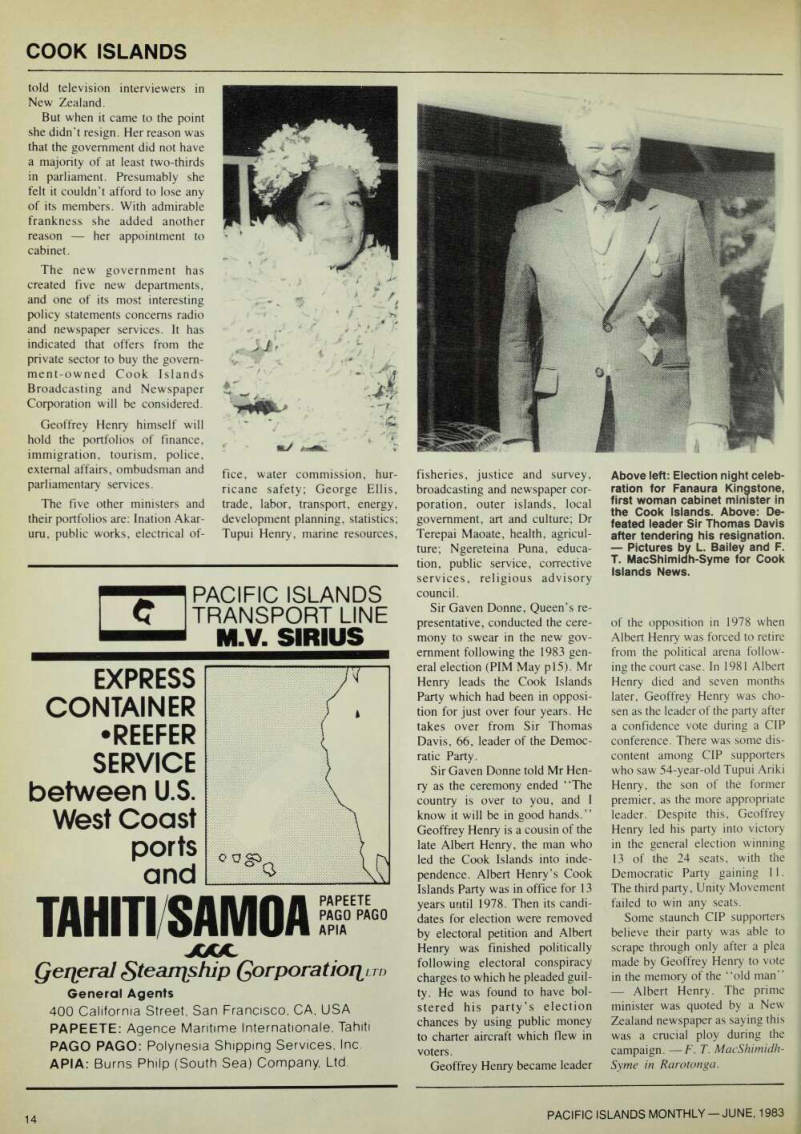
Above left: Election night celeb ration for Fanaura Kingstone, first woman cabinet minister in the Cook Islands. Above: De feated leader Sir Thomas Davis after tendering his resignation. - Pictures by L. Bailey and F.
T. MacShimidh-Syme for Cook Islands News.