Yachts
pp. 63-69 · Read in the full issue
Lan G. Menzies Re
ports from Port Mores
by and Rabaul , Papua
New Guinea:
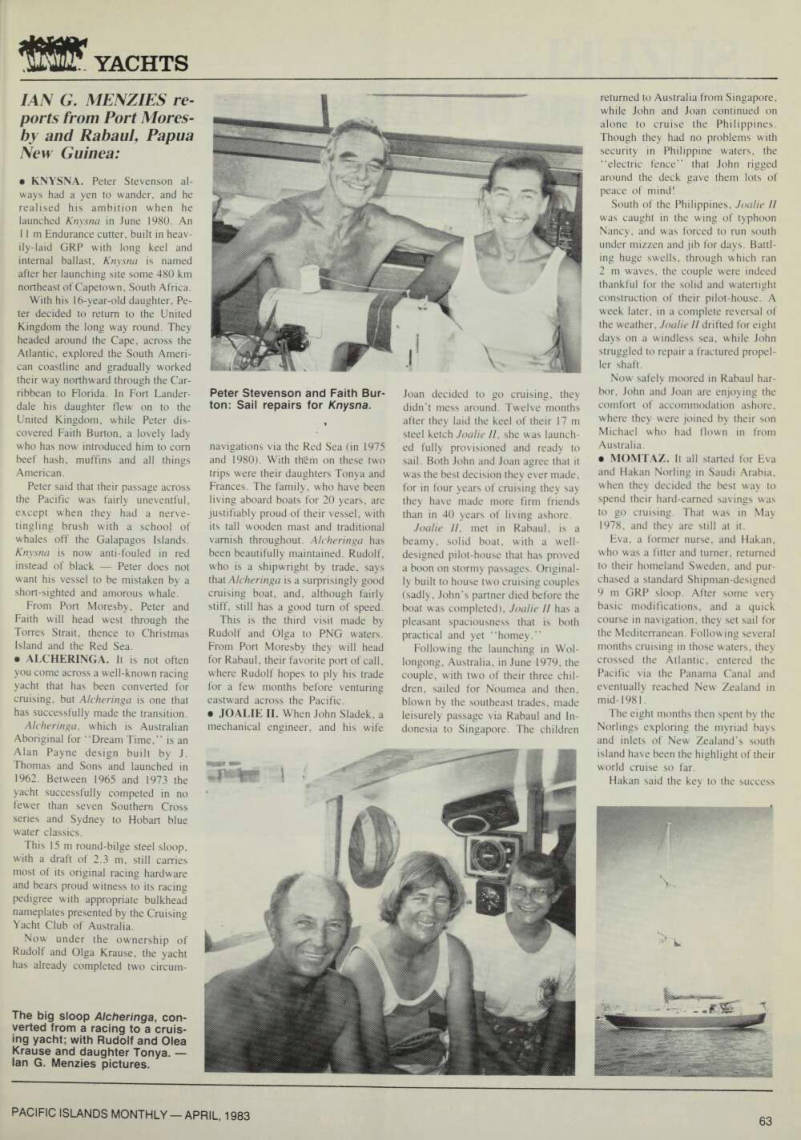
• KNYSNA. Peter Stevenson al ways had a yen to wander, and he realised his ambition when he launched Knysna in June 1980. An 11 m Endurance cutter, built in heav ily-laid GRP with long keel and internal ballast, Knysna is named after her launching site some 480 km northeast of Capetown, South Africa.
With his 16-year-old daughter, Pe ter decided to return to the United Kingdom the long way round. They headed around the Cape, across the Atlantic, explored the South Ameri can coastline and gradually worked their way northward through the Car ribbean to Florida. In Fort Lander dale his daughter flew on to the United Kingdom, while Peter dis covered Faith Burton, a lovely lady who has now introduced him to com beef hash, muffins and all things American.
Peter said that their passage across the Pacific was fairly uneventful, except when they had a nerve tingling brush with a school of whales off the Galapagos Islands.
Knysna is now anti-fouled in red instead of black Peter does not want his vessel to be mistaken by a short-sighted and amorous whale.
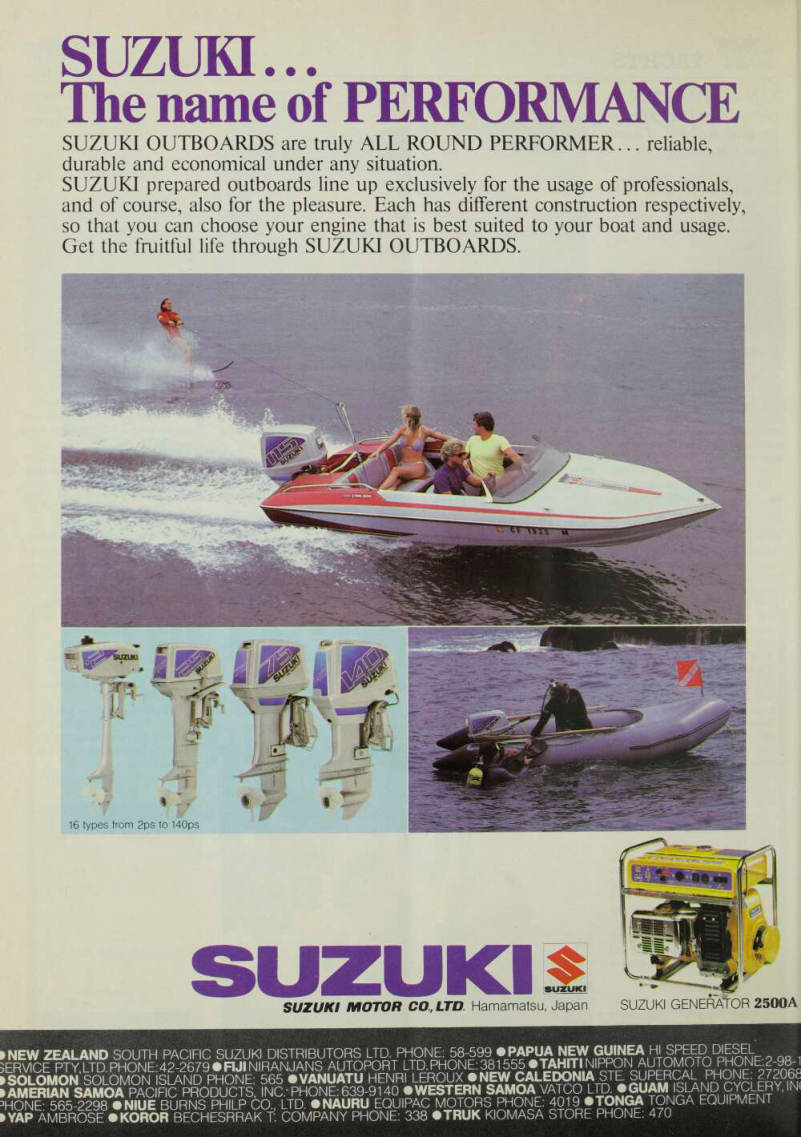
From Port Moresby, Peter and Faith will head west through the Torres Strait, thence to Christmas Island and the Red Sea. • ALCHERINGA. It is not often you come across a well-known racing yacht that has been converted for cruising, but Alcheringa is one that has successfully made the transition.
Alcheringa, which is Australian Aboriginal for “Dream Time,” is an Alan Payne design built by J.
Thomas and Sons and launched in 1962. Between 1965 and 1973 the yacht successfully competed in no fewer than seven Southern Cross series and Sydney to Hobart blue water classics.
This 15 m round-bilge steel sloop, with a draft of 2.3 m, still carries most of its original racing hardware and bears proud witness to its racing pedigree with appropriate bulkhead nameplates presented by the Cruising Yacht Club of Australia.
Now under the ownership of Rudolf and Olga Krause, the yacht has already completed two circum-
navigations via the Red Sea (in 1975 and 1980). With th‘em on these two trips were their daughters Tonya and Frances. The family, who have been living aboard boats for 20 years, are justifiably proud of their vessel, with its tall wooden mast and traditional
varnish throughout. Alcheringa has
been beautifully maintained. Rudolf, who is a shipwright by trade, says
that Alcheringa is a surprisingly good
cruising boat, and, although fairly
stiff, still has a good turn of speed.
This is the third visit made by Rudolf and Olga to PNG waters.
From Port Moresby they will head for Rabaul, their favorite port of call, where Rudolf hopes to ply his trade for a few months before venturing eastward across the Pacific. • JOALIE 11. When John Sladek, a mechanical engineer, and his wife
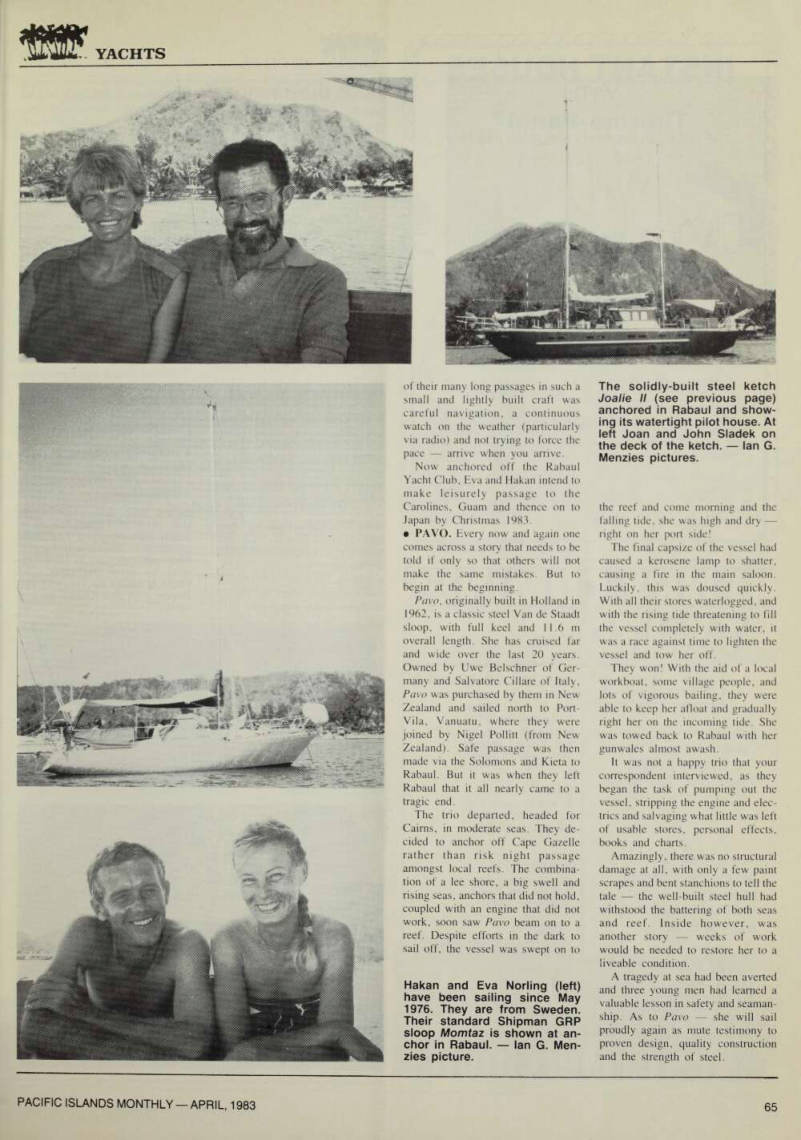
Joan decided to go cruising, they didn't mess around. Twelve months after they laid the keel of their 17 m steel ketch Joalie 11, she was launch ed fully provisioned and ready to sail. Both John and Joan agree that it was the best decision they ever made, for in four years of cruising they say they have made more firm friends than in 40 years of living ashore.
Joalie 11, met in Rabaul. is a beamy, solid boat, with a well
designed pilot-house that has proved
a boon on stormy passages. Original ly built to house two cruising couples (sadly, John’s partner died before the boat was completed), Joalie II has a pleasant spaciousness that is both
practical and yet “homey.”
Following the launching in Wol longong, Australia, in June 1979, the couple, with two of their three chil dren, sailed for Noumea and then, blown by the southeast trades, made leisurely passage via Rabaul and In donesia to Singapore. The children
returned to Australia from Singapore, while John and Joan continued on alone to cruise the Philippines.
Though they had no problems with
security in Philippine waters, the “electric fence’’ that John rigged around the deck gave them lots of peace of mind!
South of the Philippines, Joalie II was caught in the wing of typhoon Nancy, and was forced to run south under mizzen and jib for days. Battl
ing huge swells, through which ran
2 m waves, the couple were indeed thankful for the solid and watertight construction of their pilot-house. A week later, in a complete reversal of the weather, Joalie II drifted for eight days on a windless sea, while John
struggled to repair a fractured propel
ler shaft.
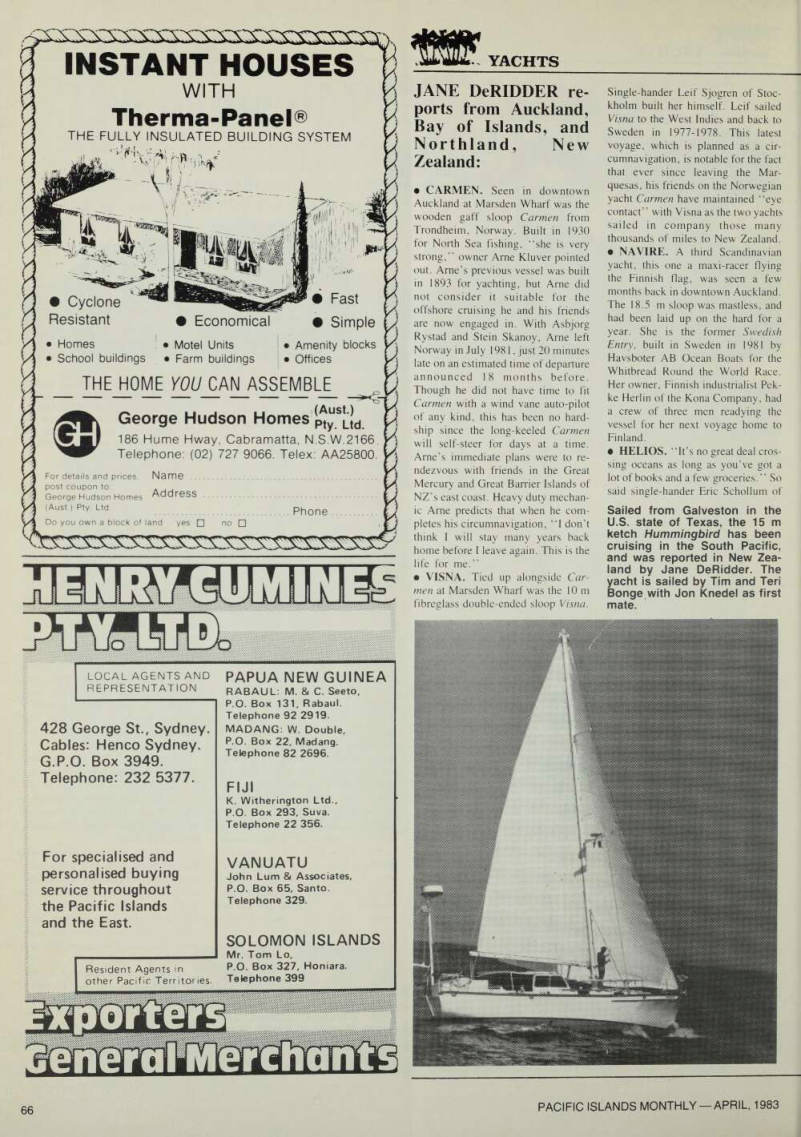
Now safely moored in Rabaul har bor, John and Joan are enjoying the comfort of accommodation ashore, where they were joined by their son Michael who had flown in from Australia. • MOMTAZ. It all started for Eva and Hakan Norling in Saudi Arabia, when they decided the best way to spend their hard-earned savings was to go cruising. That was in May 1978, and they are still at it.
Eva, a former nurse, and Hakan, who was a fitter and turner, returned to their homeland Sweden, and pur chased a standard Shipman-designed 9 m GRP sloop. After some very basic modifications, and a quick course in navigation, they set sail for the Mediterranean. Following several months cruising in those waters, they crossed the Atlantic, entered the Pacific via the Panama Canal and eventually reached New Zealand in mid-1981.
The eight months then spent by the
Norlings exploring the myriad bays
and inlets of New Zealand’s south island have been the highlight of their world cruise so far.
Hakan said the key to the success
The big sloop Alcheringa, con verted from a racing to a cruis ing yacht; with Rudolf and Olea Krause and daughter Tonya. - Ian G. Menzies pictures.
Peter Stevenson and Faith Bur ton: Sail repairs for Knysna.
of their many long passages in such a small and lightly built craft was careful navigation, a continuous watch on the weather (particularly via radio) and not trying to force the pace arrive when you arrive.
Now anchored off the Rabaul Yacht Club. Eva and Hakan intend to make leisurely passage to the Carolines, Guam and thence on to
Japan by Christmas 1983.
• PAVO. Every now and again one comes across a story that needs to be told if only so that others will not make the same mistakes. But to begin at the beginning.
Pavo, originally built in Holland in 1962, is a classic steel Van de Staadt sloop, with full keel and 11.6 m overall length. She has cruised far and wide over the last 20 years.
Owned by Uwe Belschner of Ger many and Salvatore Cillare of Italy, Pavo was purchased by them in New Zealand and sailed north to Port- Vila, Vanuatu, where they were joined by Nigel Pollitt (from New Zealand). Safe passage was then made via the Solomons and Kieta to Rabaul. But it was when they left Rabaul that it all nearly came to a tragic end.
The trio departed, headed for Cairns, in moderate seas. They de cided to anchor off Cape Gazelle rather than risk night passage amongst local reefs. The combina tion of a lee shore, a big swell and rising seas, anchors that did not hold, coupled with an engine that did not work, soon saw Pavo beam on to a reef. Despite efforts in the dark to sail off, the vessel was swept on to
the reef and come morning and the falling tide, she was high and dry right on her port side!
The final capsize of the vessel had caused a kerosene lamp to shatter, causing a fire in the main saloon.
Luckily, this was doused quickly.
With all their stores waterlogged, and with the rising tide threatening to fill the vessel completely with water, it was a race against time to lighten the vessel and tow her off.
They won! With the aid of a local workboat, some village people, and lots of vigorous bailing, they were able to keep her afloat and gradually right her on the incoming tide. She was towed back to Rabaul with her gunwales almost awash.
It was not a happy trio that your correspondent interviewed, as they began the task of pumping out the vessel, stripping the engine and elec trics and salvaging what little was left of usable stores, personal effects, books and charts.
Amazingly, there was no structural damage at all, with only a few paint scrapes and bent stanchions to tell the tale the well-built steel hull had withstood the battering of both seas and reef. Inside however, was another story weeks of work would be needed to restore her to a liveable condition.
A tragedy at sea had been averted and three young men had learned a valuable lesson in safety and seaman ship. As to Pavo she will sail proudly again as mute testimony to
proven design, quality construction
and the strength of steel.
Hakan and Eva Norling (left) have been sailing since May 1976. They are from Sweden.
Their standard Shipman GRP sloop Momtaz is shown at an chor in Rabaul. - Ian G. Men zies picture.
The solidly-built steel ketch Joalie II (see previous page) anchored in Rabaul and show ing its watertight pilot house. At left Joan and John Sladek on the deck of the ketch. - Ian G.
Menzies pictures.
Jane Deridder Re
ports from Auckland,
Bay of Islands, and
Northland, New
Zealand:
• CARMEN. Seen in downtown Auckland at Marsden Wharf was the wooden gaff sloop Carmen from Trondheim, Norway. Built in 1930 for North Sea fishing, “she is very strong,” owner Ame Kluver pointed out. Ame’s previous vessel was built in 1893 for yachting, but Ame did not consider it suitable for the offshore cruising he and his friends are now engaged in. With Asbjorg Rystad and Stein Skanoy, Ame left Norway in July 1981, just 20 minutes late on an estimated time of departure announced 18 months before.
Though he did not have time to fit Carmen with a wind vane auto-pilot of any kind, this has been no hard ship since the long-keeled Carmen will self-steer for days at a time.
Ame’s immediate plans were to re ndezvous with friends in the Great Mercury and Great Barrier Islands of NZ’s east coast. Heavy duty mechan ic Ame predicts that when he com pletes his circumnavigation, “I don’t think I will stay many years back home before I leave again. This is the life for me.” • VISNA. Tied up alongside Car men at Marsden Wharf was the 10 m fibreglass double-ended sloop Visna.
Single-hander Leif Sjogren of Stoc kholm built her himself. Leif sailed Visna to the West Indies and back to Sweden in 1977-1978. This latest voyage, which is planned as a cir cumnavigation, is notable for the fact that ever since leaving the Mar quesas, his friends on the Norwegian yacht Carmen have maintained “eye contact” with Visna as the two yachts sailed in company those many thousands of miles to New Zealand. • NAVIRE. A third Scandinavian yacht, this one a maxi-racer flying the Finnish flag, was seen a few months back in downtown Auckland.
The 18.5 m sloop was mastless, and had been laid up on the hard for a year. She is the former Swedish Entry, built in Sweden in 1981 by Havsboter AB Ocean Boats for the Whitbread Round the World Race.
Her owner, Finnish industrialist Pek ke Herlin of the Kona Company, had a crew of three men readying the vessel for her next voyage home to Finland. • HELIOS. “It’s no great deal cros sing oceans as long as you’ve got a lot of books and a few groceries. ’ ’ So said single-hander Eric Scholium of
Sailed from Galveston in the U.S. state of Texas, the 15 m ketch Hummingbird has been cruising in the South Pacific, and was reported in New Zea land by Jane DeRidder. The yacht is sailed by Tim and Teri Bonge with Jon Knedel as first mate.
Waiheke Island, New Zealand, after a virtually non-stop 71-day voyage home from San Diego. (He paused for two hours in Borabora to take on water.) Eric arrived in Auckland on Helios, his 16-year-old 10.6 m Piver Lodestar trimaran, having sailed 31,000 miles in 19 months. He had interrupted his scheduled circum navigation when he learned his mother was dying, arriving home in time to spend Christmas, 1982 with her and with his children. When visiting Sausalito in the San Francis co Bay, area Helios was vandalised.
It took Eric three days to clean up the mess. But, worst of all, all his cam era gear was stolen, a tragedy for one whose potential major source of in come comes from photo-joumalism.
Eric hopes to get away again before too long, westward bound this time.
“I can’t go ashore again for any length of time,” he explained. “I’ve only slept ashore once in four or five years . . . and never slept of course • REVELLER. After less than a week in New Zealand, the UK Nicholson 32 Reveller of Ramsgate was due to leave Auckland for the Falklands Islands, an estimated eight weeks voyage of some 6500 miles, in an attempt to round the Horn before the season is too far advanced. The owner/skipper Charles Crawshaw is a Lancashire sheep and cattle farmer.
Crewing with him are Tony Lawson, mechanical engineer, and Devon inn keeper Angela Herbert. Angela, co proprietor with her husband of the Norway Inn in Falmouth, wrote a booklet telling of Reveller’s proposed circumnavigation. The booklet is be ing sold in conjunction with a car raffle, the proceeds of which are being donated to cancer research.
People all over the UK follow with interest the adventures of Reveller.
She is scheduled to arrive back home in Falmouth in October ’B3 after a two years cruise. • OCEAN GIRL. When the Van couver Maple Leaf 48 Ocean Girl arrived in Suva two years ago, Don Tiflin, marine geophysicist with the
Canadian Geological Survey, was
offered a post with CCOP/SOPAC a branch of the UN technical sec retariat engaged in offshore evalua tion of the South Pacific’s sea floor mineral potential. Don accepted a two-year contract and Ocean Girl, a comfortable 14.6 m Huntingford designed yacht, family-built to per fectionist standards, made the Tradewinds in Suva its base. Caro lyn, Don's wife and first mate, was hired to teach Home Economics and English at the University of the South Pacific in Suva. Daughter Gwendo lyn rejoined the Ocean Girl last December in Auckland having com pleted her sixth form at a school in
Masterton, New Zealand. Fourteen year-old Kathleen just finished her fourth form year in Suva, while Gillian, eldest of the Tiflin daugh ters, is back in Vancouver. After a family Christmas and a refit in Auck land, the balsa core vessel which the Tiflins spent eight years building together Don calls it “A one-off backyard job” will sail back to Suva. Don plans on one more year with SOPAC before Ocean Girl’s cruise of the South Pacific continues.
Meanwhile, he enjoys the opportuni ty of exploring the Pacific Islands which his job provides. • DELIVERANCE. A former Roy al Yacht of Monaco, the gaff schoon er Deliverance was a splendid sight as she tied up at Opua Wharf to clear New Zealand customs, a long red pennant streaming from her masth ead. Built in 1956 as a yacht by Quincy Adams Shipyard near Bos ton, she is a copy of a grand Banks schooner. The hull is African mahogany on double-sawn oak frames. Instead of cargo holds, there are staterooms. David and Lonny Higgins of Boston, the ship’s fifth owners, bought Deliverance in 1979 with an extended circumnavigation in mind. The Higgins cruise with no
fixed itinerary, accompanied by their
two children, David, nine, and Jessi ca, five. They like to stay long enough to learn the history of each area visited and to make friends wherever they go. They read a great deal about each port of call. The children do their schooling by Cal vert correspondence lessons. David and Lonny take turns supervising their children’s studies. David, Bos ton attorney, one-time instructor in legal writing and former nagivation officer aboard a U.S. naval frigate, has a novel underway. Lonny, MD, specialist in obstetrics and gynaecol ogy, accepted a position in the New Zealand National Women’s Hospital during Deliverance’s stay in Auckland.
A vessel of Deliverance’s type and size she’s 25 m on deck, 29 m overall requires a sizeable crew in order to keep abreast of maintenance, and of course for sail handling. De liverance is self-sufficient; she car ries a chief mate, ship's carpenter, engineer, bo’s’n, cook, and steward or stewardess, all highly qualified.
(Right) Breeze shows her paces in the Russell Tall Ships Race.
The brigantine is sailing out of New Zealand ports. (Above right). The former Monaco royal yacht Deliverance, a gaff schooner, was “a splendid sight" on her arrival in New Zealand, reports Jane DeRidder.
highly motivated, young people. The crew take a pride in such traditional arts as scrimshaw, carving, knotwork and woodwork. Though Deliverance
is primarily a family cruising vessel,
she does occasional educational/ad venture charters. Future cruising plans include a visit to the People’s
Republic of China tentatively
scheduled for December 1983. • BREEZE. The Russell Tall Ships Race in the Bay of Islands on January 9 was a treat for those who love clouds of canvas. Tall ships taking part with other, less lofty but faster yachts in the light wind which pla gued the race were the training ship Spirit Of Adventure, the gaff schoon er Deliverance, Austrian artist Frederick Hundertwasser’s striped sailed Regentag, and the 16.5 m brigantine Breeze. Breeze a copy of a 19th-century New Zealand coaster, designed, built and sailed by the Sewell family of the Coromandel, is now making regular trips from Auck land and the Bay of Islands accom panied by members of the Breeze Sailing Club, a charitable trust. Club members are entitled to sail on the traditional square-rigged vessel for a small charge to cover cost of the trip plus maintenance. Captain Jim Cot tier is serving as master of Breeze, with young Peter Sewell, first mate, and his sister Janet, cook. Visitors to Northland. NZ. may direct inquiries to the Secretary of the Devenport Steam Ferry Company of Auckland’s North Shore (P.O. Box 1346, Auck land) for information regarding club membership and scheduled adventure
sailings.
• Cloud Nine. A U K.-Built,
Minneapolis-registered Bowman 57 ketch. Cloud Nine arrived in Opua in January seven days out from Suva with six persons aboard. Her owner, Minnesota com/soy bean/hog/cattle farmer, Roger Swanson, who sails with sons Steven and Philip and friends, attributes the salt water in his blood to a stint in the navy. The Swansons left Miami in July, 1981.
From N.Z. they plan on visiting Australia, then Japan before continu
ing a circumnavigation.
• SKOIERN 111. Capsized and dis masted west of Cape Horn in 55 to 60 knot winds and enormous seas, Skoiern /// was one of the particip ants in a single-handers’ round-the world race. Jacques de Roux began to cut the rigging free, but while still partly attached, the mast holed the boat. Though Jacques tried to plug the hole, water continued to flood in, and he had to hand pump for two hours out of every three. Never theless, he jury-rigged the vessel in an effort to get underway again.
Another single-handed race particip
ant, British entry Perseverance of Medina, made a rendezvous with the
sinking yacht near 55 degrees south,
126 degrees west, took Jacques aboard and continued on course at eight knots. The French navy sent a 20-knot vessel to intercept Persever ance, fetch Jacques and take him to Papeete. The encounters at sea were
made possible by Argos navigation
systems pinpointing the yachts’ posi
tions, and by amateur radio operators serving as relay stations. Those ham radio operators involved in arranging the “lift-off” on 14.347 mHz were Finn ZL4HI, with fellow South Island operators ZL4MK and ZL4JO; also FOBGM in Papeete; and FKBED mm Alain Martel on yacht Tropic Bird in New Caledonia. • TROPIC BIRD. Well known to their fellow cruising yachtsmen be cause of their frequent help on vari ous South Pacific maritime mobile nets, Alain and Gisele Martel (FKBED/mm) have been sailing ab out the Pacific on their Nicholson 38 Tropic Bird for several years now.
Frequent visitors to New Zealand and New Caledonia, the French couple plan to return to French Polynesia in a few months time, an area they cruised first in the early 1970 s in their previous yacht, Paihere of
Toulon, a Nicholson 32. Like amateur radio operator John Ander son on Norfolk Island (VK9JA) Alain transforms morse-coded weather reports into weather charts, a skill which has earned him the sobri quet, “the walking weatherfax.” • GANESH. This 16.7 m schooner with masts of equal height tied up briefly in the Kerikeri Stone Store Basin in January after an Auckland haulout and refit. Built and registered in Venice, Italy, in 1981, Ganesh is a CCYD 55 owned by Giorgio Villa, a dealer in precious metals, who man ages to fly in to join the vessel for about four weeks each year. Villa’s parents were aboard in New Zealand.
Ganesh is sailed by skipper Gavin Prescott and Sarah Fenwick, crew.
They are to leave for Tonga in April.
It was Ganesh and her crew who were instrumental in salvaging the
Bermuda-registered Tyler 42 Titanic
when she was holed and stranded on
Beveridge Reef last year. They pick
ed up the owner in Niue, returned to Beveridge Reef, patched and re floated Titanic after which she was sailed to Niue for further repairs. • SIROCCO. “A family adven ture” is how Ed and Patti Nichols describe cruising on their customised hardtop CT 54 which they had spe
dally built in Taiwan. Ed supervised the construction with several flying visits to the Taiwan yard. Sirocco is now homeward bound at an average speed of 1600 km a week after a year and a half in the South Pacific. The
Nichols left Opua in early February,
harnessing fresh westerlies to sail via the Australs to Papeete. Accompany ing their parents are Liz, 20. and Matt, 18, a football player who keeps fit with weight-lifting while cruising.
Capper, 22, was left in Fiji to return
to college studies. The family keeps
in touch with him by means of amateur radio phone patches. (Ed’s call sign is WB3FGA). Sirocco is due back in the U.S. in June. It’s back to work for Ed, a political consultant in Washington, D.C., for the Republican party. Ed was among the pioneers who introduced the com
puter into politics. Though they plan
on selling Sirocco after their arrival in the U.S.. Patti, who describes herself as “a suburban Maryland housewife”, says she hopes it won’t
be long before they are cruising
again: “Once you’ve been cruising it’s hard to give it up,” she says. The
couple previously cruised the
Bahamas, Central America, and the Galapagos on Faith Jones, their 14.6 m North Sea ketch.