The marketing of “aloha”:
pp. 55-57 · Read in the full issue

Books
The marketing of “aloha”: Tourism in Hawaii
Hawaii: The Legend That Sells. By Bryan H. Farrell. Pub lished by University Press of Hawaii, Honolulu, 1982. No price shown. ISBN 0 8248 0766 9.
At a Pacific Area Travel Associ ation (PATA) conference in Syd ney in April 1981, Chuck Y. Gee informed the gathering that one quarter of Hawaii’s entire popu lation was employed in tourism.
Travel agents around me smiled in evident satisfaction. I ex perienced a distinct feeling of discomfort. “Within tourism,”
Gee went on to say, “nothing is irrelevant.” The smiles around me grew broader. My feeling of discomfort grew more acute, as I contemplated briefly the prospect of tourism subsuming every other kind of human activity, to say nothing of all natural phenomena; the ultimate form of socio-economic expression, the ultimate intellectual discipline.
Chuck Y. Gee is Dean of the School of Travel Industry Man agement, University of Hawaii.
The existence of such a school at that academic level points, of course, to a number of things, the most significant, for the pur pose of this review, being its location.
“Hawaii”, Dean Gee informed us, “is a natural locus for teach ing the travel industry.” Leaving aside the tricky question of whether Hawaii’s position in the travel industry’s scheme was cosmically ordained, one can say with safety that it is a most appropriate choice for a com prehensive study of tourism and tourist-related development.
Author Farrell brings to his study an impressive background.
He has already published exten sively on tourism; he is professor of geography in the department of environmental studies at the University of California’s Santa Cruz campus, and was once di rector of that institution’s Centre for South Pacific Studies, the demise of which was reported in
PIM in 1979. The special interest of the centre was (perhaps you’ve guessed) tourism in the Pacific Islands.
What I have called a com prehensive approach Farrell de scribes as holistic, a term cur rently much favoured by social scientists who do not want to be accused of narrow specialisation.
Thus the book looks at Hawaii tourism as “a maxtrix of numer ous overlapping and intersecting systems. . .” In practice this means that Farrell discusses not merely contemporary develop ment, but its historical back ground and its physical, political and social context.
Unlike many other recent wri ters on the subject of Pacific tourism Farrell does not set out to attack it. For him, tourism IS, and he is concerned to describe, explain and occasionally analyse it rather than engage in the fash ionable but seemingly futile task of opposing it as a necessarily “bad thing”. “Relatively few people,” he writes, “understand that tourism, when approached with sensitivity and taste, can be a resource-creating activity.”
The phenomenon’s opponents, of course, would regard the jux taposition of “tourism” with “sensitivity and taste” as inhe rently contradictory.
While the work does not re main entirely free from value judgements (how could it?), readers are likely to bring some of their own biases to bear upon much of Farrell’s information.
Mine were awakened by the first chapter, entitled rather blandly “Setting the Stage: Background to Present Development”, which tells a sorry tale of traditional Hawaiian land tenure succumb ing to the persistence of haole demands. “By 1850 aliens pos sessed virtually all they had been pressing for. . . The common people owned less than one per cent of the land ... By 1936 only six per cent of the original awards (some 30,000 acres) were in Hawaiian hands.” By 1980,
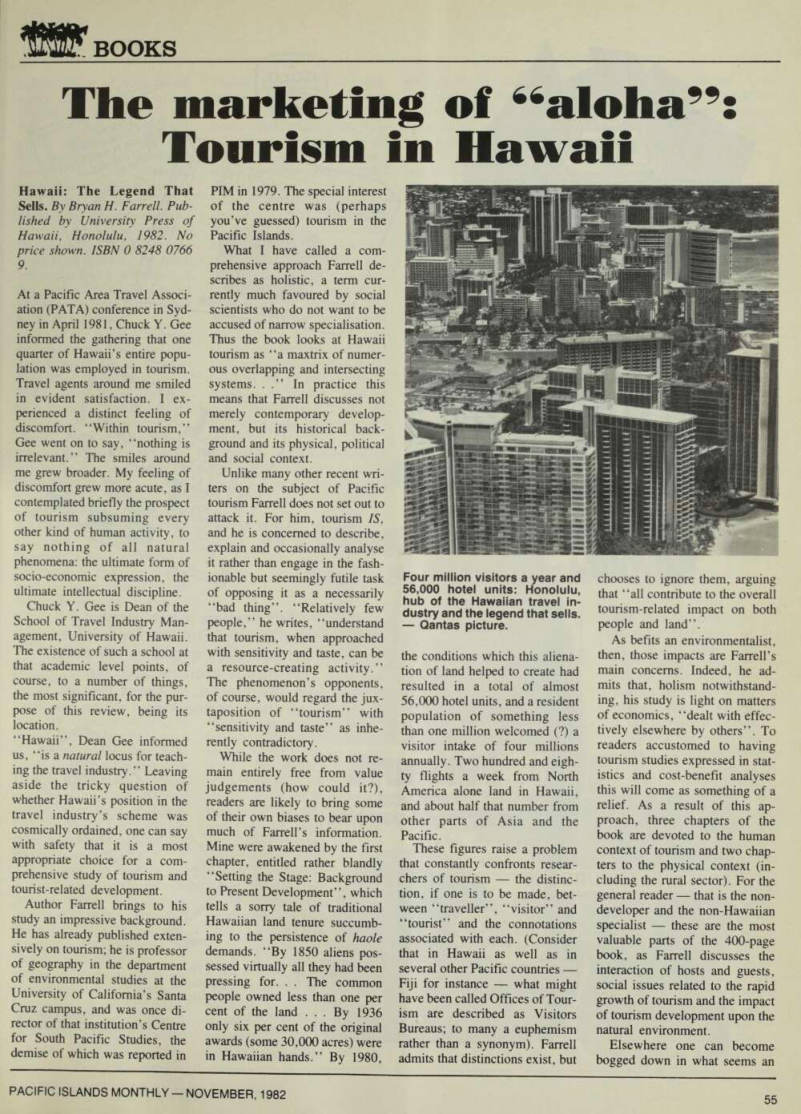
the conditions which this aliena tion of land helped to create had resulted in a total of almost 56,000 hotel units, and a resident population of something less than one million welcomed (?) a visitor intake of four millions annually. Two hundred and eigh ty flights a week from North America alone land in Hawaii, and about half that number from other parts of Asia and the Pacific.
These figures raise a problem that constantly confronts resear chers of tourism the distinc tion, if one is to be made, bet ween “traveller’’, “visitor’’ and “tourist’’ and the connotations associated with each. (Consider that in Hawaii as well as in several other Pacific countries Fiji for instance what might have been called Offices of Tour ism are described as Visitors Bureaus; to many a euphemism rather than a synonym). Farrell admits that distinctions exist, but
chooses to ignore them, arguing that “all contribute to the overall tourism-related impact on both people and land’’.
As befits an environmentalist, then, those impacts are Farrell’s main concerns. Indeed, he ad mits that, holism notwithstand ing, his study is light on matters of economics, “dealt with effec tively elsewhere by others’’. To readers accustomed to having tourism studies expressed in stat istics and cost-benefit analyses this will come as something of a relief. As a result of this ap proach, three chapters of the book are devoted to the human context of tourism and two chap ters to the physical context (in cluding the rural sector). For the general reader that is the non developer and the non-Hawaiian specialist these are the most valuable parts of the 400-page book, as Farrell discusses the interaction of hosts and guests, social issues related to the rapid growth of tourism and the impact of tourism development upon the natural environment.
Elsewhere one can become bogged down in what seems an
Four million visitors a year and 56,000 hotel units: Honolulu, hub of the Hawaiian travel in dustry and the legend that sells.
- Qantas picture.
endless listing of hotel rooms, tennis courts and golf courses (should they be on the Arnold Palmer or Robert Trent Jones plan?), how many retail stores and restaurants are needed to service a resort, and what part condominiums should play in such plans. (Question; Can a time-sharing condominium be termed a much-used condom?) Occasionally, therefore, the wood is obscured by the trees, and one begins to lose sight of that important human element which, to his credit, the author wants to maintain.
Part of this problem is due to the organisation of the book and what I consider to be an imba lance of emphasis. Maui, an is land in which Farrell obviously has a profound interest, is given 56 pages to itself, including case studies from the Kaanapali, Kapalua and Wailea resort areas, and while the justification for this intensity is that “. . . Maui is representative of Hawaii as a whole”, that quality of associa tion between whole and part does not satisfactorily emerge.
Moreover, we are introduced to this detail as early as chapter three, some considerable time before the essential aspects of physical landscape (chapter eight) and Hawaii’s population (chapter nine) are discussed at any length. Compared to the space devoted to Maui (fascinat ing to developers, I suspect), tourist and resident interaction receives shortish shrift (12 pages). A revealing breakdown of changes in the Maui labor force (while the population from 1964 to 1980 barely doubled, employment in hotels increased sixfold) is rendered less mean ingful by the fact that no compar able figures are provided for Hawaii as a whole.
A chapter on Tourism and Agriculture begins early with the proposition that “Agriculture is an important prop to tourism”.
There follows a 15-page run down on the problems of Hawaii’s agriculture, but little attempt is made to show any relationship except to restate the proposition, at greater length, that successful tourism depends on a viable agriculture (really? compare New Caledonia, Fiji,
Norfolk Island). By this time, however, we have already been informed that both plantation ag riculture and cattle ranching were evidently far from viable since a number of old ranches and plan tations have been turned to resort development.
Many aspects of tourism indisputably a major force in the Pacific for social, environmental and economic change are dy namic, many of them observable and of considerable visual im pact. Farrell’s work, however, is poorly served in this regard. The diagrams of resort development are skilfully drawn, but the photographs are drab, black and white reproductions which large ly fail to convey anything of the dynamics of tourism. Most of them are derived from the Visitors Bureau, hotels or de velopers.
As if in tacit recognition of their poor quality and their feeble impact, there is no index of
photographs though tables and figures are listed.
In his last chapter Farrell of fers some well reasoned “scenarios” for future develop ment which reveal his insights into tourism’s problems and his concern with its possible exces ses. He also offers a brief analy sis of the “aloha spirit” which, whether cynically or sincerely, infuses most tourist-related activ ity in Hawaii. But it is the in troduction to this chapter which I find both fascinating and dis quieting. “Hawaii,” writes Far rell, “has a remarkable array of resources (my emphasis) for tourism; climate, beaches, clear water, magnificent coastal scen ery, fascinating mountain vistas, open spaces, attractive rural in dustries, tourism facilities of a high quality, a high level of industry expertise, and a friend ly, hospitable, interesting multi ethnic population.” Clearly, then, to tourism in Hawaii (and
by implication the rest of the Pacific?) nothing is irrelevant; everything a resource, suscept ible of preservation, conserva tion and presumably exploita tion. I feel that acute discomfort returning.
Hawaii; the Legend that Sells is a sometimes inconsistent though frequently valuable con tribution to the increasing amount of serious literature on the subject of Pacific tourism. I find, however, a certain tautolo gy not only in the author’s style but also in the central concept.
The title is obvious enough and most of the book is devoted to describing the selling of that legend. Yet in the final sentences Farrell writes: “That attractive image the legend is still there, but it can so easily tarnish and disappear. Certainly it sells but is it for sale?” At this point the question is no longer rhetorical, merely redundant.
Norman Douglas.