March 16, 1889
pp. 45-49 · Read in the full issue

Yesterday
O Le Afā - Apia’s hurricane of March 16, 1889
JOSEPH THEROUX deftly reconstructs the dreadful events of March 16-17 1889 when a great hurricane struck the harbour of Apia, crowded at the time with warships from Germany, the United States and Britain. It is a story of heroism and shame, with hardly anybody emerging more creditably from it than the Samoan people themselves.
Halfway down the road be tween Apia proper and Mulinuu Point, on the island of Upolu, Western Samoa, stands a marble obelisk. It is enclosed by a low wall, ringed with palms, and set back on the inland side of the road. Once there were other graves, but these are now gone. Scores of people pass the obelisk daily, on their way to work or to drink at the clubs, rarely glancing over. Tourists pause, feeling obliged to take note of it, but upon seeing the inscription in German, shrug and wander off, cursing the humidity.
The front face displays a German eagle, and, beneath it, these words: Den auf der australischen Station fur das Vaterland geblieben Kam eraden. (Here lie for the Father land our Comrades of the Aus tralian Station.) Beneath that, a representation of a cluster of leaves, and, further down, a list of sailors killed in action in December of 1888. On the other three faces are listed the names of 93 sailors killed, not in action, but in a hurricane, and amidst circumstances so singu lar that they have led people to refer to them as acts of God, or Providence, or, as in the title of one book. The Typhoon that Stopped a War.
The right face reads: Im Orkane am 16 M'arz 1889 bei den Samoa Inseln mit S.M.
Knbt. Eber und S.M. Krzr.
Adler geblieben... (In the Hurricane of March 16, 1889 near the Samoan Islands with the warship Eber and the cruiser Adler their men lie here . . .) The hurricane sparked scores of accounts, ‘eyewitness’ re ports, articles, investigations and pamphlets. Even into this century, accounts of it have found their way into Pacific journals, travel books, histories, magazines and, in 1968, the above-mentioned book. Read ing these reports, one is struck by the inconsistencies in the
number of deaths given. They range from 130 to 155, with almost every number in be tween, each author concluding with an air of finality that such and-such a number of men died.
On April 1, 1889, the Sydney Daily Telegraph would report: ‘lt was a day of terror, indeed, but also of golden deeds, of staunch courage and good sea manship in the face of appalling storms, and of heroic rescue by a noble race of (so-called) savages . . .’ Unfortunately, there was also quakebuttock cowardice by some who would turn their backs on their strug gling comrades, allowing them to die.
And it was the German monument, mute in its remem brance of the Kameraden, which was to give a key to the long-sought answer as to how many died. • • • In his book. Adventures in Paradise, Willard Price sum marised neatly, though in a somewhat staccato fashion, the
events leading up to that fateful day in March; ‘Germany wanted Samoan trade. The British and Americans did not care to see Germany become dominant in the treasure islands. ‘German warships came to reinforce German demands.
The Samoans rejected German terms. The Germans then seized the public buildings and raised the German flag. People rebelled and blood was spilled. ‘More warships arrived, three American and one British.
Angrily they maneuvred around the three German vessels then in the harbor. In March 1889 the tension mounted swiftly toward a climax. A fight seemed inevitable. And a match struck here might ignite Europe . . .’
Robert Louis Stevenson wrote in A Footnote to History, in which he devotes 15 pages to the hurricane, that ‘. . . Germany and the States, at least in Apia Bay, were on the brink of war. ..’ • • • Captain H.C. Kane, of the lone British warship Calliope, was later to estimate the harbour’s capacity at four large ships.
But, on the Ides of March, there were, in the harbour of Apia, no fewer than seven warships -
three German, the Olga, Eber, and Adler; three American, the Trenton, Vandalia, and Nipsic; and one British, the Calliope.
There were also six merchantmen, two iron barques and a number of smaller craft.
And Apia harbour hardly was (or is) a sailor’s dream. Its passage and anchorage were narrow, and it was ringed by shelves and teeth of jutting coral. J.C. Furnas called it ‘a known death trap in a heavy northern blow’.
At 2pm on that day, the barometer plunged to 29.11", and the winds picked up. The beach community, believing the hurricane season to be over, was confident the squall would soon pass. They passed on their optimism to those on shipboard.
And each captain, unwilling to lose his place of ‘dominance’ in the harbour, waited for others to back down and quit the scene. When no one did, upper yards and topmasts were struck.
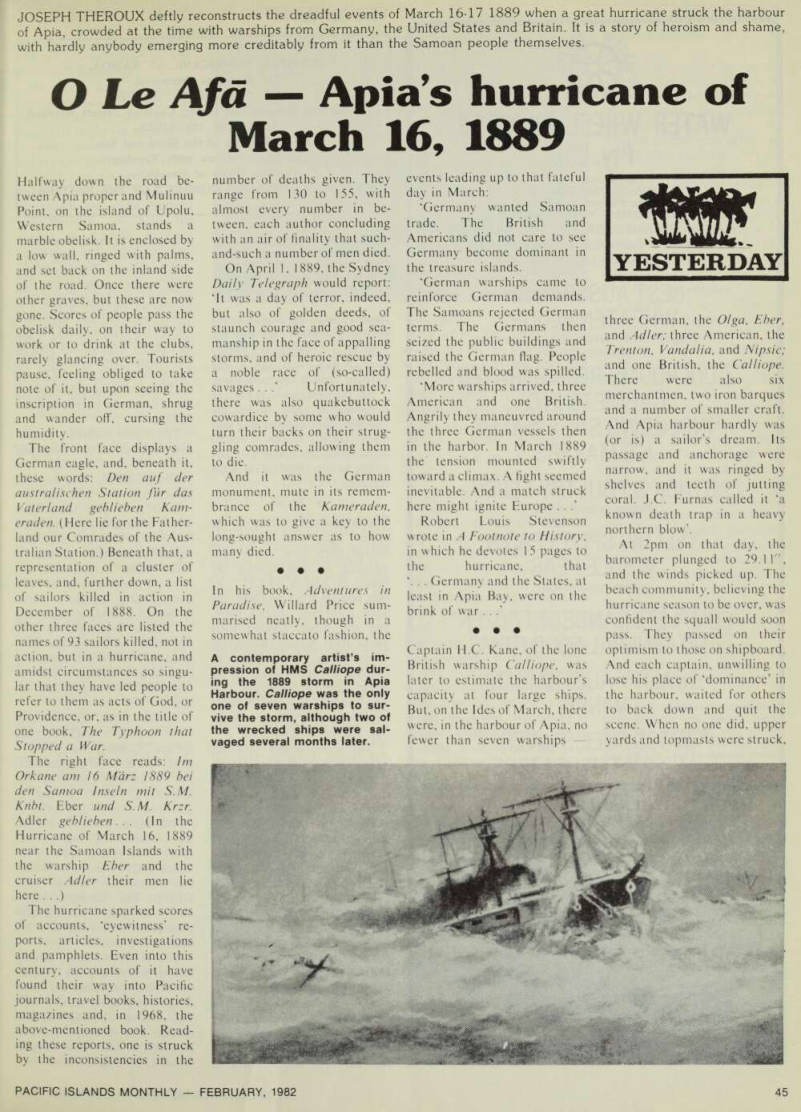
A contemporary artist’s im pression of HMS Calliope dur ing the 1889 storm in Apia Harbour. Calliope was the only one of seven warships to sur vive the storm, although two of the wrecked ships were sal vaged several months later.
The nine-decker headline which the Sydney Morning Herald used on March 16, 1889, to introduce the story of the Apia hurricane.
their bows kept into the northeast wind. ‘This was the moment,’ Stevenson wrote later, ‘when every sail in the harbour should have escaped.' But the captains were playing a dangerous game of gamble and bluff, fast approaching that point when ‘horrors (would) accumulate on horror’s head’, as the Sydney Daily Telegraph reported. • • • The ships sought to ride out the storm. They ‘were alternately buried from view ... or seen standing on end against the breast of billows’ (RLS). The rain poured down on them, the wind screamed around them, and the waves flooded their decks. Rear-Admiral Kimberly, commanding the American flagship Trenton, wrote in his report, Samoan Hurricane, that ‘two hundred men sang “knock a-man-down”, a shanty song, as they manned the pumps’.
The storm began with full force during the night of March 15 and the early hours of March 16. The Vaisigano River, usually a harmless trickle, swelled and rushed into the harbour, scouring, in Kimberly’s words, all the mud and sand out of the harbour.
The kedge anchors, with little to catch, dragged helplessly on the harbour floor. Though the winds were of hurricane force, at times exceeding 160 kilometres per hour, it was the action of the river and the harbour that would strangle the ships.
The two German ships, the Olga and the Adler, and the American Nipsic. cannoned into each other repeatedly in the darkness, hulls plunging
into beams, as the sailors franti cally tried to keep their ships afloat. In one collision, the Olga, after knocking off the Nipsic’s smokestack, span and struck the Calliope. Without a funnel, the Nipsic could not get up steam. Smoke and sparks flew around her decks, blinding and burning the crew. Low on coal, they tried to maintain the ship's fires ‘with barrels of pork'
(Res).
The Nipsic lowered a boat of five men, but the seas swamped it and the men drowned. Two others panicked, tried to swim ashore, and were also lost.
In a few hours the Nipsic would be beached and deserted by her crew. Instead of mount ing any rescue attempt, even for their fellow Americans, the Nipsic’s crew, known as wild throughout Pacific ports, wandered around, or, according to Edwin P. Hoyt, in The Typhoon that Stopped a War, ‘made for Mr Moors’ hotel and other saloons along the row’, in defiance of their captain’s or ders.
Before dawn, the German Eber was blown southwest onto the reef. Coming into the hurri cane with an injured propeller, she was unable to get steam up.
Stevenson wrote: ‘. . . she .. . struck the front of the coral . . . struck again, and (went) down stern foremost’, taking with her nearly the whole crew. Esti mates ranged from 71 to 76 men lost. Stevenson himself was unsure. The German monu ment, however, lists Captain- Lieutenant Wallis and 72 of his officers and crew.
The German Adler, having lost her bowsprit in the collision with the Olga, found her stern dangerously close to the reef.
The Trenton, having lost her rudder and become flooded, blocked the Adler’s way to open ocean. Unwilling to risk the fate
of the Eher, Captain Fritze ordered the moorings slipped.
Stevenson described it: ‘By about Sam, it was the turn of the Adler. She was close down upon the reef; doomed herself, it might yet be possible to save a portion of her crew; and for this end Captain Fritze placed his reliance on the very hugeness of the seas that threatened him. The moment was watched for with the anxiety of despair, but the coolness of disciplined courage.
As she rose on the fatal wave, her moorings were simul taneously slipped; she broached in to rising; and the sea heaved her bodily upward and cast her down with a concussion on the summit of the reef, where she lay upon her beam ends, her back broken, buried in breach ing seas, but safe.’
Many were injured, some with ‘. .. broken limbs, others insensible from the drenching of the breakers . . . one officer died, it was supposed from agony of mind, in his inverted cabin’, for it was not for nearly a day that they could be rescued. All reports, including the silent obelisk, concur that 20 men from the Adler per ished. • • • At 8.45 am, the Calliope col lided with the American Vandalia, carrying away ‘the Vandalia’s quarter gallery with her jib-boom; a moment later the Olga had near rammed her from the other side’. At 9 am the Vandalia smashed into the Calliope, ‘clapping her stern under the bowsprit of the (Cal liope), the fastenings of which were burst asunder as she rose’
(Res).
The Calliope, yardarms, booms and stays damaged, was, in the words of her captain, near to the reef on her port quarter, with the Vandalia coming ‘down on our port bow’, and the Olga close to the starboard side. ‘1 could not let my vessel ride to the length of my cables, with the reef so close astern of me.
To move ahead would be to run down the Vandalia, and if the Olga had gone ahead she would have battered into the Cal liope.’ There was no hope of allowing the waves to hurl her upon the reef, as in the case of
the Adler, for the 2800-ton Calliope was three-and-a-half times the size of the Adler. ‘lt was,’ Captain Kane noted later, with unnerving under statement, ‘the most ticklish position I was ever in . . .’
Kane was determined to at tempt to escape from the caul dron of the harbour to the relative safety of the open sea.
As the Nipsic's crew drank themselves insensible on the beach, the Calliope’s men worked the engine ‘red hot’, slipped cables and snaked past the Vandalia. Still blocking the passage lay the Trenton, venti lators flooded, engines out, rudderless, resigned. Price wrote: ‘A dangerously narrow gap was left between wreck and reef. Through this gap the Calliope ventured, almost cer tain of destruction on one beam or the other.’ Stevenson wrote: ‘Not often in naval history was there a moment of more sickening peril, and it was dignified by one of those inci dents that reconcile the chron icler with his otherwise abhor rent task. From the doomed flagship, the Americans hailed the success of the English with a cheer. It was led by the old Admiral (Kimberly) in person, rang out over the storm with holiday vigour and was answered by the Calliope’s crew with an emotion easily conceived. The ship of their kinsfolk was almost the last external object seen from the
Calliope for hours; immedi ately after, the mists closed about her till the morrow.’
In fact it was not until the next day the crew realised they had escaped: it had taken, Kimberly wrote, ‘more than two hours to cover less than four cables’ about 730 metres. • • • After the Calliope had escaped.
Captain Schoonmaker of the Vandalia sought to beach his damaged ship near the deserted Nipsic. Swimming ashore with safety lines, many sailors drowned. Schoonmaker con tinued his progress towards the beach, but the waves caught the stern and heaved it against the reef: ‘. . . her head swung to starboard,' Stevenson wrote, ‘and she began to fill and settle.’
The exhausted captain col lapsed and was swept overboard and drowned before anyone could reach him. According to another account, ‘a gun, having become loose during the gale, struck him on the head, dashing out his brains’. His body was recovered some days later,
seven kilometres down the coast.
By 3 pm, only the Trenton and the Olga were left afloat in the harbour, the Olga repeat edly dodging the American ship. Stevenson wrote: ‘. . . the Trenton parted one cable and shortly after a second ... in the fury of the gale.. . the rudderless ship drove down stern foremost into the inner basin: drifting on destruction for herself and bringing it to others . . . about 4 pm . . . the Olga (cut) into the Trenton’s quarters, first from one side, then from the other . .
Captain von Ehrhardt beached the Olga, miraculously without a single loss of life. The Trenton lost one: during a collision, a gunport was smashed in and a sailor’s skull crushed.
The Trenton dragged ashore, lurching into the sunken Vandalia. Lines were flung from the Trenton and the Vandalia’s survivors climbed down from the rigging, their clothes in tatters from the winds, and were taken aboard.
In both their reports, Stevenson and Kimberly agree that 43 men, nearly the whole crew, were lost from the Vandalia.
The morning of the 17th displayed a scene of devastation rarely equalled,’ Stevenson wrote. The Adler high and dry, the Olga and Nipsic beached, the Trenton partly piled on the Vandalia and herself sunk to
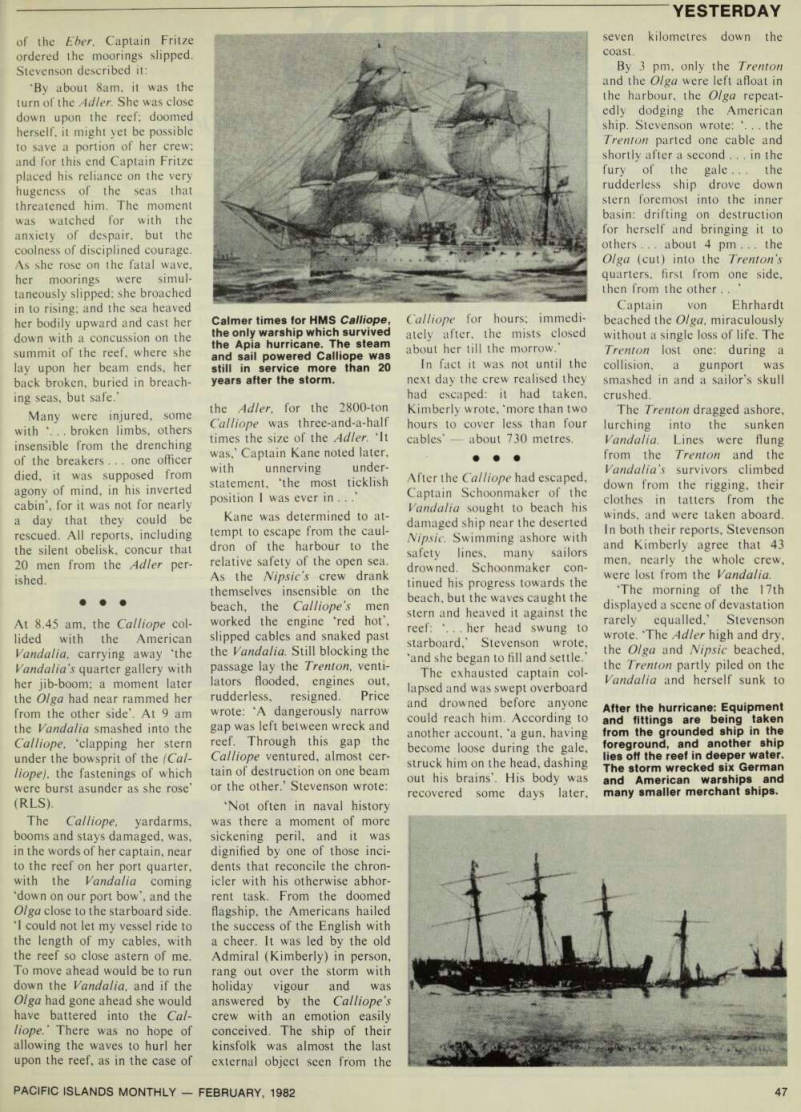
Calmer times for HMS Calliope, the only warship which survived the Apia hurricane. The steam and sail powered Calliope was still in service more than 20 years after the storm.
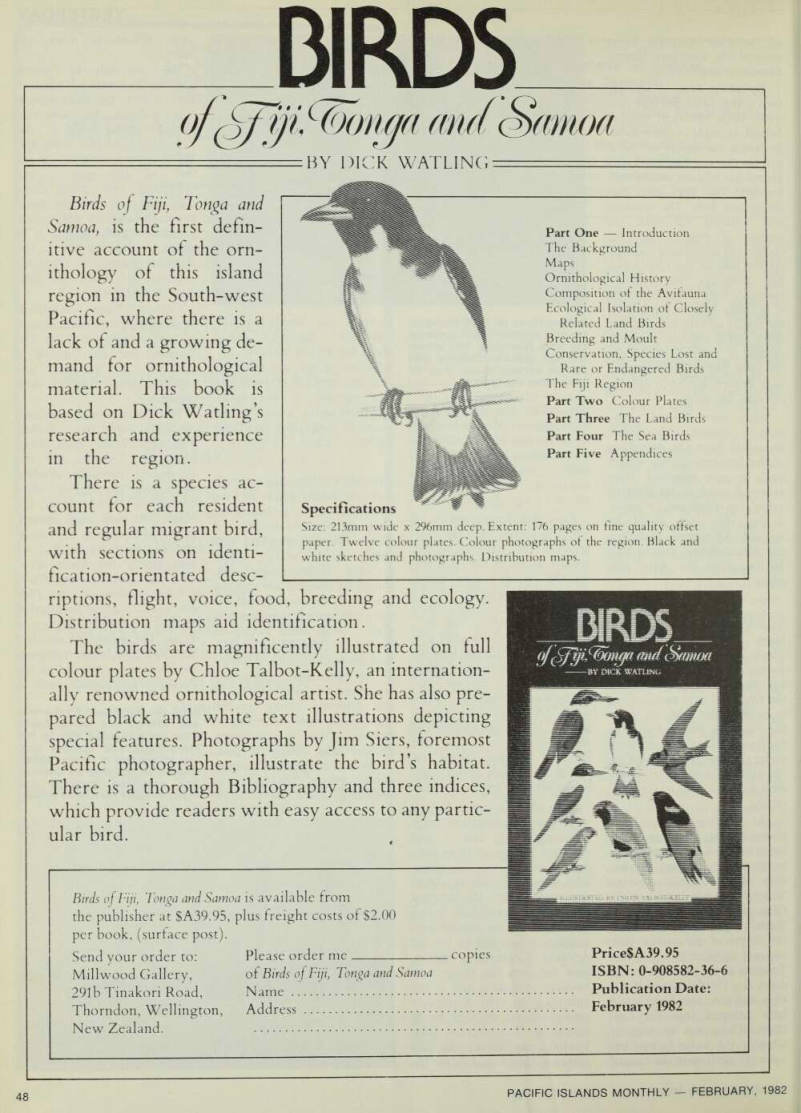
After the hurricane: Equipment and fittings are being taken from the grounded ship in the foreground, and another ship lies off the reef in deeper water.
The storm wrecked six German and American warships and many smaller merchant ships.
the gundeck: no sail afloat; and the beach heaped high with the debris of ships and the wreck of mountain forests.’
Stevenson added, along with other writers, that . . not the whole Samoan Archipelago was worth the loss in men and costly ships . . .' • • • Before the hurricane struck, one Samoan rebel leader, Mata’afa, had massed 6000 men behind Apia, intent on attacking the Germans, as they had the previous December.
But upon hearing the news of O le AJa, the hurricane, they put aside their guns and streamed into Apia. When the Nipsic was beached, they as sisted the crew to shore. When the Adler was thrown on the reef, ‘like a schoolboy’s cap’ in Stevenson’s phrase, another group of Mata’afa’s men tried to bring a safety line to the ship.
Fifty German shore guards, seeing this, held them away at gunpoint. ‘What was more natural,’
Stevenson asked, ‘to the mind of a European, than that the Mataafas should fall upon the Germans in this hour of their disadvantage? But they had no other thought than to assist.’
Later that morning, a group of Samoans did reach the Adler and returned with a safety line.
When it broke, they tried again and again without success, ‘the strongest adventurers being cast back again by the bursting seas’ (RLS).
Before dawn on March 17, the chief of Apia, Seumanutafa, commandeered a boat and ven tured out to the survivors who
had been clinging to the Adler since about 8 am the day before.
Afterwards his men attached safety lines and throughout the day the Adler’s crew was taken ashore. It was at this time that an unnamed Samoan the only native was killed: a cannon rolled and crushed him.
Samoans say that human chains were set up to pull in the drowning sailors, but I can find no record of this in the official histories.
Summing up the rescue effort, Stevenson observed; ‘. . . the Samoans earned the gratitude of friend and foe.’ • • • Many accounts reported the Calliope as the only surviving ship. This is not strictly true.
Some months after the hurri cane, both the German Olga and the American Nipsic were refloated. The Olga and the Calliope went to Sydney for repairs, the Nipsic to Honolulu.
The Eber, sucked down the throat of the harbour, was lost of course. But wreckers dis mantled the Adler, Vandalia, and Trenton, and ‘the ma terials,’ according to Captain Gray in his 1960 book Amerika Samoa, ‘were donated to the Samoans’. None of these appear to have remained. Nor, appar ently, had much else. Period ically divers come up with bones or revolvers, but spirit them away.
In 1953, the British Admir alty gave the steering wheel of the Calliope to the government of Western Samoa, and it was for a time on view at the courthouse. It was later moved to the Head of State’s house
(once Stevenson’s Vailima), but has since been given to a New Zealand museum.
The Adler, long a landmark of Apia’s waterfront, is seen no more. The United Nations, possibly thinking of Stevenson’s line, ‘the beautiful Adler, which lies there to this day, kanted on her beam, scarlet with rust, the day showing through her ribs’, urged that it remain a perma nent monument. It remained on view until 1956, when forward thinking rather than historically-minded politicians decided to extend Apia’s land over the reef. The ensuing landfill buried the Adler. Local legend suggests that this burial unleashed the hurricane of 1966, when the shrieks of the terrified sailors of 1889 were supposedly heard in the winds.
Seumanutafa, the Apia chief who directed rescue operations, was lavishly rewarded by the Americans. He was given a $250 gold coin, a gold watch and chain, a telescope, a ther mometer, and a whale boat. (The Germans gave out $3 for every German saved.) Now only the watch remains.
It was shown to me by Seumanutafa’s grandson, Seumanutafa Moepogai, along with a copy of the letter of appreciation from the American consul, William Churchill. Knowing that the only Samoan who died was never identified, I asked him who he was. ‘Tui,’ Seumanutafa replied simply. Like many
Samoan graves, Tui’s resting place is unmarked and un known.
Nor is there any monument to the Americans who perished, but they are remembered in another way. When the whale boat was presented to Seumanutafa, a song was composed for the occasion by a man named Fa’atui. For many years it has been sung in honour of departing Americans, though now it is performed for anyone who is leaving. It is probably the most famous song in the Samoan islands, Tofa Ma Feleni, ‘Farewell My Friend’. • • • In respect to those who died, it is the writer’s duty to account for their deaths as accurately as possible. It is dismaying to note that of all the writers who cast numbers about like playing cards, none has even admitted the disputed totals. When in doubt I have relied, for the American totals, on Rear- Admiral Kimberly’s report. He maintains that 51 Americans were killed or drowned: 43 from the Vandalia, seven from the Nipsic, and one from the Trenton.
Because the Germans are such notoriously efficient recordkeepers, 1 saw no reason to dispute the monument, es pecially since it was unknown to many of the writers, and un questioned by the others. It lists 93 German dead, 73 from the Eher, 20 from the Adler. This makes a total of 144 Germans and Americans. How many civilians? The Samoan, Tui, makes 145, but further investi gation turned up two more. ‘A visitor’, named Anthony Ormsby, and his ‘Hawaiian mate’, aboard the schooner Lily, possibly traders supplying one of Apia’s stores, also died, according to Hoyt. Thus, a total of 147. • • • So little remains in Samoa of the horror. Nothing, really, except that silent monument, its every face inscribed with men’s names, men who sought to impose their will on others, but who were themselves imposed on by a great and terrible storm - the Orkane, the Afd, the Typhoon, the Hurricane of 1889.
Wreck of the German warship Adler. It remained a landmark on the reef for 67 years until buried under a foreshore recla mation project.