Prisoners - and two
p. 33 · Read in the full issue
ministers - out in Vanuatu
Release of all but two of the people imprisoned for their role in the secessionist movements of May-August 1980, and the sacking of two government min isters, were highlights of an eventful week in Vanuatu poli tics in November-December last year.
Those released from gaol on the occasion of the country’s Unity Day, November 29, were: Aime Malere, Opposition MP for Malakula, and Alfred Maliu, Opposition MP for Santo Rural (and former ‘presi dent’ of the ‘Vemarana’ se cessionist movement).
Three others who benefited from the amnesty were: Mariano Lauman, brother of Alexis Yolou, who was killed in the course of secessionist dis turbances on Tanna in 1980; Joseph Navo; and Albert Ravutia, former agriculture minister in the pre independence Kalsakau govern ment in the New Hebrides.
The two persons remaining in prison are Jimmy Stevens, who is serving a !4‘/>year sentence, and Timothy Welles, who was sentenced to eight years for his role in the ‘Vemarana’ secession as Stevens’ right-hand man and chief of police in the secession ist set-up.
Those freed were informed personally by Minister of Home Affairs Fred Timakata, who told them they had been re leased because of their good behaviour. He said it was his hope ‘that the events of the past will be forgotten as we live and work together for the future good of all’.
The ministers whose dis missals were announced by Prime Minister Walter Lini on December 4 were Thomas Reuben Seru, minister of lands, and George Worek, minister of social affairs. lan Mclntyre reports from Port-Vila; The dismissals were not unexpected. Rumours had been flying around all week that there were going to be changes in government, and that some of
the ministers were speaking out against the PM.
Both Reuben Seru and Worek had, apparently, been warned by the PM on several occasions, and by the adminis tration of the Vanuaaku Party, about their personal image, or the lack of it, and their ‘antics’ in their private lives.
Both had produced children out of wedlock, and rumour has it that Reuben Seru has at least three women pregnant to him at present, and Worek, one.
Reuben Seru’s liking for drink and performances when drunk have caused police action on several occasions over the past two years, and the situation has only grown worse recently.
Certain other ministers also fit into the same category, and it was expected that more changes could have been made.
Perhaps they still could be, although at present there is a decided lack of elected mem bers capable of being placed in key ministries.
The effect of the removal of the two will no doubt be looked on as a warning to those others transgressing the high moral standards expected of them by the PM, and cause them to step up their efforts to serve their country, rather than them selves.
The fact that the prime minister has abolished the two ministries concerned is unex pected, but interesting es pecially the abolition of the lands ministry.
As a result of the dismissals, and the absorption of the two ministries into ‘appropriate’ existing ones, the Vanuatu cabi net has been reduced in size from nine to seven.
In announcing dismissal - of the ministers, the PM said: ‘I wish to pul on record the deep appreciation of the government of the long years of loyal and devoted service dedicated by Messrs Reuben Seru and Worek to the struggle for inde pendence, and to the building up of our new nation since
independence. I know that they will continue to serve the nation as members of parliament.’
Mr Reuben Seru represents a Santo constituency, and Mr Worek a constituency in the Banks group.
Teddy Kennedy
at East-West
United States Senator Edward M. Kennedy, speaking late last year before an overflow crowd at the University of Hawaii’s East West Center, said that the United States seeks a partner ship for peace and progress in the Pacific. The Massachusetts Democrat, who has spent nearly 20 years in the Senate and is a leader of liberal thought in the USA, did not define the form that partnership should lake, nor did he suggest if that was also the goal held by the Reagan Republicans.
Kennedy’s statement that there should be no nuclear storage ‘in these beautiful waters’, and that ‘the nuclear way is not the Pacific way’ was greeted with warm applause.
Additionally the Senator noted the importance of human rights and drew attention to ‘the shameful scope of human rights violations in the Philippines’, and mentioned similar concerns about Korea.
Remarking that the US now has more trade with the Pacific and Pacific Rim countries than with any other part of the world, Kennedy noted the important future for the region. However, exactly what that future holds for Pacific Islanders has never been made clear by Kennedy or by any of the other economists
and futurists who have made similar remarks in the last few years, calling the Pacific ‘the Mediterranean of the future’.
Like most high-powered Washington officials who visit the region, Kennedy seemed more concerned with the big issues of interest to larger Asian countries and the US, than those important to the Island states. Kennedy did not address how the US perceives the in creased Chinese and Russian diplomatic presence in Pacific Island countries.
The tone of Kennedy’s re marks might be more popular among Islanders than Reagan’s still unclear policies, but neither has addressed economic issues of immediate concern to the
islands.
- Robert Graham in
Honolulu.
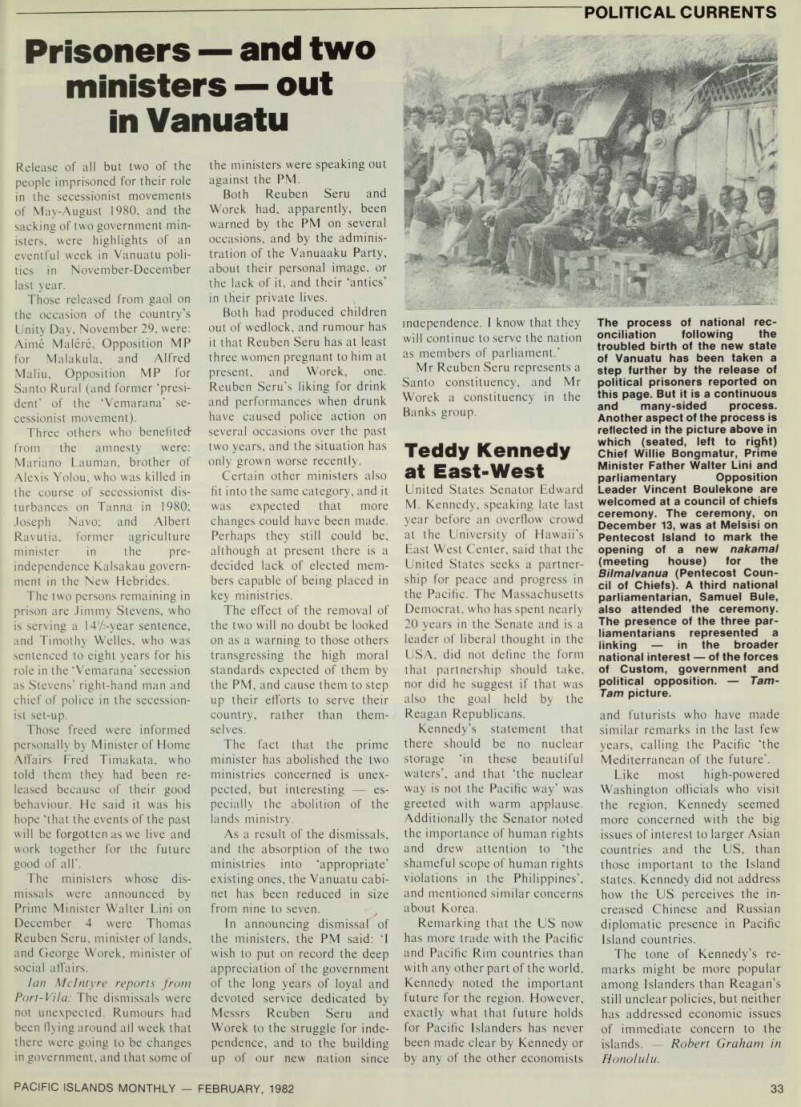
The process of national rec onciliation following the troubled birth of the new state of Vanuatu has been taken a step further by the release of
political prisoners reported on
this page. But it is a continuous and many-sided process.
Another aspect of the process is reflected in the picture above in which (seated, left to right) Chief Willie Bongmatur, Prime Minister Father Walter Lini and
parliamentary Opposition
Leader Vincent Boulekone are welcomed at a council of chiefs ceremony. The ceremony, on December 13, was at Melsisi on Pentecost Island to mark the opening of a new nakamal (meeting house) for the Bilmalvanua (Pentecost Coun cil of Chiefs). A third national parliamentarian, Samuel Buie, also attended the ceremony.
The presence of the three par liamentarians represented a
linking - in the broader
national interest - of the forces of Custom, government and
political opposition. - Tam-
Tam picture.