Fiji, PNG look at alternative fuel
p. 79 · Read in the full issue
alternative fuel
Papua New Guinea and Fiji are becoming increasingly concerned at the rising price of petrol and other fuel oils, major import items for both countries. In a series of separate studies the two countries are looking at the possibility ofproducing substitute fuels from cas sava and sugar cane.
While petrol prices continue to soar in Fiji, the government and an independent consultant are examining a new proposal to pro duce ethanol motor fuel from cassava.
In Papua New Guinea, where petrol prices so far have remained comparatively low, the government is awaiting a report from a study mission which has been examining ethanol pro duction from sugar cane and cassava in Brazil.
Fuel oil purchases provide one of the greatest drains of foreign reserves for Fiji and PNG, and both countries are anxious to insure themselves against the world-wide upward trend in oil
prices.
British Petroleum and the Fiji Sugar Corporation have already carried out a study in Fiji on the possibility of using sugar cane for ethanol. The newest study, for producing ethanol from cas sava, was carried out by Mobil and a government team. The re sults of the study went to cabinet for consideration last month, ironically only a few days before the retail price of petrol went up another three cents a litre. In terms of the old measure, motor ists in Fiji are now paying $1.96 a gallon for petrol, and the oil companies claim the price should be even higher.
The ethanol-from-cassava study now before cabinet does not hold out any promise of providing ethanol at a lower price than petrol. However the price would not be subject to outside influ ences and would be more likely to remain static. The cassava pro posal would also reduce the drain on foreign funds, possibly up by 20%. v Other advantages from the proposal are the creation of a new Fiji industry, employing up to 500 people.
Although the study claims that a cassava project would be vi able and advantageous to the national economy, it warns that flood damage to crops would be an ever-present problem in the areas considered generally suitable for production. The suggested areas are in the Korotolutolu Basin in the north-west of Vanua Levu and in the Rewa Basin at Natewa Bay.
Fiji is at present importing about 60 000 kilolitres of petrol a year, apart from other fuel oils and by-products, and the imports are increasing by about 3% a year. The present annual bill for petrol is about SF62 million annually, and the cassava study suggests that this could be reduced by 20% within five years.
Ethanol can be used as a motor fuel in two ways according to technical reports now before PNG and Fiji study teams. If it is used straight, engine modifications have to be made and the modified engines are no longer suitable for petrol fuel.
The alternative method is to mix up to one part of ethanol with four parts of petrol. This requires no engine modification and allows engines to run on pure petrol or on the mixed fuel.
The mixed fuel is known as gasohol.
Plantation company, too . . .
Dylup Plantations Limited, an Australian-listed company with plantation operations in Papua New Guinea, announced last month that it had undertaken an extensive project to study and develop substitute fuels.
In its annual report to directors the company said it had entered a joint arrangement with the government in the fuel study because of the government’s own concern at the rising cost of fuel.
Dylup Plantations is initially orientating the study to its own requirements, examining materials already available on the plan tation with a view to using them to reduce fast-rising costs.
Air Service
From Chile
Coinciding with the start of the lobster catch season in October-May on the islands of Juan Fernandez, Chile’s dom estic airline Taxpa begins com mercial passenger flights to the islands. These go on through out the season.
The Juan Fernandez Islands are a district of the continental Chilean province of Val
paraiso. They comprise three
islands: Robinson Crusoe’s, Alexander Selkirk and Santa Clara. Capital of the district is St John the Baptist on Robin son Crusoe’s Island.
The group’s population is
about 700.
There is a 25-bed hotel in the capital. Most of its guests are tourists, lured by the excellent
scuba diving possibilities, or
the attractions of ‘Bear Island’, inhabited by large numbers of bears living in natural con ditions. The island is also the home of a large colony of seals.
Fishermen are frequent visi tors to the Juan Fernandez group, whose surrounding waters are rich in tuna, rock salmon and, of course, lobster.
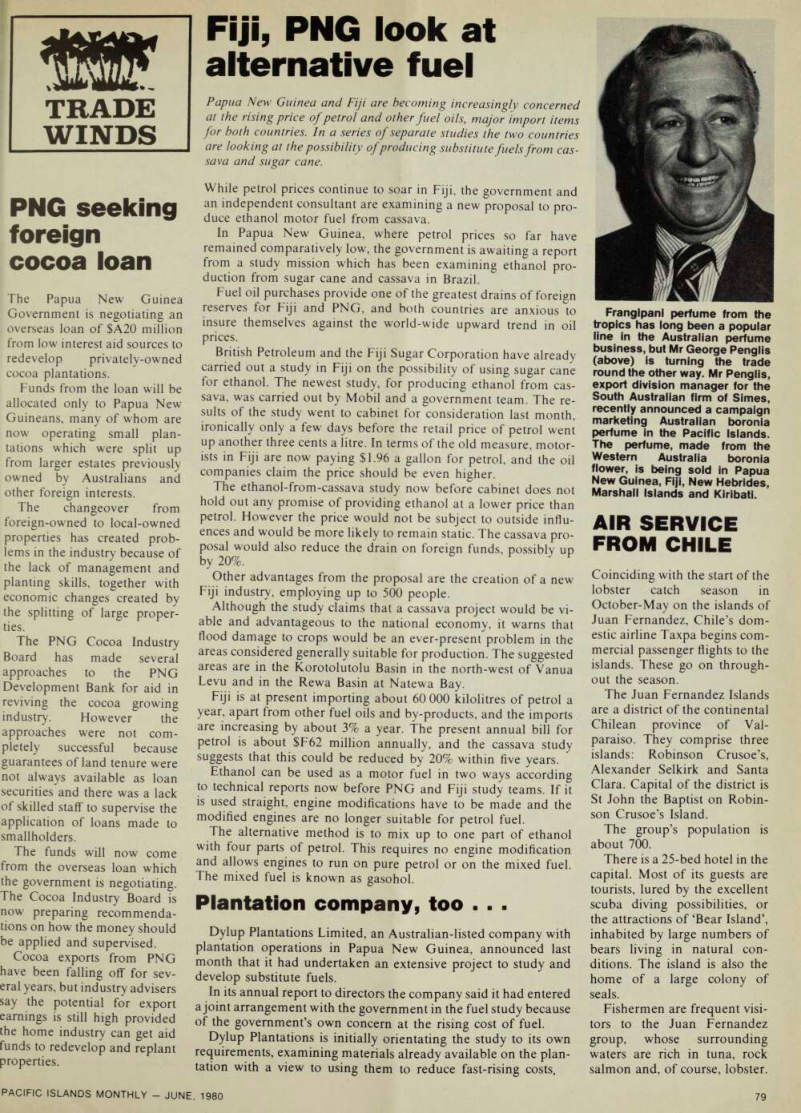
Frangipani perfume from the tropics has long been a popular line in the Australian perfume business, but Mr George Penglis (above) is turning the trade round the other way. Mr Penglis, export division manager for the South Australian firm of Simes, recently announced a campaign marketing Australian boronia perfume in the Pacific Islands.
The perfume, made from the Western Australia boronia flower, is being sold in Papua New Guinea, Fiji, New Hebrides, Marshall Islands and Kiribati.