Big Increase In
pp. 47-49 · Read in the full issue
Tourist Trade
New Zealand authorities estimate that by 1982 New Zealand will be getting 650 000 tourists a year, and that by 1990 the figure will be two million. This compares with a present figure of about 500 000 visitors a year.
While more and more people are visiting New Zealand, tourist figures show that more New Zealanders are beginning to travel abroard.
Latest figures, for instance, show that for the 12 months up to January 1980 the number of New Zealanders visiting Australia for vacation or business increased by a startling 31% from 171 700 people to 225 900. Although the number of travellers wasn’t so impressive, the percentage of New Zealanders visiting other countries last year also increased
markedly. For example, the
number of New Zealanders visiting the US and Canada (43 000) represented an increase of 28.1% on the previous year; New Zealand travellers to the UK and Europe were up 26.7%, to Asia 11.7% and to the Pacific Islands 12%. Even more New Zealanders went to the Islands (277 700 last year) than they did to Australia.
Surprisingly, the number of Australians visiting New Zealand in the same 12 months to January was down 1.2% on the previous year 214 700 in 1979 compared with 217 300 for 1978. Most tourist operators and authorities agree that the main reason for this drop in Australian visitors to New Zealand has been the recent great explosion in the variety of
package holidays offered to
Australians and not available yet to New Zealanders because of Government restrictions.
There are still millions of Australians who have yet to visit New Zealand and prob ably plan to go there, but as one tourist operator said, ‘New Zealand is friendly, right next door, and Australians are
taking the cheap holidays to
Asia and Europe while they can get them, with the idea that New Zealand will still be there the next time around’.
But New Zealand is begin-
ning to fight back by introduc ing special new tour packages which associate the Pacific Islands with New Zealand, and aimed especially at Aus tralians, and also encourage visitors from elsewhere par ticularly from Japan.
Japanese tourism will get a
shot in the arm with the inaug uration on July 4 of a direct
Japan Airlines twice weekly
flight between Tokyo and
Auckland via Nadi, Fiji, fol lowed by the inauguration on August 1 of a weekly Air New Zealand flight on the same route.
Up to now there have been no direct flights from Japan into New Zealand, and even New Zealand exports to Japan,
which are increasing steadily
by air have to be flown to Honolulu by Air New Zealand and transhipped to JAL air craft (New Zealand’s exports to Japan include live eels, deer horns, and kiwi fruit).
At present Japanese visitors
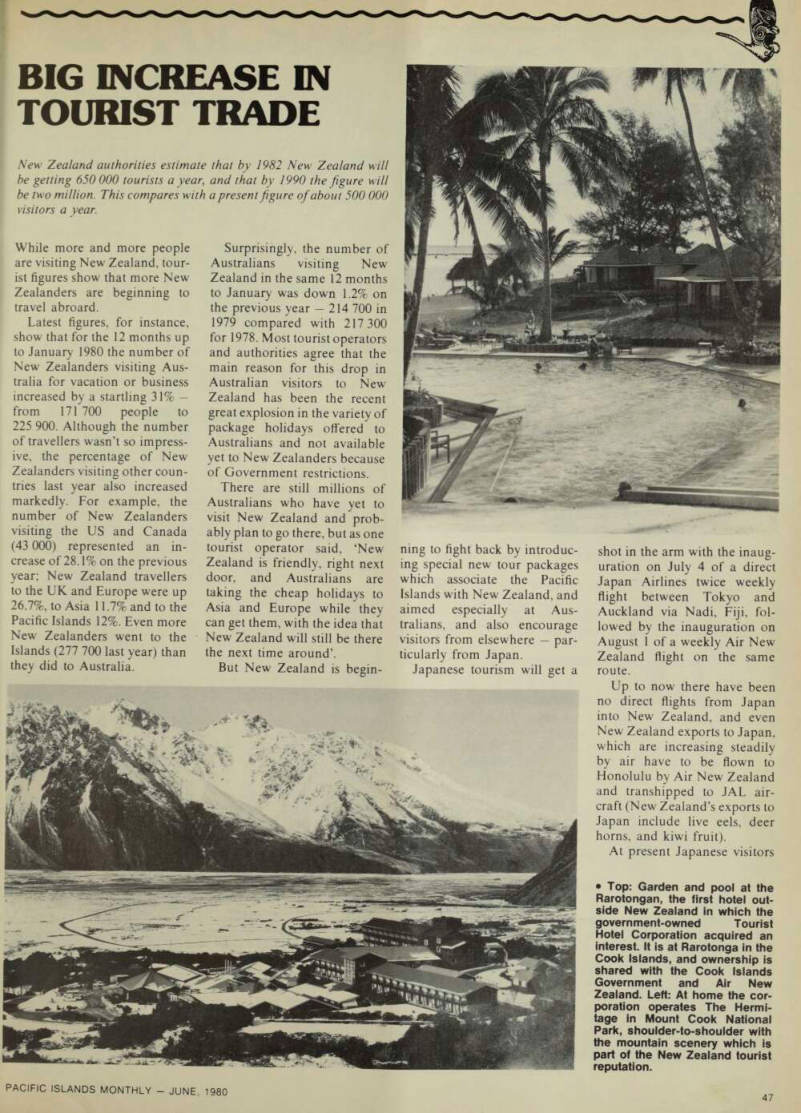
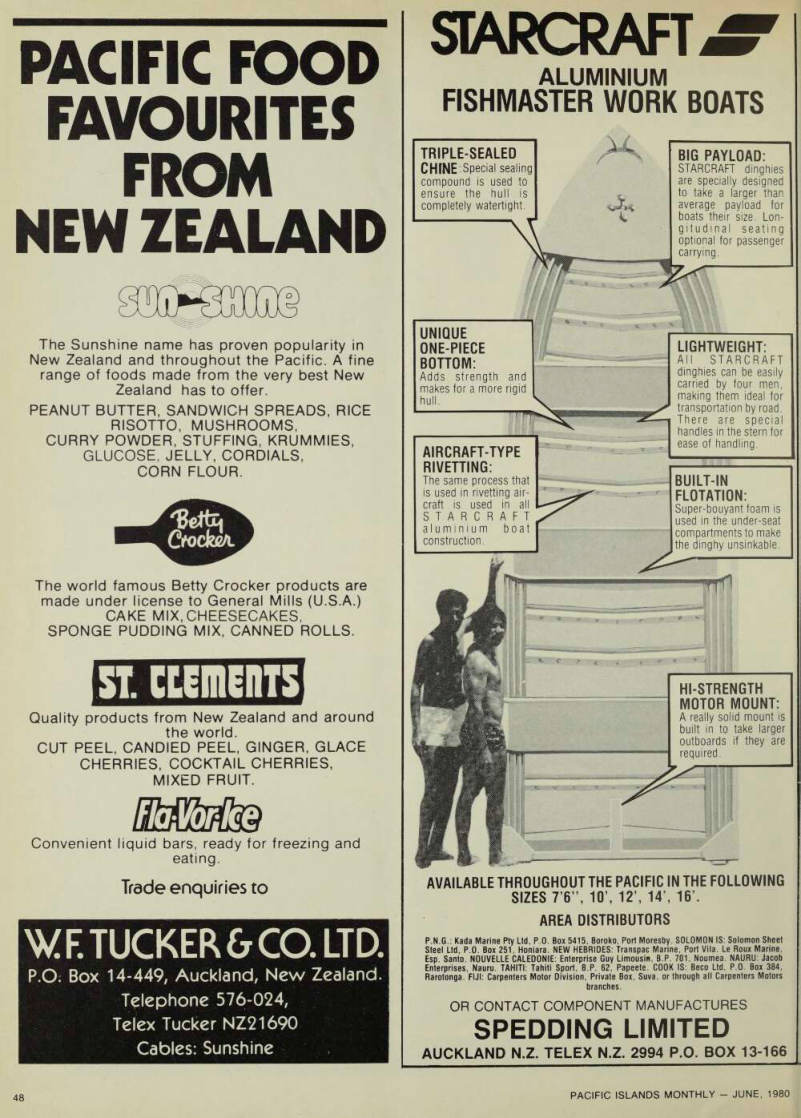
Top: Garden and pool at the Rarotongan, the first hotel out side New Zealand in which the government-owned Tourist Hotel Corporation acquired an interest. It is at Rarotonga in the Cook Islands, and ownership is shared with the Cook Islands Government and Air New Zealand. Left: At home the cor poration operates The Hermi tage in Mount Cook National Park, shoulder-to-shoulder with the mountain scenery which is part of the New Zealand tourist reputation.
into New Zealand per year amount to only 20 000, but these new flights are expected to bring in large numbers of
Japanese on special package
deals, especially as Fiji is a popular tourist destination for Japanese, and the combination of Fiji plus New Zealand will be very attractive.
Air New Zealand is also involved in the big tourist cam paign to attract those many Australians who like to visit the Islands. The new programme, beginning in June, offers a wide selection of package tours involving Islands destinations not normally visited in great numbers by Australians, such as Western Samoa, the Cook Islands, Tahiti and its neigh bours. Some of these packages also include New Zealand as a destination, but even if many passengers don’t see New Zealand, Air New Zealand will benefit as the carrier, and so will some New Zealand operated hotels in the Islands.
The new packages include stays at the Rarotongan Hotel in Rarotonga, Cook Islands, and the Tusitala in Apia, West ern Samoa, and these hotels are now associated with the New Zealand Government’s Tourist Hotel Corporation, which is also taking part in this new
drive to attract more Aus tralians.
The Tourist Hotel Corpor ation of New Zealand was established in 1955 to acquire a chain of hotels which had been built and acquired over more than 50 years by the then New Zealand Department of Tourist and Health Resorts.
When the corporation was established, these government hotels reflected the impoverished state of New Zealand’s post-war economy, and considerable development was needed. The hotels were run-down and supplying poor service, but private hoteliers at that time were offering nothing better. Freight costs and material shortages provided little incentive to supply qual ity accommodation in remote areas of New Zealand par
ticularly, so the development
of the rural hotel industry had almost ground to a halt.
The THC revolutionised the image of the government re sorts with world standard chefs and kitchens, wine cellars and first rate accommodation and staffs. The THC today operates 12 hotels throughout New Zealand, scattered from Wai tangi to Milford, with a total of 1500 beds.
In addition the THC owns
the Rarotongan in partnership
with Air New Zealand and the Cook Islands Government the first of its hotels to be acquired outside New Zealand.
Recently it took over the oper
ations of the Governmentowned Tusitala hotel in Apia,
and has considerably improved
its operations. More than 200 000 guests now stay annually in THC hotels, more than 60% from abroad. The year 1976 was a vintage year in that for the first time ever Australian visitors outnumbered New Zealanders in the THC chain - Another shot in the arm was given THC operations in June 1976 when the THC joined forces with the TraveLodge New Zealand chain, for
marketing. TraveLodge oper
ated mainly in the cities and THC mainly in rural settings, and what THC needed was access to the tourist gateways of New Zealand - Auckland, Wellington and Christchurch.
The TraveLodge association enables this.
Both TraveLodge and THC
sell each other’s accommo dation, and between them they now offer 2500 beds in 15 key locations throughout New Zealand. Both partners retain their autonomy but travellers benefit from the economy the tour operator derives from dealing with one group rather than with a multiplicity of hotel interests.
By 1982 all the THC hotels will have undergone consider able up-grading and addition.
The corporation has already spent more than $2 million on
developments at Waitangi and
Wairakai hotels, and additions to the Franz Josef hotel will cost another $1 million by next year, with more than $6 million allotted for major alterations and additions at the THC Mount Cook Complex.
In the last 10 years occupancy figures have soared 60% in THC hotels.
Contemporary Maori artist Cliff Whiting based this figure on the traditional art of his ancestors and in a new tradition creating interest among visitors from all parts of the world.
Traditional Maori dancing displays attract interest culturally and as a spectacle.
Mitre Peak on Milford Sound a New Zealand Scenic wonder.