Milk And Honey
p. 45 · Read in the full issue
Not So Sweet
Traditionally the people of the Cook Islands have seen New Zealand as a land of milk and honey where they can try their luck and come home in triumph.
Albert Henry’s period as a worker in New Zealand before he came home to become his country’s first premier was a textbook case. But now there
are growing noises suggesting
that the milk has turned sour and the honey is no longer sweet.
The Cook Islands were proclaimed a part of New Zealand under the much maligned Colonial Boundaries Act of 1895, leading to a New Zealand administration there and eventually to the 1965 act of self determination in which the Islanders adopted ‘full self government in free association with New Zealand’.
The technical arrangement means that in practice the
Islanders are fully independent
but retain a New Zealand citi zenship with full rights of entry.
The Cook Islands remain the
largest recipients of New
Zealand overseas aid, last year
receiving grants of nearly
SNZ7 million. ‘But who wants to go there any longer?’ asked the news paper Cook Islands News re cently. It quoted a cynical comment that the position of Cook Islanders in New Zealand today was ‘working in a low paying manual job, having a good time drinking and gambling and carrying out strong Christian devotion to various churches’.
And the Cook Islands Government Representative in New Zealand, Mr Norman George, says ‘lf there is any thing I would like to achieve it would be to change this feeling
of hopelessness and negative
attitude among the Cook Islanders’.
The Cook Islands News claims that after four decades of migration to New Zealand by Islanders a stage has been
reached where no longer are there better opportunities ‘in this so called land of plenty’. It
quotes rising unemployment
figures militating against jobs
for Cook Islanders, and says that ‘taxation, bills, frustrations and an ever increasing cost of
living are causing rude shocks and disillusionment’.
In an appeal to Islanders to come home and develop their own country, the paper says ‘lt is not surprising that New Zealanders should feel a cer tain degree of contempt for Islanders who come to New Zealand looking for jobs. This means that the chance of a New
Zealander finding employ
ment in his own country is con siderably minimised. Like every other country facing similar problems when the chips are down discrimination emerges, and New Zealand is no different. ‘Cliches such as “send the islanders home” become com mon. Cook Islanders are ultimately better off at home where the abundant natural re sources are available, employ ment opportunities available
and the day to day living
expenses comparatively lower. ‘For those of our Cook Islands people wanting to emi grate to New Zealand, our advice is “Don’t unless you have a job guaranteed” for the dreamers who still class New Zealand as the land of milk and honey, you had better wake up smartly and look around you.
Our final words to our people at home is for them to start ap
preciating what they have
there, confine their aspirations to the Cook Islands and work their hardest to keep our little nation the way it is.’
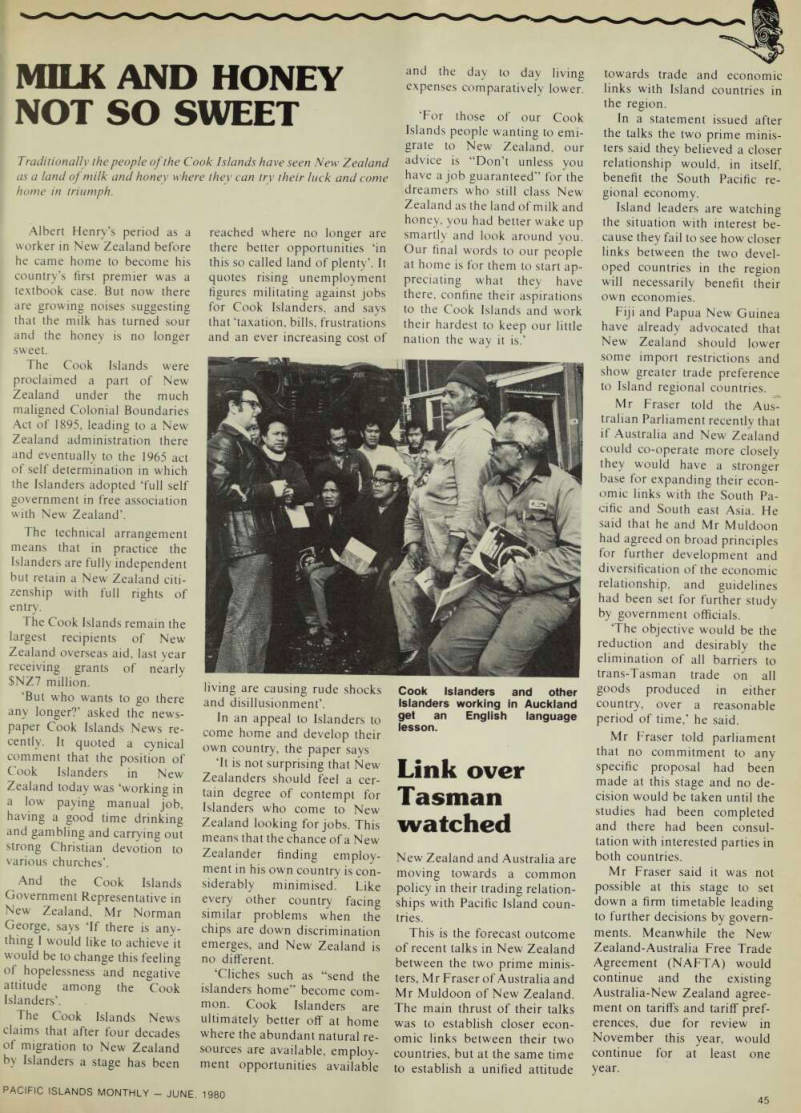
Cook Islanders and other Islanders working in Auckland get an English language lesson.