Letters
pp. 5-7 · Read in the full issue
Tuvalu’s PM off the hook
In your April issue (pps6-57) an item appeared about Tuvalu.
Your ‘dreamt-up creation’ that my statement to the Tuvalu people was an ad mission that I have been wrong in planning the deal is in fact incorrect.
The statement made by me was based on the reassessment of the joint venture in the light of great increases in world oil prices since the time of the negotiations for the venture, and the expert advice from my advisers in Tuvalu. The de cision was made from the re assessment of the project which showed that it would not be vi able.
The investment with Mr Gross has nothing to do with the payment for ships for the
fishing industry. The 15%
interest paid quarterly to
Tuvalu account has been received. This account is worked by the secretary for finance and the accountant, both Tuvalu Government officials, and Mr Gross not, as you stated, by Mr Gross alone.
Tuvalu’s share to the joint venture was to be paid from part of the profit of the catch of the ships and the rest to pay for the ships until the ships are paid off and the venture be
comes solely owned by
Tuvalu.
The question of the bank was and is one of the important matters Tuvalu pressed and is pressing for since its separation Tom the Gilbert and Ellice Islands Colony in 1976. On the irst round of negotiations, two )anks from the region were ap )roached and the result was legative. On Tuvalu’s second attempt three respected banks vere interested. Tuvalu’s hoice was made on the basis hat the bank will become the uvalu National Bank after a
period agreed to by both part ners. This will only happen when Tuvalu has the expertise and experience to run its bank.
The Barclays International Bank has offered to help put up the Tuvalu Bank and nego tiations are well on the way.
When this bank is established then all Tuvalu investments will be transferred to this, the only bank in Tuvalu.
Your statement that Tuvalu needs its investment from Mr Gross to buy the Barclays In ternational Bank is a very unkind one, especially when it is an offer from Barclays Inter national Bank to help put up the Tuvalu Bank and this offer was made after the two banks from the region had declined.
The Tuvalu investments made externally will be invested in the Tuvalu Bank once it is established.
The buying of lands with the
Green Valley Acres Corpora
tion is not a Government pro
ject.
I sincerely hope that I have updated and brought the qual ity of PIM to what it used to be several years ago.
T. Lauti
Prime Minister Funafuti Tuvalu • Our ‘dreamt-up creation ’ was designed in part to let the prime minister off the hook in view of the criticism voiced by many in Tuvalu of Mr Lauti’s associ ation with Sidney Gross. Our description of his radio address as an ‘ honest and dignified ad mission that he had been wrong in planning the deal’ was much gentler than statements made on the matter by others at various times. The prime minister appears to have misread our re ports. Our report that the $550 380 invested with Mr Gross was neededfor investment in the joint venture with Barclays Bank was taken from the Tuvalu Government's News Sheet of December 12, 1979. On page 3 it was reported (inter alia) ‘Parliament also learned that Government plans to with draw the half-a-million dollars which she invested in the Blue Chips Realty Investment Co in the United States. In reply to
supplementary questions asking
why, the Prime Minister told Parliament that Government
has officially accepted proposals from the Barclays Bank Inter national for a joint venture in establishing a bank here in Tuvalu; with Government own ing 75% and Barclays 25% of the capital share issued. It is for this venture that Government plans to withdraw the investment ’
PIM has never reported that the land deals with Green Valley Inco were a government project.
For more about that particular subject see Tropicalities. Edi tor.
More on Hawaii
and the Islands I read with much interest Dan Boylan’s article The Bishop as Symbol’ (PIM Mar p 35). Its general tone of consternation and muted optimism calls for some comment in rebuttal and clarification.
It cannot be disputed that Hawaii government has been slow to respond to develop ments within the Pacific island community. The East Asia orientation has been, among other things, the priority focus.
Professor Donald Topping remarked on other aspects which indicate a general lack of previous commitment to the Pacific island area. It is to such comments that some rejoinder must be made.
First, Topping’s criticism of the Hawaiian population is both unwarranted and unin formed. Unlike the genteel and white-dominated professional and social circles which Pro fessor Topping is accustomed to; Hawaiians are not as privi leged as Topping and his col
leagues are in taking day-trip
expeditions to the South Pa cific or to do demure research on the island areas, protected by the secure embrace of aca demic tenure.
The University of Hawaii Pacific Islands Studies
Program’s ‘lB7 faculty mem
bers’ are a white-dominated clique of continental emigres who have little empathy with the Hawaiian community.
They, moreover, have done little to substantively encourage Hawaiian students to pursue advanced degrees within and beyond the Program itself. Topping’s re marks are also uninformed in that Hawaiian contact with other Pacific islanders, par
ticularly in French Polynesia and in Kiribati, have been on human and cultural levels rather than in the ostentatious manner of academe. To be more accurate, Topping’s ignorance of Hawaiians is more appalling, though not
necessarily surprising, than his
observations on the Hawaiians themselves.
Second, Topping’s vexation concerning the evidently poor Hawaii resident response to the Polynesian Cultural Center is misplaced. The answer is pro vided in Boylan’s article.
Hawaii residents are not eager to see the tourist ‘dance in a grass skirt, sample coconut meat, or be frightened by the flapping tongue and spear of a Maori warrior’. To be fair, however, PCC (as well as BYU/Hawaii) is considerably more than a tourist-oriented destination.
It is a living repository of reconstructed Polynesian cul ture. Recently. BYU/Hawaii’s Institute for Polynesian Studies has been issuing a biannual publication. Pacific Studies, which has given a forum for serious research on the Pacific area, regardless of discipline.
Such gestures have outstripped the generally self-serving and parochial activities of the Pa cific Islands Studies Program. I disagree with the substance of Boylan’s conclusion. The ‘Hawaiian renaissance and Uncle Sam’s abundant dollars’ are not the proper vehicles for change. It would only serve to enhance the parasitic interests of the cloistered custodians of government grants.
William E. H. Tagupa
Graduate, Pacific Islands Studies
Kaui Community College,
University of Hawaii A word for some atolls Bengt Danielsson (PIM Mar p 22) writes ‘Commodore Byron was less lucky, since he sighted only a few worthless atolls’.
I am sure that your Tahiti correspondent would not de scribe his native Sweden as worthless, nor would he de scribe his adopted and beloved Tahiti as such. If Dr Danielsson opens his copy of Professor Maude’s book Of Islands and
Men and looks at chapter three he will see that Commodore Byron discovered the island of Nikunau, in the south-east of the Gilberts Group in Kiribati.
I do not think the people of Kiribati would agree that Nikunau is a worthless atoll, and I am certain the people of Nikunau would not agree.
I imagine that Dr Danielsson intended no offence but since he chose to bring up history perhaps he should read back
ground more carefully.
Furthermore, since he is also an experienced writer and cor
respondent for your magazine
I think that he might choose his words with care.
R. Overy
Librarian/Archivist Kiribati National Library Bairiki, Kiribati.
Correcting facts on
Hides and Cham
pion
I have hesitated to write to you, but now do so in a helpful, not critical way. No doubt you will have many letters on the points I am going to mention in the February PIM article, ‘When they began to roll back the frontiers’, by Judy Tudor, pp 43-45.
The late L. J. O’Malley did not resign from the Papuan Administration with the late J.
G. Flides, in July 1936. Jack Hides’ companion on the ill fated patrol was David Lyall, who died at Daru on Sep tember 16 1937. I served under Jim O’Malley in the Purari Delta in 1951-1952. He retired as a District Commissioner, in the normal course of his ser vice, and died in Sydney in 1975.
Mr Ivan Champion and the late C. J. ‘Bill’ Adamson (not Anderson) left Daru on the Vailala on April 25 1936. It was Anzac Day. They were ac
companied by the resident
Magistrate, Daru, Mr Wood ward.
The Vailala could go no further than about 160 miles above the junction of the Wawoi and Aworra Rivers. It was here Champion and Adamson disembarked with their carriers and stores, on April 30 1936.
I went to Papua New Guinea in 1946 and have been a keen reader of PIM over the years.
So I don’t like to see you pub lish mistakes.
H. E. (Lynn) Clark
Southport, Queensland
PNG vs. Tahiti
again
Please allow me to reply to two articles, both of which appeared in PIM of December 1979: the first, ‘A Tahitian takes on Mr Olewale’ (p 15), and the second ‘Free advice to PNG, Fiji’ (p4O). The first article was written by Ms de Montlue but for the second, the author remains anonymous.
My replies would be directed to the respective authors.
To Ms de Montlue; Unfor tunately, Ms de Montlue, your surname renders your argu ments invalid. I would respect the views of a true Polynesian, but from a disguised Polynesian as your surname in dicates, my respects fall short.
Your arguments are invalid be cause every logical person knows that those who ‘cry the loudest’ are the ones most dis turbed. They’re disturbed be cause their personal interests are in danger; in this case, it is France whose interests are in danger so that the de Montlues would have to raise their
voices. The de Montlues and others like them who benefit from French interests cannot entertain the idea of losing the
‘Polynesian paradise’, hence
they will go to all lengths to safeguard those interests.
I need not go any further to make my point. However, to be fair to Ms de Montlue (and the readers) I would reply to her arguments.
Ms de Montlue tells us that French Polynesia has the highest standard of living in the South Pacific apart from American Samoa. For those who can reason what is there to stop them from reasoning that this is just another form of blackmail? Can they not see that the so-called high standard of living is just one way of
keeping the Polynesians and
the Micronesians ‘cool’ while the French and the Americans carry on their nuclear tests?
Please Ms de Montlue, what is the highest standard of living today when in the future you know every living creature on the islands is bound to be dead
through nuclear poisoning?
The kind lady also referred to lawlessness in Papua New Guinea. At this point, I would refer her to the article ‘Big Terms for Papeete Eight’ (PIM,
July 1979 (pp 27-29). The sig
nificance of that article was the question ... ‘is it less criminal
to kill people slowly by
radioactive poison ...?’ If Ms de Montlue refuses to see radioactive poisoning as lawlessness, then I do not know what it is!
Finally, I give half a mark to Ms de Montlue for questioning the Honourable Minister (Mr Olewale) on the issue of Irian Jaya. However, the issue here is more historical rather than contemporary. It all goes back to the so-called ‘Act of Free Choice’ of 1969; masterminded and enforced by the colonising power, with the approval of the UN. But leaving this aside, the
question remains if people
like Ms de Montlue (or a country like France) whose interests are in danger in
Polynesia and consequently
‘raise hell’ at the slightest sound of the word ‘indepen dence’ then how would one suppose Indonesia would react to the call for freedom whether
it comes from the Irian Jayans themselves or PNG?
To Anonymous; .. the voice of the people is the voice of God.’ Please, why not admit that ‘the voice of the Polynesians is the voice of France’? I do not see why God has to come into this unless, of course, France is the equivalent of God.
.. real savages ..Well
now, are we not all products of
history? Please Anonymous,
refer to your history books.
Since you seem to favour France, perhaps you’d care to let us know just how many
French people (including kings
and queens) have had to say their last prayers before the guillotine was to do its job. Is the chopping of people’s necks any less savage than an arrow through the heart? Or is the killing of life (both human and animal) by French nuclear poison any less savage than a killing by a PNG arrow? ‘... international contami nation.’ What a word, contami nation! Even if the victims of PNG arrows are eaten there is reason to pardon our primi tiveness, but I fail to see why a highly civilised society like France has to eat away the liv ing cells of Polynesians and eventually the whole region of the South Pacific through its nuclear poison! If Anonymous; is so keen on a UN inquiry inU> the prevention of‘international contamination’ then it should! begin with a civilised society like France. After all, is eating a PNG arrow victim any more contaminated than living with a contaminated victim ofl French nuclear tests? Evidence suggests that ‘international contamination’ has occurred! and still continues without the contribution from PNG.
‘... liberating its racial
brothers from .. . Indonesians ...’ Please, Anonymous, can you not see that the barriers the Irian Jayans are facing from; Indonesia are the same kind ol barriers the Polynesians are facing from France? Currenj situations in the Polynesian islands suggest that if the islands had the jungles of Irian Jaya, they would have done what the Irian Jayans are attempting to do to the Indonesian authorities. How\
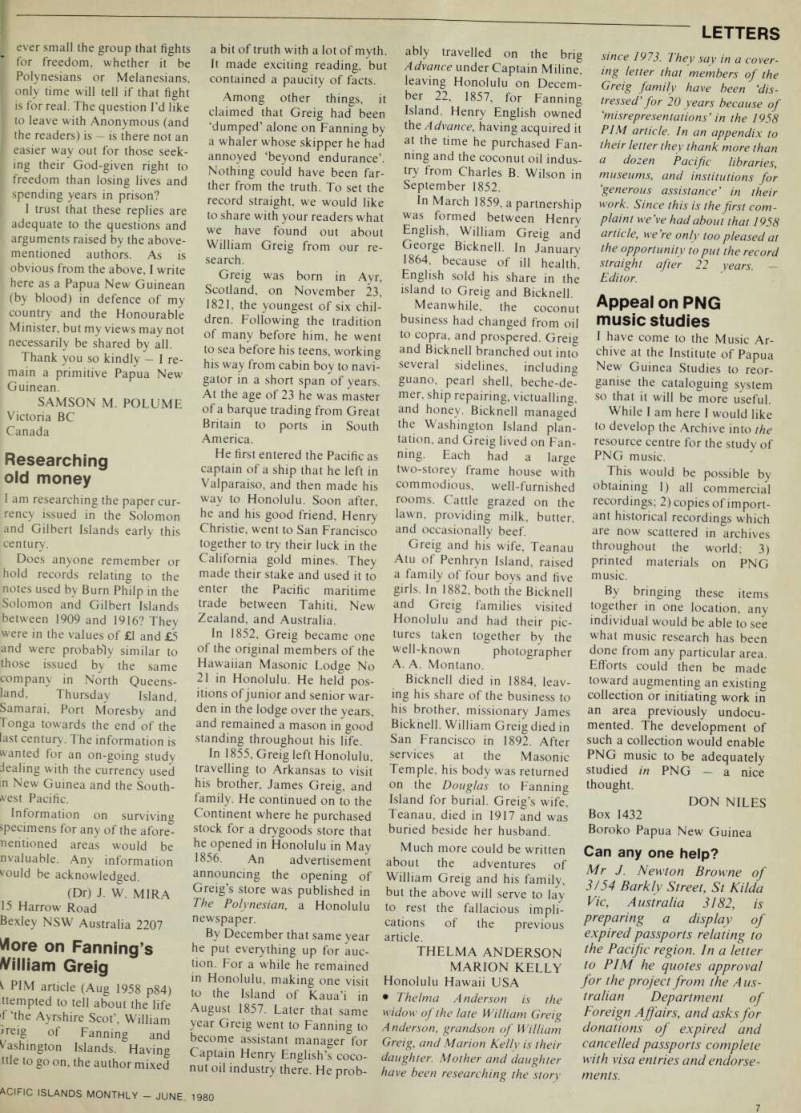
L. J. O’Malley, photographed about the time that he ac companied Jack Hides on the 1933 Strickland River patrol in Papua. Hides resigned from the Papua Administration several years later in a controversy crea ted by his writings and lectures, but O’Malley stayed on to be come one of Papua New Guinea’s best-known district commissioners.
ever small the group that fights for freedom, whether it be [ Polynesians or Melanesians, I only time will tell if that fight I is for real. The question I’d like I to leave with Anonymous (and I the readers) is —is there not an I easier way out for those seek ing their God-given right to j freedom than losing lives and [ spending years in prison?
I trust that these replies are [ adequate to the questions and arguments raised by the above mentioned authors. As is obvious from the above, I write here as a Papua New Guinean I (by blood) in defence of my country and the Honourable Minister, but my views may not necessarily be shared by all.
Thank you so kindly I re main a primitive Papua New Guinean.
Samson M. Polume
Victoria BC Canada
Researching
old money
I am researching the paper cur rency issued in the Solomon and Gilbert Islands early this century.
Does anyone remember or hold records relating to the notes used by Burn Philp in the Solomon and Gilbert Islands between 1909 and 1916? They were in the values of £1 and £5 and were probably similar to those issued by the same company in North Queens
land, Thursday Island,
Samarai, Port Moresby and
Tonga towards the end of the last century. The information is wanted for an on-going study dealing with the currency used in New Guinea and the South west Pacific.
Information on surviving specimens for any of the afore nentioned areas would be nvaluable. Any information
vould be acknowledged.
(Dr) J. W. Mira
15 Harrow Road Bexley NSW Australia 2207
More on Fanning’s
Villiam Greig
v PIM article (Aug 1958 pB4) ttempted to tell about the life T ‘the Ayrshire Scot’, William
jreig of Fanning and
Washington Islands. Having
ttle to go on, the author mixed
a bit of truth with a lot of myth.
It made exciting reading, but contained a paucity of facts.
Among other things, it
claimed that Greig had been
‘dumped’ alone on Fanning by
a whaler whose skipper he had
annoyed ‘beyond endurance’.
Nothing could have been far ther from the truth. To set the record straight, we would like to share with your readers what we have found out about William Greig from our re search.
Greig was born in Ayr, Scotland, on November 23, 1821, the youngest of six chil dren. Following the tradition of many before him, he went to sea before his teens, working his way from cabin boy to navi gator in a short span of years.
At the age of 23 he was master of a barque trading from Great Britain to ports in South America.
Fie first entered the Pacific as captain of a ship that he left in Valparaiso, and then made his way to Honolulu. Soon after, he and his good friend, Henry Christie, went to San Francisco together to try their luck in the
California gold mines. They
made their stake and used it to enter the Pacific maritime trade between Tahiti, New Zealand, and Australia.
In 1852, Greig became one of the original members of the Hawaiian Masonic Lodge No 21 in Honolulu. He held pos itions of junior and senior war den in the lodge over the years, and remained a mason in good
standing throughout his life.
In 1855, Greig left Honolulu, travelling to Arkansas to visit his brother, James Greig, and family. He continued on to the Continent where he purchased stock for a drygoods store that he opened in Honolulu in May 1856. An advertisement
announcing the opening of
Greig’s store was published in The Polynesian, a Honolulu newspaper.
By December that same year he put everything up for auc tion. For a while he remained in Honolulu, making one visit to the Island of Kaua’i in August 1857. Later that same year Greig went to Fanning to become assistant manager for
Captain Henry English’s coco
nut oil industry there. He prob
ably travelled on the brig Advance under Captain Miline, leaving Honolulu on Decem ber 22, 1857, for Fanning Island. Henry English owned the Advance, having acquired it at the time he purchased Fan ning and the coconut oil indus try from Charles B. Wilson in
September 1852.
In March 1859, a partnership was formed between Henry
English. William Greig and
George Bicknell. In January
1864, because of ill health, English sold his share in the island to Greig and Bicknell.
Meanwhile, the coconut business had changed from oil to copra, and prospered. Greig and Bicknell branched out into several sidelines, including guano, pearl shell, beche-de
mer, ship repairing, victualling,
and honey. Bicknell managed the Washington Island plan tation, and Greig lived on Fan ning. Each had a large two-storey frame house with commodious, well-furnished rooms. Cattle grazed on the lawn, providing milk, butter, and occasionally beef.
Greig and his wife, Teanau Atu of Penhryn Island, raised a family of four boys and five girls. In 1882, both the Bicknell and Greig families visited Honolulu and had their pic tures taken together by the
well-known photographer
A. A. Montano.
Bicknell died in 1884, leav ing his share of the business to his brother, missionary James Bicknell. William Greig died in San Francisco in 1892. After services at the Masonic Temple, his body was returned on the Douglas to Fanning Island for burial. Greig’s wife, Teanau, died in 1917 and was buried beside her husband.
Much more could be written about the adventures of William Greig and his family, but the above will serve to lay to rest the fallacious impli cations of the previous article.
Thelma Anderson
Marion Kelly
Honolulu Hawaii USA • Thelma Anderson is the widow of the late William Greig Anderson, grandson of William Greig, and Marion Kelly is their daughter. Mother and daughter have been researching the story
since 1973. They say in a cover ing letter that members of the Greig family have been "dis tressed'' for 20 years because of ‘misrepresentations’ in the 1958 PIM article. In an appendix to their letter they thank more than a dozen Pacific libraries, museums, and institutions for ‘generous assistance’ in their work. Since this is the first com plaint we’ve had about that 1958 article, we re only too pleased at the opportunity to put the record straight after 22 years. - Editor.
Appeal on PNG
music studies
I have come to the Music Ar chive at the Institute of Papua New Guinea Studies to reor ganise the cataloguing system so that it will be more useful.
While I am here I would like to develop the Archive into the resource centre for the study of PNG music.
This would be possible by obtaining 1) all commercial recordings; 2) copies of import ant historical recordings which are now scattered in archives throughout the world; 3) printed materials on PNG music.
By bringing these items
together in one location, any individual would be able to see what music research has been done from any particular area.
Efforts could then be made
toward augmenting an existing
collection or initiating work in an area previously undocu mented. The development of such a collection would enable PNG music to be adequately studied in PNG a nice
thought.
Don Niles
Box 1432 Boroko Papua New Guinea Can any one help?
Mr J. Newton Browne of 3/54 Barkly Street, St Kilda Vic, Australia 3182, is
preparing a display of
expired passports relating to
the Pacific region. In a letter to PIM he quotes approval for the project from the A us tralian Department of
Foreign Affairs, and asks for
donations of expired and
cancelled passports complete with visa entries and endorse ments.