the Kiaps?
pp. 11-68 · Read in the full issue

Law and order in PNG: Bring back the Kiaps?
Former Papua New Guinea Public Prosecutor Brian Egan presents a deeply pessimistic view of the future of the rule of law in PNG. His final report, reproduced below, was due to be debated by the PNG National Parliament as PIM went to press. It is certain to arouse keen discussion in that country, and, since similar problems exist elsewhere in the Pacific, in other countries as well.
This is to be my last report as Public Prosecutor my term of
appointment expires COB
November 23, 1979, and I have already advised the Judicial and Legal Services Commis sion by letter dated October 19, that in accordance with my public statement to this effect, I shall not be seeking a reap pointment. I find myself in exactly the same position as the five Judges of the National/ Supreme Court who have already resigned as a matter of principle I believe I have no alternative.
It is one matter for the arro gant and impertinent to assert that the country will not suffer any loss with the going of the Judges, and of myself, and the other experienced members of my staff who have either gone or are going in the near future.
Reality, however, is otherwise.
In the four short years since Independence there has been a definite and perceptible break down, not only of law and order, but in many areas of administration within this country. Probably the only in stitution that has successfully withstood this trend to date has been the National/Supreme Court sitting in its various juris dictions. I have heard that we are to be blessed with, (and I quote) ... ‘a judicially and intellectually more talented Bench’, as a result of the resig nations. Such a statement
betrays not only gross ingrati
tude but a total ignorance of what this country requires by way of Judges. What is needed are men of experience, not only in professional terms but, more
importantly, experience in the
ways of the people of this country. The five departing Judges have nearly 40 years of experience in this country be
tween them, and with respect, the elevation of the intelligent sia can never replace this. Nor is the answer to elevate
National Lawyers before they
are professionally ready for it, and hope that their nationality will serve as a substitute.
Law and Order - an His torical Perspective: When I took up a position here as a Crown Prosecutor almost a decade ago, this country was
being successfully adminis
tered by a group of dedicated field officers, (the ‘kiaps’), who
were probably capable of
classification as a para-military body, and who ran this country along the lines of a benevolent
dictatorship. I emphasise the
word benevolent , for at all times these men administered with the best interest of the country and especially the people at heart. At times their methods may have been a little ‘rough and ready’, but they knew bet ter than anybody that that was the language that the people best understood.
All too easily these days we lose sight of the fact that the bulk of the population of this country is still at the stage of social development that my Anglo/Saxon forebears were some 10 to 15 centuries ago. I recently commenced re reading Professor Theodore Plucknett’s authoritative text
on English legal history, A
Concise History of the Common Law, and there are amazing parallels between the then atti tudes of the pre-Norman conquest inhabitants of what is now the United Kingdom and the present people of this country. Common to both races were/are a form of vil lage courts, the concept of payback, the ‘hue and cry’, the concept of compensation for
injury, regardless of whose
fault it may have been that the injury was sustained, and many others.
The ‘kiap’ administrators realised this fact and used methods that were appropriate to this degree of development, although they never even ap proached the horrific old
English practices of trial by
ordeal, nor did their concept of what was an appropriate sanc tion even approach some of the more spectacular forms of
punishment that belonged to
those earlier times.
When the Supreme Court went on circuit in my early days no matter how small the out station was that was visited, one always found the Govern ment’s flag flying. The officer in charge of the Station always met the Judge and court party on their arrival, and the police detachment would invariably be turned out ‘spic and span’ for an inspection.
Except for the major urban centres like Port Moresby, Lae, Rabaul and Mt Hagen, urban crime was practically an un known phenomenon in those days. Most of the crime that came before the court was rural crime murders or associated crimes of violence arising out of tribal fights or sorcery situ ations. The rural towns were virtually safe havens. One would go on circuit to Madang or Wabag, and the cases for trial would have originated in Saidor, Simbai, Usino, Bundi, Josephstahl, or Sirunki,
Laiagam, Lake Kopiago, Kan
dep or Porgera respectively.
The crimes would have been uncovered by the ‘kiaps’ on
patrol, and investigations,
arrests and committal proceed ings conducted on the spot. The presence and strength of the Government was seen and felt
throughout the length and
breadth of the land, and the perimeters of civilisation were
being successfully expanded
ever outward.
What is the situation today?
Without exaggerating I estimate that in the four years since Independence, 40 years of administrative achievement has been lost!
The Court no longer sits in outstations because, with a few notable exceptions, crime from the rural areas of the country
ls no longer being detected, prosecuted or punished. A complete process of reversion to pre-contact patterns of be haviour is, I fear, presently taking place in those areas where the Government’s flag once triumphantly flew.
Rather than being safe havens, rural towns are now more like isolated pockets of civilisation in a sea of unrest, distrust and violence. When one goes on circuit to Madang these days, the crimes coming before the court are the typical urban crimes of breaking and entering, or crimes of violence associated with alcohol. The scenes at which such crimes have taken place, rarely exceed the boundaries of the town ship. In Wabag, the situation is worse. A policeman was axed to death as a payback in the heart of town not 12 months ago. His murderers have never been brought to justice. One is unable to try cases in Wabag these days, because the wit nesses living 10 miles out of town are afraid to come to town and testify because of the tribal fight that is taking place only five miles out of town. The perimeters of civilisation are
shrinking!
What has happened? As a re sult of Government policy amj particularly as a result of impo sition of the system of Provin cial Governments the ‘kiaps’, those people that held this place together, have either
‘gone finish’ or been emascu lated to the point where they have given up. The result has been the creation of an enor mous vacuum.
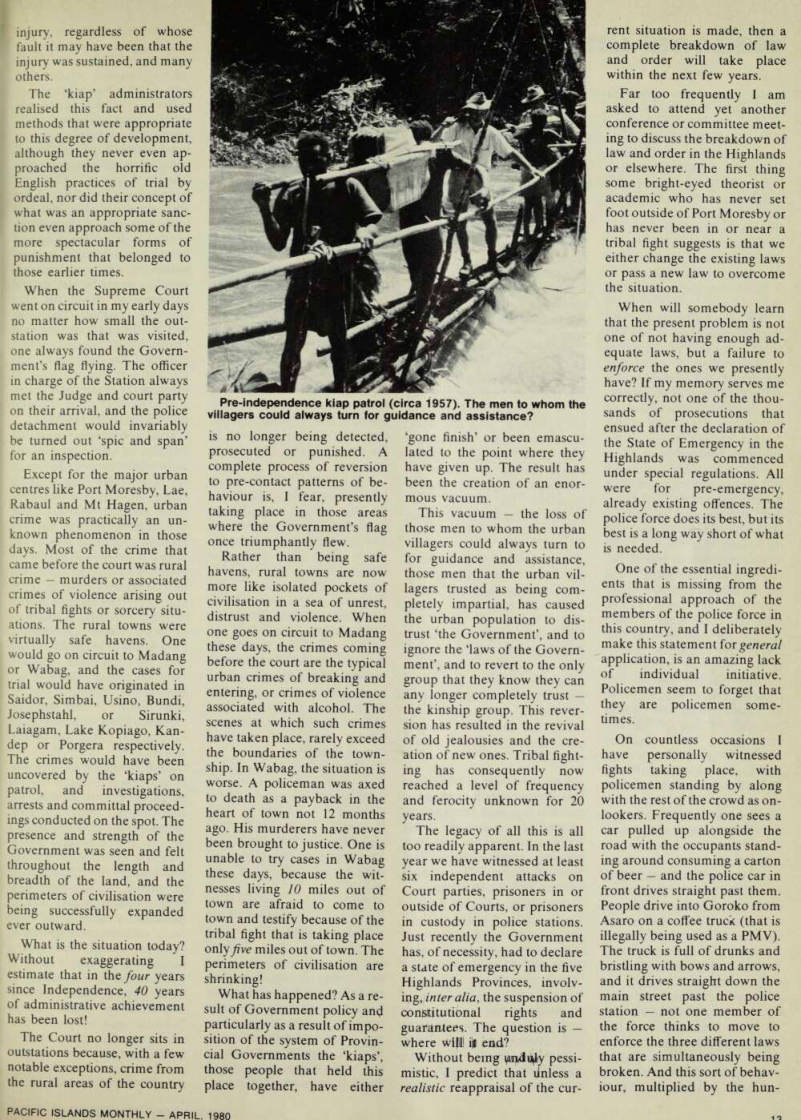
This vacuum the loss of those men to whom the urban villagers could always turn to for guidance and assistance, those men that the urban vil lagers trusted as being com
pletely impartial, has caused
the urban population to dis trust ‘the Government’, and to ignore the ‘laws of the Govern ment’, and to revert to the only group that they know they can
any longer completely trust
the kinship group. This rever sion has resulted in the revival of old jealousies and the cre ation of new ones. Tribal fight
ing has consequently now
reached a level of frequency and ferocity unknown for 20 years.
The legacy of all this is all too readily apparent. In the last year we have witnessed at least six independent attacks on Court parties, prisoners in or outside of Courts, or prisoners in custody in police stations.
Just recently the Government has, of necessity, had to declare a state of emergency in the five Highlands Provinces, involv ing, inter alia , the suspension of constitutional rights and guarantees. The question is where will! in end?
Without being pessi
mistic, I predict that Unless a realistic reappraisal of the cur
rent situation is made, then a complete breakdown of law and order will take place within the next few years.
Far too frequently I am asked to attend yet another conference or committee meet ing to discuss the breakdown of law and order in the Highlands or elsewhere. The first thing some bright-eyed theorist or academic who has never set foot outside of Port Moresby or has never been in or near a tribal fight suggests is that we either change the existing laws or pass a new law to overcome the situation.
When will somebody learn that the present problem is not one of not having enough ad equate laws, but a failure to enforce the ones we presently have? If my memory serves me correctly, not one of the thou sands of prosecutions that ensued after the declaration of the State of Emergency in the Highlands was commenced under special regulations. All were for pre-emergency,
already existing offences. The
police force does its best, but its best is a long way short of what is needed.
One of the essential ingredi ents that is missing from the professional approach of the members of the police force in this country, and I deliberately make this statement for general application, is an amazing lack of individual initiative.
Policemen seem to forget that
they are policemen some
times.
On countless occasions I have personally witnessed
fights taking place, with
policemen standing by along
with the rest of the crowd as on lookers. Frequently one sees a car pulled up alongside the road with the occupants stand ing around consuming a carton of beer and the police car in front drives straight past them.
People drive into Goroko from Asaro on a coffee truck (that is illegally being used as a PMV).
The truck is full of drunks and bristling with bows and arrows, and it drives straight down the main street past the police station not one member of the force thinks to move to enforce the three different laws
that are simultaneously being
broken. And this sort of behav iour, multiplied by the hun
Pre-Independence kiap patrol (circa 1957). The men to whom the villagers could always turn for guidance and assistance?
‘National unity a myth’
dreds, represents what is
happening throughout this
nation, and is one of the major reasons why there is a general air of lawlessness and a break down in Government control.
Everybody in the police
force seems to be waiting to be told to act, before they move to enforce the laws and arrest the lawbreakers. Somehow the force must be motivated to think and act with initiative to be 24-hour policemen on and off duty.
The responsibility for the current breakdown in law and order is not that of the police force however. I previously mentioned the disintegration of the field force of patrol offi cers and the vacuum created by their going. The filling of this vacuum is one of the keys to the solution of the problem.
Policemen were previously and are presently trained more towards the prevention, detec tion and solution of urban orientated crime. In the past there was therefore a fairly flexible division of labour be tween police and kiaps the former looked after the urban areas and the latter looked after the rural areas. I don’t pretend for one moment that there weren’t rivalries, ‘demar cation disputes’ and per sonality clashes, but by and large the system worked. Now, of course, with the disap pearance of one of the two components, the remaining one has to try and carry out a task that is not only too large for it, but one which, in terms of training, it is only half equipped to face. Thus its dis mal failure in coping with
tribal fights.
Invariably the police have
little inkling that a tribal fight is about to start, arrive well after the battle has begun, are hamstrung in what they are al lowed to do to stop the fighting when they get there and so con sequently they tend to fire off a lot of expensive tear gas and
shotgun cartridges, and then
return to base. Such an exercise is next to futile, and I say this without any attempt to deni grate the efforts of the police.
The field officers were more successful in controlling tribal
fighting because they lived in the areas where the fighting took place', knew the people, knew the terrain, and most im portantly knew the signs that indicated a tribal fight might be about to flare up. The field officers, through their corps of interpreters, were able to build up a fairly successful intelligence network, and very often those grievances that now inevitably seem to culminate in a tribal fight, were diffused by mediation before tempers reached the critical point of no return.
When mediation failed and a fight did occur, as often as not the patrol officer was aware that this would happen and was at the fighting ground ahead of the fighters to stop the clash.
Most importantly, after a fight took place, the field officers would mount a ‘follow-up’ campaign, and pursue those re
sponsible for fighting, for
months if necessary, until these
culprits were brought to jus
tice.
Somehow a field-force along the lines of the former one must be re-established. Such a force must have some police powers and be free and independent of Provincial
Governments. Sadly, experi
ence to date has shown that many Provincial Governments are unable to rise above a level of parochialism and ‘wan tokism’ of the most negative kind, hence the latter recom mendation.
Law and Order a Present- Day Perspective: It is an indis putable fact that this country presently has a law and order problem of sizeable and bur
geoning proportions. The
problem is twofold tribal fighting and urban crime.
The causes of tribal fighting I have touched upon to a de gree already. I cannot however stress too heavily the part that Provincial Governments have
played, perhaps uninten
tionally, (or ignorantly?), in
promoting this upsurge of rural, tribal violence. Provin cial Governments were the straw that finally broke the back of the kiap system pre viously the only force effec
lively controlling tribal fights.
With that check gone we are now on the verge of rural anar
chy.
Those messianic visionaries that saw Provincial Govern ment as the panacea for all the problems of this young nation
argued strongly that Papua
New Guinea never was a united nation and that its strength lay not in unity but in diversity. The solution was therefore, they argued, to tear down what had been achieved in the way of national unity in the past 90 years, and to replace this with provincialism. The flaw in the argument is that for exactly the same reasons ad vanced to justify the prop osition that national unity was a myth, so too is the concept of provincialism a myth. I invite my opponents to take any Province in the country as their example and to please demon strate the obvious ‘oneness’ of the people of that Province to me!
It is a myth! Take Bougain ville for example the Buins (in the south) are different from the Bokus (south-west), who are in turn completely dif ferent from the Rorovanas (around Kieta), who are dif ferent again from the Wakunais (north-east) who in turn are different from the Bukas (in the far north).
This diversity could be further extended by reference to other tribal groups on the main islands and completely compounded if we take into account the different groups of
people from the outlying
islands that form part of the province and that lie in an arc from the north-east to the south-west the peoples of the Carteret Islands, the Mortlocks, Fead Islands, Tas man Islands and Nissan Island.
The diversity is clearly demon strated, but where is the
unity?
Taken to its logical con clusion, the Provinces could well disintegrate to the point where Papua New Guinea ends up back where started from when it was first pen etrated no better than iso lated little pockets of people from the same language or kin ship group with a deep distrust of all ‘foreigners’ and living in fear of even immediate neigh bours. I have previously sug
gested elsewhere in this report, the only solution to this disinte gration of the nation which is the root cause of present rural unrest and tribal fighting.
Urban crime has as its roots, social causes urban over
population, unemployment, a
large number of frustrated,
partly educated unemployable
school drop-outs, all com pounded by the effect of the arch enemy of any law and order campaign in this country alcohol. Some breaking and entering and stealing is com
mitted by hungry, desperate
people some by lazy people
- some by frustrated and
vengeful people. In other
words, the pattern has not
changed from previous years.
What has changed sig
nificantly is the upsurge of crime in the larger rural towns.
I have touched upon this also previously in my report.
I do not propose to detail statistics of crimes committed as in earlier reports. Suffice to say that there has been a further growth in the volume of crime generally that my office has handled in the last 12 months, of around 15%. It has been a crime growth ‘across the board’, with the possible excep tion of crimes involving fraud and/or theft by servants, public servants or people in positions of trust. There has been a growth rate of about 20% in this
area. My statistics, gleaned
from the circuit reports of my prosecutors, confirms the re cent report of the Auditor- General. Sadly we appear to be turning into a nation of cynical thieves.
Staff Structure: Despite con
sistent representations by my
predecessor and myself, the
staff structure of this office re mains exactly as it was when I arrived in this country almost a decade ago. It does not take into account the different type of person we are recruiting from overseas today, and in particular it ignores the need for a staff structure geared to provide spaces for young national graduates. I have 10 applicants to join my office out of the present batch of gradu ates from the Legal Training Institute, and only two pos itions to offer them. I could usefully employ and train the
(continued on page 67)
lot of them. I have recently re submitted my staffing pro posals to the Secretary for Justice for onforwarding to the Public Service Commission. I an not optimistic enough to be lieve they will be accepted perhaps they may be graced with somebody’s consider ation.
Ombudsman Commission: The Ombudsman Commission has referred a number of mat ters to me in the year of this re port. To date none of them has been actioned by me. I have explained to the Chief Ombudsman that I refuse to waste the precious few re sources that I have in prosecut ing national leaders for breaches of the ‘Leadership Code’ when the government demonstrates immediately the contempt it has for such
proceedings by immediately
reappointing such leaders,
disgraced by convictions, back
to positions of equal or greater prestige and power. I have in vited the Ombudsman Com mission instead to refer clear
instances of criminal activity
by leaders to either the police force or myself, as we both have (at least technical) consti tutional guarantees against putside interference.
The Committee of Mercy: If my one body in this country is xmtributing more than any Pther to the judicial process of
ientencing becoming a com
plete laughing stock, it is the committee that advises on the power of mercy.
It does not comprehend the proper notion of what ‘mercy’ neans in the judicial sense, it
>ver-reacts, it is amateurishly
laive, it assumes powers that it loes not have and all this in ;ood faith, for I do not suggest or one moment that it acts
rith anything but absolute
vna fides. I trust I am not »eing unfairly critical when I ay that only on two occasions tiat I can recall has my office •een asked to appear before he Committee or make de ified representations in sup ort of a sentence properly nposed.
To give an idea of what takes lace during the normal oper tion of the judicial process,
the prosecution calls all its evi dence, the accused is allowed to adduce whatever evidence he wishes to place before the court, and the Judge then de cides whether he is guilty or innocent. If found guilty, the accused is allowed to call evi dence on the question of sen tence, is always given the opportunity to say anything he wishes to say on his own behalf, and then his counsel is allowed to make submissions in miti gation of sentence. Only after all these safeguards have been observed, does the trial Judge impose what to him, on the facts, is a proper sentence. All possible factors are first care fully weighed and balanced.
However, the more astute prisoners these days, and es pecially the younger and more educated prisoners, immedi ately upon entering prison, are despatching letters to the Mercy Committee asking for clemency. The letters are in
variably heart-rending tales,
detailing all the ‘injustices’ that surrounded their convictions and sentences, and generally
speaking contain exactly the
same material that was placed before the sentencing Judge at trial and which was either re jected as untrue or given due
weight by the Judge in im
posing sentence.
The problem is that the
Mercy Committee, with buoy
ant enthusiasm, invariably adopts these piteous com
plaints as being gospel truth,
untested as they are by cross examination, unopposed as they are by the prosecutors be cause we know little or nothing about them, and so the prisoner has the benefit of having his side of the story taken into account twice on the question of sentence.
This process had led to some outstandingly stupid results.
Perhaps the most arrogant misconception as to their proper role and powers by the Mercy Committee to date re lates to the case of a very well educated young Papuan gentleman who pleaded guilty to two counts of dangerous driving causing death (that of his wife and eldest son) where the aggravating factors of alcohol, speed and recklessness were involved. A non-custodial sentence was imposed by the trial Judge. An appeal by my
office against leniency of sen tence was successful, and in a very strong and determined
judgment, the Supreme Court
unanimously imposed an 18
months gaol sentence. The young gentleman immediately wrote to the Mercy Committee, which, when it sat, had the tem
erity to unanimously rec
ommend to cabinet that the original sentence of the trial Judge, a sentence already pro nounced by the highest court in the land to be legally improper, be restored. Cabinet in its wis dom rejected this recommen dation. With greatest respect, I recommend that the present
composition of the Mercy
Committee be drastically changed so as to reflect a bal ance of interests, experience and professionalism. Other wise the mercy prerogative will be reduced in status to that of the mercy ritual.
Acting Appointments: There
was one acting appointment
made during the period of this report, that of Mr Gavara- Nanu for the period of one month that I was on leave be tween May 4-June 4 1979. This appointment was contrary to my recommendation and made upon the insistence of the for mer Minister for Justice, Mrs Nahau Rooney. On my return from leave I was surprised to find Mr Gavara-Nanu acting in my position. After making a quick check of the register of counsel held at the Supreme Court I confirmed my first im pression which was that Mr Gavara-Nanu had been im
properly appointed as Acting
Public Prosecutor, in that he failed by a period of three
months, to fulfil the barest minimum qualification fon appointment under the Organic Law that of three years experience post -full ad mission.
I wrote to the Judicial and Legal Services Commission pointing out their error. To date I have not received a reply in any form.
The ‘Rooney Affair’: This is not the place to dwell upon this matter, although it is the reason for the late submission of this report. I will say only this about the Rooney affair.
History will prove, I am sadly confident, that this ca lamity that has befallen the legal system of this country, will mark the watershed be tween the integrity of our ju dicial system and the upholding of the rule of law, and the slow downhill turn toward tyranny and anarchy.
The judicial system, its status, its independence and its impar tiality have been dealt a body blow from which it is unlikely to truly recover. There are many proverbs attributed toe the sixth century BC Chinese philosopher Confucius many are unprintable and in fact! emanated from Australiani schoolboys one that did noO reads as follows: ‘By three ways? we may leam wisdom: First by reflection which is the; noblest; Second by imitation which is the easiest; And third,, by experience which is the: bitterest.’
The ‘Rooney Affair’ has? placed the legal system of this? country squarely on the path ofl ‘bitter experience’ in its searcht for wisdom and justice.